The three most low-key men in China are betting their lives on the same track
In recent days, three major events have converged simultaneously.
First, Tang Jie, founder of Zhipu AI, issued an internal letter. Half a year prior, Zhipu had just listed on the Hong Kong Stock Exchange with a market capitalization of HK$810 billion, nearly three times that of Baidu. In the letter, he revisited the words he spoke on the listing day: "Reset to Zero".
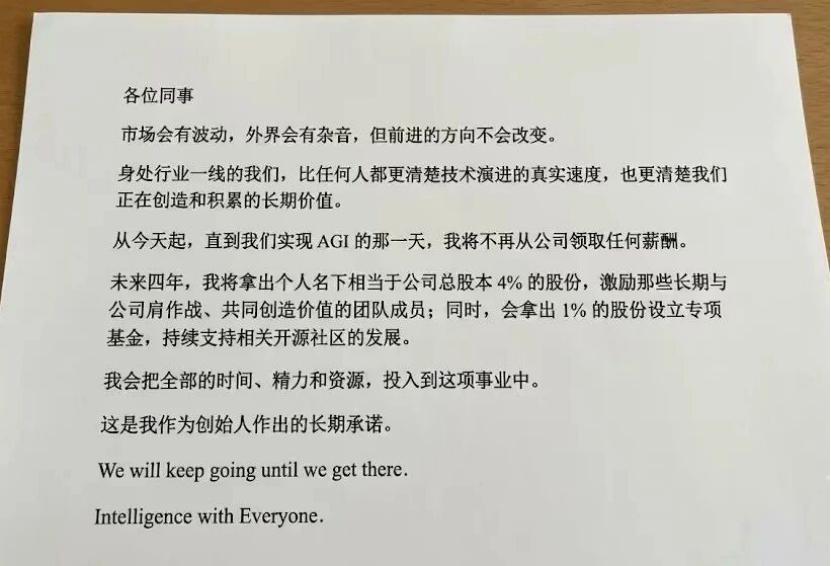
Yan Junjie, founder of MiniMax, also sent a company-wide letter. At that point, MiniMax's share price had fallen from HK$1,330 to HK$297, a 77% drop. In the letter, he announced that he would forgo all salaries until AGI arrives, and set aside 4% of his personal shares to incentivize the team.
According to the Financial Times, Liang Wenfeng, founder of Deepseek, has launched a new financing round, pushing the company's valuation from $52 billion to $71 billion, with some sources claiming DeepSeek has already begun preparing for a 2027 IPO.
On the surface, these three events seem unrelated. But when you put them together, a deeper underlying logic emerges: In China's large model industry, capital is not a multiple-choice question—it's a matter of life and death. Without financing, you can't secure enough computing power; without sufficient computing power, you can't retain top talent; without talent, you can't maintain your technological advantages.
How do you get the ticket to the next table before your technological edge runs out?
Today, we'll break down the core philosophies of these three AI founders, and explore how they make critical decisions behind the scenes.
I. Tang Jie: At the Peak, Take on the Hardest Challenge
On January 8, 2026, Zhipu AI listed on the Hong Kong Stock Exchange. By June, its market cap had exceeded HK$810 billion, surpassing Xiaomi.
In China's entire AI large model sector, Zhipu was the first company to prove "this path works" with a real, tangible market value.
Following normal business logic, what would a company do at this stage? Consolidate advantages, accelerate monetization, and deliver an impressive growth curve to shareholders.
Tang Jie did the exact opposite.
He wrote in his internal letter: "Others ring the bell to celebrate; we reset to zero. This is not a gesture—it is our conviction."
Immediately after, he announced the "Reach for the Summit" initiative. Tang Jie believes that on the path to AGI (Artificial General Intelligence), there are several peaks that must be scaled, which are also where the technological wave is surging most fiercely today. The four peaks he identified are:
Long-horizon tasks: enabling AI to sustain thinking on grand, complex projects;
Autonomous agents: evolving from "one-person company" to "no-person company";
Self-training: letting AI train other AI systems;
Ultimate safety governance: embedding safety into the fundamental axioms of AI.
He had just earned his first big fortune, but now he decided to bet all of it back on the table, chasing a far larger, more uncertain future.
Why did he dare to do this?
Tang Jie's reasoning is clear: The core of the AI revolution is not optimizing existing products, but a technological revolution that raises the ceiling of human intelligence as a whole.
The "summit" he is reaching for is not revenue, but "the limits of intelligence". He is betting on foundational breakthroughs that will benefit every application layer, not patching up frameworks built by others.
Second, he deeply believes that "the destination is AGI, and short-term gains are just scenery along the way". Listing was not the end—it was the ticket to enter a much longer game.
GLM-5.2 is already on par with Claude Opus 4.8. The company's MaaS platform has an ARR (Annual Recurring Revenue) of 1.7 billion, growing 60x year-on-year. This strong technological credibility gives him enough confidence to push all his chips back onto the table.
Third, "counter-intuition" itself is his moat. Back in 2006, he started academic search research, sticking to a little-recognized field for ten years.
In 2021, he bet on trillion-parameter large models, a year and a half before ChatGPT took the world by storm.
In 2025, he went all-in on coding. While the rest of the industry was expanding their multimodal layouts, he concentrated all resources on a single focal point. His summary can be summed up in seven words: "Essence, counter-intuition, focus."
If everyone thinks something is the right thing to do, it is almost certainly no longer an opportunity.
But "resetting to zero" has a high qualification threshold: you must have proven yourself before you can afford to start over. Zhipu has the backing of a trillion-dollar market cap, the technological credibility of GLM-5.2, and the commercialization proof of 1.7 billion from MaaS.
Tang Jie's "starting over" means "climbing a higher mountain", not "returning to the foot of the hill".
From another perspective, this is exactly where his clarity lies. In China's AI competitive landscape, if the capital raised from listing is not immediately reinvested in technology, you are essentially handing over your leading advantage to the next round of capital-backed challengers.
Market capitalization prices the "past"; technological credibility anchors the "future". His "reset to zero" is not romanticism—it is the only choice to remain at the table after passing the listing milestone.
II. Liang Wenfeng: I Don't Need Your Money, But I Need to Give the Team Confidence
Among all Chinese AI founders, Liang Wenfeng is the most reclusive, having barely given any public speeches.
But his actions speak louder than any letter. From "refusing all investments" to "closing two financing rounds in a month", from "I don't need money" to "$71 billion is still not enough, I'm preparing for IPO", this transition happened so fast that the market couldn't keep up.
A closer look at the deal terms reveals a counterintuitive truth: Liang Wenfeng never gave up a single bit of control. He holds approximately 78% of the company's shares, while the seven co-founders of Anthropic own less than 1% of their company's total equity.
What makes him capable of this?
First principle: Founder control is more important than valuation size. Most founders in financing focus on "how to get the highest possible valuation". Liang Wenfeng asks: After the valuation rises, how much of the company do I still own?
Analyst Michael Taiwo, when breaking down Liang's 78% stake, said: "Valuation is what people applaud for; ownership is what pays your bills."
If the company is valued at $10 billion and you hold 5%, you are just a highly paid senior employee. If you hold 78%, you can steer the company in any direction you want at any time.
Second principle: Technological credibility equals financing credibility. His confidence comes from the V3 and R1 models, which achieved cutting-edge performance at extremely low cost.
Most AI companies pitch financing by saying "we burn a lot of money so we are strong". DeepSeek tells the opposite story: "We achieved leading results without burning much. Give me a little more funding, and what can we accomplish?"
Someone who has consistently rejected capital suddenly saying "you can invest in me" is the strongest scarcity signal in the investment community.
The third principle is the sharpest: The best time to raise money is when you don't need it. DeepSeek's financing is fundamentally not about survival. It has continuous financial support from the profits of High-Flyer Quant behind it.
What's the real reason? Three core researchers were poached in the same month by ByteDance, Xiaomi, and Tencent. It's not that they couldn't afford the salaries, but that the employee stock options had no external market price reference.
"An option without a clear market value is no different from an IOU."
So Liang Wenfeng's logic is: Let external investors participate in pricing, but never let them participate in decision-making.
This strategy cannot be replicated. Liang can do this because he holds three things at once: a technological reputation that the global market recognizes, personal wealth from High-Flyer Quant to anchor the bulk of financing, and a long, proven track record of "rejecting capital".
III. Yan Junjie: If the Ship Runs Aground, the Captain Jumps in First to Push It
At the start of 2026, MiniMax listed on the Hong Kong Stock Exchange, hitting a peak of HK$1,330. By July 15, the share price had fallen to HK$297.
A 77% drop.
Over 80% of Pre-IPO and cornerstone shareholders pledged long-term holdings, but the market kept selling off. During the same period, Zhipu's share price stabilized after the lock-up period, and DeepSeek's valuation rose from $52 billion to $71 billion.
Against this backdrop, Yan Junjie sent a company-wide letter:
"Starting today, until the day the company achieves AGI, I will no longer draw any salary. I will allocate 4% of my personal shares (of total equity) to incentivize the core team, and set aside an additional 1% to establish an open-source community special fund. We have simultaneously completed a HK$16 billion financing, with 80% explicitly earmarked for AI infrastructure and model R&D."
Why did he do this?
First principle: Trust can only be rebuilt with actions, not words. When the share price crashes, no amount of CEO presentations can make a difference.
Yan Junjie did the most straightforward thing: Put his own interests on the table. Forgoing salaries means his financial interests are fully aligned with the company's value. Giving away shares means his personal wealth rises and falls with the team's options.
Second principle: The team's confidence is harder to maintain than the market's. Core R&D staff hold options and watch the share price every day. Their confidence cannot be restored by financial reports, but by the "sense of security" the founder provides.
Yan Junjie wrote in the letter: "The frontline team knows the real speed of technological progress better than anyone else." The subtext is: I know you have doubts, and I have them too, but I'm willing to bet everything I have.
Third principle: The founder's "sacrifice" is not the destination—it is the starting line. Forgoing salaries and giving away shares buys time. Time to build products and achieve commercialization after the HK$16 billion arrives. Money can buy time, but it cannot buy product-market fit.
The promises only clear the runway. Whether you can take off depends on the engine, not the runway.
What exactly can these promises solve?
They can stabilize the core team in the short term; send a signal to the market that "the founder stands with the company through life and death"; and win a window of trust for strategic adjustments.
But there are far more things they cannot fix: Product competitiveness itself—promises don't make the model stronger. The market's collective doubts about "large model business models" cannot be moved by personal sacrifice; institutional investors only care about numbers.
If Tang Jie's "reset to zero" is the composure of a peak conqueror, and Liang Wenfeng's control is the confidence of a rule-maker, then Yan Junjie's shared burden is the most honest choice at the foot of the mountain.
He doesn't have the safety net of a trillion-dollar market cap, nor 78% equity as negotiation leverage. All he has left is the most fundamental thing a founder can do in the hardest times—tell everyone: "I have no retreat, so neither do you."
This is not the most brilliant strategy, but it is the most sincere gesture.
IV. Three People, Three Choices
What determines their respective choices?
The answer is: Their circumstances.
Tang Jie dares to "reset to zero" because Zhipu has already won the first round. The trillion-dollar market cap and GLM-5.2's technological proof give him the luxury of composure.
Liang Wenfeng dares to "show his cards" because he never intended to live off other people's money from the very beginning.
The profits from High-Flyer Quant, his 78% equity, and his multi-year track record of rejecting capital—combined, these give him all the chips for an "asymmetric negotiation". He is not "raising money"; he is "setting the price".
Yan Junjie has no choice but to "carry the flag", because MiniMax is undergoing the most brutal market test. With the share price down 77%, he has the fewest cards in his hand, but he lays out every usable card on the table. He is playing the "sincerity" card.