OnePlus withdraws from Europe and the US to focus on India and China, will Liu Zuohu's "Never Settle" have to settle now?
On July 14, Tencent Tech reported that OnePlus and its parent company OPPO are on the verge of announcing a fundamental strategic adjustment, which may see the brand formally exit the U.S. and European markets to refocus resources on core Asian regions including China and India.
This is not the first time such rumors have emerged.
Back in January and March 2026, similar reports circulated but were denied by OPPO. However, by April, OnePlus publicly acknowledged it was "evaluating" its future in Europe, coinciding with news of layoffs. Adding to this, recent banner ads on the official websites of Germany, France and Spain have been directing users to purchase OPPO products, alongside leaks that OxygenOS will soon be fully replaced by ColorOS.
Meanwhile, another noteworthy update comes from foreign media AndroidHeadlines, which reported that OnePlus will no longer have product lines with independent hardware design in the future. Instead, it will be transformed into an OPPO-affiliated mid-to-low-end product line selling rebranded OPPO devices.
Regarding the authenticity of the above news, on July 15, OPPO's official customer service responded to New Knowledge Research Institute that they are not aware of the matter at present, and the public should pay attention to the announcements released on the official website or various social platform channels, which shall prevail.
If this adjustment is confirmed, it may represent a stress test for OPPO amid the industry winter marked by soaring upstream costs. Currently, OPPO is fully pushing into the high-end market, and it is a reasonable move to delegate the mid-to-low-end market to OnePlus and realme for coordinated management.
At the heart of this integration lies not just OnePlus, which is losing its independent hardware design capabilities, but also Liu Zuohu, who sits at the core of decision-making, and his overall blueprint for OPPO.
With OPPO Assigning Mid-to-Low-End Tasks to OnePlus, Will OnePlus and realme End Up Competing Head-to-Head?
The most intriguing aspect of this adjustment is not just OnePlus's withdrawal from Western markets, but the shift in the brand's positioning.
According to foreign media reports, OnePlus will no longer have product lines with independent hardware design in the future, and will instead sell rebranded OPPO devices targeting the mid-to-low-end market.
Since OPPO completed the integration of OnePlus and realme in April 2026 and established a unified sub-series business unit, the physical boundaries between the two brands have blurred. With interconnected supply chains and shared R&D resources, the organizational-level issue of "whether sibling brands will compete" has been resolved.
However, now that OnePlus is explicitly tasked with the mid-to-low-end market, a more thorny problem may arise: will OnePlus and realme end up as "twins" churned out of the same mold in terms of their product offerings?
The former independent brand that lived by the "Never Settle" mantra and carved out its niche through high specs at affordable prices has gradually become a volume-driving tool for OPPO's mid-to-low-end segment.
Meanwhile, realme, long defined by the "Dare to Leap" brand tag, has always targeted the 1,000 to 4,000 yuan price range, emphasizing performance and design.
Now that OnePlus is rumored to abandon its high-end exploration and set its main battlefield in the mid-to-low-end segment, it may very well adopt a "value-for-money volume-driven" brand path — essentially a direct copy of realme's existing positioning.
If OnePlus and realme are adjusted in such a manner, they will achieve high-level integration in R&D, supply chain and product planning, forming a joint management structure in actual operation. By assigning mid-to-low-end tasks to OnePlus, OPPO has objectively dragged OnePlus into a "self-defeating" competitive situation on the same track as realme.
The two brands will operate in coordination under the same system, sharing resources to reduce costs and improve efficiency, which is likely OPPO's goal of achieving a "1+1>2" effect.
But coordination does not mean zero friction. As OPPO's Chief Product Officer and OnePlus's founder, Liu Zuohu is at the core of this integration. He needs to coordinate resource allocation at the group level, while drawing clear product boundaries between OnePlus and realme to avoid internal homogeneous competition.
The previous merger mainly solved the organizational structure problem of "whether brands will compete", but it did not fully address the practical challenge of "whether products will look identical".
How OnePlus and realme can differentiate themselves in the market — for example, one leaning into "performance-driven sentiment" and the other focusing on "youthful trendiness" — sounds reasonable, but execution will put Liu Zuohu's balancing skills to the test.
Historically, internal homogenization among sub-brands has plagued many industry groups. Xiaomi and Redmi, as well as vivo and iQOO, all paid the price of sales "internal friction" when their brand boundaries blurred. If OnePlus and realme fail to handle this properly, consumers may be left wondering: are these two phones even different from each other?
Without OnePlus Pursuing the High-End, Will OPPO's "Purse" Feel More Relaxed?
OnePlus will no longer have an independent hardware R&D team, and its future products will likely be deeply tied to OPPO's solutions.
This means that against the backdrop of rising costs, it will most likely lose the opportunity to launch high-end models priced above 5,000 yuan, with its new battlefield almost certainly set in the 1,500 to 4,000 yuan mid-range market.
This may not necessarily be a bad thing, as the industry landscape is evolving at a rapid pace.
The reason for targeting this specific price range is that under cost pressure, the high-spec, low-price strategy is no longer sustainable.
According to Counterpoint Research's monitoring, global smartphone shipments in the second quarter of 2026 fell 11% year-on-year, marking the lowest second-quarter level since 2013. The report points out that the worsening memory shortage crisis has become the top variable dragging down the entire consumer electronics industry.
The latest research data from Omdia also shows that global smartphone shipments in the second quarter of 2026 dropped 4% year-on-year. The ongoing memory supply crisis has disrupted market supply and driven up the costs of key components, further exacerbating market pressure.
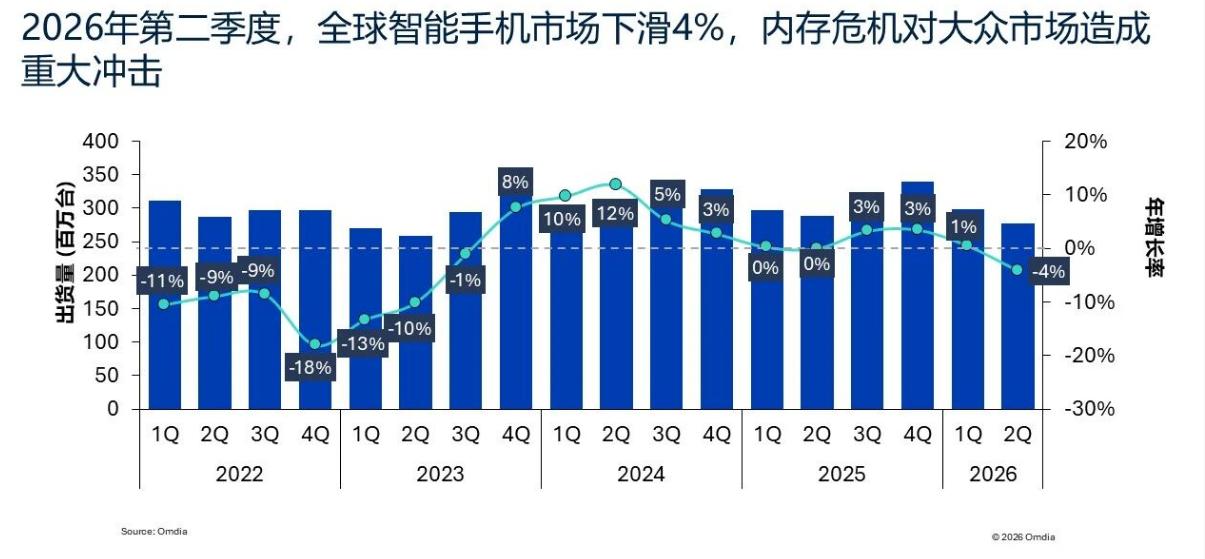
(Data source: Omdia)
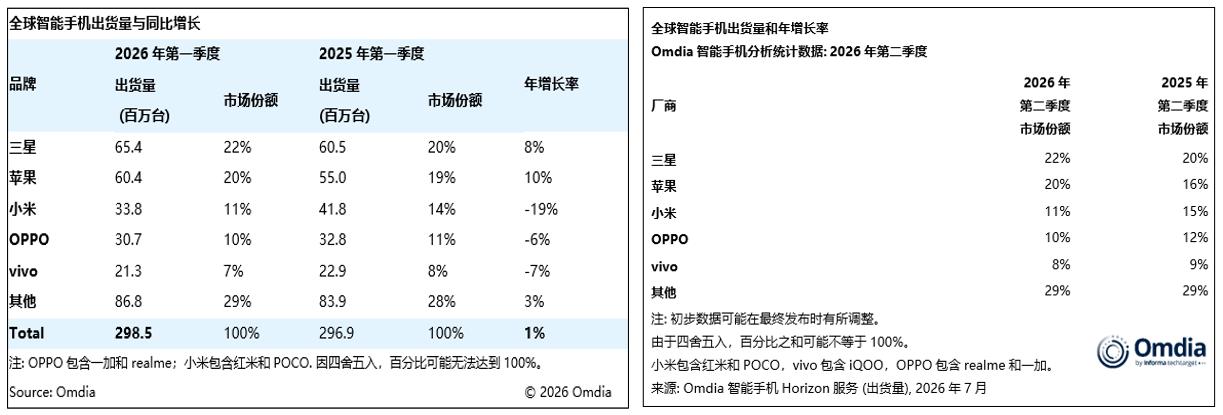
In terms of manufacturer shipment rankings, OPPO is restructuring and optimizing the business of its three major brands, ranking fourth with a 10% market share, while vivo ranks fifth with 8%. The top three spots are held by Samsung, Apple and Xiaomi respectively.
The overall ranking changes are largely consistent with the figures from the first quarter.
Prices of NAND and DRAM memory have surged significantly due to AI demand. Counterpoint predicts that the material costs of some high-end devices will rise notably. The current upstream cost transmission has squeezed the room for high-spec low-price products, forcing brands to shift toward the mid-range to pursue economies of scale.
After OnePlus's transformation, it may evolve into a continuation of the Nord series — featuring mid-range processors, large batteries, a smooth operating system, affordable prices, and relying on scale to achieve success. This series has seen very limited sales in China, with its main markets overseas, such as India.
Previously, OnePlus could independently control some core hardware parameters, such as its early distinctive explorations in charging technology and system optimization. Now, new models will be more adapted and developed based on OPPO's mature chip platforms, battery solutions and structural designs, which also limits the scope for single-point breakthrough innovation.
OnePlus's contraction and refocusing is taking place amid the downward pressure on global smartphone shipments. The risk of independently challenging the high-end market is too high, so by focusing on mid-range volume sales, OnePlus can at least contribute stable cash flow to the OPPO group while maintaining a certain market presence through shared resources.
In this era of stock competition in the mobile phone industry, survival takes priority over brand sentiment.
OnePlus's transformation is regrettable in some ways, but it aligns with the laws of the industrial cycle. As long as it builds a solid reputation in the 1,500-4,000 yuan price range, it can still find a sustainable position within the OPPO ecosystem.
OPPO's Products Are Getting More Expensive, But Consumers Are Still Buying In
In stark contrast to OnePlus's "downscaling" strategy, the main OPPO brand is fully pushing into the high-end market.
Since the start of this year, OPPO has continuously increased the launch of high-end models, with prices and configurations reaching premium levels, while the number of mid-to-low-end models released has decreased compared to previous years. Taking advantage of the rising upstream costs, OPPO has chosen to "fully enter" the high-end market. High-end users are less price-sensitive, and as long as product capabilities are strong enough, there is greater room for premium pricing.
Since 2026, OPPO has launched high-end models including the Find X9 Ultra, Find X9s Pro, and the foldable OPPO Find N6, etc. The upcoming Find X10 series and OPPO Find N7 are expected to be priced above 5,000 yuan, with some models even exceeding 10,000 yuan.
According to incomplete statistics from the New Knowledge Research Institute, nearly 6 Find series models were released last year, generally priced above 4,000 yuan. This year, combining the already released models and the upcoming ones as rumored, the total number is likely to reach 6 or more.
In other words, both the prices and quantity of high-end models have increased this year.
For OPPO's mid-to-low-end models, according to incomplete statistics from the New Knowledge Research Institute, OPPO's three series — the K series, A series and Reno series — released a total of 8 models in 2026, including the Reno 16, Reno 16 Pro, K15 Pro+, etc. In 2025, a total of 13 models were launched, including the A6 Pro, Reno 15, etc.
The number of mid-to-low-end models released has seen a noticeable decline.
The data shows that OPPO's high-end push is not based on blind confidence. While it has scaled back in the mid-to-low-end market, its overall user base remains very stable.
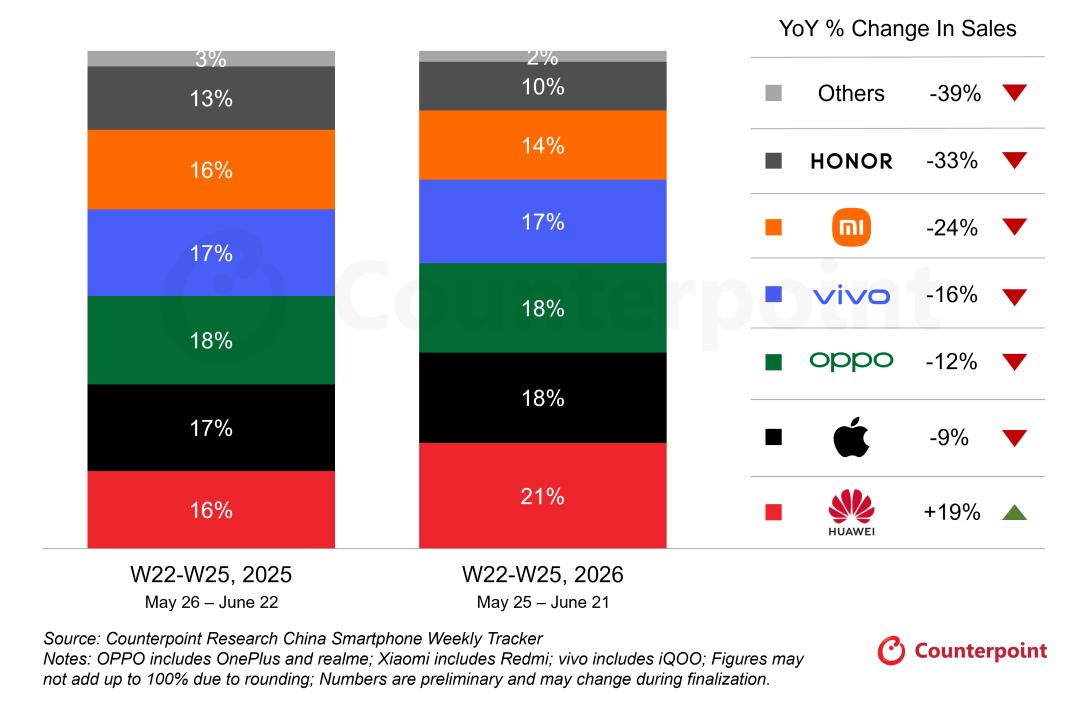
According to Counterpoint's 618 sales data, OPPO ranked second alongside Apple with an 18% market share, with Huawei taking the top spot. OPPO's sales declined by 12%, but compared to competitors other than Apple and Huawei, its smaller drop allowed it to maintain its ranking during the 618 promotion. Vivo held a 17% share with a 16% sales decline, Xiaomi 14% with a 24% drop, and Honor 10% with a 33% decrease.
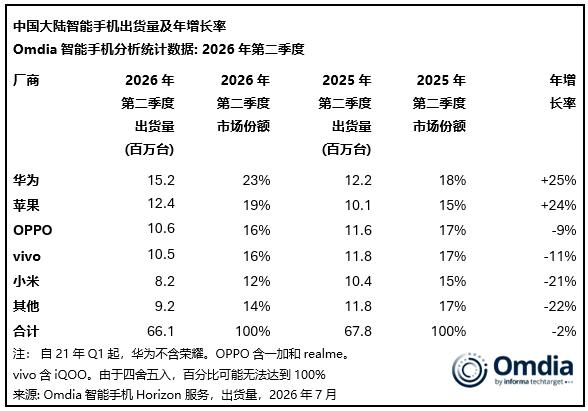
Omdia's data shows that in terms of mainland China shipments, OPPO ranked third after Huawei and Apple with 10.6 million units, down 9% year-on-year. Vivo followed with about 10.5 million units, and Xiaomi with around 8.2 million units, taking fourth and fifth place respectively. The fact that Apple and Huawei still managed to grow amid global market pressure demonstrates the resilience of their high-end positioning, which explains why OPPO is also eager to pursue high-end success.
OPPO's current Find X series imaging capabilities, foldable screen innovations, and Reno series trendy designs have all enhanced the brand's premium appeal.
Back in April, Liu Zuohu posted on Weibo: "I came across an interesting set of data: 77% of 100 potential phone buyers chose to 'place an order immediately' after only seeing all the pre-launch information about the Find X9 Ultra. This level of anticipation far exceeds expectations, proving a simple truth: everyone recognizes the breakthroughs and upgrades in imaging brought by the Find X9 Ultra and Find X9s Pro."
In other words, consumers have a high willingness to accept OPPO's new high-end models.
Looking at the entire series, statistics from June showed that Find X9 sales had reached 2.165 million units. While this is not yet enough to catch up with the Find X8's 3.6 million units, growth has been extremely rapid. By July, the Find X9 series had reached 2.628 million units, with sales momentum no less robust than the previous generation.
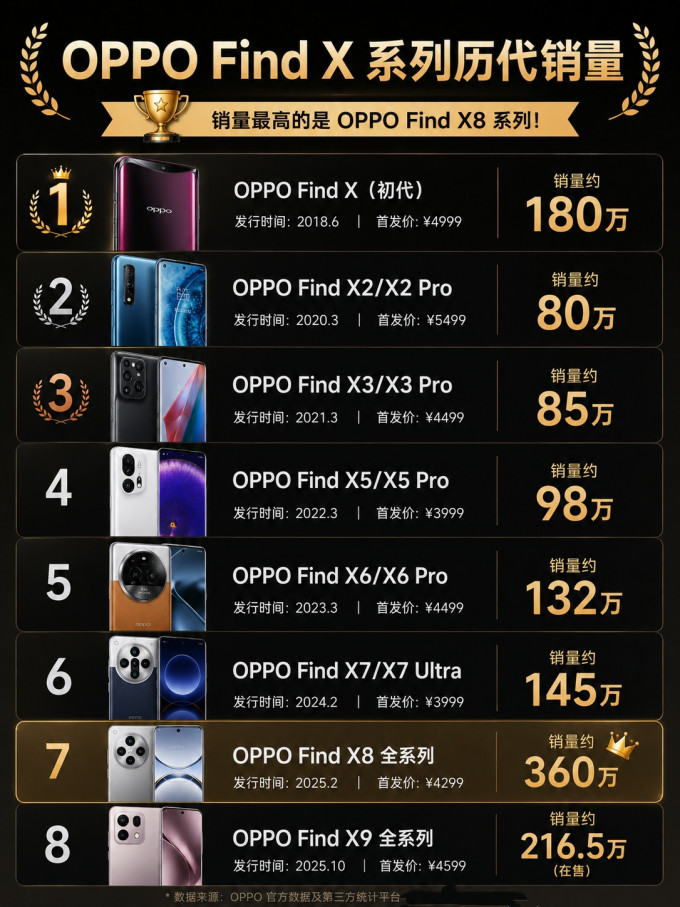
(Image source: SMZDM)
Consumers are willing to pay because high-end devices offer differentiated experiences with better screens and more powerful imaging capabilities. Compared to the red ocean of competition in the mid-to-low-end market, the high-end segment boasts higher profit margins that can be reinvested in R&D to form a positive feedback loop.
Yet risks still exist. With rising costs, if high-end pricing is too aggressive or product capabilities fail to keep up, consumers may turn to Huawei, Apple or Samsung. OPPO needs to strike a balance between the perception of "expensive but worth it" and lingering expectations for cost-effectiveness.
OPPO's high-end push is not simply about raising prices. It is leveraging the industry's new trends to drive a full brand upgrade. In the current context of skyrocketing AI and memory costs, competing purely on shipment volume is becoming increasingly unsustainable. The industry is increasingly recognizing that success now depends on delivering real tangible value.
Apple and Huawei's ability to maintain growth amid market pressure proves that the high-end market has its own buffer space.
The entire mobile phone industry is shifting from the past frenzy of spec chasing to prioritizing efficiency and value. OnePlus's pragmatic transformation and OPPO's high-end sprint perfectly embody this dual shift.