The next-generation AI-native UGC platform is hidden in Eggy Party
In 2026, a new business concept is drawing widespread attention — OPC (One Person Company), also known as a "solo enterprise". It refers to micro teams of only 1 to 3 members that can complete full project deliverables with the support of digital tools like artificial intelligence.
Few people have noticed, however, that the gaming industry has long had a natural breeding ground for this shift: UGC creation communities.
The widespread adoption of AI technology is continuously redefining the boundaries of productivity in content creation. Development work that once required dedicated professional teams can now be accomplished by individual creators using accessible tools. This trend is particularly prominent in the gaming UGC space: ordinary users are no longer just content consumers, but can also become creators of original gameplay.
Previously, most UGC creators remained in the amateur "creating for passion" stage, limited by tool capabilities and unclear monetization paths that prevented them from growing into fully-fledged micro-business entities. It was only with the deep penetration of AI that this bottleneck began to break through.
Last weekend, NetEase's *Eggy Party* hosted its 4th Creator Conference. While showcasing its achievements in the UGC ecosystem, the platform officially launched the industry's first dual-sync UGC editor framework — the "Twin Stars" editor system, and further upgraded AI integration across the entire creation pipeline.
More than a simple tool update, this adjustment amounts to a full reconstruction of UGC infrastructure: by combining AI capabilities with the new editor system, *Eggy Party* is exploring how to empower ordinary creators with game production skills approaching those of professional developers.
In a sense, this is also the gaming industry's forward-looking exploration of the ultimate future form of UGC — when AI redefines how games are made, how will the next generation of AI-native UGC platforms emerge?
2026 *Eggy Party* UGC Ecosystem Strategy Launch
01 AI is becoming the new foundational infrastructure for UGC creation
Over the past two years, game companies have significantly increased their investment in UGC communities. In 2025, miHoYo's *Genshin Impact* launched the "Stellar Odyssey" gameplay, leveraging its massive user base to validate ideas and build a UGC ecosystem. In 2026, X.D. Network rolled out its AI game creation tool "TapTap Make", led directly by CEO Huang Yimeng. The predecessor of this product, *Spark Editor*, once used "Everyone can make games" as its core slogan.
An industry consensus is taking shape: UGC will be the critical competitive battlefield in the next phase of development.
Those who placed their bets earlier have already crossed the river by feeling the stones. NetEase's *Eggy Party* has nearly perfectly aligned itself with the development trends of both UGC ecosystems and artificial intelligence.
The core team behind this product largely originated from NetEase's first game editor project, *Beaver Plan*. Back then, they accumulated extensive experience in editor development and UGC ecosystem operations. When building *Eggy Party*, they drew on that prior expertise, chose to believe that "true masters are among the public", and positioned UGC as the core of the game's future development. The original casual party gameplay was primarily a means to attract and grow the user base.
The subsequent success of the product proved they had chosen the right path.
Just six months after launch, *Eggy Party* crossed the critical threshold for user acquisition through UGC and began explosive growth. Even four years later, it remains one of NetEase's highest DAU products. At the 2026 Global Digital Economy Conference, officials released the game's latest metrics: over 700 million registered users worldwide, stable monthly active users exceeding 100 million, more than 50 million native UGC developers, and a cumulative total of over 200 million published maps.
Few products in China or globally can match this scale of UGC activity.
But scale is only the foundation. What truly differentiates *Eggy Party* from traditional UGC platforms is its systematic integration of AI capabilities.
For a long time, UGC creation has faced a core contradiction: users have the willingness to create content, but lack the ability to turn their ideas into playable games.
In the past, even when editors significantly lowered the barriers to game development, creators still needed to master multiple processes including gameplay design, art asset production, and logic building. Users who could consistently produce high-quality content remained concentrated among those with prior development experience.
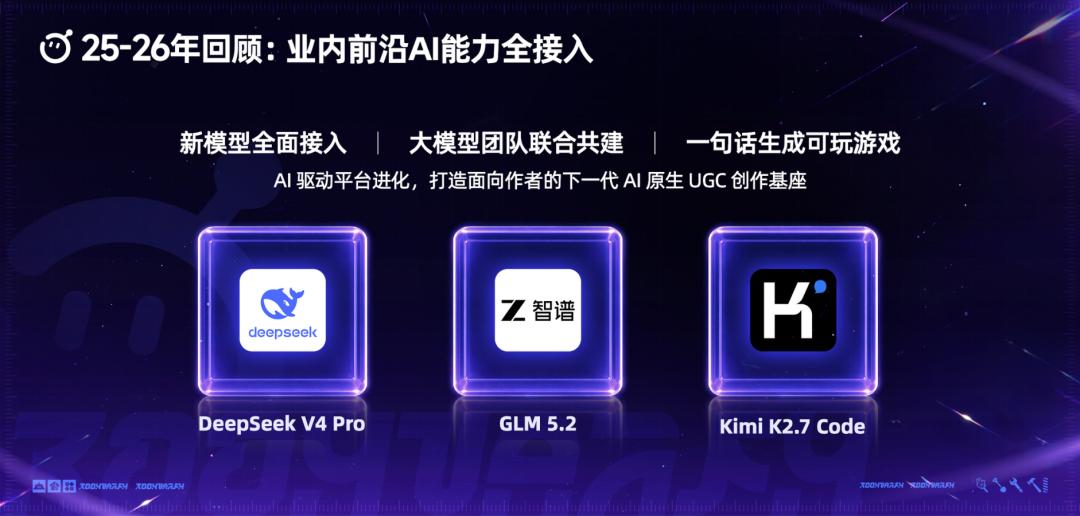
Now, *Eggy Party* has integrated cutting-edge large language models such as DeepSeek V4 Pro, GLM-5.2, and Kimi K2.7 Code into its editors, embedding them deeply across the entire creation workflow.
Source: *Eggy Party*
These large AI models primarily solve problems across three key dimensions.
The first is "learning cost". The technical difficulty of game development lies in the fact that most issues require case-by-case solutions. Moreover, there is rarely a universal solution to a single problem, which heavily tests creators' coding skills and forces them to repeatedly consult massive tutorial documentation.
The value of the AI assistant is that it can help players resolve specific issues in real time. Even at a minimum, when it cannot provide a complete solution, it can help creators clearly identify where the actual problem lies.
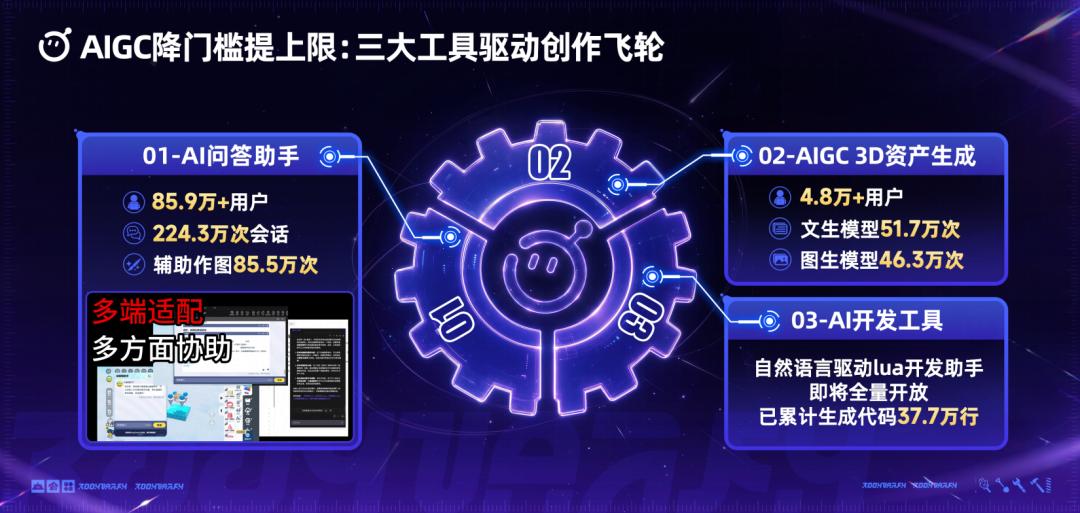
According to data released at the Creator Conference, from its launch at the end of October 2025 to July 2026, the AI Q&A assistant has supported 859,000 creators, generated 2.243 million sessions, assisted in 855,000 map editing operations, and handled tens of thousands of queries and editing actions on average every day.
Source: *Eggy Party*
The second dimension is "time cost". Game development typically demands a huge volume of programming work and assets. Solo developers or small teams that pursue higher-quality content presentations often lack the bandwidth to complete all this workload.
To address this issue, *Eggy Party* first connected with 3D generation algorithm company Yingmu Technology during the 2024 GDC Conference.
Last September, the two parties formally established a partnership, integrating the Rodin 3D generation algorithm into *Eggy Party* to enable real-time large-scale application of 3D generation technology on mobile devices.
With this AIGC 3D asset system, creators do not need professional modeling skills to obtain usable game assets through simple text descriptions. Officials revealed that highly requested features including 3-view to model generation, automatic sub-model splitting, and intelligent automatic polygon optimization are currently in development.
The third dimension is the biggest challenge in game development: "difficulty in realizing ideas". To achieve this, AI must be able to understand creators' intentions and fully learn all relevant code.
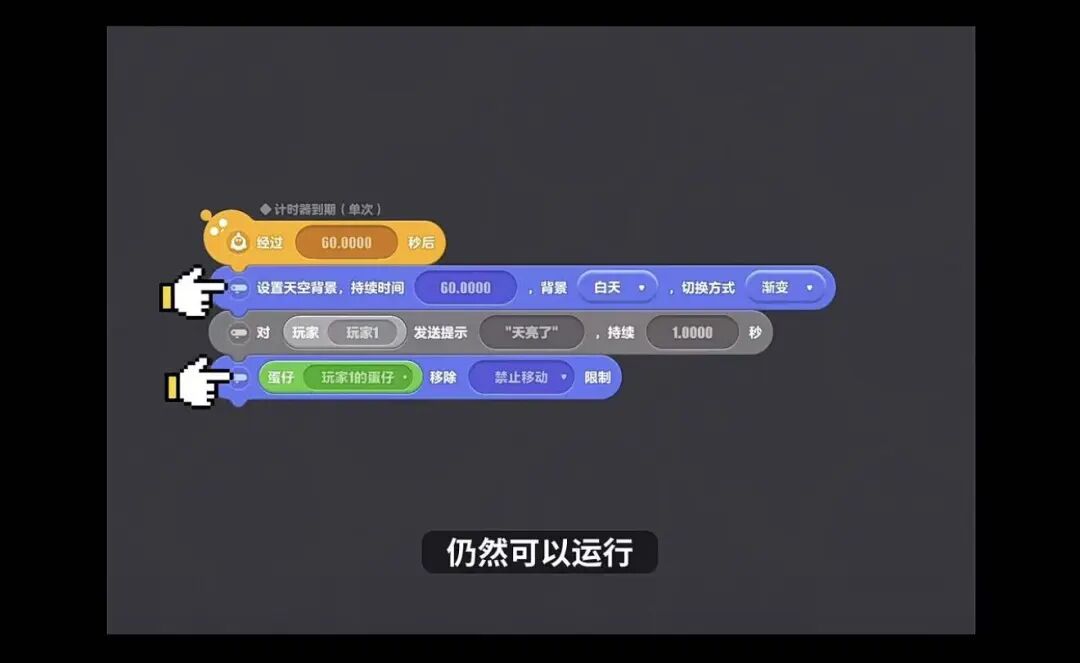
*Eggy Party* already has visual programming called "Eggy Code", which displays code through simple logical text to ensure creators can get started making gameplay with zero barriers.
Source: *Eggy Party*
On this foundation, the platform later introduced Lua scripting. Compared to other programming languages, Lua is lighter, simpler, and easier to manage. Compared to "Eggy Code", Lua scripting enables a higher ceiling for advanced content editing. Combined with AI, developers pursuing higher-level capabilities can seamlessly transition from "Eggy Code" to Lua scripting, ultimately implementing more complex and interesting game designs.
According to statistics, the development assistant alone generated a total of 377,000 lines of code during the beta testing phase.
With these three layers of capabilities combined, the role of AI within the Eggy ecosystem has undergone a qualitative transformation. It is no longer an external auxiliary feature of the editor, but a foundational infrastructure covering the entire creation pipeline. When the most time-consuming, expertise-dependent foundational tasks are handled by AI, the proportion of creative input from ordinary people rises dramatically.
The ideal scenario, as described by Baozi, Head of UGC Operations at *Eggy Party*, during the 2026 Global Digital Economy Conference: "Users can generate assets with a single sentence, and make fully playable, online-multiplayer games even without knowing how to code."
AI is not only improving tool efficiency, but also reshaping how creators participate in game production.
02 Unleashing creators' capability boundaries in the AI era
Interestingly, as AI gradually lowers creation barriers, the *Eggy Party* team has begun to consider another question:
When more and more players gain development capabilities, can existing UGC tools still support their expanding creative demands?
At this year's Creator Conference, Daxiangzi, Technical Lead of *Eggy Party*, revealed that in the first half of 2026 alone, the team's own AI usage increased by over 10 times. When digital employees can solve a portion of routine problems, the team naturally gains the bandwidth to explore deeper issues.
For example, when AI empowers more players to create, and veteran creators become more skilled, whose needs should the platform prioritize?
Kwan, Producer of *Eggy Party*, mentioned that through ongoing communication with creators and players, the team has observed an increasingly clear trend: the content people want to make is outgrowing the limits of existing tools. More open vast worlds, larger-scale social interactions, deeper gameplay mechanics, and long-term operation — these ambitions face real bottlenecks under the current editor capabilities. But diversifying editor features might create unnecessary complexity for casual, lightweight users.
The *Eggy Party* team deliberated for a long time and ultimately arrived at the answer: "We want both."
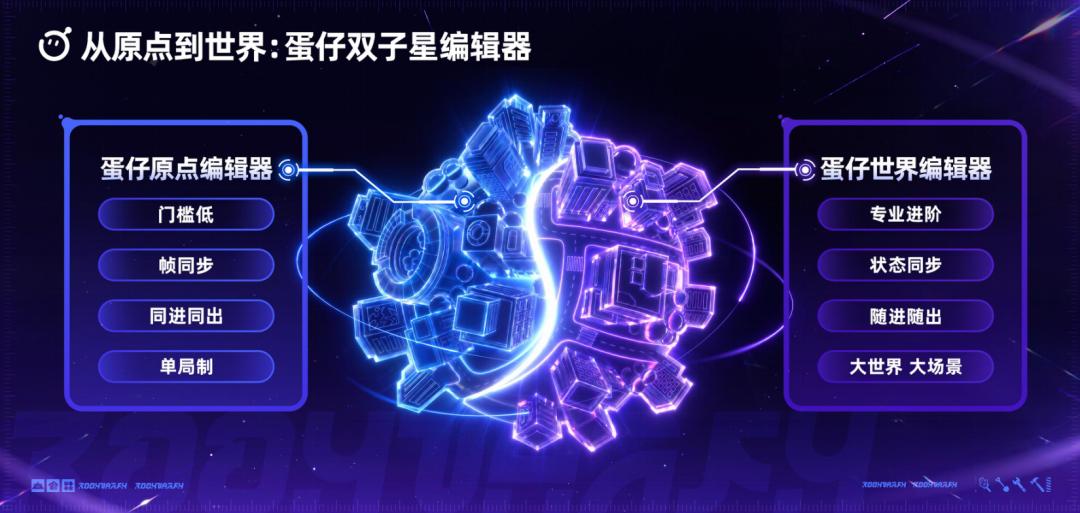
At this Creator Conference, they officially launched the industry's first "Twin Stars" editor system. The original frame-sync editor was renamed the "Eggy Origin Editor", while a brand new state-sync editor, the "Eggy World Editor", was introduced.
Source: *Eggy Party*
According to official explanations, the two editors address distinct use cases. Previously, some creators might have had to use a rice cooker to bake a cake; now the rice cooker remains available, but the platform has also specially provided an oven for everyone.
The Origin Editor, essentially the legacy editor, focuses on low barriers to entry. It adopts a frame-sync architecture, so creators do not need to handle synchronization logic, and can complete map construction by dragging and dropping visual "Eggy Code" modules. It supports cross-platform play on both mobile and PC: the mobile version lowers the psychological and technical barrier for "first-time creation", while the PC version preserves professional-grade productivity for advanced creators.
The Origin Editor supports six major categories: competitive, racing, role-playing, simulation management, casual, and puzzle, and has already produced over 200 million maps.
However, the Origin Editor has one limitation: constrained by the frame-sync mechanism that requires all players to start simultaneously, it cannot easily support drop-in/drop-out gameplay.
This means creators cannot make vast worlds, open worlds, MMORPGs, or other game types that allow players to enter and exit freely with individual progress saves — players should not have to count down 3-2-1 like waiting for a traffic light when joining a friend's map, only to be "kicked out" after a set duration.
Source: *Eggy Party*
The World Editor is designed to fill this gap. It uses state-sync technology, supports chunked loading and ultra-large-scale maps, and allows players to enter and exit freely. Creators can use it to explore more complex game forms such as vast open worlds, RPGs, and long-term operated experiences.
In other words, if you roughly consider the Origin Editor as a MOD development tool and manager, the World Editor is moving toward being a full-fledged game engine — making the realization of a true One Person Game a very real possibility in the future.
The two editors form a seamless growth path: new creators start with the Origin Editor to build experience, then can transition smoothly to the World Editor for advanced development as their skills improve. The platform has thus evolved from a single content production tool to a full-development system covering the entire creation lifecycle.
This directly addresses the core challenge for UGC platforms in the AI era. The core logic of traditional UGC was a simple loop of "players produce content, users consume content". When AI flattens technical barriers, creators' demands for deeper gameplay, larger content scale, and greater commercial space rise simultaneously, requiring the platform's technical foundation to upgrade accordingly — otherwise it will eventually become a bottleneck for creativity.
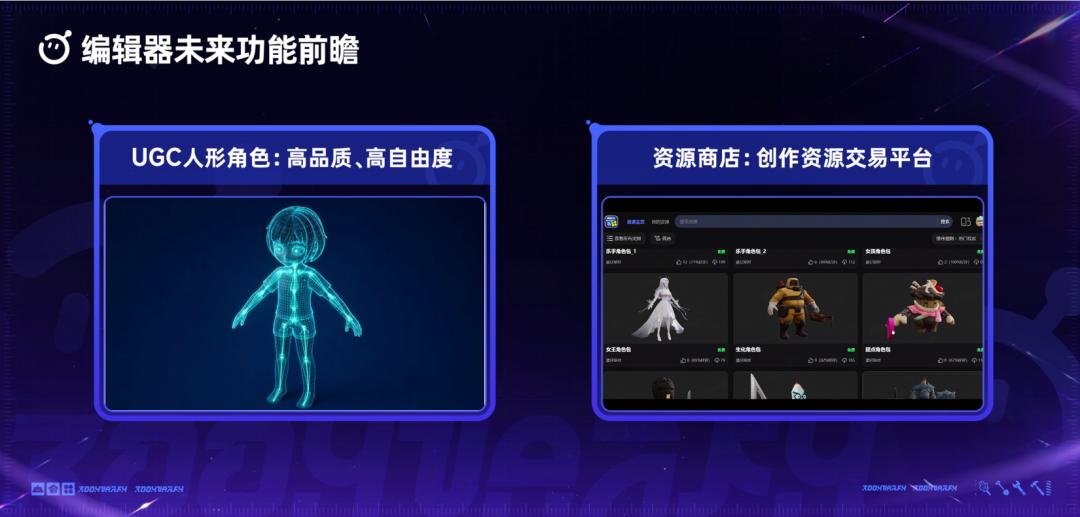
In addition to the World Editor, *Eggy Party* is also gradually releasing accumulated capabilities from other tools. Previously, players could only use the built-in asset library in the editor, which limited their creative styles. With the opening of custom model uploads, creators can import self-made 3D models, no longer restricted by any pre-existing "templates".
The introduction of the VFX editor gives creators more control over visual presentations. The PC editor "Eggitor" also supports fine-grained editing of terrain, special effects, and more.
Source: *Eggy Party*
The launch of these systematic development tools by *Eggy Party* also signals that competition in the UGC ecosystem has formally entered a new phase. Now, UGC competition is no longer just about sheer content volume and viral reach, nor about creating high-profile content to attract users. Instead, it focuses on building a virtuous cycle of comprehensive capabilities including creation tools, technical infrastructure, and creator incubation.
In other words, *Eggy Party* is evolving into a streamlined "integrated game platform".
03 The final validation of the UGC ecosystem's long-term value
At this point, many people might ask: why did *Eg