Leading companies have launched 16 AI education products. Who is taking the lead?
In the past six months, almost all leading education companies have launched their latest AI products.
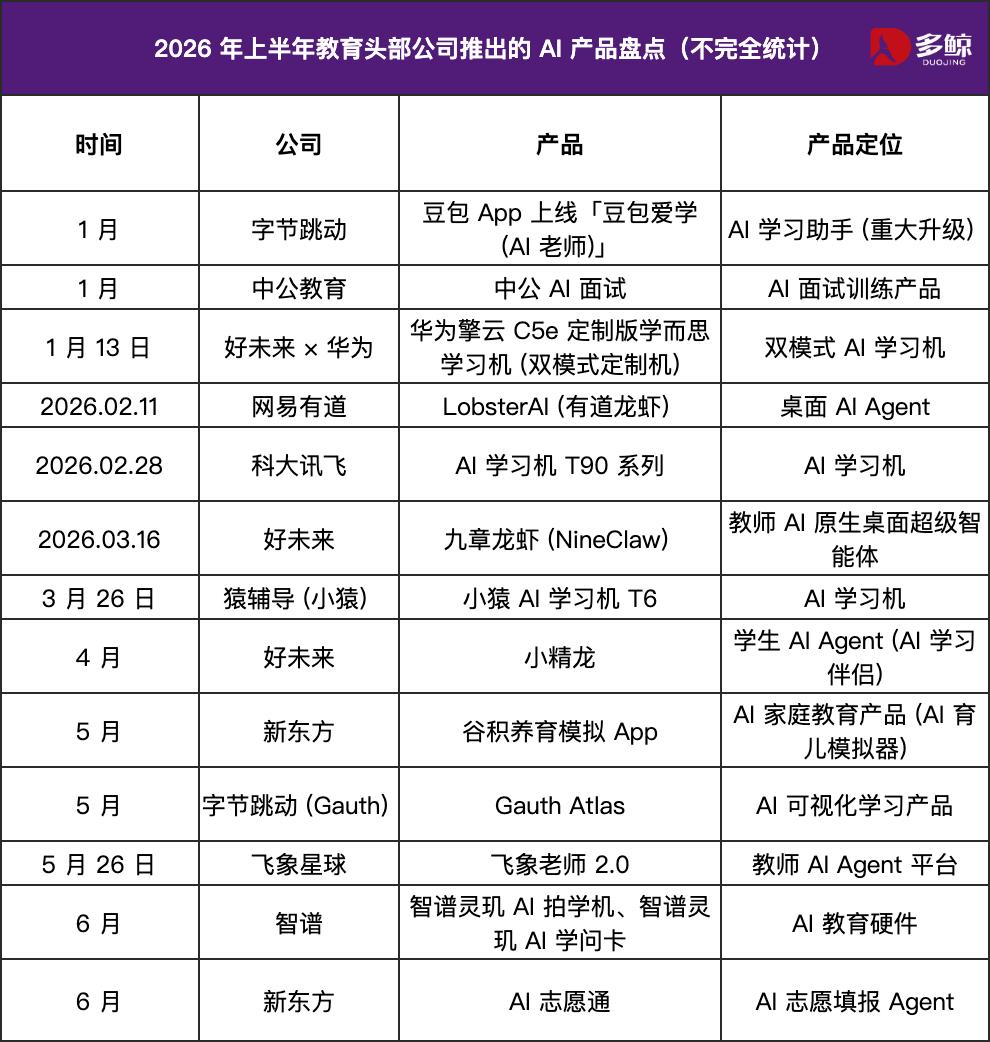
TAL has successively rolled out Zhangjia Lobster, Little Smart Dragon, and the T6 series of learning devices. New Oriental launched the AI College Admissions Guidance Tool and the Guji Parenting Simulation App. Yuanfudao released the Xiaoyuan AI Learning Device T6. Iflytek upgraded the AI Learning Device T90 series. NetEase Youdao and Zhonggong Education also launched their AI products one after another. Meanwhile, tech giants including Baidu, Alibaba, ByteDance, and Zhipu AI continue to increase their investment in education scenarios.
Which scenarios will take off first, which companies keep investing, and what capabilities have become standard configurations for new products — all these are reflected in these 16 products.
Beyond the core student market, new education scenarios are emerging
In the first half of this year, 16 publicly released AI education products have covered multiple scenarios including student learning, teacher instruction, college admissions planning, family education, and early childhood enlightenment. However, in terms of product quantity, students remain the most crowded track.
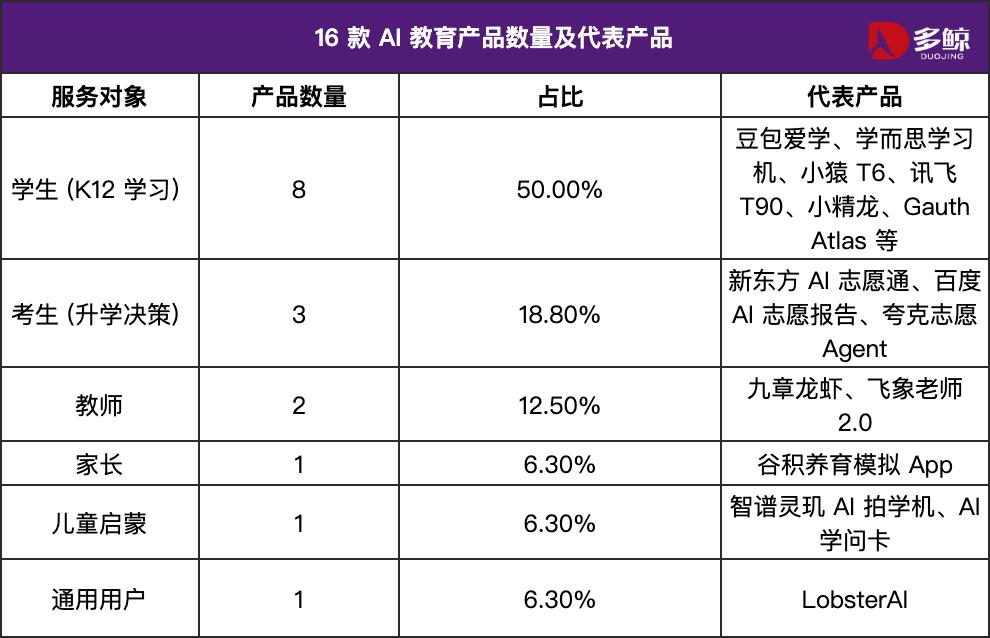
Statistics show that among the 16 products, 8 are targeted at students, accounting for half of the total; 3 products are for college admissions planning, making up 18.8%; 2 are teacher-focused products, accounting for 12.5%; and 1 product each is dedicated to parent users and early childhood enlightenment. This means that for every 2 AI education products launched in the first half of the year, one targets the student market.
The student market is still the area where companies invest the most, but their products have started to take different development paths.
ByteDance integrated its "Doubao Love Learning" feature into the Doubao App, bringing AI learning capabilities directly into a high-frequency daily-use application. Iflytek, Xiaoyuan, and TAL continue to update their learning device products, prioritizing upgrades in learning diagnosis, personalized study planning, and AI-assisted practice. TAL launched the student-focused Agent "Little Smart Dragon" to provide long-term learning companionship centered on learning records, knowledge mastery tracking, and study schedule management. Gauth released Atlas, which replaces traditional Q&A interfaces with interactive knowledge visualization. Despite different product forms, all these solutions are exploring new product entry points centered on the core scenario of student learning.
Compared to the student market, the fastest-growing new scenario in the first half of this year is college admissions planning.
Entering June, New Oriental launched the AI College Admissions Guidance Tool, Baidu upgraded its AI Admissions Report, and Quark rolled out its college admissions planning Agent — the three companies released related products almost simultaneously. In terms of product design, none of them are limited to basic information query functions. Instead, they integrate capabilities such as Agent systems, multi-round reasoning, and data retrieval to help students complete complex decision-making processes including admissions plan generation, risk analysis, and major matching. In the past, college admissions planning relied heavily on manual consulting agencies; this year, AI has emerged as a new player in this market.
The teacher side follows a different development rhythm.
There are two publicly released teacher-focused products in the first half of the year: TAL's teacher Agent "Zhangjia Lobster" and Feixiang Planet's "Feixiang Teacher 2.0". Neither product prioritizes AI chat functions; instead, they focus on supporting the full teaching workflow including lesson preparation, courseware generation, test paper creation, learning performance analysis, and classroom interaction. In terms of quantity, the teacher market is still smaller than the student market; but from the perspective of product orientation, AI has begun to penetrate into classroom scenarios, rather than being limited to after-school learning.
In comparison, family education and early childhood enlightenment are still in their initial stages. New Oriental launched the Guji Parenting Simulation App, which uses generative AI to simulate children's growth processes and provide parents with references for different education decisions. Zhipu AI released the AI Camera Learning Device and AI Knowledge Flashcards, attempting to extend AI capabilities to enlightenment scenarios for children aged 3 and above, as well as portable learning devices for K-12 students.
From students to teachers, from academic advancement planning to family education, and then to early childhood enlightenment, the scenarios covered by AI education products in the first half of this year are more extensive than ever before. However, the development speed of different scenarios varies: student learning still accounts for half of all products, the college admissions planning market is rapidly heating up, teacher-focused products have just started to emerge, and family education and enlightenment products are still in the exploration stage. As a result, the product layouts of education companies have begun to show clear differentiation.
From single-product solutions to multi-scenario layouts, education companies are taking divergent AI development paths
In the first half of this year, education companies have shown differences in how they invest in AI technology.
Statistics show that 11 companies have launched a total of 16 AI education products. Among them, TAL released 4 products, while ByteDance and New Oriental each launched 2 products — these three companies are the only publicly known players that have covered two or more education scenarios. Meanwhile, more companies are still promoting AI upgrades around their existing businesses, continuing to invest in niche areas such as learning devices, teacher tools, and college admissions planning services.
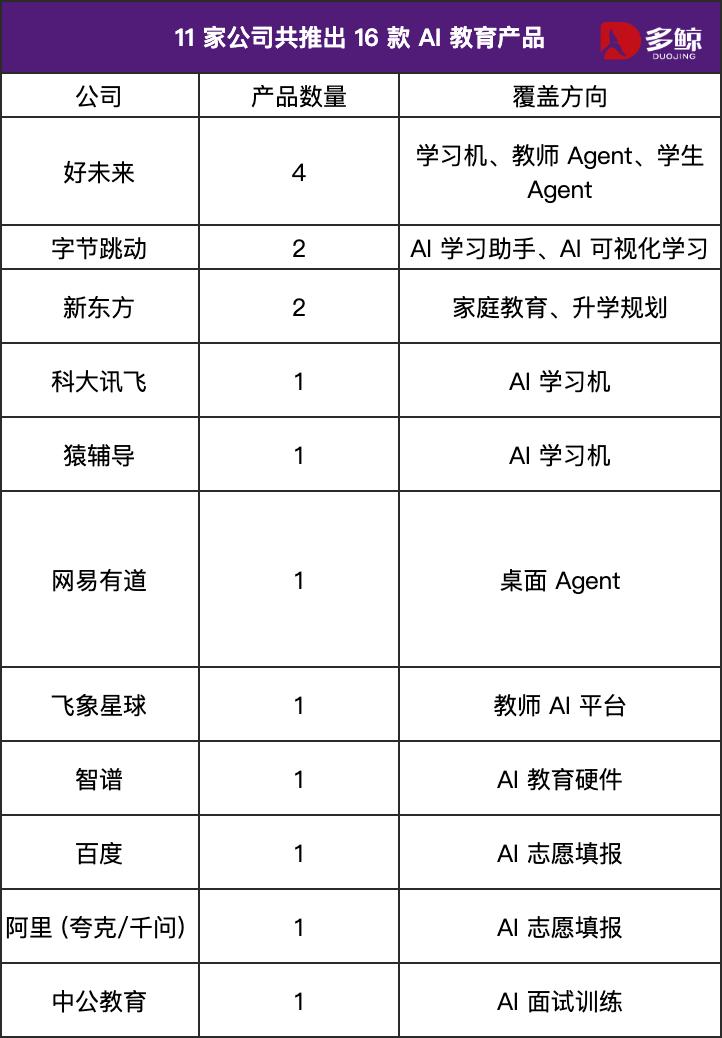
The choices made by different companies are closely tied to their existing business foundations.
TAL currently has the most comprehensive AI product layout among all education companies. In the first half of the year, the company successively launched the teacher Agent "Zhangjia Lobster", the student Agent "Little Smart Dragon", and the Xueersi Learning Device T6 series, whose products correspond to three core links: teacher lesson preparation, student learning, and hardware terminals respectively.
Among these products, "Zhangjia Lobster" is designed for teachers, supporting teaching tasks including lesson plan generation, courseware production, learning performance analysis, and intelligent test paper creation. "Little Smart Dragon" targets students, tracking their learning data, knowledge mastery status, and error question trajectories. The Xueersi Learning Device T6 series further connects courses, practice exercises, assignments, and personalized study plans. The three products cover different user groups, but all are built around education content and learning data.
ByteDance has chosen a different development path.
In January this year, the Doubao App launched the "Doubao Love Learning (AI Tutor)" feature, integrating AI learning capabilities directly into its existing high-traffic application entry point. In May, its subsidiary Gauth rolled out Atlas, applying AI capabilities to overseas learning scenarios. The former relies on its super App to reach domestic users, while the latter continues to explore the overseas education market — the two products correspond to distinct market opportunities respectively.
New Oriental has focused its AI capabilities on the education decision-making segment. In May, its subsidiary Mantianxing launched the Guji Parenting Simulation App, providing parents with growth simulation services and parenting advice. In June, the Zhiyuantong App launched the AI College Admissions Guidance Tool, leveraging multi-Agent capabilities to assist in college admissions planning. From family education to academic advancement decision-making, the two products cover two critical decision nodes in education consumption.
Compared with these companies that have deployed across multiple scenarios, most enterprises still choose to promote AI upgrades within their familiar business lines.
Iflytek and Xiaoyuan continue to compete in the AI learning device market. The Iflytek T90 series enhances AI-powered one-on-one personalized learning, generating customized learning paths through knowledge diagnosis. The Xiaoyuan AI Learning Device T6, based on a knowledge mastery model, constructs a complete learning workflow of "diagnosis-practice-assessment-improvement".
The same trend applies to the teacher side. Feixiang Planet launched "Feixiang Teacher 2.0", embedding AI capabilities into the full teaching workflow including lesson preparation, courseware production, and classroom interaction. Baidu and Quark have focused on entering the college admissions planning scenario, launching the AI Admissions Report and the college admissions planning Agent respectively.
In terms of product quantity, education AI in the first half of the year is still dominated by single-scenario exploration. However, judging from the actions of leading companies, AI is driving education enterprises to restructure their product ecosystems. In the past, a single product usually corresponded to one specific user need; nowadays, some enterprises have begun to attempt to connect different user groups including students, teachers, and parents, extending AI capabilities into more links of the education process.
What capabilities are new AI education products improving?
In the first half of this year, the AI products released by education companies have shifted their upgrade focus from basic Q&A capabilities to specific links within the complete learning, teaching, and decision-making workflows.
Among the 16 products, personalized learning diagnosis and study planning are the most frequently featured capabilities, integrated in 8 products; multi-modal interaction is supported by 7 products; Agent capabilities are built into 6 products; and 5 products emphasize long-term learning data recording.
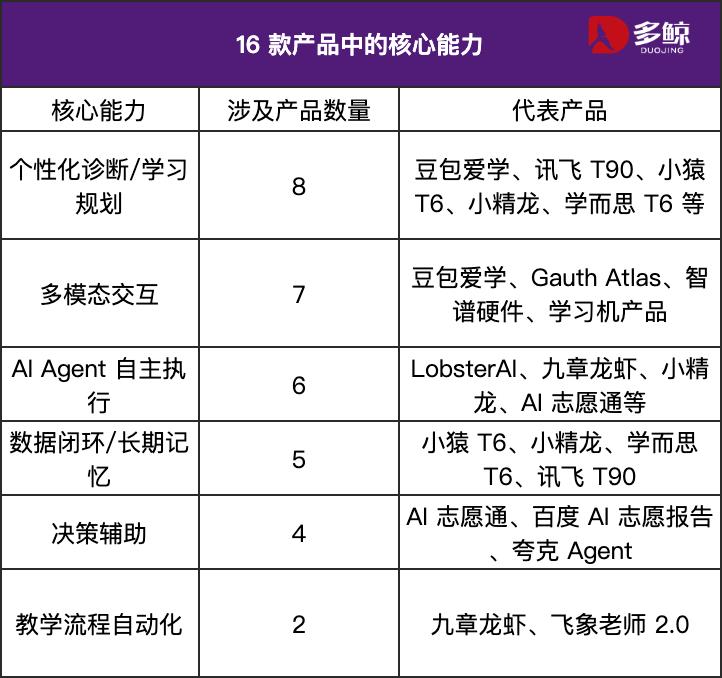
Among all these capabilities, learning diagnosis has become the most concentrated direction for learning device product upgrades.
In February, Iflytek released the AI Learning Device T90 series, which proposes to generate personalized learning paths through knowledge diagnosis. In March, Yuanfudao launched the Xiaoyuan AI Learning Device T6, which analyzes students' knowledge mastery status based on a "mastery model". At the end of June, TAL released the Xueersi Learning Device T6 series, which further integrates the full workflow of learning diagnosis, error question analysis, study planning, and dynamic adjustment.
These companies use different product names, but their core changes are similar: learning devices are evolving from mere content carriers to full learning process management tools.
Apart from learning devices, Agent has also become a high-frequency keyword in this year's AI education product launches.
In March, TAL released Zhangjia Lobster, which provides teachers with functions including lesson plan generation, courseware production, teaching material organization, and intelligent test paper creation. The "Little Smart Dragon" launched in April is designed for students, offering study planning, error question recording, and knowledge mastery analysis services.
In the academic advancement decision-making field, Agent has also become a new way for enterprises to enter the market. In June, New Oriental launched the AI College Admissions Guidance Tool, Baidu upgraded its AI Admissions Report, and Quark released its college admissions planning Agent — all three products apply AI to links including university information retrieval, major matching, and admission risk analysis.
Compared with traditional information query tools, these new products have begun to take on more complex decision support tasks.
Multi-modal interaction is more commonly featured in learning entry points and education hardware.
ByteDance's Doubao Love Learning supports users to submit questions via text, voice, and photo capture. Zhipu Lingji AI Camera Learning Device supports functions including photo recognition and AI story-telling. Gauth Atlas presents knowledge relationships through dynamic infographics. For students, the learning entry point is expanding from traditional keyboard input to images, voice, and real-world objects.
Meanwhile, long-term learning data recording has also become an important component of many products.
TAL's Little Smart Dragon records students' learning paths and knowledge mastery status. The Xueersi Learning Device integrates learning data from courses, assignments, and error questions. Iflytek optimizes personalized recommendations through learning behavior recognition. The data accumulation cycle in education scenarios is relatively long, and enterprises aim to build more accurate user profiles through continuous product usage.
Judging from the product launches in the first half of this year, the competitive focus of education AI has been concentrated in several clear directions: helping students identify their knowledge gaps, helping teachers reduce repetitive work, helping users complete complex decision-making processes, and improving service quality through long-term data accumulation.
In the past, competition in education products revolved around content, services, and distribution channels; nowadays, AI has opened up new capability boundaries for education products. However, the validation cycle in the education industry remains unchanged: learning effectiveness requires long-term accumulation, teaching efficiency needs to be tested in real classroom scenarios, and user trust is built through continuous long-term usage.
AI features can be replicated quickly, but tangible education outcomes cannot be achieved overnight.
AI that can generate answers is no longer scarce; what is truly scarce is a deep understanding of the complete learning process.
Products that can call large models are no longer scarce; what is truly scarce is long-term accumulated high-quality education data.
This article originates from the WeChat Official Account "Duojing" (ID: DJEDUINNO), Author: Siluo, Published with authorization from 36Kr.