Has urban services become a new examination field for embodied intelligence?
The same robot, when placed in a factory workshop and on an urban road, essentially faces two completely different worlds.
In structured scenarios (such as factory workshops), robot deployment has already reached a highly mature stage. But once entering open environments (like urban roads), the difficulty level changes entirely. Especially in outdoor urban settings, robots need to operate nonstop 24/7, which requires them to withstand constant exposure to the elements and navigate through heavy pedestrian and vehicle traffic.
The *Embodied Intelligence Development Report* from the China Academy of Information and Communications Technology summarizes the current situation in one sentence: There is a lack of closed loops for data, models, hardware platforms, and real-world scenarios. However, there is no doubt that by 2026, embodied intelligence will have transitioned from the technical validation phase to real-world scenario implementation, with urban services emerging as a critical testing ground to evaluate all deployment capabilities.
Facing this landscape, Kusa Technology — which sets its vision on "applying embodied intelligence to urban open scenarios" — has made a clear strategic choice: to integrate the full-stack engineering workflow of data collection, model training, and robot deployment, enabling robots to start operating in the real world first while ensuring stable performance. According to Kusa's assessment, to bridge the gap to large-scale deployment, both R&D capabilities and engineering expertise must be outstanding at the same time.
Founded in 2023, Kusa's core team consists of graduates from top universities including Tsinghua University and Shanghai Jiao Tong University. Its key members boast 15 years of R&D and management experience in complete vehicles, robotics, and autonomous driving. The company's flagship product is a service robot designed for urban open scenarios, which has already been deployed and operating in over 40 cities.
In mid-July this year, Kusa Technology launched an embodied intelligence development platform called Kusa Robo Platform. The platform has a clear positioning: it is an engineering platform purpose-built for city-level embodied intelligence deployment, forming a full-stack closed loop covering data collection, model training, multi-terminal deployment, and remote operation and maintenance. As one of the few companies that have truly stepped into this testing ground, Kusa aims to use this platform to answer a question that no one in the industry has been able to clearly explain:
Why is building a dedicated platform the key to large-scale deployment of embodied intelligence?
01. Why is city-level embodied intelligence so difficult to achieve?
Teams transitioning from autonomous driving to robotics almost universally assume at the very beginning that they only need to upgrade 2D problems to 3D.
Kusa's team initially thought the same way. Moving from a 2D plane to 3D space seemed like a manageable challenge, but when they dove deep into real scenarios, they discovered that the underlying benchmarks had completely changed.
The most fundamental difference lies in the shift in evaluation criteria. In the same scenario, a passenger car's task is to travel from point A to point B, and success is defined by avoiding collisions and ensuring a comfortable riding experience. An urban sanitation robot, however, operates in the opposite manner: it needs to actively make contact with various objects and make corresponding judgments.
For example, a bulging black plastic bag on the road — is it filled with bricks, a water bottle full of liquid, or an empty bottle? The required handling methods differ drastically. For autonomous driving vehicles, simply rolling over the bag or driving around it is sufficient. But a sanitation robot has to try sweeping it first, and only decide on the next action if it cannot be cleared. Because the hard performance metric for sanitation is to remove all waste, avoiding every object on the path means the robot is not fulfilling its core function.
The change in evaluation criteria hides an underestimated dimension and challenge: physical interaction.
Tao Sheng, Co-founder and CTO of Kusa Technology, told 36Kr that autonomous driving pays little attention to contact mechanics, because the automotive industry has years of accumulated experience, and vehicle chassis are "already well-developed." But urban service robots must fully integrate the torque feedback and rotation control of their end-effector cleaning structures with the entire vehicle control system. This is exactly the key difference that defines the leap from a "vehicle" to a "robot." To properly handle physical interactions, relying solely on sensors is not enough — models must also develop a deep understanding of the physical world itself.
02. Why choose urban scenarios specifically?
Tao Sheng states that the core judgment comes from identifying real and urgent market demands:
Urban spaces feature high complexity and strong technical barriers, while directly generating commercially viable value, making them the ideal environment to validate the engineering capabilities of embodied intelligence. More importantly, the market penetration rate of the urban service robot industry is extremely low, less than 1%, representing an untapped blue ocean market.
A business that is difficult to execute but delivers clear returns is a "difficult but correct undertaking" worthy of long-term technical investment. These barriers mean that city-level embodied intelligence requires a dedicated engineering platform, and Kusa's answer to this demand is the Kusa Robo Platform, which we will explain starting with three core technologies.
03. The Foundation, Fuel, and Brain
The three core technologies launched this time each have clearly defined roles.
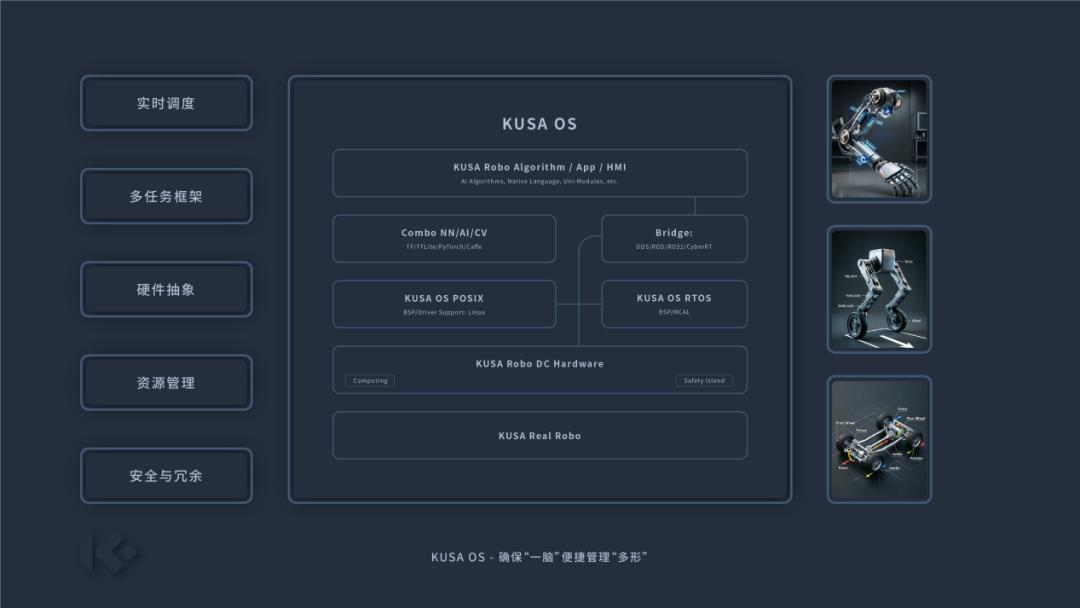
Kusa OS is a dedicated operating system for city-level embodied intelligence, responsible for the stable operation and real-time scheduling of robots. Corner Factory is a data factory that automatically mines, cleans, and annotates long-tail scenarios from collected data. Kusa Omni-CTS is a multimodal embodied model that covers the entire workflow from scenario perception and cognitive understanding to motion output. These three technologies collectively address the same question: how can robots operate stably, learn rapidly, and adapt to scenarios in urban environments?
The first problem Kusa OS solves is "stable operation." The development of this operating system can be traced back to 2018, when Kusa's core team was still working on autonomous driving solutions for port operations.
ROS2 is the most popular open-source software framework in the robotics community, designed with an emphasis on flexibility and usability to help researchers quickly test new algorithms. However, this comes at the cost of insufficient hard real-time performance, which leads to unpredictable latency and jitter, creating potential risks in urban service scenarios that demand extremely high long-term stability and real-time responsiveness.
This is exactly the core reason why Kusa independently developed Kusa OS from the ground up.
Similar to urban services, port scenarios require nonstop 24/7 operation and have extremely high standards for long-term stability and real-time performance. Starting from the real needs of these scenarios, Kusa built the entire system from scratch based on data distribution technology, with a core design philosophy of keeping the system streamlined and ensuring strict control over every module. A smaller system inherently delivers greater stability.
Through long-term iterative development, this system has solved three key industry challenges: long-term stability, deterministic scheduling, and latency jitter reduction.
However, the cost of independently developing an operating system over the past few years has been very real.
"Even now, I still find myself struggling with this decision," Tao Sheng describes the experience. The biggest challenge is the incomplete toolchain: the ROS2 community has massive open-source contributions covering the full workflow from real-time visual monitoring, robot dynamics simulation, to 3D world reconstruction. But with in-house development, Kusa had to build all of these components on its own. Kusa's solution was to develop a brand-new programming toolchain that automatically generates initialization code using descriptive language, minimizing the migration cost.
The investment put into independent development has finally paid off in the form of underlying system flexibility and real-time stability.
If the operating system is the foundation, then Corner Factory is the fuel, as it solves the problem of "continuous learning."
Kusa's data flywheel has been fully validated: when the company's first mass-produced product was launched, the entire data processing pipeline was already operational, and the proportion of automatic annotation has increased from 80% in the early stage to over 90% today.
According to Tao Sheng, the complete data pipeline operates as follows: when a robot encounters an anomaly during operation and triggers an emergency stop, it automatically saves multi-sensor data from several seconds before and after the event. After returning to the operation station, a dedicated data collector transmits the data to the data factory. The data first undergoes desensitization processing to remove personal information such as faces and license plates, then enters the automatic annotation phase, which has been upgraded from early 2D segmentation and classification to 3D occupancy grid mapping and 3D reconstruction. Human operators perform the final verification and correction, after which a dedicated model filters out the truly valuable long-tail scenarios, which are then stored in the database for subsequent model training.
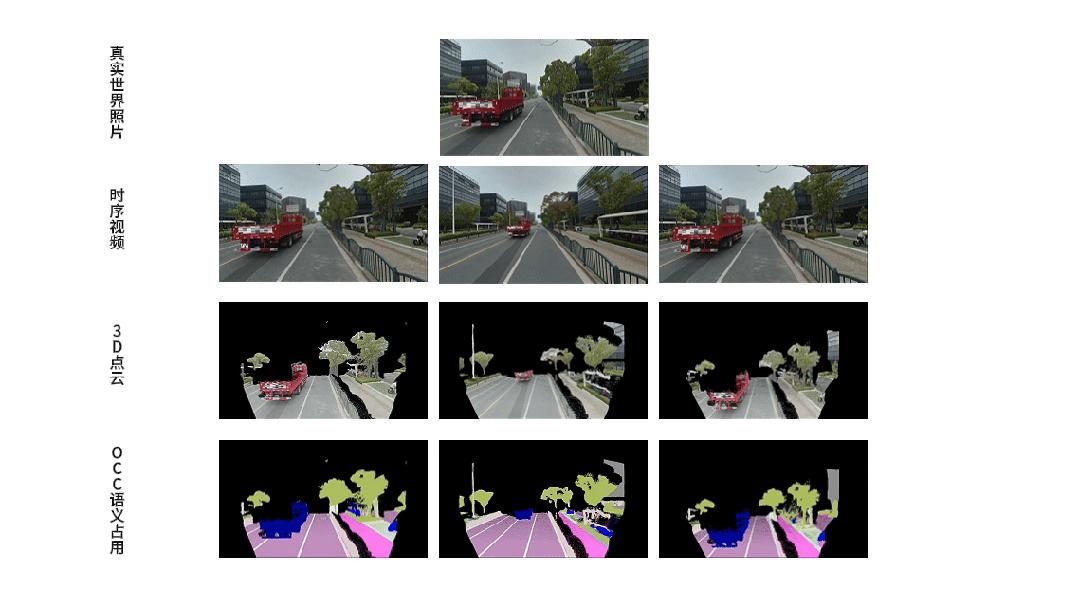
Within Corner Factory, Kusa Omni-CTS generates sequential video streams based on single-frame real-world scenario inputs, while synchronously deriving 3D point clouds and OCC semantic occupancy data. Kusa Omni-CTS establishes OCC/3D point clouds as the core intermediate representation, constructing physical-level spatial constraints between 2D observations and 3D structures to ensure spatial understanding accuracy, supporting the efficient operation of the data closed loop and weekly model iterations.
But Tao Sheng also candidly states: "The data flywheel or pipeline itself is not the real barrier — the actual barrier is the data. Because data is highly scenario-specific: if the system has not encountered a scenario before, it cannot be imagined by engineers. The first-mover advantage brought by the data flywheel essentially comes from the product of time and data volume."
The top-level Omni-CTS acts as the "brain," solving the engineering challenge of enabling robots to "understand scenarios."
Tao Sheng explains that the "first principle" of Kusa's model is: the difficulty does not lie in any specific technology, but in the transformation of thinking patterns. He even jokes: "We are a 'patchwork monster'." But this patchwork is not a random assembly — it integrates cutting-edge ideas from different fields such as video generation, spatiotemporal encoding, and 3D Gaussian Splatting into an original solution.
In the engineering field, there is a more precise term for this: it is an innovation in model architecture that breaks through the challenge of asynchronous input processing.
The core problem is very concrete. On real robots, multiple sensors are inherently out of sync. For example, LiDAR operates at 10Hz, cameras at 30Hz, and IMUs at up to 1000Hz, meaning their data arrival rates are completely different. Forced synchronization either causes waiting delays or generates conflicting data, leading to a sharp drop in model performance.
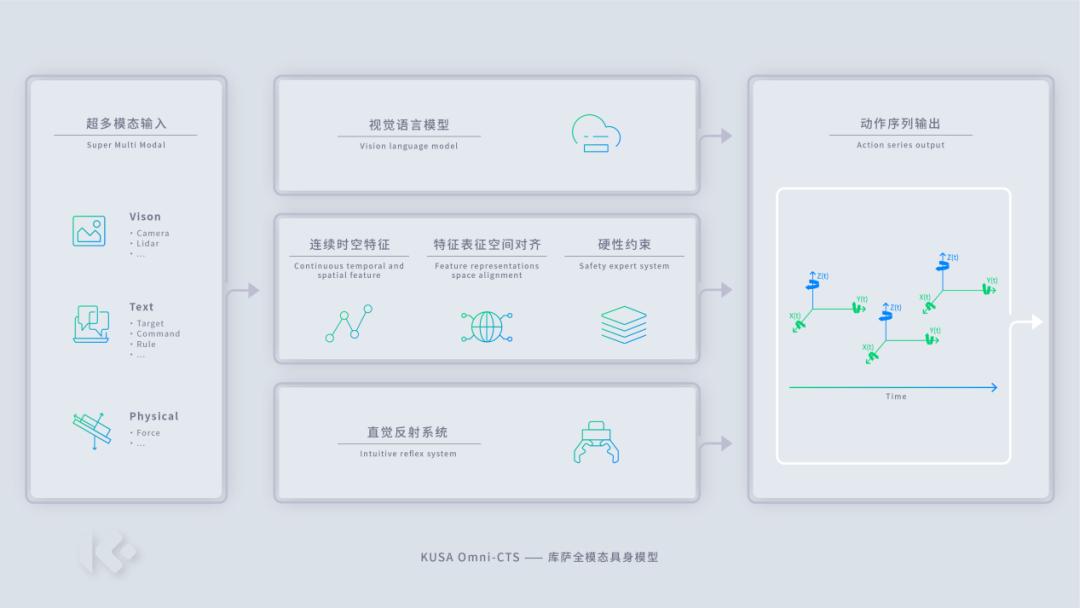
Kusa Omni-CTS is designed to solve this problem, with its solution divided into two layers:
The first layer is cross-modal asynchronous feature alignment. Abandoning traditional discrete frame alignment, the model constructs continuous spatiotemporal curves in a high-dimensional latent space. Vision, LiDAR, IMU, and torque feedback data are collected at their own native frequencies, and automatically "synchronize their clocks" after entering the model, allowing data to flow naturally without relying on expensive hardware synchronization systems.
The second layer is physical consistency prediction — which directly addresses the "physical interaction" challenge. By constructing continuous trajectories that conform to physical dynamics in high-dimensional space, the model not only understands what is happening in the current moment, but also predicts various possible future situations based on physical laws and environmental changes, then selects the most reasonable execution method.
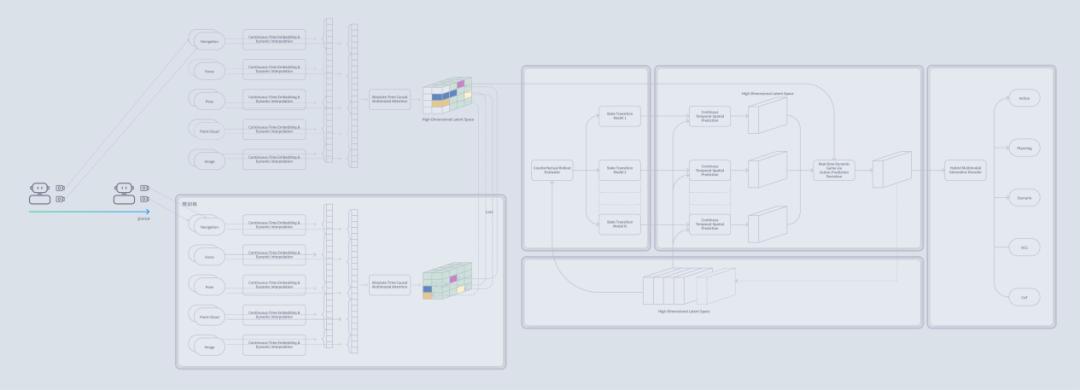
Kusa Omni-CTS Model Architecture Diagram: A Multimodal Model Based on Continuous Spatiotemporal Prediction
From a hardware perspective, this design requires very few hardware modifications, but it solves the problem of significant performance degradation caused by temporal jitter. In the embodied intelligence field, multimodal fusion is the ultimate solution, which not only unlocks maximum performance potential but also provides robust fallback capabilities.
For Kusa, R&D and engineering are never two separate undertakings. Pure R&D cannot lead to real deployment, while pure engineering cannot maintain technical barriers. Kusa chose to integrate these two aspects. The architectural innovation of Kusa Omni-CTS and the underlying reconstruction of the in-house OS are built on solid R&D foundations. At the same time, the tight integration of the OS, data flywheel, and multimodal fusion transforms R&D achievements into an engineering system that operates stably and learns rapidly. It can be said that R&D is Kusa's basic capability, while engineering expertise is its ultimate competitive advantage.
The three technologies combined form a closed loop for cognitive evolution. Looking deeper, each individual technology could potentially be replicated in the short term, but the deep integration of the OS, data flywheel, and multimodal fusion, multiplied by years of accumulated experience in urban scenarios, creates a full-stack collaborative systematic advantage that builds a unique moat for Kusa.
04. Has it been fully validated?
As mentioned earlier, this entire process is an examination — so the more important question is: what are the results?
Currently, Kusa's embodied intelligence products have been deployed in over 40 cities. In terms of growth rate, starting from scratch three years ago, the delivery scale has expanded several times or even dozens of times year over year. No other player in this niche segment has achieved such a steep growth curve.
In medium and large open road scenarios, Kusa has entered a phase of normalized operation where it has validated a viable business model and delivered practical operational value. But Tao Sheng quickly provides a sobering perspective:
From the current installed base, the problem of large-scale deployment has not been perfectly resolved. Scenario generalization capabilities still need improvement, hardware has not been tested under extreme weather conditions, and the milestone of increasing production capacity from 500 units per line to 5000 units is still ongoing.
His words are straightforward and carry significant weight for the entire industry: "Before real validation, everything is just empty talk."
This is because mass production ramp-up is a breakthrough process from 0 to 1, from 1 to 100, and from 100 to 10,000. Each stage faces completely different challenges, and it is often impossible to determine which stage is "more difficult."
The only certainty is that on this growth path, technological iteration is driven by real-world demands — the number of long-tail scenarios in the real world will always exceed what was predefined.
The first convincing scenario involves a seemingly insignificant fishing rod.
As Kusa expanded its operations from municipal roads to scenarios closer to people, such as parks, industrial parks, and tourist attractions, the team occasionally encountered fishing rods propped up by anglers. These rods are only 1-2 cm thick and stand alone in the air. The team previously focused on ground segmentation and detecting pipes and wires, and never considered detecting such thin objects suspended in mid-air, so they had to re-collect data and retrain the models.
This experience gave Tao Sheng a key insight: before achieving large-scale deployment, most technological iterations are developed to address newly discovered scenarios. Teams cannot anticipate every problem from the very beginning — it is a gradual discovery process.
The second case involves "paper and pencils next to a schoolbag."
In the evening, the robot detects a schoolbag, paper, and pencils, with students running nearby. Through semantic understanding of this scene, it can judge that the running student is likely the owner of these items, which are temporarily placed, so it chooses not to clean them. The next day, when the schoolbag and students are no longer present, the same piece of paper will be identified as discarded waste. This scenario judgment is realized through the large model's semantic understanding of the entire image, which can associate people, objects, time, and space together.
Whether it is recognizing a fishing rod or understanding the after-school scenario, the rapid iteration and deployment of these capabilities rely on the Corner Factory data flywheel and the general versatility of the Kusa Robo Platform.