6 joint-venture automakers are outperformed by new EV players? Domestic brands hold over 70% market share, accelerating the massive reshuffle in the automotive industry
Market share halved in 5 years, 8 joint-venture brands see collective sales decline.
"From January to May this year, a total of 542 new car models were launched in the Chinese market, averaging 3.6 models per day. Developing a new model requires an investment of over 1 billion yuan and a development cycle of more than two years, yet market enthusiasm typically lasts no more than three months. With so many new vehicles hitting the market while overall domestic sales have still dropped by 20%, this competition is no longer fierce—it is brutal."
On July 14, these remarks from He Zhiqi, Executive Vice President of BYD Co., Ltd., laid bare the harshest reality of China's auto market: explosive product growth paired with shrinking demand.
Data from the China Passenger Car Association (CPCA) shows that cumulative wholesale sales of narrow-segment passenger vehicles in China reached 12.547 million units from January to June this year, down 5.7% year-on-year, while cumulative retail sales stood at 8.701 million units, a 20.2% year-on-year decline.
Against this backdrop, the domestic auto market continues to reshuffle, with the positions of Chinese brands and joint-venture brands undergoing profound shifts.
Figures from the China Association of Automobile Manufacturers (CAAM) indicate that in the first half of 2021, Chinese passenger car brands held a 42.0% market share. By the first half of this year, that share had climbed to 71.8%, up 3.3 percentage points from the same period last year, with total sales reaching 9.138 million units. In the single month of June alone, this figure surpassed 75.5%.
The market share of domestic Chinese brands versus joint-venture/foreign brands shows a clear "one rising as the other falls" trend. Five years ago, joint-venture brands controlled nearly 60% of the Chinese market; today, that share has been compressed to less than a quarter.
This is no simple zero-sum game—it represents a complete restructuring of the entire power dynamic in the automotive market.
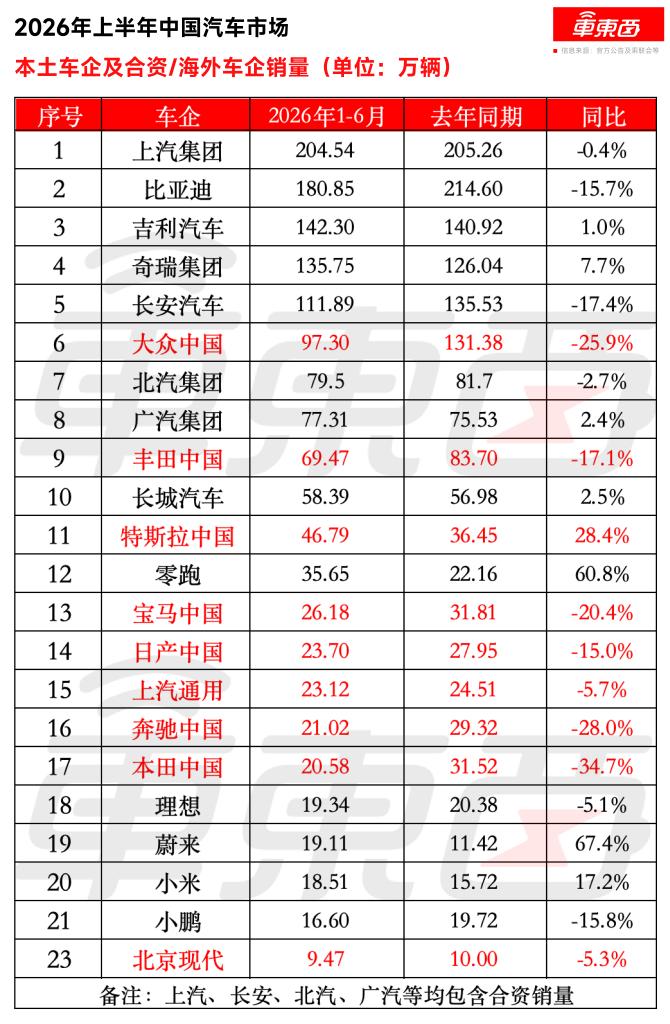
2026 H1 China Auto Market Sales Ranking: Domestic Automakers vs. JV/Foreign Brands
01. Joint-venture Brands Lose Ground Across the Board, Outpaced by Traditional Domestic Giants and Encircled by New EV Startups
Looking at the first-half sales rankings of the Chinese auto market, Chinese car brands delivered standout performance in the first six months.
Among them, SAIC Motor recorded cumulative sales of 2.045 million units from January to June, becoming the only Chinese automaker to break the 2 million-unit threshold in the first half of the year and claiming the 2026 mid-year sales crown.
More notably, SAIC's self-owned brands sold a total of 1.469 million units, marking a 12.6% year-on-year increase and accounting for 71.8% of the group's total sales—meaning for every 10 vehicles sold by SAIC, over 7 are from its domestic brand portfolio.
Additionally, BYD sold 1.8085 million units in the first half of this year (about 991,000 in the domestic market), Geely 1.4230 million units (about 1.021 million domestic), Chery 1.3575 million units (about 413,000 domestic), and Changan 1.1189 million units (about 546,000 domestic). Five Chinese automakers have each exceeded 1 million units in half-year sales.
In sharp contrast, the former joint-venture leaders have been left far behind by Chinese automotive groups.
Volkswagen China's sales in the first half of this year amounted to only 973,000 units, plummeting 25.9% year-on-year.
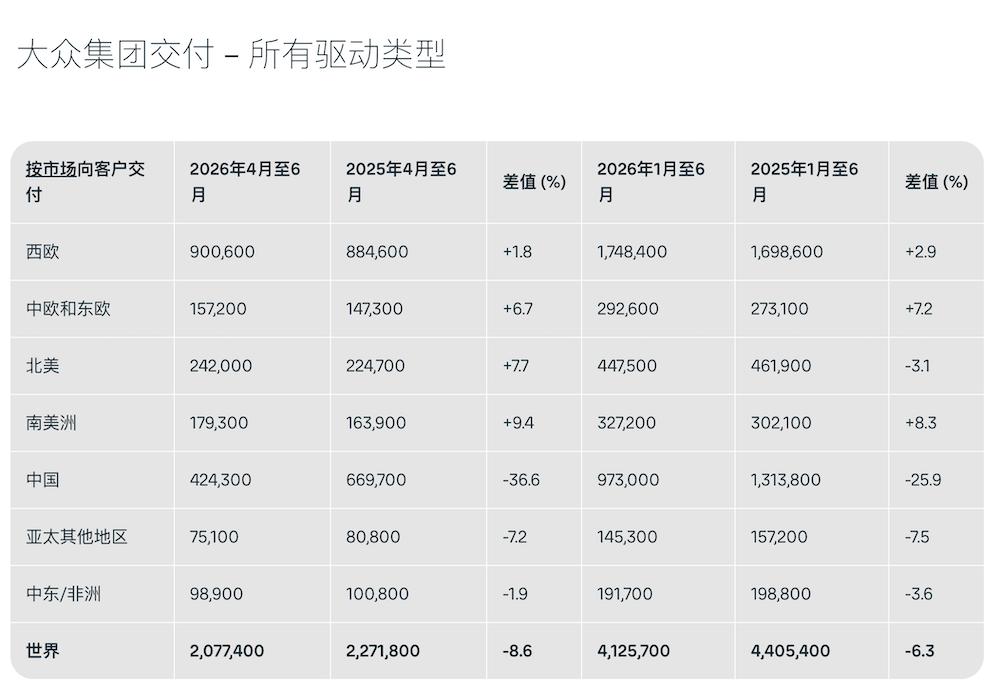
Volkswagen China H1 2026 Sales Down 25.9% YoY
Not only has the Volkswagen Group underperformed in China, but German luxury brands have also seen their local sales shrink.
BMW China delivered 261,800 units in the first half of this year, down 20.4% year-on-year; Mercedes-Benz China sold 210,200 units, a 28% plunge; Porsche's China deliveries dropped 32% to just 14,500 units. The once-impenetrable "moat" of German luxury brands is eroding rapidly.
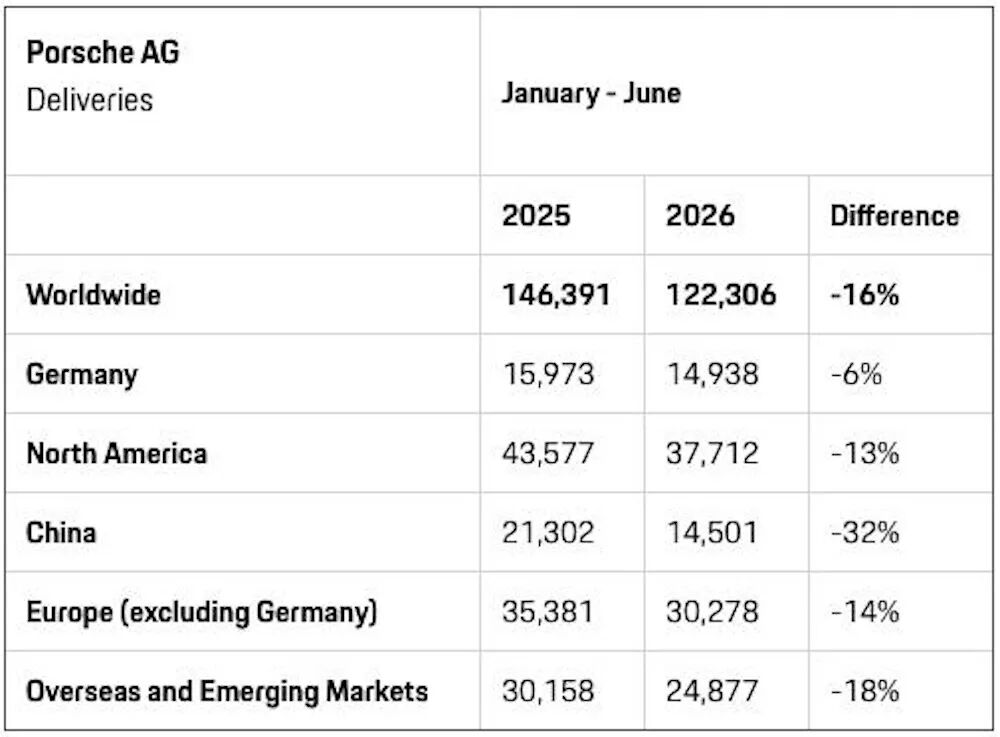
Porsche H1 2026 Sales Down 32% YoY
A similar trend is unfolding among Japanese automakers. Toyota China's cumulative sales in H1 2026 reached 694,700 units, down 17.1% year-on-year. Honda China's total sales stood at just 205,800 units, a steep 34.7% year-on-year decline, while Nissan China recorded 237,000 units, down 15.0%.
For American brands, SAIC-GM sold 231,200 units in the first half, a 5.7% year-on-year drop.
Tesla stands out as an exception. Its China sales hit 467,900 units in H1 2026, up 28.4% year-on-year, making it the only foreign brand tracked so far that maintains strong growth in the Chinese market.
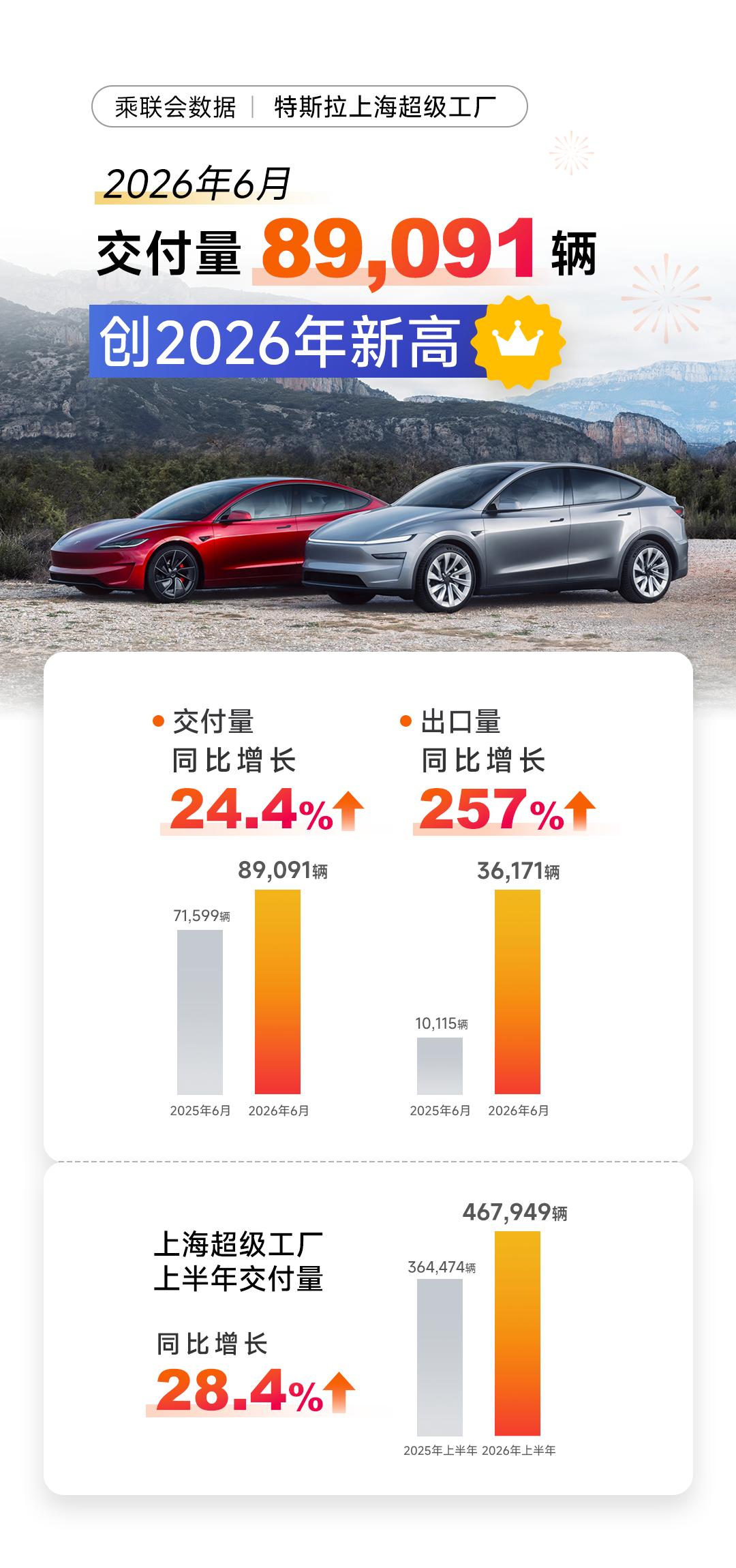
Tesla Delivers 467,900 Units in H1 2026
It is worth noting that nearly every new EV startup now positions itself against Tesla in product launches, yet Tesla's sales have barely taken a real hit. What these new players are actually competing for is the traditional joint-venture market—the market share that once belonged to BBA, Toyota, Honda, Volkswagen, and GM.
Overall, the vast majority of foreign/joint-venture automakers in China, including BMW China, Nissan China, SAIC-GM, Mercedes-Benz China, and Honda China, are clustered in the 200,000–270,000 unit sales range in H1 2026, translating to average monthly deliveries of just 33,000–45,000 units.
By comparison, several new Chinese EV startups are already approaching this sales bracket: Li Auto delivered 193,400 units, NIO 191,100 units, and Xiaomi 185,100 units. Leading the pack, Leapmotor, the top-selling new EV brand in China, saw H1 sales reach 356,500 units, a 60% year-on-year surge that has allowed it to overtake multiple joint-venture brands in succession.
02. Why Have Joint-Venture Brands Lost Their Luster in China's Auto Market?
For one thing, the macro market landscape has shifted dramatically: the fuel vehicle market has shrunk sharply, while joint-venture/foreign brands have fallen short in their new energy transition.
According to CPCA data, cumulative wholesale sales of new energy vehicles (NEVs) in China reached 6.788 million units in H1 2026, up 5.1% year-on-year, with the market share rising from 48.5% in the same period last year to 54.1%.
Especially in the second quarter of this year, NEV penetration in China's auto market surged rapidly. The retail penetration rate of NEVs broke through 60% starting in April and has held at this historic high for three consecutive months.
Correspondingly, demand for fuel vehicles has contracted drastically. CPCA figures show that retail sales of fuel vehicles in H1 2026 fell below 4 million units, down 26.4% year-on-year—a decline that outpaces the 20.2% overall drop in the retail auto market. Since foreign brands represented by German marques like Volkswagen, American brands such as SAIC-GM, and the big three Japanese automakers still rely heavily on fuel vehicles for their China sales, the overall contraction of the fuel vehicle market has directly dragged down their performance.
Moreover, multinational and joint-venture automakers have long suffered from lengthy decision-making chains. Adjustments to domestic vehicle configurations require headquarters approval, leaving their product iteration speed far behind that of local Chinese brands, which has further delayed their NEV transition progress.
On the other hand, as Chinese automakers rise strongly, intelligent features have become a key priority for domestic car buyers, intensifying competition in the Chinese auto market.
Early electric vehicles launched by German luxury brands in China were mostly conversions from fuel vehicle platforms. Their dedicated pure electric architectures were slow to roll out, missing out on popular intelligent and electric features that Chinese consumers increasingly prefer, such as 800V ultra-fast charging and advanced autonomous driving systems.
Currently, joint-venture brands have begun to catch up aggressively. Initiatives like the Volkswagen Anhui ID. series, BMW's Neue Klasse platform models, and Mercedes-Benz's MMA platform vehicles are being accelerated for the Chinese market. However, as these efforts are still in their early stages, they remain to be validated by the market over time.
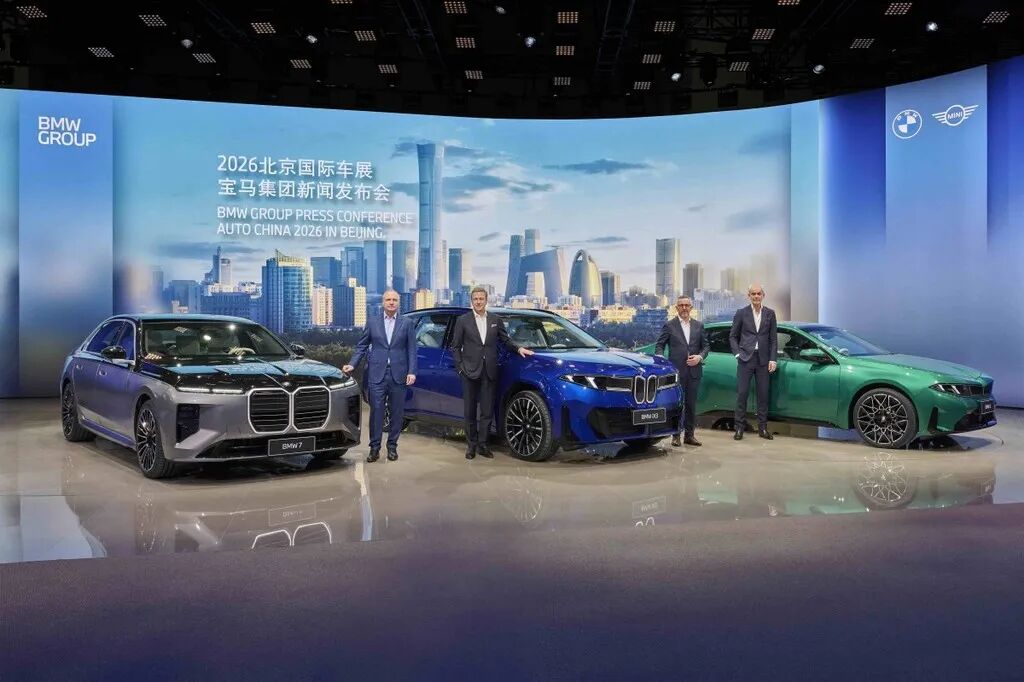
BMW Group Unveils 16 Premiere Models at Beijing Auto Show
Meanwhile, high-end Chinese NEV brands such as AITO, NIO, Xiaomi, and Zeekr have emerged powerfully. These domestic automakers boast inherent localization and intelligent advantages in the NEV sector, redefining luxury standards through intelligent cockpits, advanced autonomous driving, and spacious vehicle designs. As the weight of intelligent experience continues to rise in consumers' car purchasing decisions, joint-venture/foreign brands have seen part of their market share diverted.
All in all, Chinese brands, leveraging economies of scale and vertically integrated supply chains, have seized pricing power for NEVs in the local market, further squeezing the living space of traditional joint-venture brands.
03. Conclusion: Joint-Venture Brands Are Accelerating Their Transformation
Amid fierce competition in the Chinese market, joint-venture/foreign brands are actively pursuing strategic changes.
Many of these brands have converged on two adjustment paths: on one hand, they are optimizing production capacity and streamlining organizational structures to improve operational efficiency; on the other hand, they are accelerating the launch of NEV models tailored specifically for the Chinese market, striving to adapt to new consumer demands through localized supply chains and faster product iteration.
Judging from their H1 2026 sales performance, joint-venture brands as a whole are still in a critical phase of transformation. Facing the strong rise of domestic Chinese brands, the joint-venture camp is undoubtedly under considerable pressure. However, given China's vast market capacity and diverse consumer needs, there still exists room for differentiated competition.
Looking ahead, whether foreign brands can truly align themselves with China's electrification and intelligent industrial rhythm will determine if they can hold their ground in the new round of competition. Time is precious for all players, and the market will ultimately reward those enterprises that genuinely understand Chinese consumers.
This article is from the WeChat public account "CheDongXi", written by Guo Yue, edited by Zhihao, and published with authorization from 36Kr.