The new regulations on "re-employment after retirement" have been implemented, and elderly workers finally have guarantees.
If you have elderly family members who are still working, this new regulation is a must-read!
Effective July 1, 2026, the Interim Provisions on the Protection of Basic Rights and Interests of Over-age Workers, jointly issued by five departments including the Ministry of Human Resources and Social Security, will officially come into force.
This is China's first national-level regulation specifically targeted at protecting the rights and interests of "over-age workers."
Who are over-age workers?
Simply put, they are people who have exceeded the statutory retirement age but are still employed.
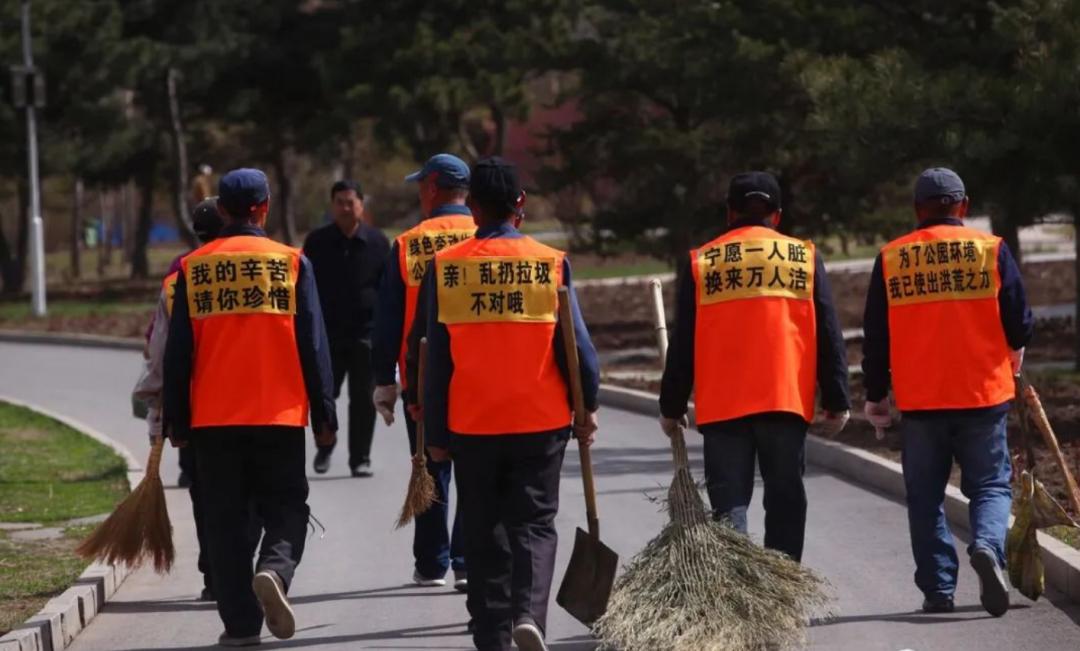
For example, security guards, cleaners, rehired doctors, rehired teachers, kitchen staff in the catering industry, and other middle-aged and elderly workers.
In the past, the rights and interests of such people were in an awkward legal vacuum.
The Labor Contract Law does not apply to them because they have passed the retirement age; work-related injury insurance is not recognized in many places, because the agreements they sign with employers are labor service agreements rather than labor contracts.
However, starting from July 1, this group of people who "have to work after retirement" will gain more dignity and protection.

Why is this new regulation for the protection of elderly workers being introduced now?
On social media, many netizens are "complaining" that the security guards in their residential compounds are "too old":
"In our community's security team, three people share a total of six teeth."
"I'm not sure who is supposed to protect whom."
Behind these complaints lies the fact that a large number of retirees are still working.
According to data from the National Bureau of Statistics, by the end of 2025, the number of people aged 60 and above in China had reached 320 million, accounting for 23% of the total population. It is projected that this group will grow even larger around 2035.
And the elderly have a strong willingness to re-enter the workforce.
Previously, 51job released the "2022 Research Report on Retirement Re-employment of the Elderly Group", which showed that 68% of the elderly group had a strong desire to work after retirement.
Among them, 46.7% of the elderly return to the job market to pursue personal and social value; 19% of the job seekers hope to leverage their professional skills to continue advancing their careers.
Currently, the number of over-age workers in China ranges from 87 million to 120 million.
This is a huge group, and it will continue to grow larger in the future.

However, there is no corresponding rights protection system for this group.
In the past few years, cases of over-retirement-age workers engaging in long-term high-intensity labor without adequate labor protection have repeatedly aroused public concern.
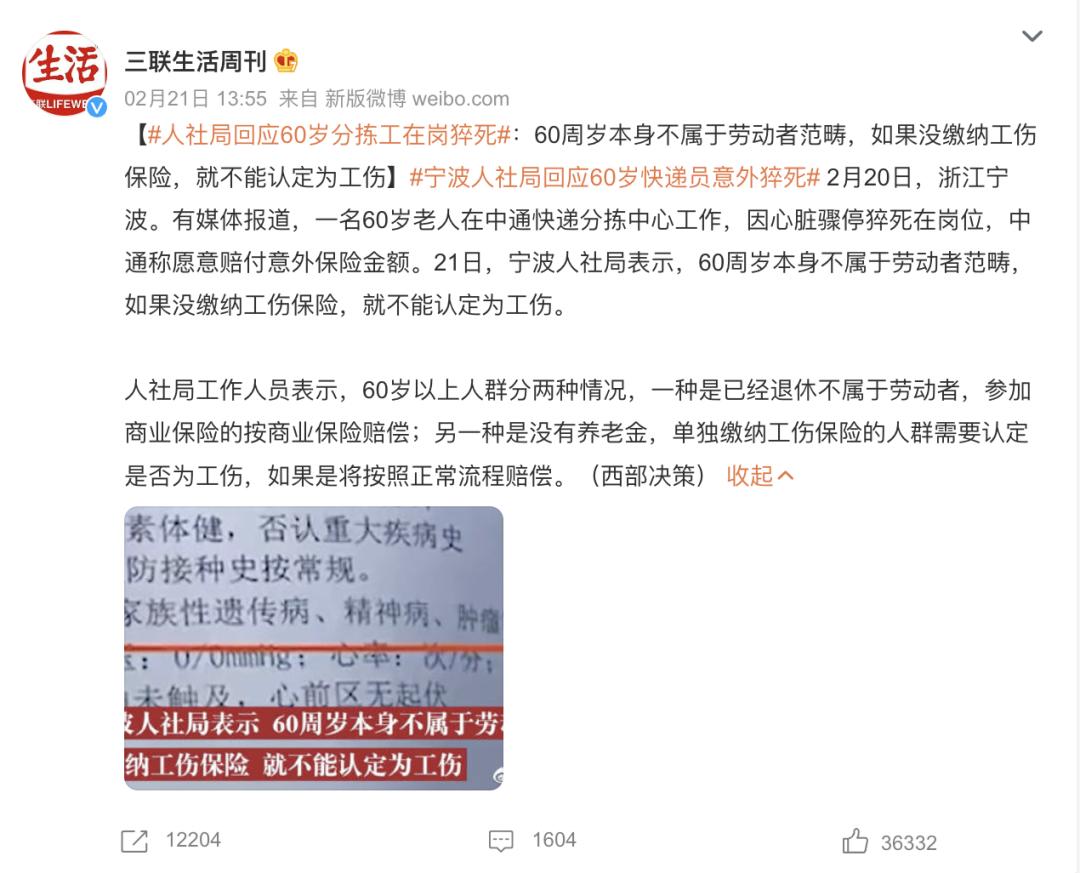
For example, a 60-year-old man in Ningbo, Zhejiang, worked as a sorter at an express delivery center and unfortunately died suddenly while on duty at 3:50 a.m.
At that time, the Ningbo Human Resources and Social Security Bureau stated that "people aged 60 do not fall under the category of laborers", and because the elderly man had not paid for work-related injury insurance, he could not even obtain a work-related injury certification.
The difference between "labor relationship" and "labor service relationship" is just one word, but the implications are huge.
Once classified as a labor service relationship, "over-age workers" are no longer considered "laborers" in the legal sense, making it difficult for them to be protected by the Labor Law and related regulations.
They cannot sign formal labor contracts, and a large number of non-standard small and medium-sized enterprises do not even sign any contracts, leading to widespread rights and interests dilemmas for over-age workers.
According to a research report from the Beijing No.1 Intermediate People's Court, from 2020 to 2022, there were more than 40,000 labor and labor service dispute cases involving over-age workers heard by courts across the country. The appeal rate reached 50%, which is more than twice that of ordinary labor disputes in the same period.
Now, with the protection of the new regulation, this group of elderly people re-employed after retirement will no longer be in an "unregulated" situation.
In addition, the "15th Five-Year Plan" Outline passed during this year's Two Sessions clearly states:
Actively develop human resources for the elderly, steadily implement the progressive delay of the statutory retirement age, optimize age limit policies in employment and social security, and expand diverse job positions suitable for the elderly.
This indicates that China's population structure is undergoing changes, and we will face the reality of "working longer".
Under such circumstances, this group of people must be supported by a complete set of "safety nets".
This new regulation is just the beginning. It will continue to be optimized and upgraded in the future.

What exactly does the new regulation specify?
There are four core points
1. Regarding labor remuneration
In the past, people were paid by the day, but how much they actually received depended entirely on the employer's goodwill.
However, the new regulation now stipulates that the labor remuneration paid to over-age workers must not be lower than the local minimum wage standard, and must be paid in full on a monthly basis without deduction or delay.
This is not a suggestion, but a mandatory requirement.
The old practice of "you are already retired, so just accept whatever you are given" will no longer be allowed.
2. Regarding leave and vacation.
In the past, enterprises believed that "since you are a rehired retiree, there is no need to strictly follow the work schedule".
Such reasoning no longer holds water.
Because the new regulation clearly states: Over-age workers are generally not required to work overtime. If overtime is truly necessary, overtime pay must be provided in accordance with the Labor Law — 150% of the normal wage for extended work hours on working days, 200% if no compensatory leave is arranged on rest days, and 300% on statutory holidays.
This is not a negotiation with employers, but a legal requirement.

3. Regarding contract signing.
Verbal agreements are completely invalidated, and a written employment agreement must be signed.
In the past, employers took shortcuts, and the elderly did not know the rules, so people started working with just a casual promise like "work with peace of mind, your salary will not be short-changed". This is no longer allowed.
The new regulation clearly requires that when employers recruit retirees, they must sign a written agreement, which should clearly specify the work content, work location, work hours, labor remuneration, rest and vacation, conditions for terminating the agreement, and even the handling methods for work-related injuries.
This agreement acts as a "protective amulet" for elderly working people. In the future, if you encounter situations such as wage arrears or unjustified dismissal, you can use the agreement to safeguard your rights and you will definitely get a favorable ruling.
4. Regarding work-related injury protection.
This is the most practical provision!
In the past, when an over-age worker suffered a work-related injury, the employer could easily shirk all responsibility by claiming "you do not have a labor relationship with us".
The biggest breakthrough of the new regulation now is: Employers must pay for work-related injury insurance for over-age workers.
Pension insurance is not required, because they may already be receiving their pensions; medical insurance is not required, because they may already be enjoying retirement medical benefits; unemployment insurance is not required, because they are not classified as unemployed in the first place.
However, work-related injury protection must be guaranteed as a bottom line.
Because the jobs that over-age workers take on are precisely the ones with the highest risk of work-related injuries.
According to data from China's population census yearbook, among the employed population aged 60 and above, 62.44% work in the agriculture, forestry, animal husbandry and fishery industries, 8.31% in the construction industry, 7.29% in the manufacturing industry, and 6.61% in the wholesale and retail industry.
This new regulation directly resolves the "worries behind" for the elderly who re-enter the workforce, and they no longer have to fear that no one will take responsibility if they get injured at work.
At the same time, employers can also share risks through work-related injury insurance, reducing the burden on enterprises.
In conclusion
It can be said that this new regulation directly addresses the most prominent pain points of current "over-age workers".
However, in an interview, an over-age worker who has retired but is still working said: he hopes that relevant departments will strengthen the labor security supervision and law enforcement, "The most critical thing is how to implement and enforce the regulations."
Let's wait and see what happens next.
After all, this may concern your parents, relatives, or even the future of you and me.
Finally, if you have elderly family members who are re-employed after retirement, please share this good news with them, so that more people can know that their legitimate rights and interests are now protected.
Every elderly worker who is willing to continue contributing deserves respect and kind treatment.
This article is from the WeChat public account "Xiaofeng Talks about Career" (ID: XF-SZC), authored by Wang Xiaofang's team, and published with authorization from 36Kr.