Eight Years of Community Group-buying Wars: A Slice and Legacy of China's Internet Money-burning History
36Kr 「Workplace Bonus」 (ID: ZhiChangHongLi)
At Meituan's annual general meeting held on June 26, CEO Wang Xing openly shared two major regrets regarding the company's business development: First, Meituan failed to expand overseas as early as possible after going public, missing the critical penetration window; second, the massive investment that was gradually shut down last year was the "Meituan Youxuan" business.
During this meeting, the management reviewed the competitive gains and losses of the past year, the strategic missteps of the past five years, and how to improve the sluggish stock price. For a leading "Retail + Technology" company that can continuously iterate on itself, spending money to learn lessons is sometimes an inevitable path. Judging from subsequent actions, Meituan is drawing lessons from the Meituan Youxuan business - for example, shifting from pure seller bidding to deepening the supply chain to achieve extreme cost-effectiveness, and launching a new business called "Happy Monkey".
Last June, Meituan shut down operations in most regions, and its supplier and warehousing resources were quickly absorbed by another giant, Pinduoduo; two months later, JD went "against the current" - quietly restarting its community group-buying business under the name "Jingdong Pinpin" in Beijing, Hebei, Anhui, and Jiangsu; by late November 2025, the GMV of Duoduo Maicai exceeded the combined GMV of Duoduo Maicai and Meituan Youxuan from the previous year, and it remains the only national community group-buying platform in the market so far.
Looking back at this "gold rush track" that was first bet on by local leading convenience stores and then followed by internet giants - China's community group-buying industry has experienced three rises and two falls.
1. In 2018, the first generation of community group-buying companies represented by the "Old Three Groups" (Xingsheng Youxuan, Shihui Group, Tongcheng Life) entered the fresh food sinking market with regional supply chains and group leader models, but eventually withdrew from the market one after another due to their extensive models and difficulty in achieving profitability.
2. In 2020, the pandemic catalyzed a second outbreak, with giants like Meituan and Pinduoduo entering the market with capital, sweeping across the country through subsidy wars, but the industry suddenly cooled down due to the "Nine Prohibitions" regulation, and early players were eliminated one after another.
3. In 2025, marked by the exit of Meituan Youxuan, the industry entered its third adjustment period - giants shifted to focusing on efficiency and deep cultivation of the supply chain, and the capital game moved from "next-day delivery" to "hourly delivery".
The capital-driven "Thousand-Group War" has been repeating itself in the history of internet commerce - from the early Hundred-Group War to the recent shared bicycles, food delivery, and community group-buying. Although their business models are different, the underlying logic is the same.
They usually start when the industry can tell a compelling story, and then when the time is right, giants embark on frantic expansion fueled by money and targeting scale. However, relying solely on capital infusion cannot build a sustainable business model, and the chaotic battles usually end with giants emerging victorious, while small companies are left in ruins.
This tens of billions of yuan capital battle that swept across China's internet, from frantic expansion to collective retreat, the entire evolution of the community group-buying industry is not only a history of giants' trial and error, but also a typical sample for understanding the competitive logic of China's internet - it not only teaches small companies how to survive in the tide of hot money inflows, but also reflects the underlying changes in China's entire consumer market.
Understanding community group-buying means understanding how giants respond to policies, restructure their strategies, and even more importantly, understanding what kind of business models can find the ultimate balance between efficiency, compliance, and user experience in the next decade.
A Commercial Battlefield Accelerated by the Pandemic ⁄ 01
Who Runs Out of Money First? ⁄ 02
Failed Self-Rescue: Three Years at Meituan Youxuan ⁄ 03
The Divided Endgame ⁄ 04
A Commercial Battlefield Accelerated by the Pandemic
2020 was a year of transition for the community group-buying industry.
Before the pandemic arrived, the capital market had long maintained a wait-and-see attitude toward the community group-buying business. Even though Xingsheng Youxuan had already set a good example, for the entire capital market, community group-buying was still a "business lacking imagination".
As early as 2017, there were thousands of community group-buying enterprises in Hunan. The local convenience store giant, Furong Xingsheng, set its sights on this "fat opportunity", and 「Xingsheng Youxuan」 was born. Leveraging its own convenience store network, Xingsheng Youxuan deeply cultivated the sinking market with the "pre-order + self-pickup" model. While other platforms were charging group leaders a deposit of around 5,000 yuan, Xingsheng Youxuan not only waived the deposit but also gave group leaders commissions, quickly capturing market share. Due to its origins in the convenience store industry, Xingsheng Youxuan only allowed store managers to join as group leaders.
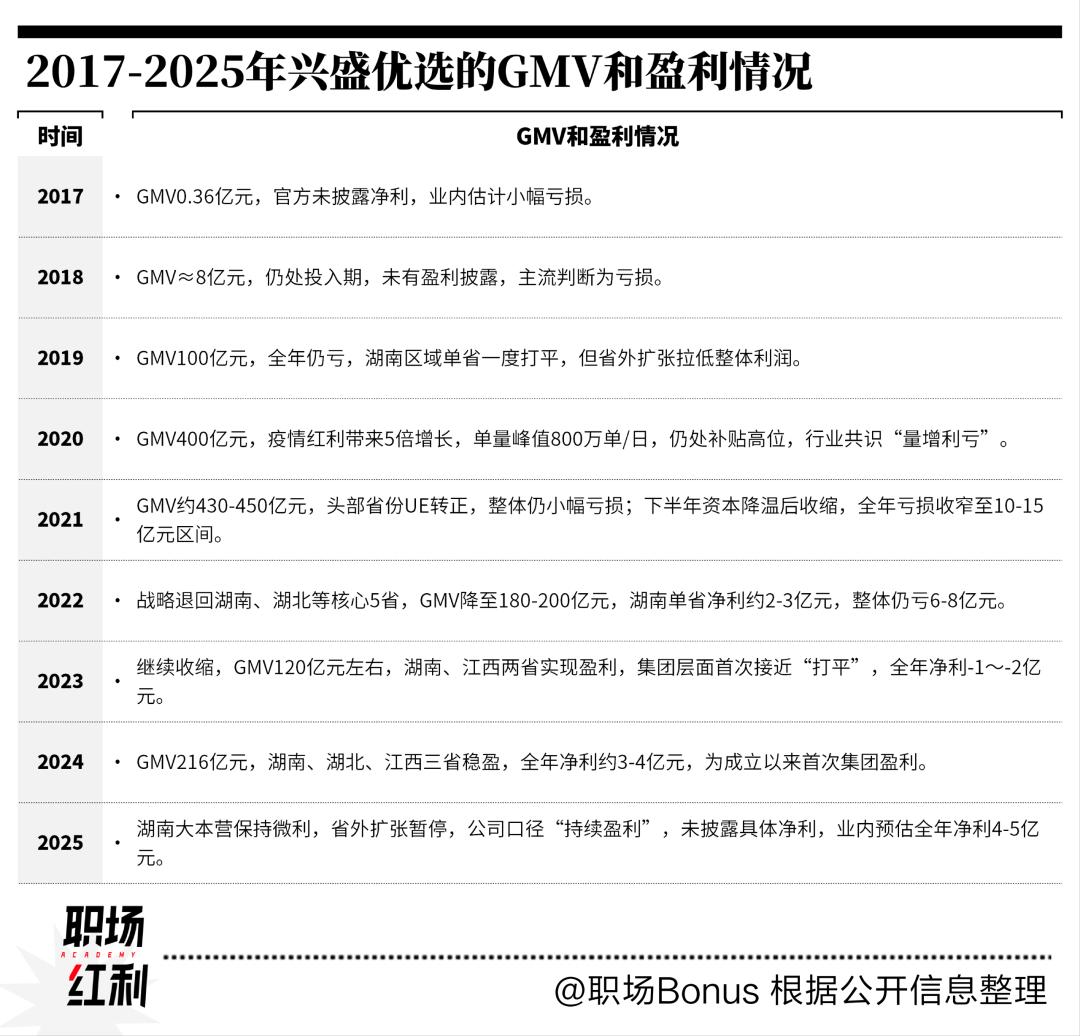
Although Xingsheng Youxuan did not make a profit from 2017 to 2019, in 2019 it achieved figures of "100 billion yuan in GMV [1] and 8 million orders per day", which almost broke even in unit economics (UE) [2] within Hunan province alone.
36Kr 「Workplace Bonus」 (ID: ZhiChangHongLi)
At this point, capital saw the potential of community group-buying for the first time - if "scaled replication" was possible, there were more than 30 provinces across the country, and theoretically 30 more "Xingsheng Youxuan" could be created. Since Hunan alone could achieve 100 billion yuan in GMV, the peak national valuation was instantly amplified to 8 billion US dollars.
However, past "failures" still made many people hesitant about community group-buying. In 2018, the community group-buying track raised about 4 billion yuan in financing, with more than 20 platforms such as Linlinyi, Songshu Pinpin, and Shihui Group receiving investments from Sequoia, IDG, and others, which the media called the "Hundred-Group War". In 2019, capital receded, fulfillment costs were exposed, and total annual financing dropped to 1.9 billion yuan, only half of the previous year; Songshu Pinpin, Dailuobo, and others successively went bankrupt or merged, marking the first major industry reshuffle.
But in 2020, a turning point arrived. During the pandemic, people stayed at home in quarantine, offline supermarkets faced restricted development, and "community group-buying", a once-marginal retail model, quickly took their place and rose to prominence.
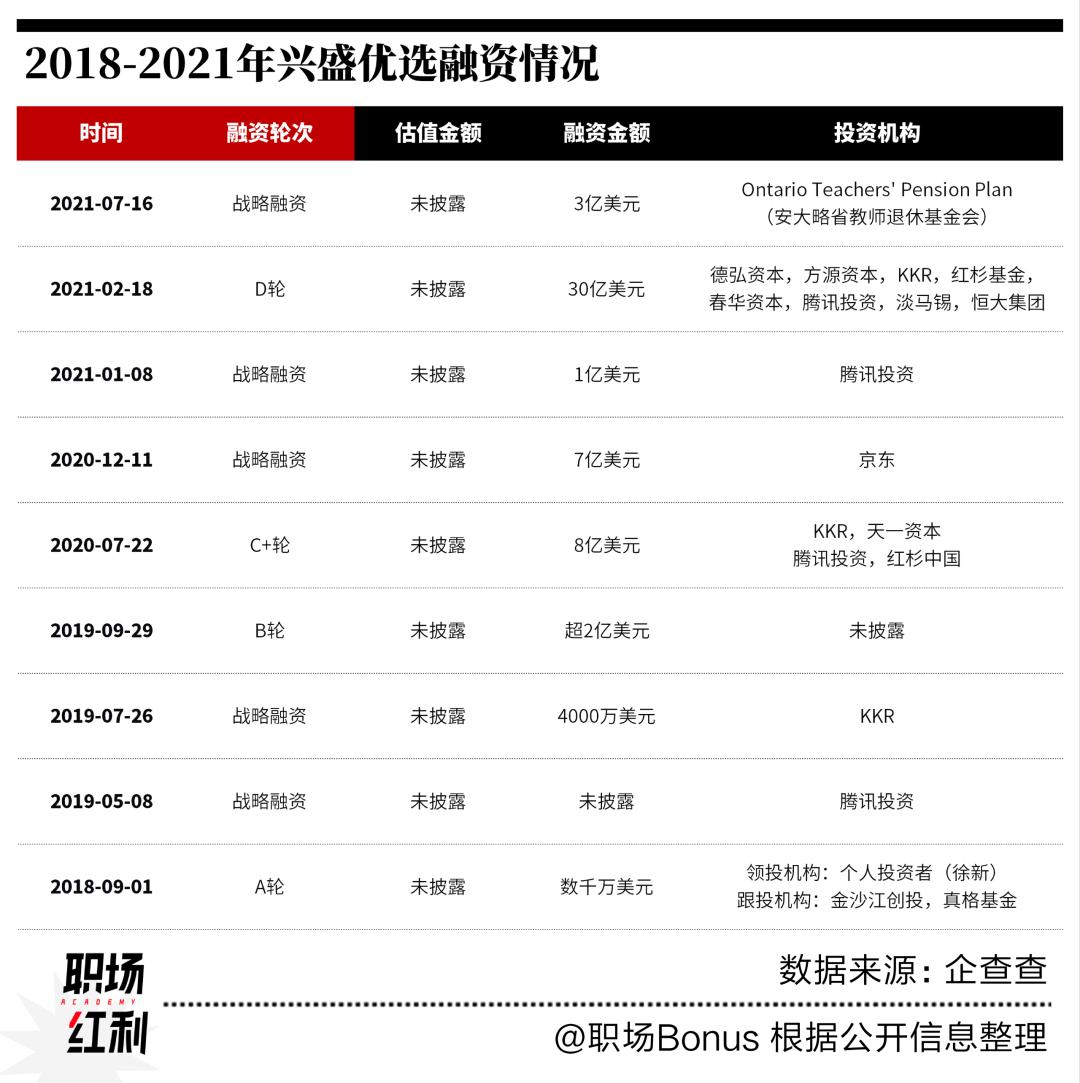
Within a year, Xingsheng Youxuan raised 1.5 billion US dollars (about 97 billion yuan), far exceeding the total financing of the previous three years. Xu Xin, the visionary investor who led the Series A round for Xingsheng Youxuan and is also the founder of Capital Today, famously said the widely quoted phrase "Great companies are worth investing in twice" to endorse the business.
36Kr 「Workplace Bonus」 (ID: ZhiChangHongLi)
At the same time, total financing in the track exceeded 100 billion yuan, 「Shihui Group」 raised about 280 million US dollars in two rounds, Tongcheng Life raised about 230 million US dollars in total, and valuation myths emerged one after another - large companies rushed to inject capital into potential companies, because in this chaotic battle, "whoever reaches the top scale first locks in the upstream and downstream".
Shihui Group, which belonged to the "Old Three Groups" [3] along with Xingsheng Youxuan, was regarded by the market as Alibaba's "prince" project. Starting from its Series B round in 2019, Alibaba led four consecutive rounds of investment, injecting more than 750 million US dollars in total and becoming Shihui Group's largest shareholder. Different from Xingsheng Youxuan's convenience store-based layout, Shihui Group's product pool and pricing system were redesigned by Freshippo, using Alibaba's Retail Link million stores and Cainiao Stations as self-pickup points.
In 2020, Shihui Group acquired several local group-buying companies in Changsha in one go, leveraging Alibaba's resources to quickly obtain a large number of grid warehouses and group leader resources.
Compared with Shihui Group, Tongcheng Life laid out its community group-buying business earlier. In January 2018, 「Tongcheng Life」 was incubated within the Tongcheng Group, with its operating entity being Suzhou Xiancheng Technology. Tongcheng Life targeted the sinking market by focusing on non-standard fresh products, with fresh products accounting for 70% of its offerings, and other categories covering household items and local services, mainly adopting the model of "large-scale direct sourcing from upstream origins + downstream community self-pickup".
Because its founder, He Pengyu, previously served as Senior Vice President of Tongcheng Travel and brought inherent OTA resources, Tongcheng Life completed 8 rounds of financing in just two and a half years. In June 2020, its Series C round of 200 million US dollars was led by JOYY (the parent company of YY Live) with 100 million US dollars. After that, capital quickly followed, pushing Tongcheng Life from a regional East China company to a "unicorn" - after its Series C+ round in July 2020, it was valued at 1 billion US dollars, ranking second among the "Old Three Groups".
Although the Old Three Groups had their own unique operating methods, Xingsheng Youxuan was undoubtedly the top student in the industry, and later-entering internet companies scrambled to learn from it, gaining immense momentum for a time - when the entire industry was manually copying order forms, Xingsheng Youxuan already had a more automated system; its "supplier - shared warehouse - central warehouse - front warehouse - grid warehouse - self-pickup point (group leader)" model was also adopted by Meituan and Pinduoduo. Multiple industry practitioners stated: After 「Duoduo Maicai」 settled in Nanchang, the first thing it did was to communicate with all Xingsheng Youxuan group leaders.
The New Three Groups [4], backed by capital, focused their efforts in 2020.
2020 was a particularly memorable year for Jin Chen, a Meituan employee. In December, he, who was working as a designer, received an urgent transfer order to join the Meituan Youxuan department.
Prior to that, Meituan went through a relatively lengthy research process. According to Jin Chen, in 2019, the head of the business, Chen Liang, went south to research Xingsheng Youxuan, and after returning to Beijing, he set the tone for vigorously developing community group-buying. After the S-team [5] approved the decision, the community group-buying business was piloted in Jinan. On July 7, 2020, the 「Meituan Youxuan」 division was established, launched with the priority of a first-tier Meituan division.
At that time, no company had achieved profitability in community group-buying, but everyone could see that once this model was proven feasible, it would represent a huge market. Meituan immediately decided to first expand rapidly to capture market share, and figure out how to make profits after achieving scale - Xingsheng Youxuan, Meijia Youxiang, and Duoduo Maicai had all started their efforts, and Meituan, as a latecomer, raced to catch up, targeting expansion to thousands of cities.
"It really felt like being at war back then." During his three months at Meituan Youxuan, Jin Chen's daily routine was 10 AM to 10 PM (with double pay on Saturdays). Previously, he would definitely get off work by 8 PM, but now 8 PM marked the start of the night shift. Even at 11 PM, the office was still brightly lit late into the night.
At the same time, new employees joined the department every day, and there were so many people that no one could tell who was transferred internally and who was newly recruited. People didn't have time to get to know each other, rushing straight into meeting rooms to start assigning tasks. He heard from colleagues that Meituan Youxuan had built a team of nearly 10,000 people internally at that time. It wasn't just the product side that needed to be built from scratch - employees worked desperately for three months, completing the construction of the product frameworks for the user side and group leader side, which are still in use today.
In such a high-pressure work environment, it was very difficult for anyone to persist. Jin Chen's department transferred in a total of five colleagues, three of whom couldn't handle the pressure and resigned. Jin Chen, who stayed, often suffered from insomnia and uncontrollable tears at night. Later, a colleague that Jin Chen referred to join the team also experienced severe stress that caused physical symptoms like "breaking out in hives all over the body" and resigned after the probation period ended.
In contrast, Meituan entered 20 provinces and launched operations in 20 cities within 3 months, covering more than 2,000 cities and counties by December, accounting for over 90% of all towns across the country. In 5 months, Meituan Youxuan achieved 20 million daily orders and added over 100 million new users.
About a month and a half after Meituan's pilot, 「Duoduo Maicai」 quietly launched its pilots in Nanchang and Wuhan, quickly expanding across the country starting in September; its official brand debut was about a month and a half later than Meituan's.
However, Duoduo Maicai attached no less importance to community group-buying than Meituan Youxuan - about 60% of Pinduoduo's 600 million annual active buyers came from third-tier and lower cities, and the "next-day delivery + self-pickup" model of community group-buying naturally targeted the same group of users. Pinduoduo's Chairman, Huang Zheng, stated frankly in his internal 5th-anniversary speech on October 8: "If others occupy consumers' dining tables, why would they come to Pinduoduo?"
To capture this market, Pinduoduo adopted the "low-price + high-frequency" strategy, launching a "1-yuan flash sale" zone within the first month of each city's launch, coupled with entry-level traffic support from its main app, allowing Duoduo Maicai to cover more than 300 cities within half a year, leading in daily order volume for a period of time.
As one of the