Snack discount stores create an illusion of low prices with "shrunken products"
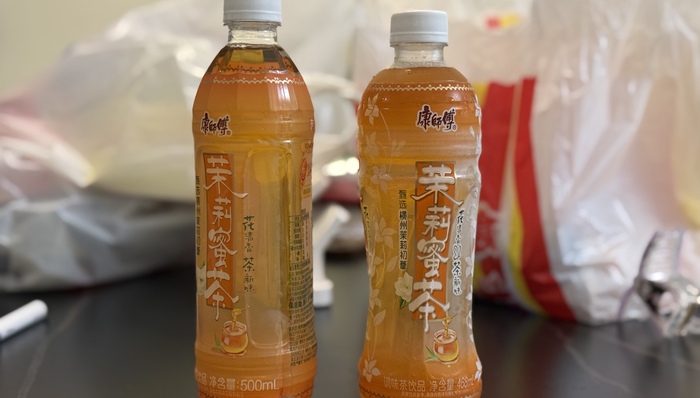
Master Kong Jasmine Tea sold in offline supermarkets (left) and Master Kong Jasmine Tea sold in snack discount stores (right) Photo by: Yang Shuhongji, Jiemian News
Place the two bottles of Master Kong Honey Jasmine Tea purchased from a supermarket and a snack discount store side by side, and you may hardly spot any differences at first glance.
Both bottles are printed with jasmine flowers, and their packaging color schemes and product names are almost identical. One is the common 500ml version sold in offline supermarkets, priced at 2.3 yuan; the other is from the snack discount store Haoxianglai, priced only 10 cents cheaper, but with its capacity reduced to 468ml.
In other words, the seemingly cheaper version from the snack store actually has 32ml less content. Calculated by unit capacity, the 500ml supermarket version is about 2.1% cheaper per milliliter — consumers think they have found a bargain, but what they get may just be a subtly downsized product that is hard to notice.
In response, a representative of Haoxianglai told Jiemian News that Haoxianglai stores sell products of multiple specifications, with all information clearly marked on the shelves; the 468ml Master Kong Green Jasmine Tea is a special supply product jointly developed by the brand and its upstream suppliers.
This is not an isolated case. Recently, a number of brands of beverages, potato chips, biscuits and other products have sparked controversy for launching exclusive products labeled as "snack channel limited".
The outer packaging of these products is almost identical to the standard supermarket version, but their net content is smaller than the standard products. In other cases, the unit price of a single product seems lower, but the converted unit price per weight or capacity is actually more expensive. This sales tactic has been criticized by consumers as "channel-exclusive downsized products that create an illusion of low prices".
01
This phenomenon is particularly prevalent among large well-known consumer brands.
Offering branded beverages and snacks is a common strategy for snack discount stores to attract customers. During visits to Haoxianglai and other brand outlets, Jiemian News found that a 400ml bottle of Mizone (lime flavor) is priced at 2.8 yuan. In fact, most regular Mizone products are 600ml, sold at Yonghui Supermarket for 4.5 yuan. Calculated accordingly, the unit price per milliliter at the snack store is slightly more competitive. Moreover, the 400ml version is not a custom product developed exclusively for snack channels, as this 400ml product is also sold through traditional wholesale and e-commerce channels.
A similar situation exists with potato chips. Jiemian News observed at Haoxianglai that a bag of potato chips with a net content of 35g is priced at 2.8 yuan. In comparison, there is a 40g version on the market with almost identical packaging design and bag size. When the two bags are placed side by side, it is difficult for consumers to detect the 5g difference just by appearance, and they are more likely to make judgments based on the single-bag price marked on the shelf.
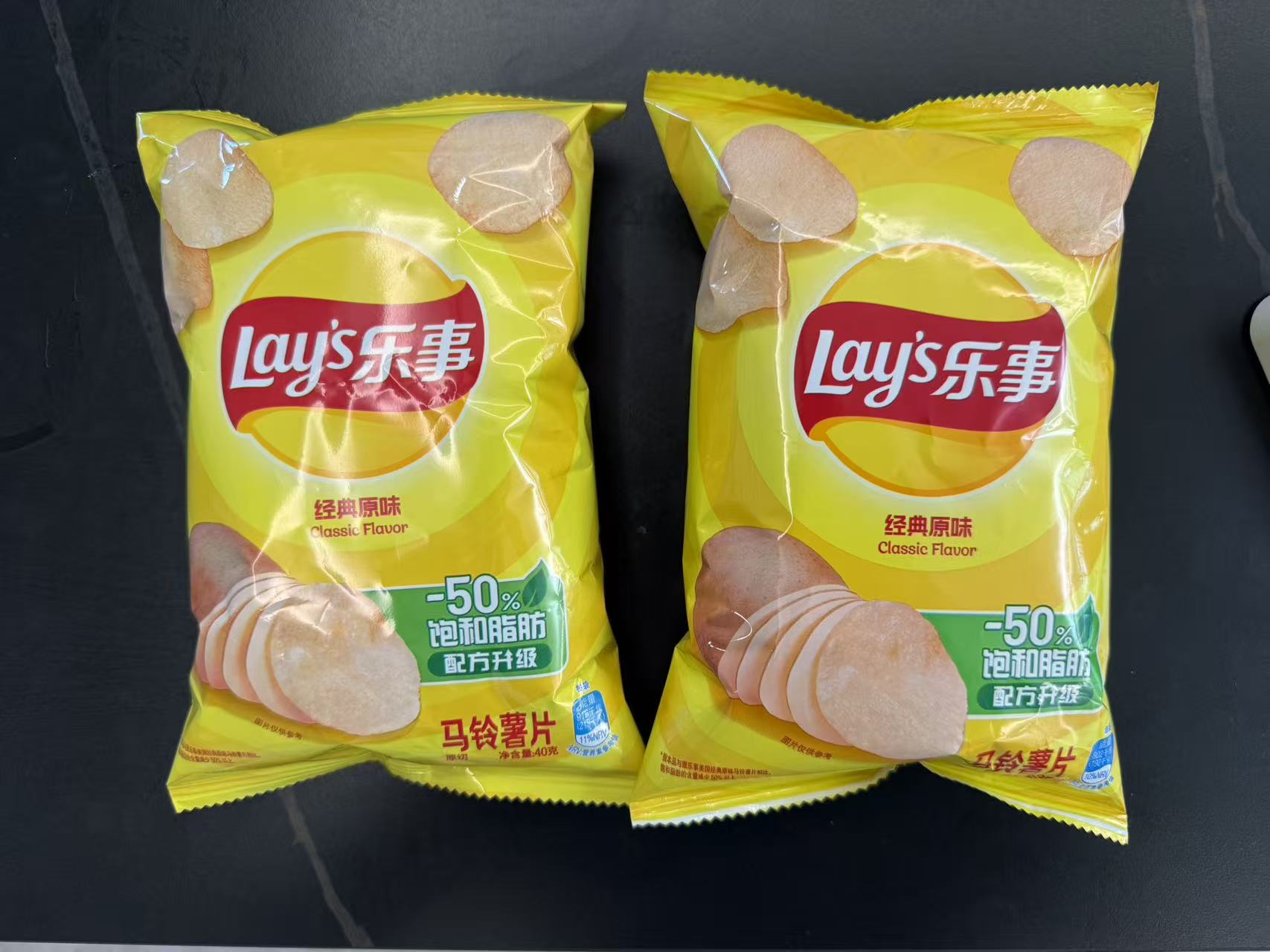
The same type of potato chips sold at a snack discount store (left) and an offline supermarket (right) Photo by: Reporter Yang Shuhongji, Jiemian News
02
Yet these seemingly smaller and cheaper products are actually the result of the low-price operational model of snack discount stores.
A snack manufacturer in South China told Jiemian News that this is essentially a common practice among major brands. Negotiations on product pricing depend on multiple factors, including the brand's own market influence, its compatibility with the sales channel, and the purchasing scale of the channel operator. Brands need to use various specification differentiation strategies to stabilize the omnichannel price system as much as possible and balance the interest demands of different channels.
An insider from a snack store revealed to Jiemian News that if a brand supplies snack discount stores and traditional supermarkets with products of exactly the same specifications but different supply prices, traditional supermarkets may raise objections to the brand's price system, which will in turn affect their cooperative relationship. Therefore, brands separate different channels by distinguishing packaging capacities and product specifications.
At the same time, the exclusive specifications for snack discount channels also serve to prevent cross-region resale and channel arbitrage. If products sold through snack discount channels have exactly the same specifications as those in other channels but are priced lower, some distributors or retailers may purchase goods from snack discount stores and resell them to other regions or sales channels.
A beverage industry practitioner also confirmed this point to Jiemian News.
He said that many brands reduce product specifications to achieve relatively lower supply prices in the snack retail system. This is very similar to the past era when large hypermarkets were booming and had strong pricing power, and later when e-commerce became popular, the "e-commerce exclusive" products emerged.
For example, when a certain channel experiences sudden rapid growth, exclusive specifications or even dedicated products are needed to differentiate the offerings. However, if a brand is extremely dominant in the market, it usually maintains very strict price control across all channels, and there will be no situation of different specifications for different channels.
"Many casual snack brands rely heavily on snack retail channels, which involves a game of interests between brands and channels. Eventually, they reach a balance through channel customization. If the cooperation is even closer, they will carry out brand-customized (private label) production, which can avoid such problems," the aforementioned beverage industry practitioner told Jiemian News.
03
Behind the channel specification differentiation lies the cutthroat price competition in the snack discount industry.
Since 2022, leading snack discount brands have expanded rapidly through the franchise model, with each top brand operating more than 20,000 stores. Under such a dense store network, continuously competitive individual products are needed to attract customers. From the perspective of brand owners, on the one hand, they need to maintain the price system of traditional supermarket channels, and on the other hand, they have to provide lower supply prices to snack discount channels to maintain the competitiveness of their stores. Ultimately, the only way to balance costs is to reduce product specifications.
However, from the consumers' point of view, maintaining the channel price system and preventing cross-channel resale cannot be reasonable excuses for creating a "low-price illusion".
Consumers visiting snack discount stores often see lower individual product prices, but may not immediately notice that the product capacity has also shrunk accordingly. There may even be situations where the packaging appearance is similar, the specification difference is not obvious, and the price per gram is not actually cheaper.
When channels and brands hide their complex interest balance behind different product specifications, the cost of identifying the real price is shifted to consumers. Exclusive specifications themselves are not the problem, but brands and retailers should at least clearly mark the unit price and the differences from regular products, instead of relying on smaller packaging to lower the price figure and amplify the illusion of "cheaper prices".
In fact, the phenomenon that brands enter different channels by differentiating product specifications has long existed, before the discussions of "being deceived" arose in snack discount stores.
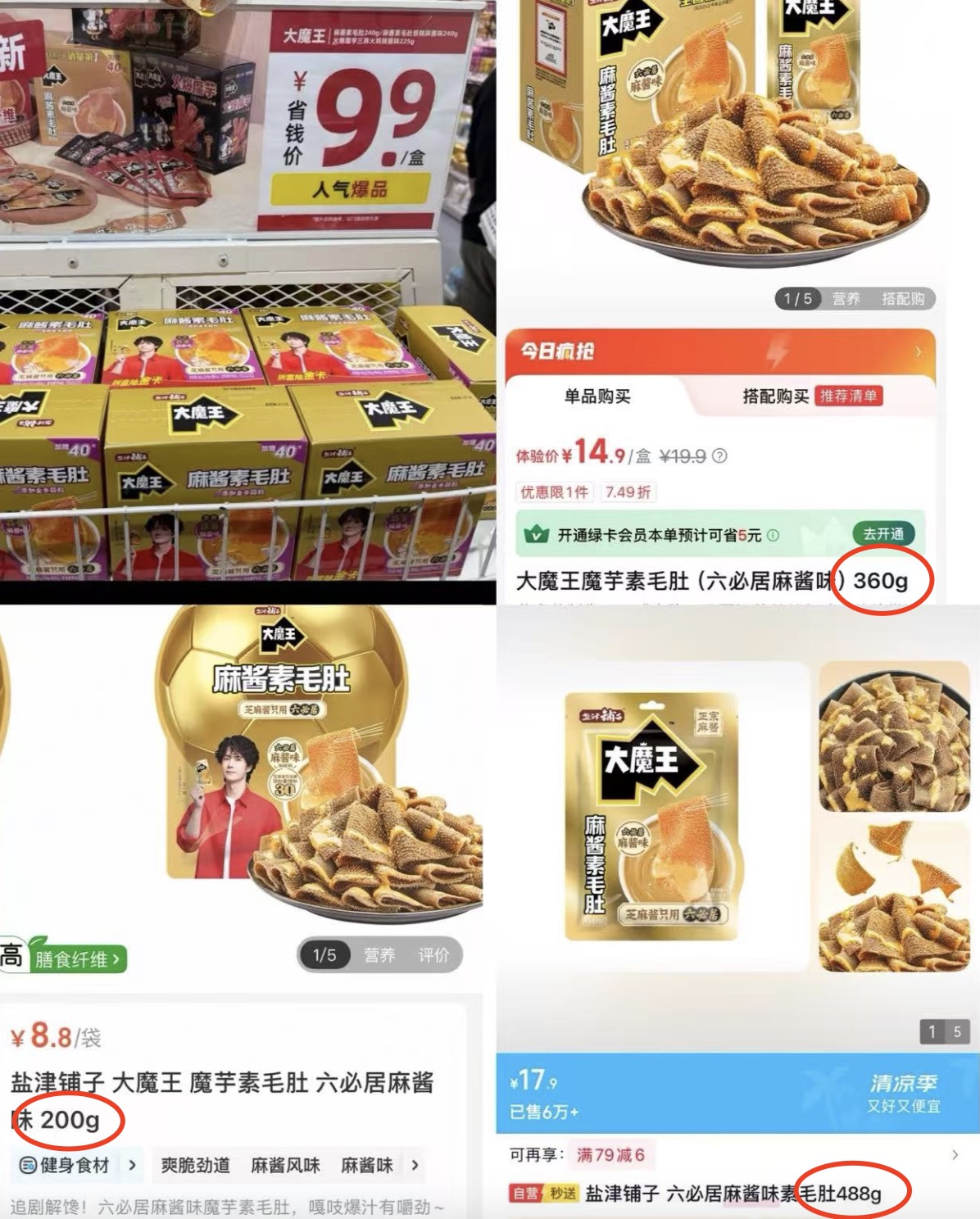
Different specification products of "Big King Vegetarian Tripe" across different channels.
Take the "Big King Vegetarian Tripe" produced by Yanjin Puzi as an example. Jiemian News compared the specifications and prices of the same product at three different platforms including snack discount stores, and found that not only the product specifications in snack discount stores are different from the standard products, but different retail channels also offer products of different specifications. The prices of the "Big King Vegetarian Tripe" at the four aforementioned outlets are 9.9 yuan, 14.9 yuan, 8.8 yuan, and 17.9 yuan respectively, with net weights of 240g, 360g, 200g, and 488g accordingly.
Calculated by the price per gram, the overall difference is minimal, and the unit price per gram at JD Fresh, which has the largest net weight specification, is the lowest. Supplying products of different specifications across multiple channels is a long-standing common balancing practice in the industry, which is not inherently illegal. However, the root cause of consumers' perceived disappointment is that stores do not clearly distinguish between two products with similar appearances, which easily misleads consumers to only look at the marked price and ignore the comparison of net content.
In fact, the essence of the net weight controversy is not the channel exclusive model itself, but the consumption imbalance caused by information asymmetry. If adjusting product specifications turns into a marketing tactic that deliberately hides the reduced net content, the trust that snack discount stores have built with their customers will be eroded.
This article is from "Jiemian News", Reporters: Zhao Xiaojuan, Yang Shuhongji, Editor: Ya Hanxiang, Published with authorization from 36Kr.