Did AI trading crash? The bond market "smashed" the stock market
The cracks in the bond market are turning into earthquakes in the stock market.
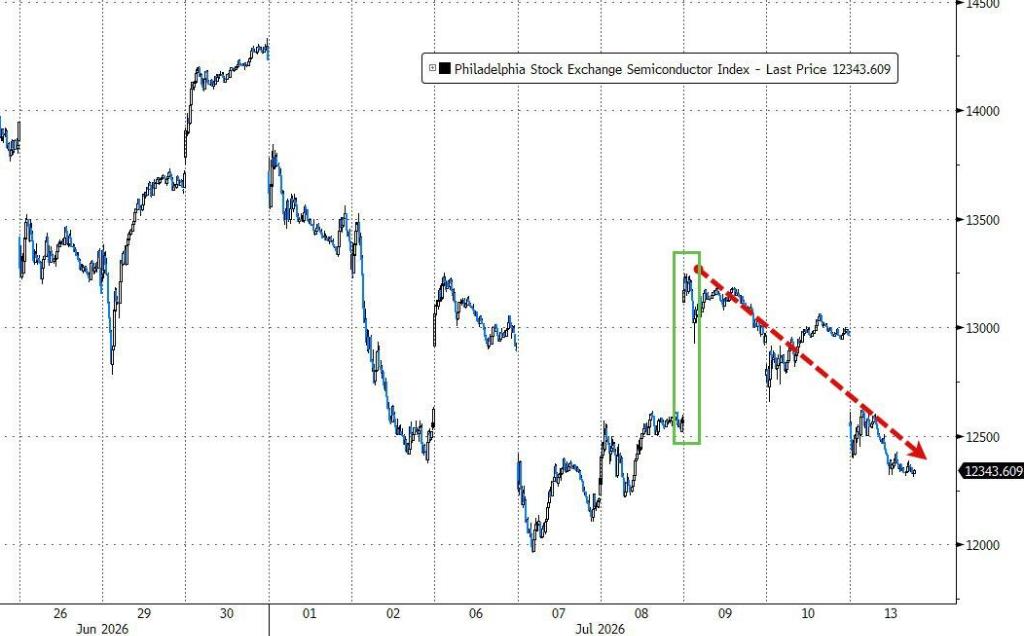
On local time July 13, the US stock semiconductor sector was crushed, and the entire AI segment collapsed. Following the brutal nearly 9% plunge of South Korea's KOSPI index, the Nasdaq once again fell below its 50-day moving average overnight and closed beneath it, making it the worst-performing major US index of the day.
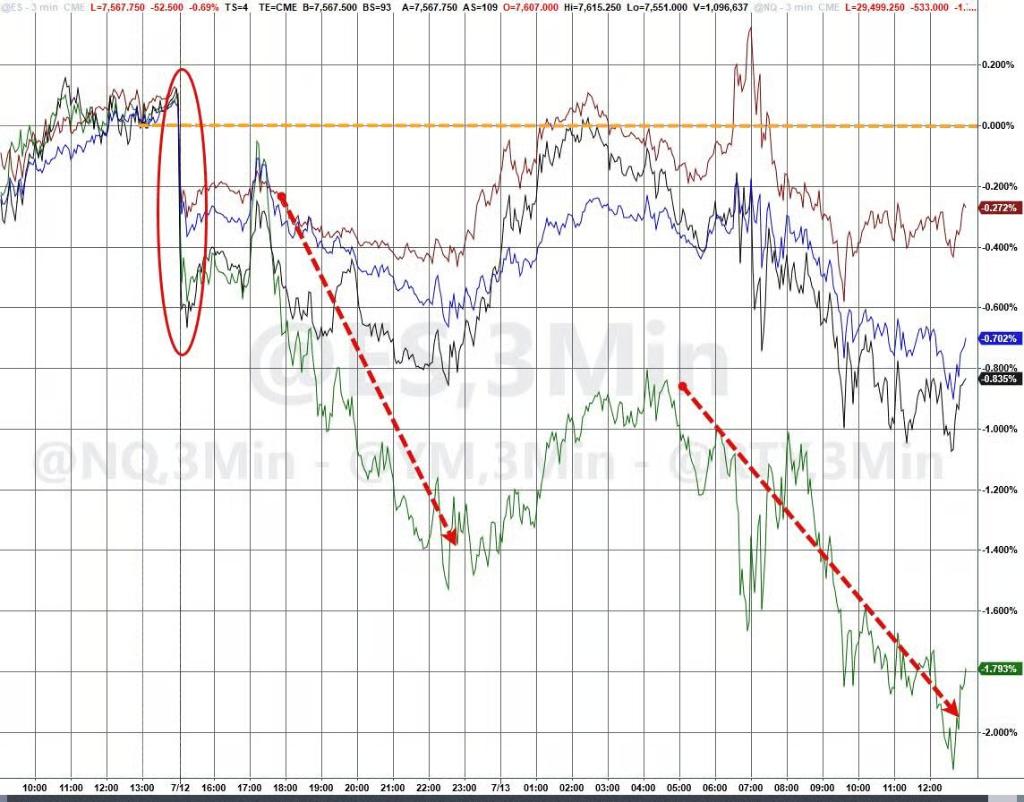
The semiconductor sector suffered heavy losses, and all AI-related stocks were sold off — neither the "bill issuers" (capital expenditure investors such as cloud computing giants) nor the "bill receivers" (computing power providers such as chip companies) were spared, with the latter posting deeper declines.
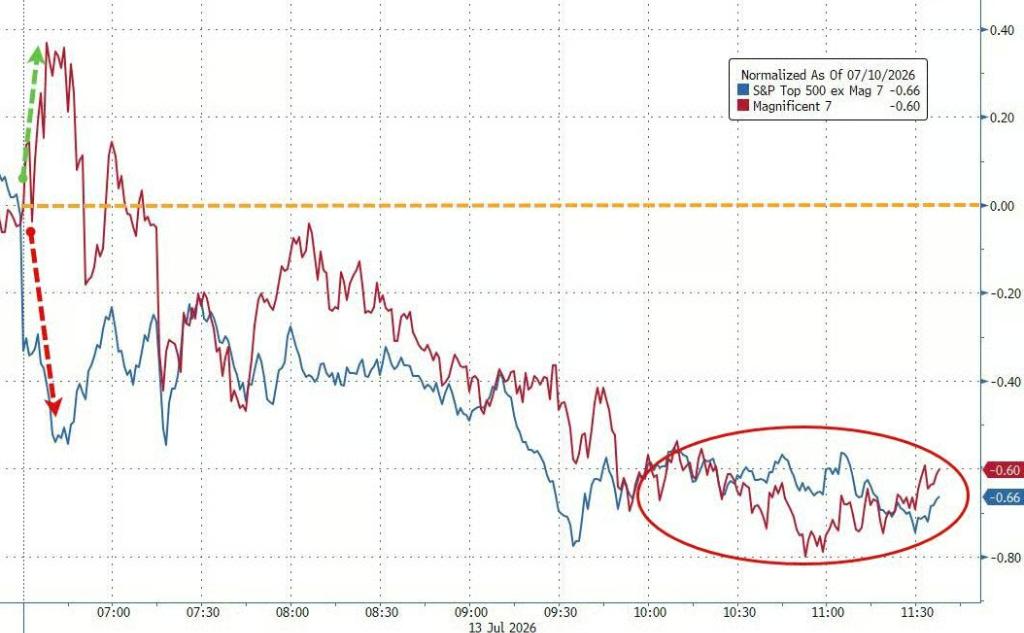
Interestingly, the Mag7 and the remaining 493 S&P 500 stocks saw roughly equivalent declines on the day — which means this is not a simple style rotation, but a broader contraction in market sentiment.
On that day, three major trading lines tightened simultaneously: US-Iran tensions pushed up oil prices, the Fed's hawkish remarks crushed the bond market, and debt concerns over AI capital expenditure detonated the semiconductor sector. And the "brutal" state of the bond market may be one of the truly core signals worthy of vigilance.
The logical chain of AI trading is: Tech giants borrow money → pour funds into building data centers → drive up demand for computing power → semiconductor and AI stocks rise. Now, the first link in this chain — the bond market's absorption capacity — is loosening.
Brian Garrett, head of derivatives trading at Goldman Sachs, said bluntly this week: "My credit colleagues are more nervous than my equity volatility colleagues for the first time in many years... The word 'brutal' is being mentioned repeatedly on the credit trading desk, while the S&P 500 has only fluctuated within a 30 basis point range over the same period."

Bond Market Alert: AI Borrowing Frenzy Hits Absorption Limits
The issuance scale of AI-related bonds has pushed the investment-grade bond market to the edge of indigestion.
According to recent reports from The Wall Street Journal, six hyperscale computing companies — Alphabet, Amazon, Meta, Oracle, Nvidia, and SpaceX — have collectively issued approximately $244 billion in bonds this year, more than doubling from the $108 billion for the whole of last year, and over 14 times the $17 billion recorded in 2024.
Jeffrey Papai, an investment-grade bond trader at Goldman Sachs, wrote in a report: "Over the past month, AI-related bond issuances reached $75 billion ($241 billion year-to-date, $360 billion over the past year), which has widened the spread of our AI bond basket by about 25 basis points."
More critically, the market's absorption threshold is declining rapidly. Papai pointed out: "Previously, it took over $75 billion in supply to put pressure on the market, but now only $25 billion is enough to put the market in a passive position." In other words, the market is increasingly unable to withstand the same level of impact.
Data from Morgan Stanley shows that the overall leverage ratio of hyperscale computing companies has soared from 0.9x in the third quarter of 2025 to the current 1.8x, doubling in just over two quarters, surpassing the leverage level of the entire energy sector, and still climbing at a rate of about 0.3x per quarter.
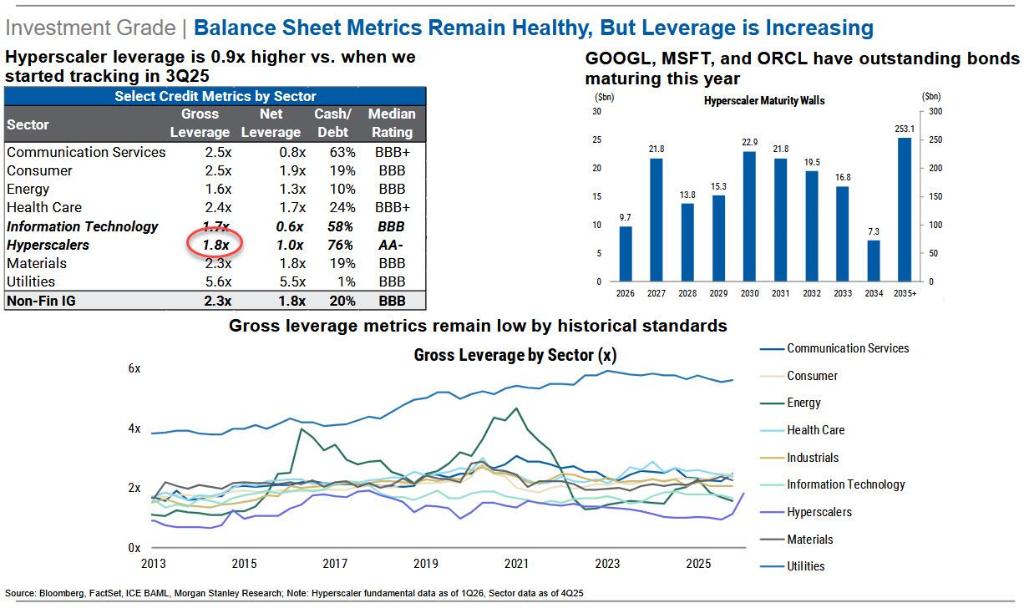
In terms of market share, five companies — Amazon, Meta, Google, Microsoft, and Oracle — now account for 4% of the entire US dollar investment-grade bond index. Calculated on a duration-weighted (DV01) basis, the six major hyperscale computing companies plus three leading chip companies already account for 9% of the index — and this is before chip financing has truly kicked off.
Papai's conclusion is straightforward: "Recent trends clearly show that the incremental absorption capacity from investors has shrunk significantly."
Why Does Trouble in the Bond Market Drag the Stock Market Down?
The logic is straightforward: AI capital expenditure is supported by debt, and debt is funded by investors.
Papai acknowledged that for the market to absorb the next round of supply, several prerequisites are needed: issuers slow down their pace, change their issuance structure (diversify currencies and durations), private credit and banks take on a larger share, and bond prices fall further (spreads widen) to attract new buyers.
But he also pointed out the inherent contradiction of this path:
Once a full-scale sell-off in AI bonds unfolds, it will have a direct impact on the stock market and could spread to the broader investment-grade market.
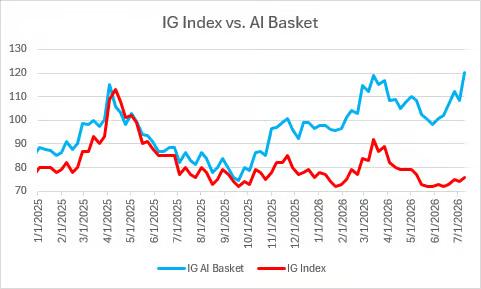
Michael Hartnett, Chief Investment Officer of BofA, has labeled "AI capital expenditure cuts" as the biggest market tail risk, outlining the trigger path: bond vigilantes cut off the liquidity of hyperscale computing companies, forcing them to turn to equity financing and lay off staff — Meta, Microsoft, and Amazon have already cut headcount by 13%, 10%, and 9% respectively.
Torsten Slok, Chief Economist at Apollo, warned:
AI is currently the only pillar supporting the economy and markets, and when so many bets are placed on so few companies, once returns materialize later than expected, this will not just be an industry problem — it could push the economy into recession and drag the S&P 500 into a correction.
Slok also pointed out that token prices have continued to decline, and Chinese models have surpassed their US counterparts in both share of the world's most commonly used models and token usage — further squeezing the free cash flow outlook of hyperscale computing companies.
Can This Narrative Be "Rescued" Again?
This is not the first time the AI bond market has approached a critical point.
In early May 2026, the Financial Times reported that banks including JPMorgan, Morgan Stanley, and SMBC were looking for ways to transfer data center-related debt risks to a wider range of investors, as core buyers had begun to resist AI bond supply.
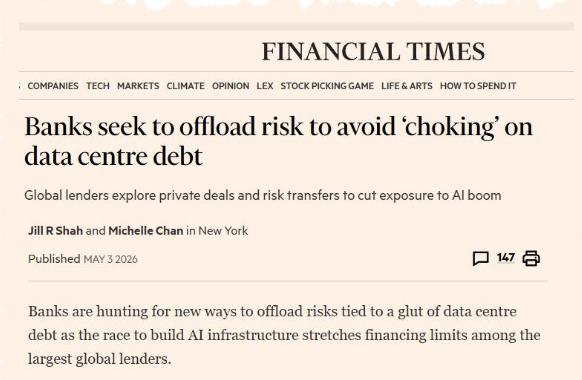
At that time, about 48 hours after the report was released, Goldman Sachs published the report "Decoding the Agent Economy", predicting that agent AI would drive a sharp rise in LLM profit margins. The narrative shift quickly calmed market tensions and spawned a new, even larger wave of bond issuances — Amazon completed a $37 billion issuance in March (the fourth-largest corporate bond in history) and issued another $25 billion in July; SpaceX knocked on the market's door with a $25 billion bond deal just days after its IPO.
Now, Goldman Sachs' own credit trading desk is using the word "brutal", which means the support of this round of narrative is weakening.
Papai wrote in the report:
Given that spreads have already adjusted and the issuance window is approaching the earnings quiet period, the AI bond complex may get a temporary respite in the short term. But in the medium to long term, given the supply outlook, it is expected to underperform the broader market further. It is recommended to hold credit volatility positions to hedge against the possibility of broader market "contamination".
Beyond the Bond Market: Waller's Rate Hike Warning + Oil Price Shock Overlay
The bond market pressure on this day also came from another direction.
Fed Governor Waller's speech in New York directly pushed up rate hike expectations:
If this week's core inflation data comes in hot again, the FOMC will need to consider tightening monetary policy in the near term.
No matter how you measure it, inflation has been rising this year.
Right now, I'm worried that core inflation is staying persistently high.
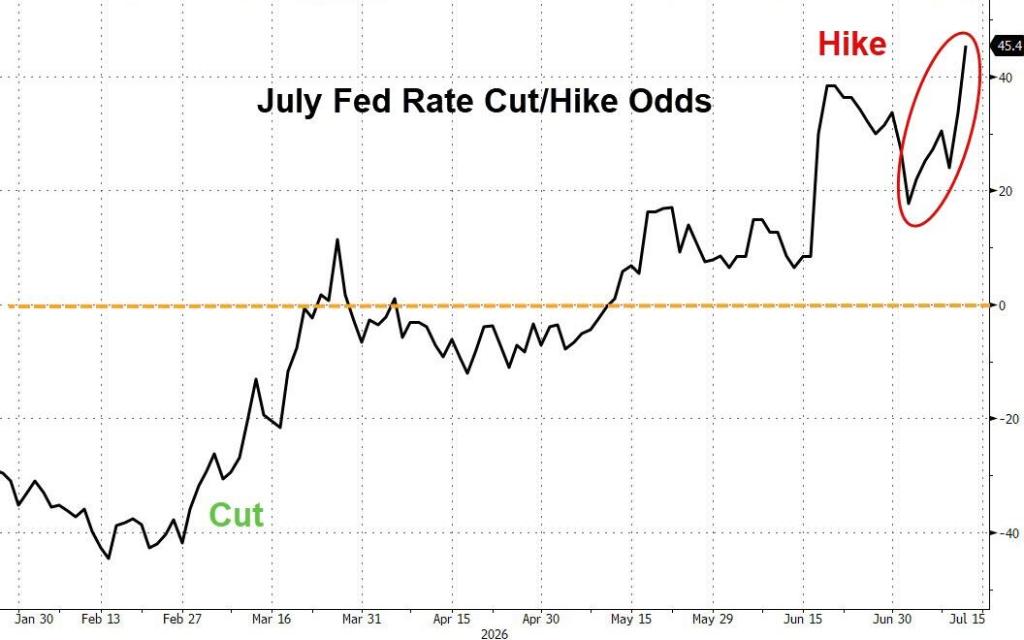
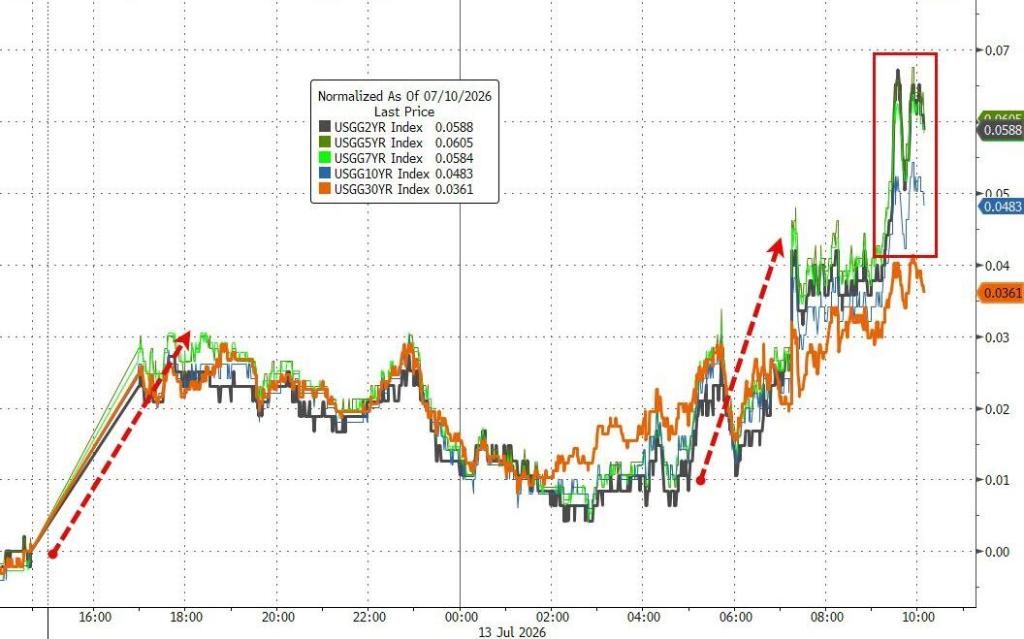
The yield on the 2-year US Treasury rose 6 basis points on the day, and the 30-year yield rose 3 basis points. The probability of a July rate hike soared to its highest level since Wash took office, approaching 50%.
Krinsky of BTIG pointed out that the 10-year real interest rate has risen to its highest level since April 2025, climbing from 2.11% at the end of June to 2.34%. He judged:
If the real interest rate quickly breaks through 2.40%, it will be enough to cause a broader impact on the stock market.
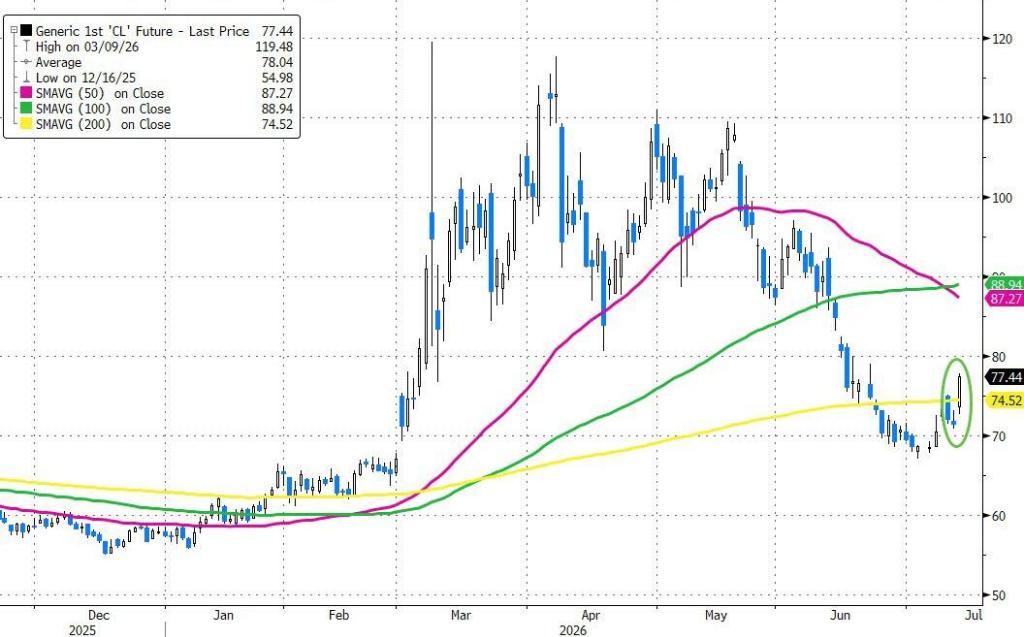
Oil prices added fuel to the fire. WTI rose nearly 9% on the day, approaching $78, hitting a new high in nearly a month — commercial traffic through the Strait of Hormuz plummeted to only 3 trips within 24 hours (compared to 57 trips at the rebound high on June 24). Rising oil prices pushed up inflation expectations, further reinforcing the hawkish narrative in the bond market.
What Happens Next?
Krinsky of BTIG laid out three scenarios with corresponding probabilities:
Rotation Continues (40%): Capital continues to flow from semiconductors/tech/AI to other sectors
Rotation Reverses (20%): Capital flows back into tech, exiting recently strong sectors
Rotation Fades, Full Sell-Off (40%): Correlation surges, the market declines across the board, similar to the end of July 2024
Krinsky specifically noted that the probability of the third scenario "has risen significantly today" — due to the surge in real interest rates, the overnight KOSPI crash, and the nearly 50% probability of a July rate hike.
This article is from the WeChat public account "Wall Street CN", author: Long Yue, published with authorization from 36Kr.