NVIDIA's money printer is now fretting about AI demand
Summary:
Shanghai Electric Power Co., Ltd. (SHDP) harbors aggressive expansion ambitions. It launched a capacity expansion plan in Q1, then acquired 100% equity of Kunshan Pujiang Warehouse Facilities Co., Ltd. in June, and concurrently submitted its listing application to the Hong Kong Stock Exchange. Right as SHDP went all-in on its sprint, the market's unwavering faith in AI began to crumble.
When you open a NVIDIA GB300 server cabinet, massive volumes of data travel at high speed between GPUs, CPUs, and switching chips. The underlying carrier that supports chip power delivery, high-speed signal transmission, and connects various computing power components is the Printed Circuit Board, also known as PCB.
And this high-spec computing power PCB is very likely manufactured by Shanghai Electric Power Co., Ltd.
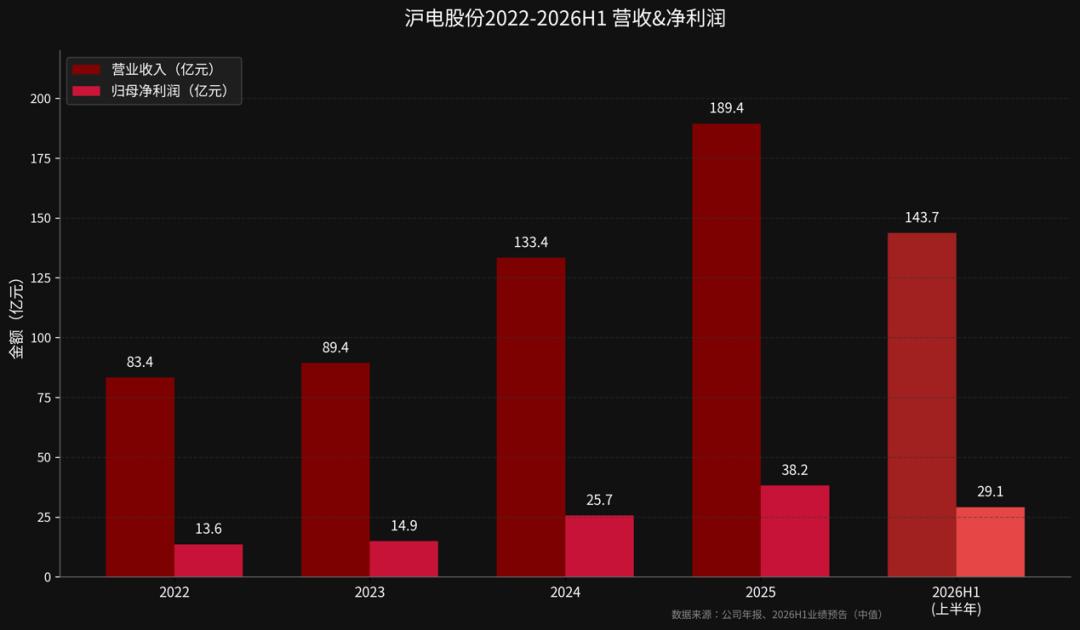
On the evening of July 13, Shanghai Electric Power disclosed its 2026 H1 performance forecast, predicting that its attributable net profit for the first half of 2026 will range from RMB 2.83 billion to RMB 3 billion, representing a year-on-year increase of 68.17% to 78.28%. Its projected non-recurring profit-and-loss adjusted net profit will reach RMB 2.73 billion to RMB 2.88 billion, up 66.08% to 75.2% year-on-year. The company attributed this growth to structural demand across application sectors including high-speed switches, AI servers, high-performance computing, and smart vehicles, paired with continuous optimization of its product portfolio.
Shanghai Electric Power's expansion drive is formidable: it kicked off capacity expansion in Q1, and in June, it completed the acquisition of 100% equity in Kunshan Pujiang Warehouse Facilities Co., Ltd., repurposing its plant facilities for production line expansion.
Just over a month ago, Shanghai Electric Power submitted an updated H-share issuance and listing application to the Hong Kong Stock Exchange. If successful, it will become the second company after Shenzhen Hongfa Technology to achieve A+H dual listing in the AI computing power PCB track.
This marks its second attempt to list in Hong Kong, after its first filing last November expired upon reaching the 6-month validity threshold. Despite the twists and turns in its Hong Kong listing journey, the market holds high expectations for this "shovel seller" in the computing power sector: on the A-share market, Shanghai Electric Power's current market capitalization exceeds RMB 250 billion, with its A-share stock price surging over 100% since last November.
The critical question now is: before it even lands on the Hong Kong stock market, have market expectations for the company already been overstretched?
The "Shovel Seller" in the Computing Power Track
PCBs are indispensable for almost all electronic devices — pry open a mobile phone or remote control, and that dark green rigid board inside is exactly the PCB. It lays out conductive traces on the substrate to enable coordinated operation between chips, resistors, capacitors and other components, acting as the "skeleton" and "information highway" of electronic products.
The global PCB market is valued at approximately USD 80 billion, with Chinese enterprises accounting for over 50% of the world's total output value, leading the global industry scale. As for the ultra-high-layer, high-frequency high-speed PCBs dedicated to AI servers, their technical barriers are comparable to semiconductor packaging, and there are no more than three Chinese enterprises capable of stable mass production — Shanghai Electric Power is one of them.
The massive boom in AI computing power in recent years has driven explosive growth in Shanghai Electric Power's financial performance. From 2022 to 2024, the company's revenue skyrocketed from RMB 8.3 billion to RMB 13.3 billion, while its net profit surged from RMB 1.36 billion to RMB 2.57 billion.
In 2025, Shanghai Electric Power reported total revenue of RMB 18.945 billion, up 42% year-on-year; net profit reached RMB 3.822 billion, representing a 47.74% increase, of which the PCB business contributed approximately RMB 18.143 billion in revenue, a 41.31% year-on-year growth.
Data Source | Prospectus, A-share Annual Reports
From a business structure perspective, the data communications segment generated RMB 14.656 billion in revenue in 2025, accounting for 77.4% of total revenue as the absolute core business. High-layer boards related to AI servers and high-speed switches drove the main incremental growth, with revenue from high-end PCBs with 22 or more layers reaching approximately RMB 5.2 billion, making up around 27.5% of annual total revenue and roughly 28.7% of PCB business revenue.
The explosive demand for high-end computing power PCBs has directly led to the industry's "simultaneous rise in volume and price": on one hand, a single AI server requires several times the PCB area of a traditional server, driving a sharp surge in consumption; on the other hand, technical barriers have pushed the per-square-meter value of products to rise exponentially. Statistics show that Shanghai Electric Power's PCB business gross margin jumped significantly to 36.91% in 2025.
According to data from CIC Consulting, based on 2025 revenue rankings, Shanghai Electric Power holds the 6th position among global PCB manufacturers. However, in the niche segments of data communications PCBs, data center PCBs, and multi-layer PCBs, it ranks first in global market share.
Shanghai Electric Power's end customers cover the world's top 5 communications equipment companies, the world's top 5 listed AI computing power infrastructure enterprises, and 4 out of the world's top 5 automotive Tier 1 suppliers. Figures show that overseas revenue already accounted for 82.1% of the company's total 2025 revenue.
Smart vehicles are positioned as the company's second growth curve. In 2025, the smart vehicle business generated RMB 3.045 billion in revenue, up 26.41% year-on-year, but its proportion in total revenue remains only 16.1%.
The "Electronic Seed" Sown in Paddy Fields
The story of Shanghai Electric Power began with an "electronic seed" planted in rice paddies.
Founder Wu Lianggan was born in Taiwan Province in 1941, with his ancestral hometown in Tianmen, Hubei Province. His father Wu Shanqing was a prominent wealthy businessman in Hubei and the owner of the well-known "Wu Yuanmao" trading firm. In 1978, Wu Lianggan founded Nanzi Electronics in Kaohsiung, launching operations in PCB manufacturing. At that time, Taiwan's PCB industry was in its early stages, and benefiting from overseas technology transfer, Nanzi Electronics experienced rapid growth and successfully listed in Taiwan in 1991.

In the spring of 1992, 51-year-old Wu Lianggan set his sights on mainland China. When he first visited Kunshan, all he saw were endless stretches of rice paddies with leftover rice stubble, and narrow field ridges that could only fit one person at a time. Kunshan's investment promotion officials set up a development planning sandbox right on the ridge to explain the city's industrial layout plans.
After the site visit, Wu Lianggan invested USD 30 million to establish Shanghai Electric Power, which became the largest Taiwan-invested project introduced by the Kunshan Development Zone that year. Longtime employees later joked: "We actually planted an 'electronic seed' in the middle of rice paddies."
Wu Lianggan bet on the rise of mainland China's electronics industry — and as it turned out, he won the bet.
In 2002, Shanghai Electric Power launched shareholding reform to prepare for a public listing, but its listing journey was full of twists and turns: it initially targeted the B-share market, only to see the CSRC halt B-share expansion plans; after shifting to the A-share market, it faced successive setbacks including IPO suspensions due to the split-share structure reform, and listing rejections over horizontal competition issues with its parent company Nanzi Electronics. To clear listing obstacles, Wu Lianggan completely withdrew from Nanzi Electronics — the company he founded and ran for over 30 years — in 2008, with all family members selling their stakes.
In August 2010, Shanghai Electric Power finally listed on the Shenzhen Stock Exchange, earning the title of "the first listed Taiwanese enterprise in Kunshan".
In March 2024, due to advanced age, Wu Lianggan stepped down as chairman, and passed away the following month. After his passing, his wife Chen Meifang took over as chairman. As the single largest shareholder group, the Wu family still holds 20.35% of Shanghai Electric Power's shares as of May 2026.
A+H Layout: A Do-or-Die Capital Competition
For its renewed Hong Kong listing push, Shanghai Electric Power plans to use the raised funds primarily for: capacity expansion, high-performance PCB R&D, and forward-looking technological innovation.
As of March 31, 2026, the capacity utilization rates across Shanghai Electric Power's 5 production bases are: over 99% for both Kunshan sites, 99.7% in Huangshi, 99.1% in Thailand, and 92.5% in Jintan. All 5 production lines are operating at nearly full capacity.
Shanghai Electric Power is pushing capacity expansion with unprecedented intensity. From January to April this year, it rolled out investment plans at a pace of one per month, with a total investment exceeding RMB 17.6 billion: in January, it invested USD 300 million to build a high-density optoelectronic integrated circuit board project in Jintan, Changzhou; in February, it allocated RMB 3.3 billion for a high-end PCB production project in Kunshan; in March, it poured RMB 5.5 billion into the Kunshan Huli Microelectronics high-end PCB project; in April, it invested another RMB 6.8 billion to construct a PCB production facility and its supporting infrastructure.
RMB 17.6 billion is 4.6 times Shanghai Electric Power's total 2025 net profit.
This is a capital competition no leading player wants to lose, with peers all ramping up investment: Shenzhen Hongfa Technology set a maximum annual investment limit of RMB 20 billion, earmarking RMB 14.8 billion specifically for AI computing power boards; Shennan Circuits allocated RMB 4.882 billion from its private placement proceeds to expand its Wuxi computing power PCB base.
Continuous aggressive capacity expansion has driven up Shanghai Electric Power's financial leverage: its asset-liability ratio rose from 38.7% at the end of 2023 to 46.5% at the end of 2025, and further climbed to 48.6% in Q1 2026. However, this has not caused cash flow pressure — the company's cash and cash equivalents balance increased from RMB 2.087 billion at end-2023 to RMB 2.579 billion at end-2025, and jumped to RMB 4.392 billion in Q1 2026.
As a Chinese enterprise deeply embedded in the global computing power industrial chain, Shanghai Electric Power undoubtedly needs more flexible financing channels that align with its global operational footprint. Shenzhen Hongfa Technology listed on the Hong Kong Stock Exchange in April, raising approximately HKD 19.9 billion in the largest Hong Kong IPO of that year — a record later broken by Luxshare Precision. But by establishing a successful A+H capital model for the computing power PCB track, it has undoubtedly given Shanghai Electric Power tremendous confidence.
Risks Behind the Prosperity: The Looming Cycle Sword
On the A-share market, in the roughly 7 months since Shanghai Electric Power first submitted its prospectus, its market capitalization surged from around RMB 124 billion to over RMB 280 billion at its peak, before retreating to about RMB 250 billion — marking a total increase of over 100%.
Market sentiment is optimistic, but risks cannot be ignored.
Guojin Securities warned in a research report that the core driving force of the industry comes from demand for high-end AI PCBs generated by NVIDIA Rubin/Rubin Ultra, as well as custom ASIC chips from Google, AMD, Meta and other players. If mass production of AI servers slows down, computing power capital expenditures are cut, or PCB layer count/aperture upgrades fail to meet expectations, the core logic of "simultaneous volume and price growth" in the AI PCB industry will be directly undermined.
Multiple international investment banks also cautioned that as the global cloud vendors' AI capital expenditure base continues to rise, the growth rate may see marginal slowdown in the next 1 to 2 years. If the commercialization progress of large models falls short of expectations and server procurement decelerates, demand pressure will propagate upstream along the industrial chain to the PCB sector.
For enterprises, the key financial risk lies in timing mismatch: when demand growth decelerates, the fixed depreciation costs from previous large-scale capacity expansion are already locked in. The slowdown in revenue will collide with rigid cost pressure, directly impacting the profit statement.
More critically at the valuation level, based on 2025 net profit of RMB 3.82 billion, Shanghai Electric Power's current dynamic P/E ratio exceeds 60x — a level significantly higher than the historical valuation center of traditional PCB enterprises.
This indicates that the market is not just pricing the PCB main business itself, but also paying a premium for its rare, advantageous position in the global AI infrastructure expansion cycle, alongside strong expectations for sustained high growth in the future. Once the growth trajectory deviates, the valuation center will face downward revision risks.
In fact, since Meta announced in early July that it would lease out its idle computing power resources, the market's unshakable belief in "permanent shortage" of AI computing power has begun to falter.
The core logic that drove the entire AI hardware sector's bull run over the past two years was the assumption that global cloud vendors would endlessly procure servers, HBM, and high-speed PCBs, with backlogs never clearing and capacity always insufficient. But Meta's move directly signals to the market: even one of the world's largest AI computing power buyers now has surplus computing power to lease out.
Panic spread rapidly along the industrial chain: in the US stock market, computing power leasing firms such as CoreWeave and Nebius plummeted by over 15% in a single day, memory giants including Micron and SK Hynix lost 20% of their market value within a week, and the Philadelphia Semiconductor Index corrected by over 8% in a single week. The sentiment spilled over to the A-share market, where Shanghai Electric Power — a stock that had risen 13 times over the past two years — opened higher then trended lower on the day of its better-than-expected H1 report release, closing down 3.69%.
This RMB 17.6 billion capacity expansion bet is a powerful tool for capturing market share during an industry upturn, but once demand growth slows down, these fully loaded production lines will turn into heavy fixed depreciation burdens. 34 years ago, when Wu Lianggan invested RMB 30 million on Kunshan's paddy field ridges, he bet on a 30-year long-cycle rise of mainland China's electronics industry; now, when Chen Meifang and the management team invest RMB 17.6 billion, they are betting that AI computing power demand will maintain high growth for at least 3 to 5 years, long enough for all these new capacities to be fully deployed and absorbed.
This article is sourced from the WeChat Official Account "Phoenix Tech", authored by Phoenix Tech, and republished by 36Kr with authorization.