Uncovering a major bank scandal, the 100-billion-yuan "king of unfinished buildings" who had been out of contact for 9 months cannot escape this time...
After all employees under its subsidiaries had their salaries suspended and the boss went missing for 9 months, Dofar Group, once a Fortune 500 company, finally had new updates — Boss Hu has been subjected to compulsory measures.
Boss Hu's real name is Hu Xingrong, formerly known as Hu Fengyun, both names sounding very grand. In 2000, at the age of only 19, he dared to start his own business alone, founding Yajie Locks Industry. Later in 2008, by specializing in revitalizing unfinished properties, he became a well-known tycoon in the non-performing asset circle. In just 7 years, Dofar Group's projects have covered more than 20 cities, with a total of over 30 unfinished building sites renovated, and the group's revenue exceeded 100 billion yuan.
By 2024, Dofar Group had grown into a large company that regularly ranked on the list of China's Top 500 Enterprises, with both revenue and total assets exceeding 100 billion yuan. Hu Xingrong also made it to the Hurun Rich List with a personal fortune of 13 billion yuan.
However, rapid expansion driven by leverage often leads to a swift collapse. Since last year, liquidity risks of Dofar Group erupted intensively. The equity under Hu Xingrong's name was frozen, and his last public appearance was in October last year, after which he never showed up again.
Boss Hu, Missing for 9 Months, Has Been Placed Under Compulsory Measures
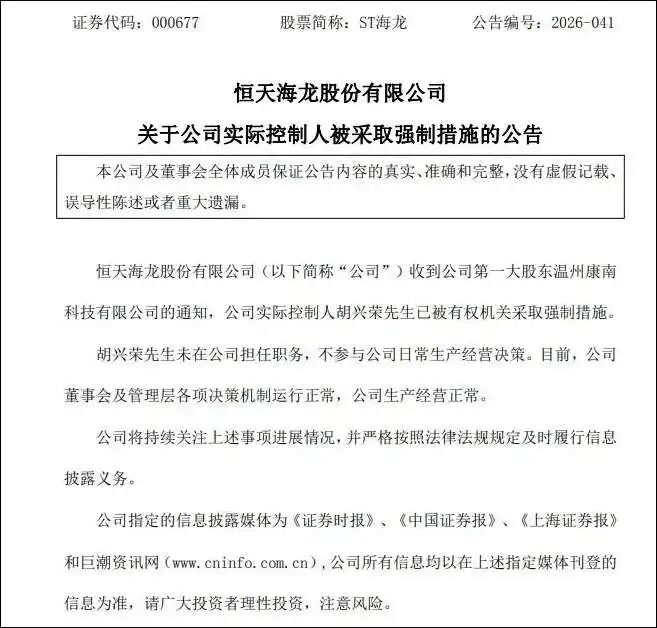
On the evening of July 7, the listed company ST Hailong issued an announcement confirming that Hu Xingrong, its actual controller who had been out of contact for many days, had been subjected to compulsory measures. ST Hailong also stated that Hu Xingrong does not hold any position in the company and does not participate in daily operational decisions. Currently, the company's board of directors and management are operating normally, and production and business activities are proceeding as usual. The company will continue to monitor developments and fulfill its information disclosure obligations.
Public information shows that ST Hailong is mainly engaged in the production and sales of viscose fiber and cord fabrics. Its core products include high-performance, high-modulus low-shrinkage dipped polyester cord fabric and canvas, which are widely used in the manufacturing of rubber tires, V-belts, conveyor belts, hoses, bulletproof vests, military soft oil tanks, fishing nets, and rubber dams. In 2025, the company achieved operating revenue of 1.146 billion yuan, a year-on-year increase of 8.58%; the net profit attributable to shareholders was 3.4708 million yuan, a year-on-year decrease of 92.09%.
It's true that Boss Hu does not hold a formal position in the company, but it's impossible for this incident to have no impact on the business. Because he has been listed as a dishonest person subject to enforcement, his equity and other assets could be put up for auction at any time, which will bring uncertainties to the company's shareholding structure and control rights.
Boss Hu controls two listed companies: one is an A-share listed firm, and the other is a Hong Kong-listed enterprise. He controls the equity of ST Hailong through his Wenzhou Kangnan Technology. On October 30, 2019, Kangnan Technology won 200 million shares of ST Hailong for 581 million yuan and completed the transfer, becoming the largest shareholder of the listed company. In addition, Boss Hu holds the controlling stake of Hong Kong-listed Minsheng International, serving as the chairman of the board and executive director of the company since May 2018, holding 60.95% of its shares.
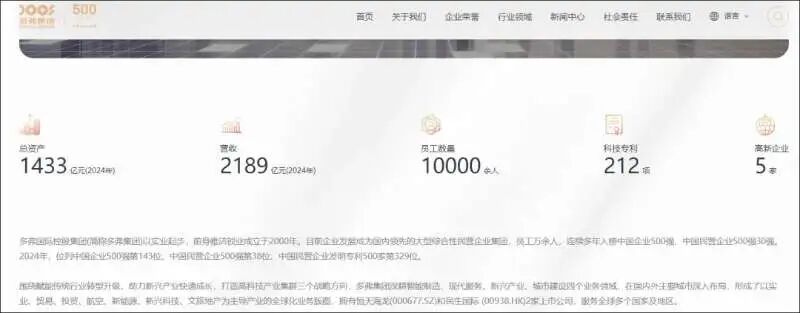
Publicly, Dofar Group claims that the company has long been listed in the rankings of China's Top 500 Enterprises and China's Top 500 Private Enterprises. In 2024, it ranked 143rd among China's Top 500 Enterprises, with an annual revenue of 218.9 billion yuan, total assets of 143.3 billion yuan, more than 10,000 employees, 212 technology patents, and 5 high-tech enterprises under its umbrella.
However, starting from 2023, the equity of multiple companies under Boss Hu has been frozen one after another, involving a total amount of nearly 1 billion yuan. Many subsidiaries have been notified of tax arrears, and disputes such as payment arrears to upstream and downstream suppliers and private financing defaults have erupted intensively. Real estate projects have also been widely suspended and overdue. Among the two listed companies under his control, one has been issued a risk warning, and the other was exposed to be insolvent.
Last October was the last public appearance of Boss Hu, after which he went missing. By June, Dofar Group had not paid salaries for three consecutive months. Not only did it owe money to its employees, but Dofar Group and Hu Xingrong also had a large amount of debts that could not be repaid. Industrial and commercial registration information shows that Hu Xingrong's equity and various other assets have been frozen by Chengdu-Chongqing Financial Court, with the corresponding frozen amount reaching as high as 9.9 billion yuan.
How Did the "Inspirational Figure" of Post-80s Entrepreneurs Decline?
The story of Hu Xingrong starting his business is truly inspirational.
Hu Xingrong was born in 1981, originally named Hu Fengyun, and grew up in an ordinary family in Wenzhou. He dropped out of school early to engage in business. By 2000, at the age of only 19, Boss Hu dared to register a company, establishing Yajie Locks Industry, which mainly focused on the processing and wholesale of civilian locks. At that time, he traveled around with samples on green trains to secure orders. After squatting in the hardware city for 3 days, he finally got his first order — 500 brass locks. The boss himself worked as a salesperson traveling everywhere. With the developed hardware industry in Wenzhou, the supply chain and sales channels were quickly stabilized, and Boss Hu soon pushed the annual revenue to over 20 million yuan.
Although the lock business was booming, he did not limit himself to this single industry. In 2008, under the impact of the financial crisis, housing prices plummeted, and a large number of unfinished properties emerged across the country. As the lock industry was also part of the real estate industry chain, Hu Xingrong keenly spotted the business opportunities in unfinished buildings. Therefore, he changed his name to Hu Xingrong and immediately went north to Beijing. His first project was an unfinished commercial mall in Chaoyang District. He invested a huge sum of 200 million yuan to acquire it at 30% of the market price. 8 months later, after sorting out the debts and completing simple renovation, he sold the building and made a net profit of over 300 million yuan.
This was far more profitable than his previous business: no need to toil to produce locks, no need for factories and warehouses, and a single order earned him more than doubling his investment. Thus, Boss Hu completely switched his career, specializing in non-performing real estate projects from banks, buying seized unfinished commercial buildings with debts at low prices, and then reselling them after renovation or upgrading.
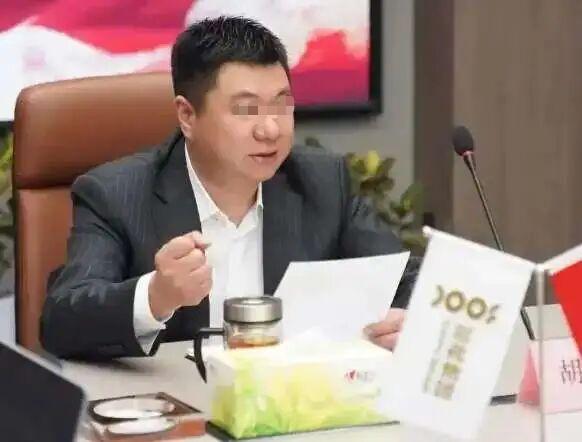
This business was far larger than the lock industry. Right after the 4 trillion yuan stimulus plan was launched, housing prices stopped falling and rebounded, and all the projects in his hands made huge profits. In 2010, Boss Hu, who had made a large fortune, founded Dofar Group, specializing in the revitalization of non-performing assets. At its peak, Dofar Group had a presence in six major regions across China, covering more than 20 cities, with a total of over 30 unfinished real estate projects renovated. In 2015, Dofar Group's revenue officially exceeded 100 billion yuan.
Subsequently, Boss Hu set his sights on capital market operations. In 2018, he acquired 60.95% controlling stake of Hong Kong-listed Minsheng International. In 2019, he spent 581 million yuan to bid for 200 million shares of ST Hailong. With this move, he had listed platforms in both A-share and Hong Kong markets, and the financing channels were greatly expanded. To follow the hot trends in the capital market, Dofar Group also made large-scale bets on the low-altitude economy trend in previous years. In June 2022, it completed the full acquisition of Italian helicopter manufacturer Fama, and later acquired Canadian fixed-wing aircraft manufacturer Murphy. Hu Xingrong also ambitiously stated that in the future, Dofar Aviation would lay out the entire new general aviation industry chain.
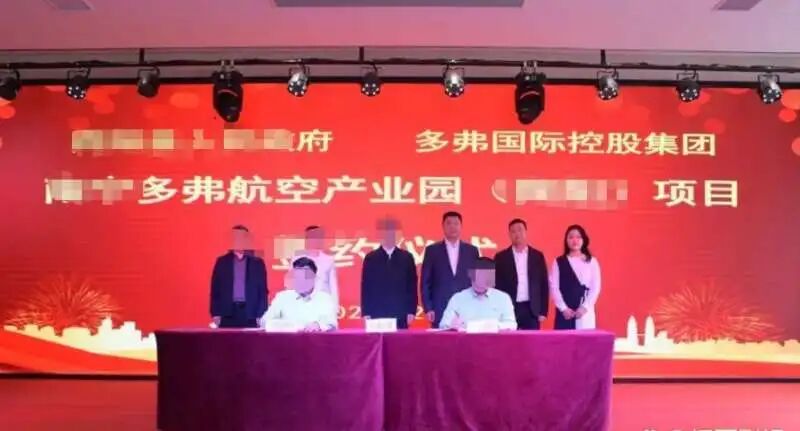
Similarly, Dofar Group has also dabbled in popular industries such as new energy, cultural tourism, and intelligent manufacturing.
All Expansion Was Funded by Borrowing, Leading to a Major Bank Scandal
However, there were hidden tricks behind Dofar Group's rapid growth.
In 2019, Dofar Group was first shortlisted in the Top 500 Private Enterprises, with revenue of 25.767 billion yuan, ranking 332nd; just one year later in 2020, its revenue skyrocketed to 175.337 billion yuan, jumping to 25th place.
This figure is too absurd. If this growth rate occurred in the semiconductor industry in recent years, it might be achievable. But considering the overall situation of the real estate industry over the past decade, it's unbelievable that the annual revenue could nearly surge 7 times in one year. Anyway, Dofar Group claimed that the sharp revenue increase was mainly driven by the bulk trade business — the scale was huge, but the net profit was not that high.
Why did they emphasize the trade business? Because trade generates cash flow, which can be used to apply for bank loans, and then the capital can be obtained.
To get access to bank resources, Boss Hu once spent a lot of money to recruit a group of retired bank executives to work for him, specializing in studying the credit approval rules of city commercial banks, then traveled around to negotiate cooperation with local city commercial banks, aiming to secure credit approval.
It's no coincidence that when Hu Xingrong went missing last November, Jinzhou Bank, which had issued a large number of loans to Dofar Group, also got into trouble. Industrial and commercial information shows that the equity of many companies under Dofar Group has been pledged to Jinzhou Bank.
Zhang, the chairman of Jinzhou Bank, had held the position for 17 full years from 2002 to November 2019. In 2019, Zhang went to Yizhuang, Beijing to discuss the share subscription with an enterprise, but in fact he planned to take a flight to flee to the United States. Fortunately, he was stopped by the investigators, because he had long been targeted by the investigation team. The non-performing loan balance of the bank was nearly 30 billion yuan.
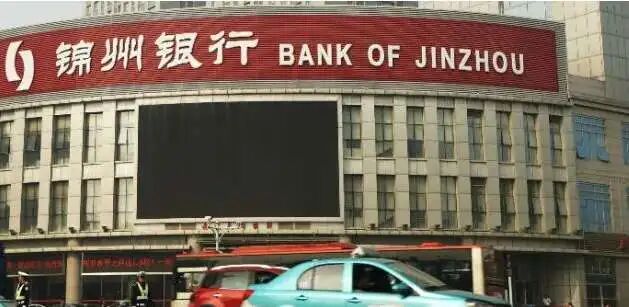
After Zhang was stopped, he died of illness at the end of the year, and many details were not explained, which affected the progress of the investigation. It was not until last March that an announcement was issued, revealing that Zhang was suspected of taking bribes of 244.8 million yuan. During this period, two secretaries of the board of Jinzhou Bank, as well as the vice president in charge of off-site business and executives of financial leasing business, were all investigated.
Among the private clients that Zhang cooperated with, Boss Hu and Dofar Group had the largest credit line and the deepest bond. They could often obtain loans directly with equity, without even the need for real estate mortgage.
By October 2025, Jinzhou Bank was merged and absorbed by a major state-owned bank. The next month, Jinzhou Bank suspended its external business, and all documents, accounts and business situations were re-examined. This investigation uncovered Boss Hu's involvement, and he disappeared. Now it has been announced that he has been placed under compulsory measures.
This time, Boss Hu's case will probably be thoroughly investigated, and he cannot escape legal responsibility.
This article is from the WeChat Official Account "Financial Gossip Girl Channel" (ID: baguanvpindao), written by Xinghua, and published by 36Kr with authorization.