The AI investment boom has fueled inflation, driving up the price of smartphones by $94 within a year.
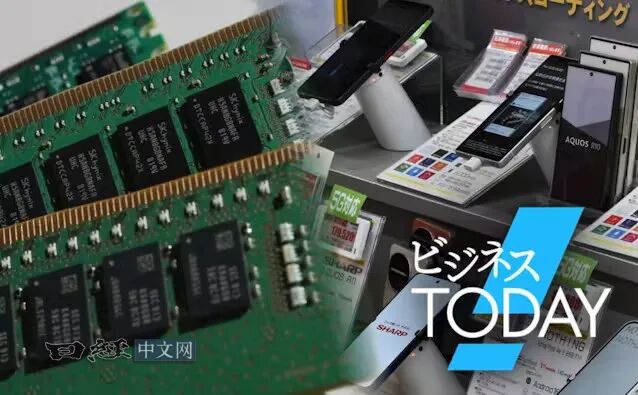
DRAM (left) and a smartphone retail store
"The era of exceptionally cheap smartphones for consumers is over," research firm IDC points out. AI investment is triggering a sharp surge in memory semiconductor prices, with DRAM prices skyrocketing more than sixfold over the past year. This is driving up the prices of electronic devices such as smartphones and PCs, which in turn is dampening consumption...
The surge in memory semiconductor prices fueled by artificial intelligence (AI) investment is further causing successive price hikes for electronic devices. The average price of smartphones has risen by $94 within a year, marking the largest-ever decline in global shipments. With semiconductor prices expected to keep rising, concerns are growing that AI-driven inflation will cool consumer spending.
"I never thought even older-generation memory modules would get more expensive," an official at a U.S. West Coast-based smartphone manufacturer expressed surprise that low-cost memory chips used in their company's devices had risen by $100 compared to a year ago. They receive price increase notifications every time they place an order with contract manufacturers, saying with concern, "Prices will likely keep going up."
Supply Shortage for General-Purpose Products
A June report from U.S. investment bank Morgan Stanley stated that due to tight supply and demand for "DRAM" — memory chips for temporary data storage — prices have surged more than sixfold over the past year. The AI investment boom is behind what the report calls a "sharp reversal of a decades-long downward price trend."
In the U.S., led by tech companies, many enterprises are pouring massive funds into building data centers required for AI development and operations. Four major companies including Amazon saw their 2026 capital expenditure rise 76% year-on-year to a peak of $725 billion, equivalent to the scale of Japan's national budget.
With the ongoing boom in new data center construction, demand for the cutting-edge semiconductor "High Bandwidth Memory (HBM)" used in AI servers has grown dramatically. All memory manufacturers are prioritizing the production of HBM-compatible DRAM, which offers larger profit margins.
This has resulted in insufficient supply of general-purpose memory chips, driving their prices higher. Prices of long-term storage devices are also on the rise, pushing up the costs of consumer electronics in Japan.

Smartphones are expected to see an average price increase of $94 within a year (at an electronics retail chain in Tokyo)
A typical example is smartphones used by consumers worldwide. Sharp has set the price of its premium "AQUOS" smartphone model launching in July in the 160,000-yen range, a 50% increase over the previous model.
Chinese brands OPPO and Xiaomi have also raised prices by several thousand yen, centered on their existing models priced between 30,000 and 60,000 yen. U.S. tech giant Apple is also expected to hike prices for its flagship "iPhone" line.
According to forecasts from U.S. research firm IDC, the global average smartphone price will reach $550 in 2026, up $94 from the previous year. A further $23 increase is projected for 2027. Data from Japan-based research firm Nint (Shinjuku-ku, Tokyo) shows that the average price of smartphones transacted via Japanese e-commerce sites from January to May 2026 is approximately 60,000 yen, 25% higher than the 2024 average.
Personal computer makers are also passing rising costs onto consumers. Apple's "MacBook Neo" (priced at 99,800 yen) launched in March saw a 20,000-yen price hike in June. VAIO, under Japanese electronics retailer Nojima, raised prices on its consumer and business-focused PC products in April.
Game console manufacturer Sony Group raised the price of the "PlayStation 5" by 18,000 yen, while Nintendo also increased the price of the "Nintendo Switch 2" by 10,000 yen.
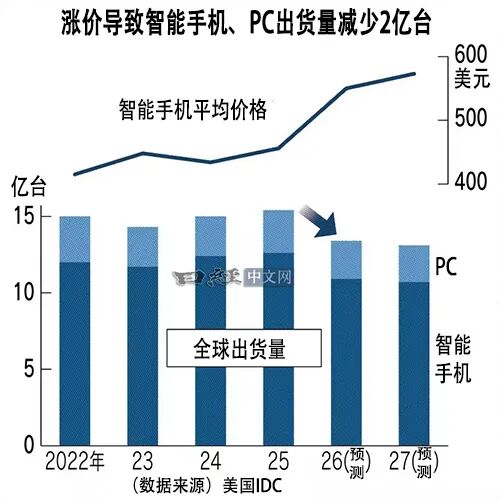
IDC forecasts that global shipments of smartphones and PCs in 2026 will reach 1.34 billion units, 200 million units fewer than the previous year. Smartphone shipments are set to drop by 14%, marking an all-time record decline. Shipments of mid-to-low-end devices, where memory chips account for a high proportion of total production costs, will fall significantly.
IDC also notes that "the era of exceptionally cheap smartphones for consumers is over," and the market shrinkage has become inevitable as affordable pricing options diminish.
The server business targeting enterprise clients is also facing supply shortages due to memory chip scarcity. Otsuka Shokai, a Japanese IT distributor, has been unable to secure server stock from manufacturers for four consecutive months to fulfill orders for small and medium-sized enterprise clients.
Takayuki Morita, President of server manufacturer NEC, stated: "We cannot even guarantee delivery two months from now." The company is currently advising customers to place orders well in advance or switch to cloud services that eliminate the need to procure physical servers separately.
Three Companies Control 90% of the Global Market
The global DRAM market is 90% dominated by three companies: South Korea's Samsung Electronics, SK Hynix, and U.S.-based Micron Technology. Driven by the AI demand boom and rising general-purpose memory prices, the three firms' performance has skyrocketed in the short term. Market estimates put their combined net profit for the current fiscal year at around 70 trillion yen, surging sevenfold from typical annual levels.
In late June, consumers in California, U.S., filed a class-action lawsuit against the three memory chip companies. The plaintiffs claim: "The three companies colluded to cut production around 2022, deliberately driving up DRAM prices." However, that period coincided with a phase of continuous DRAM price declines, during which all three companies saw their performance deteriorate sharply. The lawsuit highlights growing consumer resentment toward memory manufacturers reaping massive profits.
The three memory firms have stated they will build new factories and expand production capacity to ease the memory shortage. However, it will take several years for new facilities to reach full operational capacity, and tech companies' enthusiasm for AI investment remains unabated.
At the same time, manufacturers are also keen to avoid overinvestment that could trigger a price collapse. Industry consensus holds that memory chips will remain in short supply at least until 2027, with high prices set to persist for an extended period.
Data from Hong Kong-based research firm Counterpoint Research shows that the price of 1GB of DRAM will rise from $0.48 in 2025 to $1.96 in 2027. While prices are projected to dip to $1.47 in 2028, they will still remain at elevated levels.
Large-scale opposition movements against AI investment are emerging across the U.S. Local residents are widely concerned that data center operations will consume massive amounts of water and electricity, leading to sharp hikes in local utility bills.
If this "semiconductor inflation" that drives up prices of everyday consumer devices persists for a long time, public resistance to the AI industry could intensify further.
This article is from the WeChat official account "Nikkei Chinese" (ID: rijingzhongwenwang), written by Ban Masaharu, and republished by 36Kr with authorization.