How can Chinese auto brands be so absurdly mocking their own people?
"Their taunts back then were so loud..."
This viral internet meme, widely used in short videos recently, must have been lingering in the minds of every employee at Zhijie Auto not long ago.
The reason is simple: this month-long story of "the full account of Zhijie Auto recruiting Ferrari's former chief designer" has finally reached its conclusion.
On June 4, Zhao Changjiang, Executive Vice President of Zhijie Auto, dropped a bombshell on Weibo: Zhijie had recruited Ferrari's former chief designer. The news immediately sparked widespread public discussion, drawing heated debates from Ferrari China executives, peer automakers, and automotive content creators, with endless voices of skepticism.
Exactly one month later, on July 9, Zhao Changjiang finally posted a work photo with designer Werner Gruber on social media. Gruber previously served as Senior Lead Exterior Designer at Ferrari, participating in the design of models including LaFerrari, FXX-K, and Portofino.
While strictly speaking Gruber never held the official title of "Chief Designer" at Ferrari, he did possess a senior leadership title with "lead" in it. But what is the essence of this incident? Why did a positive brand move that should have been about introducing international talent end up as a full-public "Rashomon" of self-justification?
Ten years ago, this would have been nothing more than regular industry news. But in the past two years, the culture of taunting in China's automotive industry has evolved from occasional accidental conflicts to almost daily occurrences in the automotive circle: rivalry-focused product launches, executives publicly confronting each other online, and AI-generated malicious smear campaigns...
From Warm Interactions to Hostile Attacks
Once upon a time, the automotive industry was far less tense than it is today. While brands competed, there was a prevailing sense of mutual respect, warmth, and decency. Traditional foreign brands in particular demonstrated remarkably positive dynamics in their brand communications.
The most memorable examples for most people are the interactive posters released by Mercedes-Benz, BMW, Audi, and other brands on important milestones. For instance, during BMW's 100th anniversary celebration in 2016, Mercedes-Benz shared a poster with the copy: "Thank you for 100 years of competition. The 30 years without you were truly lonely."
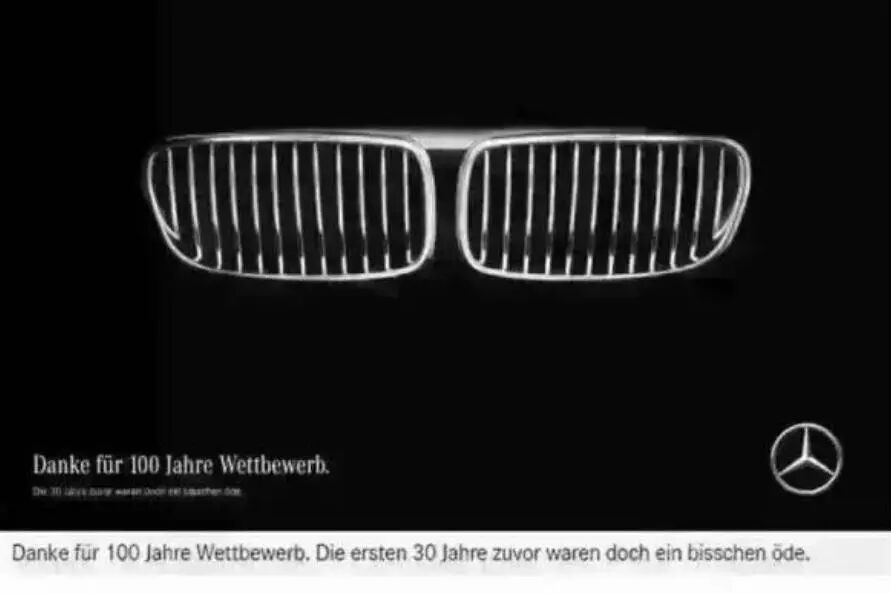
The most brilliant responses came from internet users, some of whom even created a spontaneous reply poster for Mercedes-Benz that read: "You were not born when I first appeared; when you grew up, I was already old." It's clear that the automotive circle back then was remarkably harmonious, with major luxury brands maintaining a shared rhythm even amid their "love-hate rivalry."
In fact, driven by that atmosphere, domestic Chinese automakers also shared such warm moments. When Geely launched its "Galaxy" series in 2023, the tagline "Galaxy: the stardust everyone looks up to" sparked a magical collaborative poster campaign across the industry. That chain of poster responses became a rare touching moment among Chinese automotive brands.
Back then, rivals were also peers: they competed, but they also lifted each other up. No one tried to elevate themselves by smearing competitors, no one manufactured public anxiety using partial data. While racing to refine their products, they treated competitors' strengths as benchmarks for their own progress, collectively elevating the entire industry's brand value.
But what about now? Some automaker executives publicly belittle rival models in owner groups, peers openly confront each other at industry forums, and brand founders blast competitors on social platforms for hiring malicious online trolls. The warm interactions of the past have been replaced by insults and attacks, with mutual respect giving way to calculated exploitation.
It has become increasingly common to see brands disparage competing product performance during launch events, using aggressively confrontational terms like "crush" and "completely outclass." One automaker executive revealed that less than a day after a new model launched, they were flooded with pre-written malicious smear articles that "predicted" the vehicle would fail, detailing hypothetical breakdown scenarios for the following 72 hours before the car even hit the market.
In January this year, CCTV's flagship investigative program *Focus Report* exposed the escalating vicious competition in the industry: from executives personally instigating public feuds, to industrial-scale AI-powered rumor-mongering, to ordinary car owners becoming targets of online violence. This chaotic phenomenon stems from distorted cutthroat competition, which not only misleads consumers but also hinders the high-quality development of China's automotive industry.
Many people still remember how the viral news claiming "8 automakers summoned for investigation over OTA battery-locking" was later fully debunked as false information by the China Association of Automobile Manufacturers. Traceability investigations later revealed that most of these false rumors originated from malicious PR campaigns spawned by industry competition.
Instead of investing billions in R&D, automakers can spend just hundreds of thousands to post a few malicious articles on social platforms and severely damage a competitor's brand reputation. While it is reasonable for domestic brands to benchmark against foreign brands to capture more market share, attacking fellow domestic players when they should be joining forces shows the industry has strayed down the wrong path.
Respecting Rivals Means Respecting Yourself
Many argue that 2026 marks the start of a stock competition era for China's automotive market. As every automaker strives to sell more new cars, taunting rivals has become the lowest-cost differentiation strategy. As the saying goes: "I don't need to prove I'm better—I just need to make consumers believe you're worse."
Especially in the past year, the pace of new product launches and iterations has exploded, bringing unprecedented intensity to industry competition. For many automakers, the top priority has become generating maximum public attention at minimal cost amid the flood of dozens of new models released weekly—and public feuds are the cheapest way to grab the spotlight.
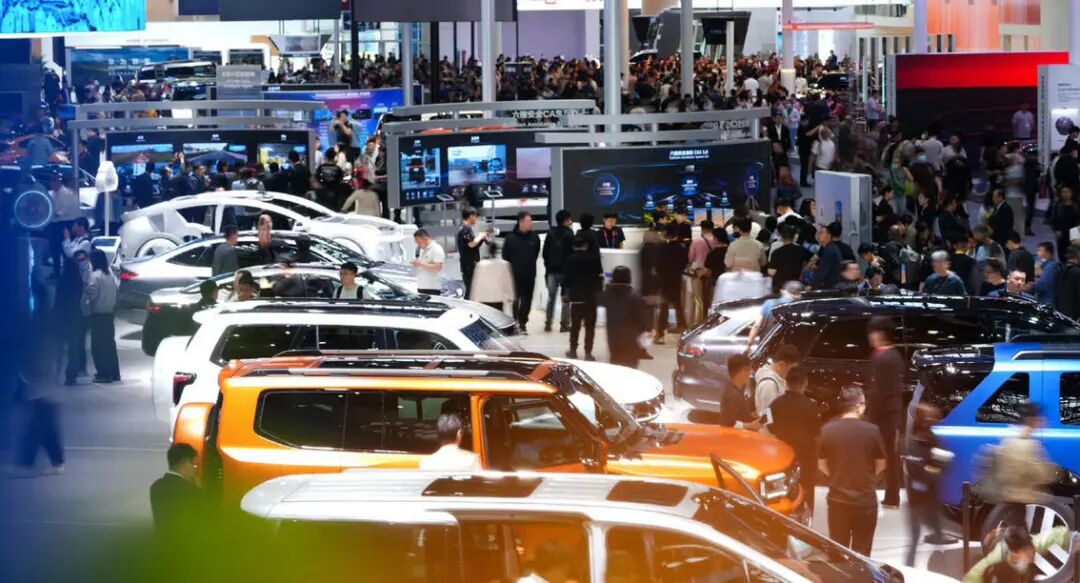
When industry participants care more about appearing better than others rather than actually becoming better, the entire sector's innovation ecosystem will inevitably deteriorate. As we can see today, new models have become increasingly homogeneous, with brands no longer able to tell stories that truly resonate with consumers.
In fact, we need to clearly recognize where China's automotive industry now stands. From January to May this year, the market share of Chinese automotive brands rose to 71%, reaching 73.8% in May alone. Auto exports achieved a historic breakthrough, totaling 5.096 million units in the first half of the year—the first time half-year exports have surpassed the 5 million mark.
With Chinese automotive brands' total sales already exceeding those of foreign brands, we have secured a spot in the global automotive industry's top tier. This means the real competitors for China's auto industry are no longer fellow domestic players, but century-old international luxury brands and multinational automotive groups with deep technical heritage.
While the global market opens up to us, excessive internal friction is not just a matter of lacking vision—it is a strategic miscalculation. To build truly world-class automotive brands, we must first learn mutual respect: respect for competitors' products, respect for consumers' judgment, and respect for our own brand dignity.
Regulators have already made their stance clear. On June 11, 2026, the Ministry of Industry and Information Technology and the State Administration for Market Regulation summoned automotive manufacturers suspected of irrational competitive behavior, requiring them to strictly abide by relevant laws and regulations, strengthen price compliance, and jointly maintain a market order of fair competition with quality matching price.
The Ministry of Industry and Information Technology explicitly stated it will intensify efforts to rectify the cutthroat competition in the automotive industry, but these external constraints are only temporary solutions. True competition has always been about product strength, not public opinion mudslinging.
From power batteries to smart chips, from in-vehicle large language models to AI-powered chassis systems, China's automotive industry has built considerable advantages. Whether these advantages can translate into long-term competitiveness depends on shifting from the primary stage of price competition to value-based competition focused on technology, quality, and service.
Looking back, China's peak auto sales of 28.879 million units in 2017 were never achieved through petty arguments. Even the record-high 34.4 million units sold in 2025 were not won through mutual smearing. Consumers choose vehicles based on product quality, technical strength, cost-effectiveness, and service experience—this ironclad rule has never changed.
Historical success has proven that what truly expands the market and builds strong brands is always product strength, not attack power. Instead of draining each other in endless verbal battles, the industry should return to a down-to-earth approach, letting technology and quality speak for themselves, and winning consumers over with real strength.
This article originates from the WeChat Official Account "Auto Community" (ID: iAUTO2010), written by Yang Jing, and published by 36Kr with authorization.