T3 Travel's IPO: A Mediocre "Third Fiddle" with a Clichéd Narrative
In the grueling ride-hailing industry, one year after Caocao Mobility, the second-largest player, went public, T3 Mobility, the third-ranked company, is also gearing up for an IPO.
On the surface, T3 Mobility seems to have been "born with a silver spoon in its mouth". Its backers include FAW Group, Dongfeng Motor Corporation, and Changan Automobile, each holding a 16.39% stake in T3 Mobility. Additionally, an asset management firm under Tencent and Alibaba hold 6.15% and 5.12% of the shares respectively.
Yet T3 Mobility cannot escape the industry's common woes: over-reliance on a single revenue stream, low profit margins, and heavy dependence on aggregation platforms.
Furthermore, across the entire ride-hailing sector, there is zero brand loyalty on the demand side, while the supply side is already saturated. In this stock market competition, T3 Mobility lacks strong competitiveness, and its envisioned "AI + Robotaxi" strategy overlaps completely with that of its rivals.
As T3 Mobility rushes toward its IPO, it can only present itself as a mediocre third-tier industry player, offering a completely unoriginal narrative about its future.
Doing the Spadework for Amap
Just how "tough" the ride-hailing industry is becomes clear when you look through T3 Mobility's prospectus.
In the full year of 2025, T3 Mobility's total gross transaction value (GTV) reached 18.9 billion yuan, with 797 million annual orders, averaging around 2.18 million orders per day.
By order volume, T3 Mobility ranks third in the industry, close to the second-placed Caocao Mobility, but its figure is merely 6% of Didi's total orders.
The ride-hailing industry landscape can be described as "one dominant player with no other strong contenders", where Caocao Mobility and T3 Mobility are two "fellow sufferers" operating under the shadow of industry giants.
T3 Mobility's revenues from 2023 to 2025 stood at 14.9 billion yuan, 16.1 billion yuan, and 17.1 billion yuan respectively. While its revenue has grown year on year, the year-on-year growth rate has gradually slowed down.
Over the same period, its net profits were -1.968 billion yuan, -690 million yuan, and 7.44 million yuan. This marked remarkable progress, as the company finally turned a profit in 2025 after accumulating losses exceeding 14.4 billion yuan — this is the biggest highlight of this IPO.
However, against its revenue of 17.109 billion yuan, T3 Mobility's net profit margin is a mere 0.04%. Calculated by order volume, the company earns an average of only about 0.009 yuan per order, less than 0.01 yuan.
With such low profit margins, the only way to generate substantial returns is to leverage economies of scale, a defining characteristic of the ride-hailing industry.
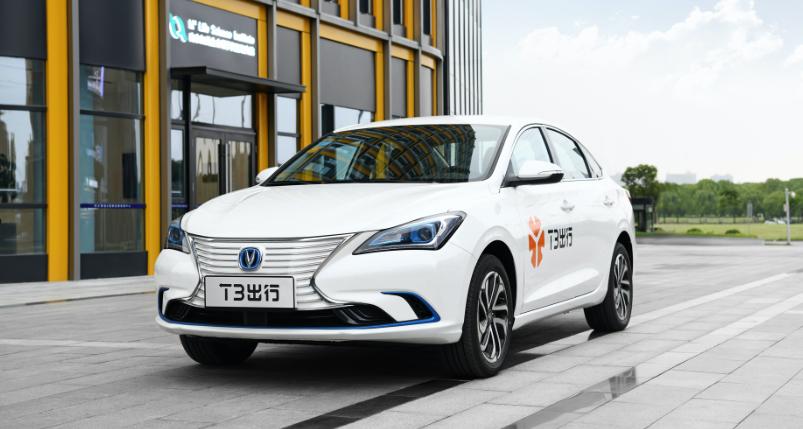
But in this regard, T3 Mobility cannot act entirely on its own; it is at the mercy of aggregation platforms such as Amap.
The prospectus shows that in 2023, 2024, and 2025, orders placed through aggregation platforms including Amap and Tencent Mobility Services accounted for approximately 61.5%, 77.5%, and 85.9% of T3 Mobility's total order volume respectively. The corresponding transaction values made up 61.8%, 78.6%, and 86.4% of the company's total revenue.
This phenomenon is not unique to T3 Mobility: more than 80% of Caocao Mobility's GTV also comes from aggregation platforms, and only Didi has managed to remain independent of this trend.
The entire ride-hailing workflow works as follows: aggregation platforms like Amap provide traffic channels and information matching services, collect the average transaction value from passengers, deduct information technology service fees (commissions), after which T3 Mobility takes its own cut and settles the driver's earnings.
Therefore, compared to self-operated platforms, T3 Mobility has to strengthen its cooperation with aggregation platforms to attract more users, which has led to a sharp increase in its sales and distribution expenses.
From 2023 to 2025, T3 Mobility's commission expenses expanded from 791 million yuan to 1.388 billion yuan, with its proportion in total sales and distribution expenses rising from 66.9% to 90.7%. In 2025, sales and distribution expenses increased 20.4% year on year to 1.53 billion yuan, while revenue only grew 6.2%.
T3 Mobility's heavy reliance on Amap exposes it to huge uncertainties.
If it loses the support of aggregation platforms, or if changes in the industry landscape and power dynamics force T3 Mobility to accept harsh terms, its financial performance will be severely impacted.
This is not an unfounded worry: similar scenarios have already played out in other sectors. For example, conflicts between game developers and the "Hardcore Alliance" of Android app stores over commissions as high as 50%, as well as disputes between software developers and the 30% "Apple Tax", all demonstrate the dominance of platforms and the discontent of service providers.
Given T3 Mobility's order volume, its bargaining power in front of Amap is unlikely to be strong enough. Moreover, aggregation platforms typically set lower average transaction values than self-operated platforms to compete with them, which further squeezes T3 Mobility's profit margins.
Passenger Xiao Li has a deep personal experience of the differences between T3 Mobility and Amap.
She told AI Blue Media Hub: "A couple of days ago, I used the T3 Mobility app to commute to work. The one-way fare was 14.83 yuan, but the driver only received 9.5 yuan. On normal days, when I use Amap for ride-hailing without specifically selecting low-cost vehicles, the one-way fare is just over 10 yuan."
Even after using coupons, the actual price is around 11.86 yuan, which is still about 1 yuan higher than Amap's. Calculated based on the actual amount paid, T3 Mobility's commission rate is 19.9%, which falls within the normal range.
At the same time, Amap also offers discounted rides of 8 to 9 yuan provided by little-known small ride-hailing companies.
However, drivers are very unhappy about this. One driver told AI Blue Media Hub: "When I receive those 8 or 9-yuan discounted orders, I reject them. Relatively speaking, T3 Mobility doesn't have a huge number of orders, but its average transaction value is higher."
In the end, Xiao Li decided to stop using T3 Mobility, because she discovered a dilemma: during the morning rush hour, it's very hard to get a T3 Mobility ride, only metered taxis are available, but you can't use coupons on them.
So after spending 15 yuan on a T3 Mobility ride to work, she decided to go back to Amap's ride-hailing service which costs only 10 yuan.
AI + Robotaxi: A Tired Narrative
After a decade of rapid development in the ride-hailing industry, its profit model has long had no secrets or surprises. The current situation is: traffic dividends have peaked, subsidy wars no longer work, transport capacity supply is saturated, and the industry has entered a stock competition phase.
Not just T3 Mobility, for almost all mainstream ride-hailing platforms, instead of obsessing over operational efficiency, it makes more sense to transform their business models.
That's why everyone is talking about AI and Robotaxi. This is not just about profitability, but also affects market capitalization and valuation.
If a ride-hailing platform only acts as a "transport capacity intermediary" earning tiny, hard-won profits, its price-to-earnings ratio ceiling is very clear. But if it positions itself as an "AI-driven technology platform", its valuation model can jump to the logic of tech stocks, greatly expanding its perceived growth potential.
Didi launched the "Xiaodi" AI mobility assistant v1.0; Xiangdao Mobility released its AI "3+2" strategy; Caocao Mobility announced a comprehensive AI transformation; T3 Mobility also listed "AI + Mobility" as one of its core strategies.
On the AI front, a key achievement to date is its self-developed vertical domain large language model "Lingxing Qianmo", which includes three core models:
The intelligent dispatch model can accurately predict travel demand and allocate transport capacity reasonably, reducing empty driving rates by 17.5% since its launch. The safety model monitors real-time for fatigue driving, distracted driving, and all kinds of risky driving behaviors, bringing T3 Mobility's 2025 traffic accident rate down to around 15.7 per million orders — far below the industry average. The driver-passenger service model optimizes driver recruitment management and passenger service systems, enabling customized handling of customer complaints.
In 2025, AI took over around 90% of T3 Mobility's service operations; AI-powered customer service handled approximately 85% of driver service-related cases and nearly 55% of lost-and-found cases without human intervention. The company's AI recruitment system has processed more than 1.4 million phone inquiries.
It is clear that AI's biggest benefit is enabling extreme operational efficiency, which is of great significance to the ride-hailing industry characterized by high order volumes and low average transaction values.
T3 Mobility was able to achieve profitability quickly in part because AI technology boosted efficiency and optimized operational costs.
T3 Mobility has also made progress in Robotaxi. By the end of 2025, a fleet of over 300 Robotaxis had been connected to the T3 Mobility platform, carrying out L4-level tests in Nanjing and Suzhou.
The primary use of the funds raised in this IPO is to build full-stack Robotaxi capabilities, including deploying Robotaxi fleets, establishing a network of urban operation stations, and upgrading the hybrid dispatch platform.
The problem is that this path is already crowded with competitors, and T3 Mobility has no obvious advantages in order volume or technical strength.
Baidu's Apollo Go has launched services in 26 cities around the world, with accumulated orders exceeding 20 million. With the support of GAC Group and Pony.ai, Ruqi Mobility already operates more than 600 Robotaxis on its platform.
Even without comparing itself to long-established players, T3 Mobility still lags behind Caocao Mobility.
As of June 30, 2025, Caocao Mobility owned more than 37,000 purpose-built vehicles across 31 cities. Its two custom vehicles, the Maple 80V and Caocao 60, developed specifically for shared mobility scenarios, have an average total cost of ownership about 36.4% lower than typical pure electric vehicles in the industry. By February this year, Caocao Mobility had deployed 100 Robotaxis in Binjiang District, Hangzhou.
Meanwhile, T3 Mobility has not disclosed any relevant data.
What is observable is that T3 Mobility's R&D expenditure is decreasing — shrinking from 234 million yuan in 2023 to 165 million yuan in 2025.
Overall, as T3 Mobility rushes toward its IPO, it has neither impressive achievements, nor outstanding technology, nor a compelling, innovative story to tell. Its overall strength is rather mediocre.
These problems cannot be resolved in a short time. All we can do is wish it good luck.
This article is from the WeChat public account "AI Blue Media Hub", author: Feng Hua, editor: Wei Xiao, published with authorization from 36Kr.