OpenAI has found a new job for Codex
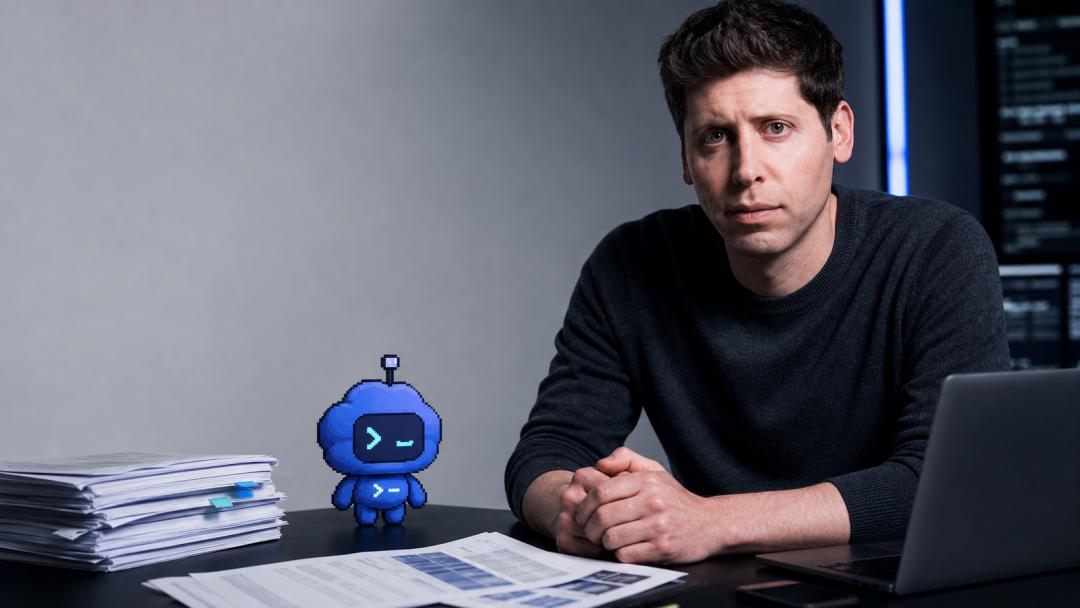
Header and cover source | codex
On July 9, OpenAI released a set of interconnected updates on its official website.
The first is GPT-5.6. This model family is divided into three tiers: Sol, Terra, and Luna. Sol is the flagship model, Terra balances capability and cost for daily work, and Luna emphasizes speed and affordability.
The second offering is ChatGPT Work. An Agent that can call apps and files, work continuously for hours, and turn goals into documents, spreadsheets, slides, and websites.
The third update appears to be merely a client-side adjustment. The Codex desktop app launched in February has been integrated into the new ChatGPT desktop client, making Chat, Work, and Codex three parallel entry points. The original ChatGPT desktop app has been renamed ChatGPT Classic.
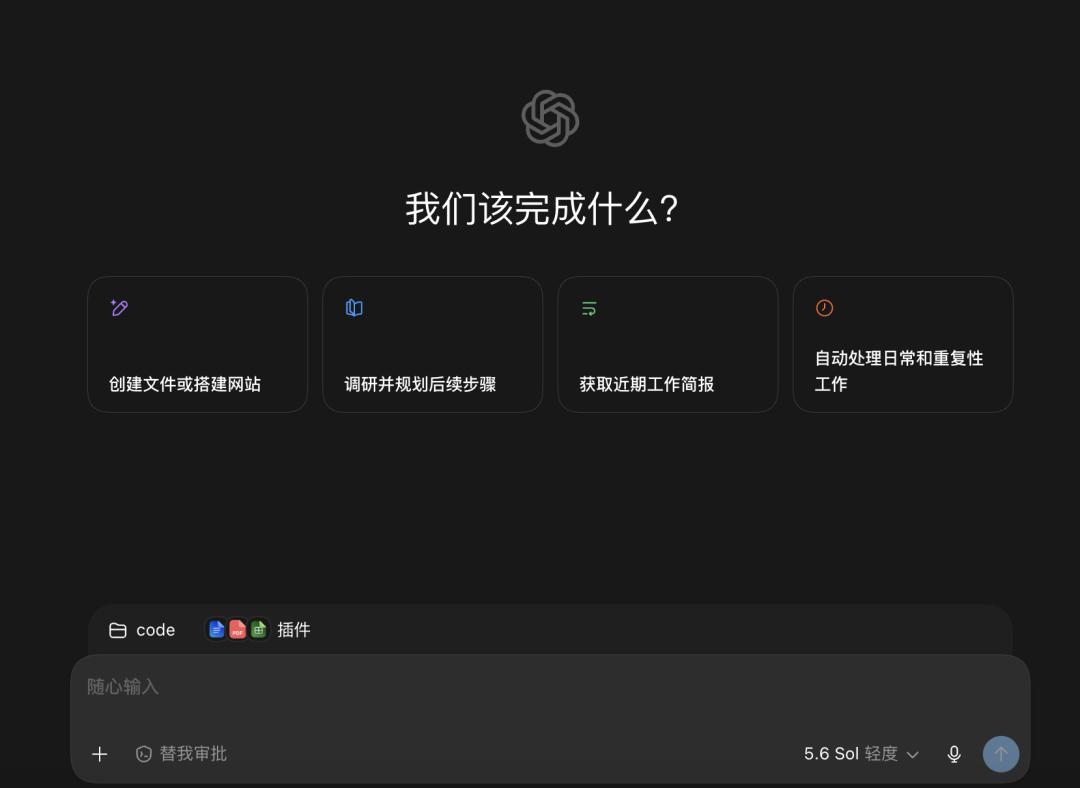
Screenshot of the new ChatGPT desktop client in Work mode
In other words, beyond model updates, OpenAI has extracted some of the capabilities validated by Codex and extended them into a Work entry point for general productivity tasks.
On July 9, in the article "Tencent, Alibaba, and ByteDance Are Rebuilding Office From Scratch," Heji Finance discussed the trends of related domestic "Work" products. For example, WorkBuddy added project collaboration features, QoderWork launched a professional workspace, TRAE renamed its SOLO product to TRAE Work, and Tencent, Alibaba, and ByteDance have all been restructuring their AI productivity products recently.
The core argument of the article is: Programming Agents were the first to close the full loop of "understanding tasks, calling tools, checking results, and delivering files," so they naturally expanded from writing code to documents, spreadsheets, research, and office work, eventually evolving into a new form of Office for the AI era.
OpenAI's recent updates are exactly a timely example of this judgment. The name Codex tells users it can write code; the name Work tells users it can take over their tasks.
Interestingly, the other side of this update took place at Microsoft.
Also on July 9, OpenAI announced that GPT-5.6 would become the preferred model for Microsoft 365 Copilot in Word, Excel, PowerPoint, Copilot Chat, and Cowork. Nitin Agrawal, President of Microsoft Copilot and Agents Core, and Nikunj Handa, Head of OpenAI API Products, both appeared in the announcement. Handa explicitly stated that GPT-5.6 would enter Microsoft 365 through the OpenAI API.
In other words, on the same day, OpenAI not only stepped into the engine compartment of Office but also built a new cockpit outside the Office ecosystem.
On the surface, this is a model and client-side update. From a product narrative perspective, OpenAI has translated parameters and features that used to be understandable only to programmers into work tasks like presentations and reports that more people can grasp.
A New Name, A New Product Narrative
OpenAI appears to be highly confident about this update.
In the related product introduction released alongside the updates, the title is directly "ChatGPT for your most ambitious work." Not stopping at the word "ambitious," the team added the modifier "most."
Looking beyond specific parameters and technical details, from the overall product logic, the new ChatGPT first redefines the division of product responsibilities.
OpenAI's official website gives very specific definitions for the three entry points: Chat handles questioning, searching, brainstorming, and quick conversations; Work focuses on research, analysis, and creation of documents, spreadsheets, presentations, reports, or Sites; Codex takes charge of writing code, debugging, running tests and commands, reviewing modifications, and managing code repositories.
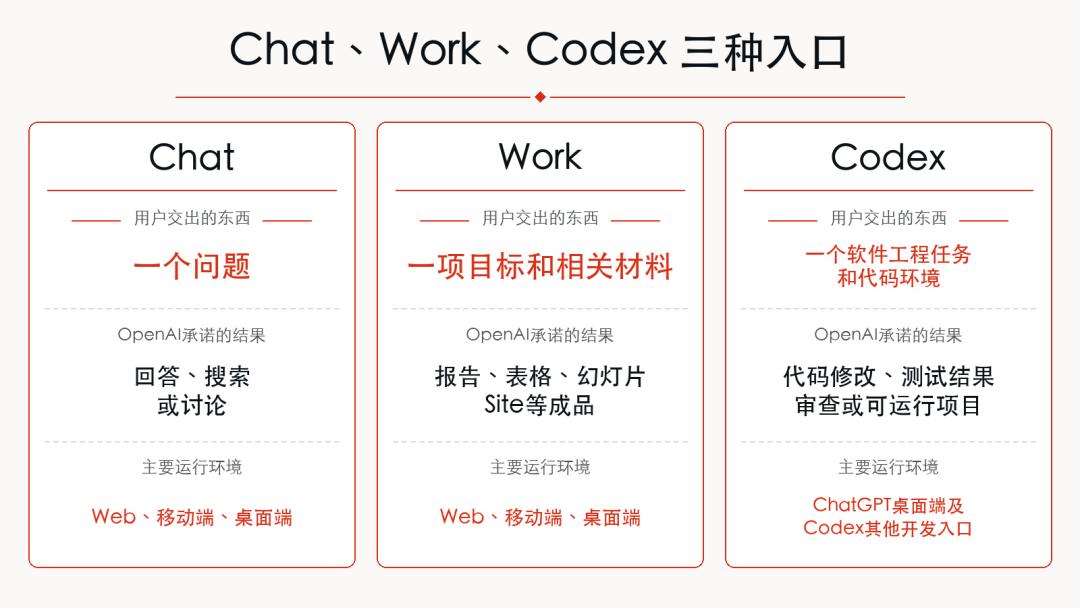
Illustration by Heji Finance
Three entry points correspond to three distinct human-AI relationships.
Chat still uses conversational interaction as its basic unit, Work takes a deliverable task as its core unit, and Codex retains the professional environment composed of code repositories, terminals, and development tools.
In Work's official demonstrations, this difference is deliberately embedded into real-world work scenarios.
Users can ask it to analyze month-end budget variances, organize raw materials into marketing briefs, or prepare for a sales meeting. Users can also track progress, answer clarifying questions, adjust directions, and approve critical operations. OpenAI even outlined a longer workflow: Work first converts customer research into a campaign brief, then generates marketing assets based on that brief, adapts materials for different markets, and preserves full context at every step.
The release page also features endorsements from several early users.
Nathan Bolt, Head of Digital Products at Virgin Atlantic, used Work to research competing airlines, compare service differences, and build a verifiable dataset for his team while developing the company's five-year strategic plan.
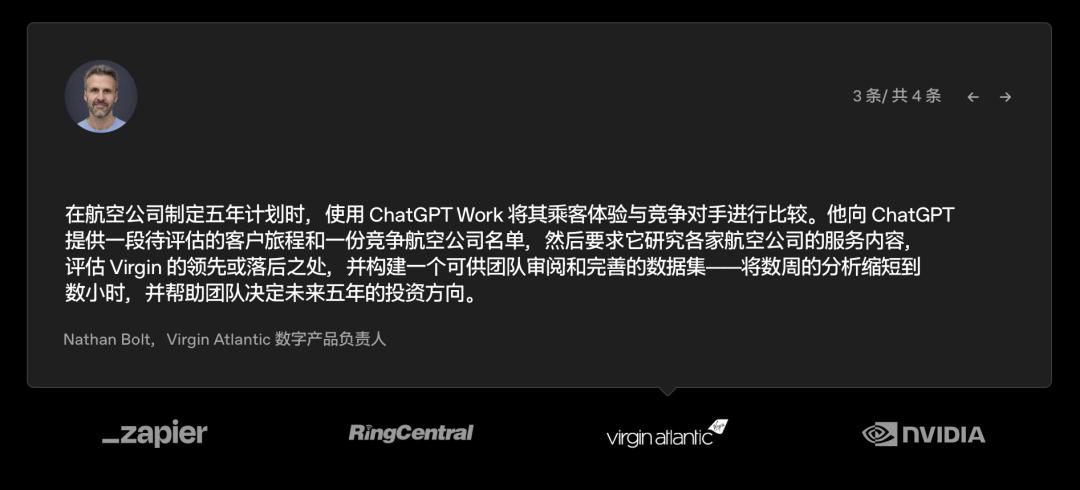
Screenshot from OpenAI official website
OpenAI claims that this analysis process was shortened from several weeks to just a few hours.
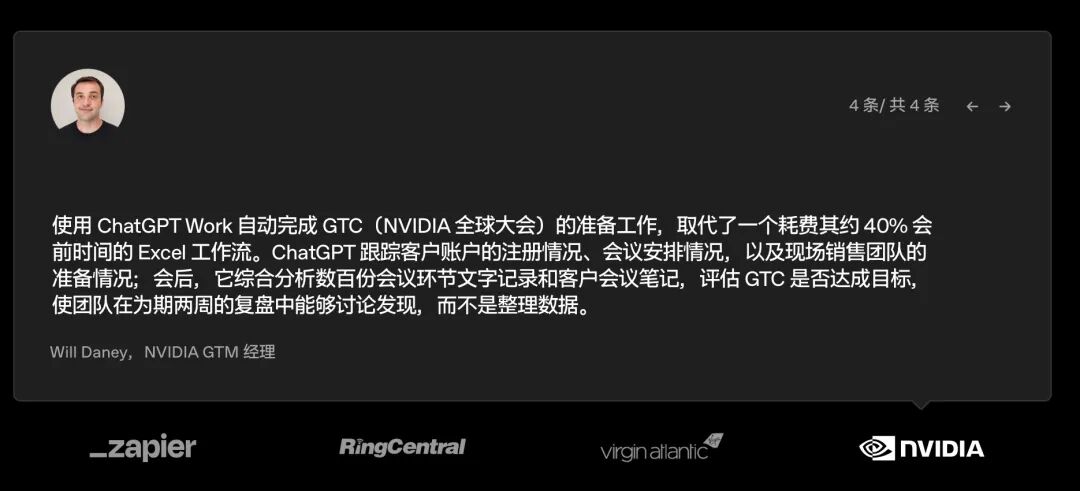
Will Daney, a Market Development Manager at NVIDIA, delegated pre-GTC conference tasks including customer registration, meeting scheduling, and sales preparation to Work, then asked it to summarize hundreds of meeting transcripts and customer notes after the event.
Screenshot from OpenAI official website
According to Daney, the original Excel-based workflow used up about 40% of pre-meeting preparation time. Both results come from early test cases selected by OpenAI, not third-party controlled experiments.
Around continuous execution and final deliverables, OpenAI has centralized multiple capabilities that were previously scattered across Codex and ChatGPT around the Work experience.
Plugins connect to Slack, Microsoft Teams, Google Drive, SharePoint, email, calendars, CRM systems, and project management tools. Scheduled Tasks can execute actions and monitor changes based on predefined times or events. The built-in browser accesses websites and online files. Desktop Computer Use can operate local applications after user authorization. Sites allow users to turn results into shareable dashboards, project trackers, internal portals, and interactive reports accessible via links.
Model naming has also evolved alongside the product narrative: The focus is no longer solely on parameter scale, but on matching capabilities, speed, and cost to different task types.
On July 9, GPT-5.6 exited limited preview and began full rollout across ChatGPT, Codex, and the API. Sol serves as the flagship model, Terra prioritizes balancing capability and cost for daily work, Luna emphasizes cost efficiency, while the top-tier ultra mode automatically coordinates multiple Agents to work in parallel.
Compared to the past practice of covering all tasks under a single model name, Sol, Terra, and Luna are defined by OpenAI as long-term capability tiers that can iterate independently. The selection criteria are no longer just "new vs. old," but also include task complexity, speed requirements, and cost considerations.
From the client-side arrangement, Codex has not been replaced by Work. After July 9, developers can still set Codex as the default interface for the desktop app, and even replace the app icon with the Codex logo. Meanwhile, existing Codex users will automatically receive the new ChatGPT desktop client after a normal app update.
What has truly changed is that OpenAI has added a general-purpose productivity entry point alongside Codex, redefining user expectations through the three names: Chat, Work, and Codex.
This also explains why the old desktop app was renamed ChatGPT Classic. Chat remains OpenAI's most successful product form, but in the new desktop client, conversation is just one of three entry points. Answers are no longer the sole product offering; task execution and deliverables have been elevated to the same level.
Users Who "Misused" Codex Invented Work for OpenAI
This update is essentially a reorganization based on AI product insights and real user demands.
Codex has not disappeared. The new ChatGPT desktop client offers two optional modes: Work and Codex. Codex targets developers and technical work, while Work focuses on "getting tasks done for you."
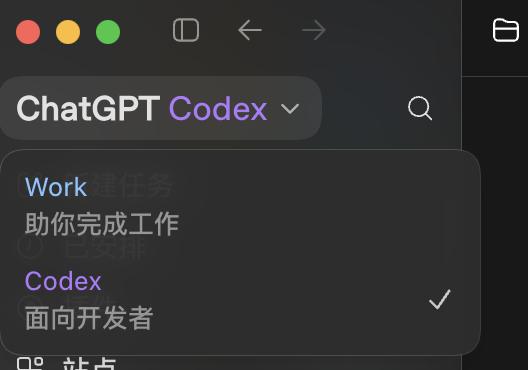
Screenshot of the new ChatGPT desktop client
OpenAI explicitly stated on its July 9 release page that ChatGPT Work is powered by GPT-5.6. The main differences between Work and Codex lie in task scenarios, tool environments, and delivery methods, rather than each being tied to a specific generation of models.
However, many of the execution methods emphasized by Work already existed in Codex: working around files, calling tools, continuous execution, result verification, and ultimately delivering finished outputs. This update essentially abstracts these capabilities from programming scenarios and repackages them as a formal entry point for knowledge work.
There is plenty of supporting evidence, including customer cases published by OpenAI.
In May 2026, Juan José Guerrero at Singular Bank, a private bank in Madrid, was already doing something that seemed unrelated to programming.
Previously, he had to pull portfolio holdings from multiple systems before client meetings, manually verify data, and piece together a complete investment portfolio view. After the bank built its internal assistant Singularity using ChatGPT and Codex, Guerrero can analyze portfolios in real time during meetings, freeing up more time for client conversations. Singular Bank reports that pre-meeting preparation time per session dropped from about 20 minutes to under 1 minute, saving bankers 60 to 90 minutes per day. Over a 30-day period, the team completed more than 3,500 operations across 19 different workflows.
Why did a tool originally built for programmers end up in a private bank's internal system? The answer traces back to the origins of Codex.
When OpenAI publicly released the cloud-based Codex research preview on May 16, 2025, its boundaries were clearly defined: it was a cloud software engineering Agent that could write features, answer codebase questions, fix bugs, and submit pull requests.
Code, as it turns out, provided a rare training ground for Agents. When the Codex desktop app launched for macOS on February 2, 2026, the product was still described as an "Agent command center."
What does that mean?
In simple terms, users could let multiple Agents work in parallel across different threads and work trees, review modifications, and follow up with further questions. At this stage, OpenAI also added Skills and Automations. Skills package instructions, reference materials, and scripts into reusable workflows, while Automations let Codex run tasks in the background on schedule, such as categorizing issues, summarizing CI failures, and generating release briefs.
Interestingly, at the end of that February introduction post, OpenAI left a line stating that code capabilities "lay the foundation for a broader set of knowledge work tasks."
At that time, it revealed that Codex had over 1 million developer users in the past month; four months later, the user base began to reshape the product's definition.
On June 2, OpenAI released a more direct set of data showing that Codex had over 5 million weekly active users, more than a 6x increase since the desktop app launched in February. Non-developers including analysts, marketers, operations staff, designers, researchers, investors, and banking professionals accounted for about 20% of users, growing more than three times faster than developers. The July 9 Work release page further states that over 1 million people are already using Codex for tasks outside of software development.
A product built for programmers had thus been validated by users ahead of schedule as a testbed for general productivity. The article "Tencent, Alibaba, and ByteDance Are Rebuilding Office From Scratch" already elaborated on this phenomenon.
The same shift is happening at Anthropic.
On the Claude Cowork product page, Anthropic disclosed that non-technical teams within the company, including marketing and data departments, are bypassing regular chat interfaces and using Claude Code to handle complex, multi-step tasks. External users have adopted similar usage patterns. Cowork was born from this: it retains the file, tool, and app execution capabilities of Claude Code, but wraps them in a simpler interaction interface for non-technical users.
Domestic Chinese vendors are taking an even more direct approach.
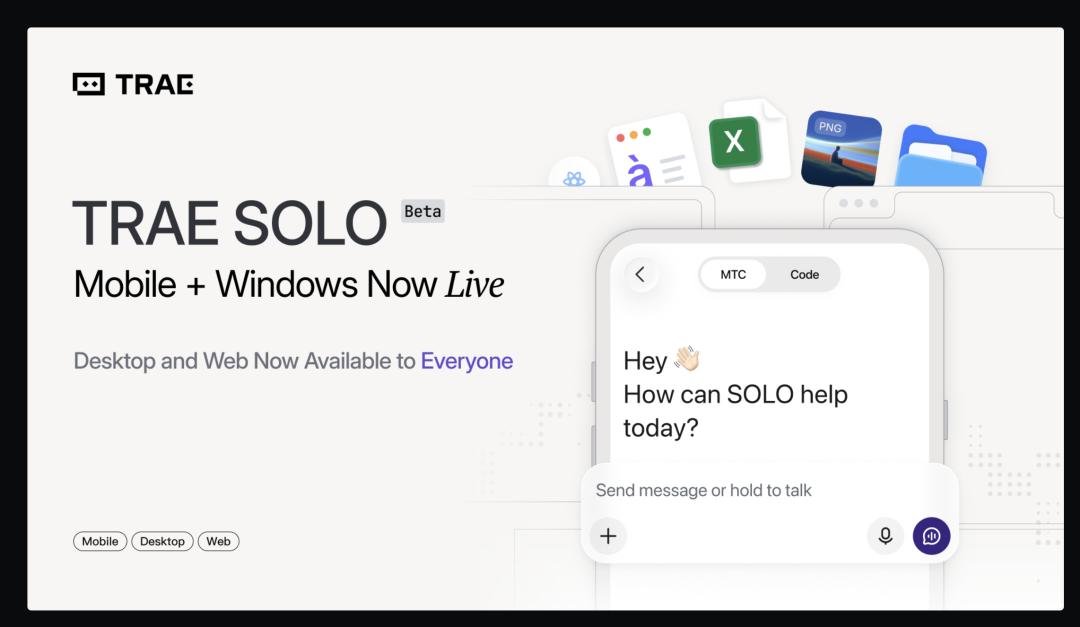
On June 9, 2026, TRAE, an AI development tool under ByteDance, announced that it had officially upgraded "TRAE SOLO" to "TRAE Work." TRAE stated that the product originally served independent developers, but users soon began using it to write product requirements, analyze data, draft marketing plans, organize research reports, and coordinate cross-departmental projects. The official explanation for the rename is that the work users are accomplishing has outgrown the original name.
QoderWork was designed from the ground up to transfer the capabilities of Coding Agents to non-programmers. Qoder states that the product is built on its CLI Coding Agent, which can autonomously plan tasks, operate local files, and call Skills.
On June 2, OpenAI pushed this expansion even further, launching six role-specific plugins covering data analysis, creative production, sales, product design, stock investment, and investment banking, connecting to 62 apps in total and including 110 Skills. The announcement explicitly noted at the time that these plugins "require no coding."
One month later, ChatGPT Work made its debut.
Coopetition: Supplying Models for Office While Circumventing It
As the product narrative expands from "writing code" to "getting work done," the competitive landscape shifts accordingly.