Top creators halting shoots, ad spend slashed by half – can a 60 billion yuan subsidy not rescue live-action short dramas?
In May 2026, the National Radio and Television Administration of China launched the "High-Quality Short Drama Creation and Distribution Initiative", with 11 provinces allocating dedicated support funds. Six major platforms including Douyin, Tencent, Mango TV, Migu, Kuaishou, and Dianzhong have collectively invested no less than 6 billion yuan in special funds to support the high-quality creation and distribution of live-action short dramas.
More than a month has passed, and the live-action short drama market still shows no signs of recovery. Leading short drama producer Tinghuadao has almost suspended all live-action short drama filming projects, shifting its focus to expanding AI short dramas for overseas markets. Actors under Tinghuadao have collectively stopped releasing their two-week schedule plans due to massive project uncertainties. Another leading studio, Masiu, which previously created the hit short drama "Summer Fendela", has not launched any new titles in the first half of this year.
Judging from a series of support policies rolled out by platforms, they have not abandoned live-action short dramas. Douyin's minimum guaranteed support budget for live-action short dramas in 2026 has exceeded 1.5 billion yuan, with the average minimum guarantee per work rising 60% year-on-year. The revenue-sharing ratio for paid content has increased to 80%, and a single work can receive a maximum of 1.5 million yuan in special incentives, while sequels can enjoy up to 20% revenue subsidies. A senior executive from Douyin's Short Drama Creator Center recently stated that over 10,000 live-action short dramas will be produced in the second half of 2026.
However, the situation of live-action short drama practitioners has not improved with the so-called 6 billion yuan in support funds. The effects of platform support are yet to be seen for now.
01
Leading Players Suspend Filming, Ad Spend Cuts by Half, Live-Action Short Dramas Show No Recovery
Over the past six months, the monthly number of new live-action short drama releases has continued to decline. Data from Shenzhen Chuangliang shows that from January to June 2026, the monthly new release counts for live-action dramas were 1,934, 1,918, 1,867, 1,832, 1,700, and 1,429 respectively. Compared with the end of last year, the number has plummeted by over 90%.
In terms of ad spending, the monthly ad expenditure for live-action short dramas has also dropped significantly in the past two months. Statistics show that the total market spending for live-action short dramas from March to June was 62.29 million yuan, 251 million yuan, 390 million yuan, and 308 million yuan respectively. June's spending was nearly 100 million yuan less than May's.
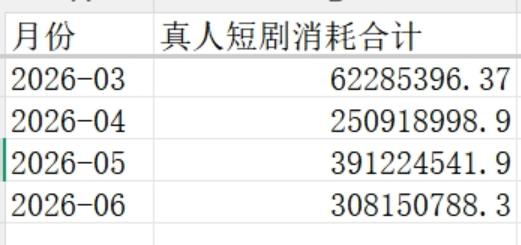
Changes in ad spending directly reflect the market size and confidence in live-action short dramas. In comparison, daily spending for comic-style short dramas exceeded 200 million yuan at one point in May, with monthly spending more than 10 times that of live-action short dramas.
Celia, market director at Shenzhen Chuangliang, stated that the live-action drama sector has declined significantly. Currently, clients spending 2-3 million yuan a day are already at the top tier of the live-action drama market, whereas previously daily spending could easily exceed 10 million yuan.
The entire live-action short drama market is shrinking. Tinghuadao, once known as the "hit factory" for creating countless viral short dramas, has almost suspended all live-action short drama filming projects to fully engage in the booming overseas expansion of AI short dramas.
The top short drama actors under Tinghuadao no longer have fully packed schedules as before. On June 29, fan clubs for Tinghuadao's leading actors Li Keyi, Han Yutong, Wang Peiyan, and Zeng Hui all released statements announcing that they would stop sharing two-week schedule updates starting July.
The official fan club announcement for Wang Peiyan noted, "The overall short drama industry is currently experiencing significant fluctuations, with feasible scripts and filming resources continuously tightening. Many previously confirmed projects face temporary adjustments or cancellations. If schedules are released in advance, unexpected project changes will not only disappoint audiences who have been eagerly anticipating updates, but also easily trigger various negative discussions."
Last year, short drama actors rose to prominence collectively, with top-tier actors' salaries soaring alongside the industry boom. A-list stars once earned 50,000 to 100,000 yuan per day. They appeared on the same stage as long-form drama celebrities, walking red carpets, securing brand endorsements, and participating in variety show recordings. However, in just half a year, short drama actors have been brought back down to reality, with salaries for actors below the top tier plummeting sharply. Many mid-tier actors have even reached a point where they cannot find roles to film, with their commercial value being lower than that of AI actors.
This year, no breakout live-action short drama comparable to last year's viral hit "Summer Fendela" has emerged. As the industry cools down, its star-making capabilities have vanished too. Over the past six months, the industry has failed to cultivate any new actors whose names audiences can remember.
02
Survivors Are Obsessed with Boosting Hit Rates
Leading studios are either suspending live-action short drama production to pivot to AI short dramas, adopting a hybrid live-action filming + AI workflow, or reducing output to focus strictly on high-quality content and higher hit probability.
An industry insider close to Chinese All Digital told Tech Planet that the company's monthly live-action short drama output is currently low, roughly in single digits. Chinese All Digital's domestic live-action short drama label is 17K Theater, while its overseas live-action drama operations are managed by FlareFlow. Meanwhile, these live-action drama teams are also producing AI comic dramas and AI hyper-realistic human dramas.
The insider added that the cooling of the live-action short drama market has had minimal impact on the company, as live-action short dramas have always accounted for a small proportion of its overall business. Internally, the strategy for live-action short dramas is to pursue high-quality production. Since AI short dramas have lower costs, the company prefers to work on low-cost projects. When they do produce live-action short dramas, they are almost exclusively focused on premium works. "One reason we're not chasing volume is our business judgment: flooding the market now means working for platforms for no return. Prioritizing overall quality helps ensure cost recovery and a higher hit rate."
The high-quality production strategy sounds like a public relations slogan, but in reality, it reflects short drama studios' stricter control over return on investment. "We know that low-quality works are very likely to fail, so we're fully committed to boosting hit rates to at least recover most costs. The web novel business line is fully transforming into comprehensive content operations, with teams working intensely in Hengdian, and some editors transitioning into combined editor-producer roles. Many short dramas are adapted from web novels, so when signing web novel authors, we're also adding rights for short drama script adaptations, allowing authors to earn extra income from the short drama sector."
Nowadays, short drama studios must prioritize profitability when producing live-action short dramas. They conduct comprehensive evaluations of long-term returns before deciding whether to produce a live-action or AI short drama.
Short drama series are more likely to be retained for continued production, as these works have already been proven successful by the market and offer more predictable returns. Chinese All Digital's hit male-focused short drama "A Commoner of Distinction" has produced 4 seasons with a total of 6 billion views, and the company will continue producing new installments. Many of Tinghuadao's hit short dramas in the first half of this year are IP series. The "Great-Grandma at 18" series has reached its 4th season and still garnered 2 billion views, while the 2nd season of "Young Madam from Northeast China" also surpassed 2 billion views.
However, the production model for live-action short dramas has changed, with studios leaning toward a light-operation model. Light-operation means leading studios outsource projects and no longer maintain in-house filming teams, only assigning producers to oversee on-site operations. Funding is also increasingly sourced externally. Industry insiders note that live-action short dramas now raise investment from external parties, with profits shared proportionally, and production teams collaborating with third-party partners. If a short drama becomes a hit, the series can retain both drama fans and actor fans.
03
Capital Is on the Sidelines, Leaving Studios No Choice But to Compete on Quality
The AI short drama boom is still ongoing. Competition in generative video large models for AI short drama production is intensifying: Kuaishou's Keling has spun off independently and recently secured 3 billion yuan in financing, ByteDance's Seedance 2.5 is about to launch, and Alibaba's HappyHorse-1.1 is gaining increasing attention. Technological competition and advancements will further accelerate the explosion of AI short drama production capacity, continuously diverting traffic and posing growing challenges to live-action short dramas.
Short drama producer Wu Xie told Tech Planet that from a policy perspective, live-action short dramas are here to stay and will only get better. The current cooling is temporary, as short dramas drive not just the film and television industry, but also surrounding economic benefits that benefit all sectors.
However, both the volume and cost of live-action short dramas have changed now. Wu Xie explained that live-action short dramas have shifted from quantity-driven to quality-driven. Costs have naturally increased, after all, high-quality art requires investment. Previously, a single drama cost around 200,000 to 500,000 yuan with a 7-15 day filming period. Now production costs have risen to over 1 million yuan, depending on whether more investment goes toward actors or production values.
Currently, low-budget short dramas targeting mass audiences still dominate the market, and salaries for actors below the top tier have plummeted sharply.
For small and medium-sized production studios, the challenges are significant. Wu Xie said it's impossible to set a fixed monthly production volume for live-action short dramas; strictly speaking, it depends on individual projects. Raising investment has also become difficult, with far fewer investors than before. In his memory, there were many investors in short dramas in 2023, fewer in 2024, then capital returned as large tech companies entered the market. Now investors have become extremely cautious. Capital is sitting on the sidelines, and platforms are also conducting research. "It's understandable, after all, no one's money comes easy."
The only benefit of the live-action short drama cooling is that low-quality players have been eliminated, forcing remaining participants to compete on quality. This change may actually be good for the short drama industry, as the market has become more rational. Wu Xie noted that the biggest difference now is that previously crews could start filming with any script, but now they must polish the script and core creative team thoroughly.
For short drama studios, whether voluntarily or involuntarily, they must commit to high-quality production.
Short drama industry practitioner Dou Xiuwei told Tech Planet that for the short drama sector, the persistent challenge is the lack of high-quality content. Creating great content that audiences love is very difficult, and all other factors are secondary. Great content is always the key to attracting users, not platform subsidies and support. Platform policies and support are certainly helpful, but studios cannot rely solely on platform assistance.
The quality of short drama content in the market varies drastically, and high-quality content actually delivers higher cost-effectiveness in terms of view counts, viral potential, and revenue. Persistently creating great content will ultimately lead to positive outcomes.
In the entire live-action short drama market, hot money has dried up. Even Tinghuadao, which boasts an extremely high hit rate, no longer invests as heavily as before. Other players still in the game must improve their core capabilities even with the recent support policies released by platforms. They need to produce more high-quality hit content with less funding.
This article originates from the WeChat public account "Tech Planet" (ID: tech618), author: Zhai Yuanyuan, published with authorization from 36Kr.