Supplying products to Advanced Micro-Fabrication Equipment Inc. China and SK Hynix, the "Little Giant" enterprise of semiconductor equipment components in Yangzhou is striving for an IPO.
Core components of semiconductor equipment are one of the weak links and critical "chokepoint" areas in China's semiconductor industry, as well as a key direction for policy support. Recently, another company in this sector has filed for an initial public offering (IPO).
According to reports from Gelonghui, Jiangsu Shenzhou Semiconductor Technology Co., Ltd. ("Shenzhou Semiconductor") has recently submitted a prospectus to the Shanghai Stock Exchange, planning to list on the Sci-Tech Innovation Board, with Guotai Haitong Securities as its sponsor.
Shenzhou Semiconductor is mainly engaged in the R&D, production, sales and technical support services of core components for critical semiconductor process equipment. It is a national-level "Little Giant" enterprise specializing in specialized, refined and innovative technologies, with customers including Advanced Micro-Fabrication Equipment Inc. China, Tuojing Technology, SK Hynix, Intel, Applied Materials, etc.
01. Intel APAC and AMEC have equity stakes, the company turned profitable in 2024
Shenzhou Semiconductor is registered in Yangzhou, Jiangsu Province. Its predecessor, Shenzhou Co., Ltd., was founded in 2016 and was restructured into a joint-stock company in 2025.
Prior to this offering, Zhu Pewen collectively controlled 64.74% of the voting rights corresponding to Shenzhou Semiconductor's shares, making him the actual controller. Meanwhile, Jiangsu Xinji, Intel APAC, China Integrated Circuit Industry Investment Fund Phase II, Zhiwei Panfeng, Yangtze Memory Industry Fund, and Advanced Micro-Fabrication Equipment Inc. China are all shareholders of the company.
Currently, Zhu Pewen serves as the chairman of Shenzhou Semiconductor. Born in 1975, he holds a postgraduate degree. He previously served as executive director and general manager of Yangzhou Shenzhou Technology Co., Ltd., and has successively held positions as general manager and chairman of Shenzhou Semiconductor since April 2016.
Shenzhou Semiconductor provides high-end plasma power system products and comprehensive technical support services for China's advanced semiconductor manufacturing process chain.
The plasma power system is the core component of etching and thin-film deposition equipment, which are among the three key process tools in semiconductor manufacturing. Its performance directly determines the effectiveness and stability of processes such as etching and thin-film deposition.
Divided by major downstream application sectors, during 2023, 2024 and 2025 (the "reporting period"), over 85% of Shenzhou Semiconductor's revenue came from the semiconductor industry, with a small portion of revenue from sectors like photovoltaics and displays.
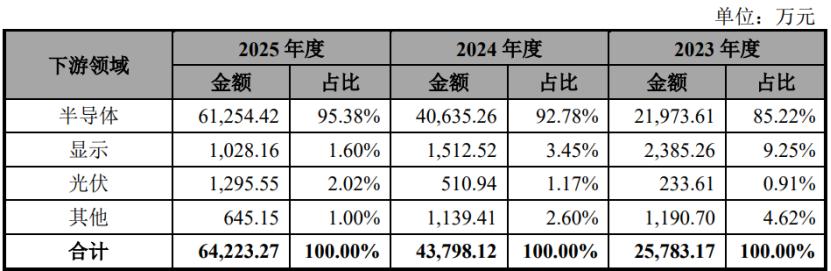
Breakdown of the company's main business revenue by major downstream application sectors, sourced from the prospectus
In the past two years, Shenzhou Semiconductor's revenue has shown a growing trend, and it achieved profitability in 2024 after previous losses.
In 2023, 2024 and 2025, Shenzhou Semiconductor's operating revenue reached approximately RMB 261 million, RMB 446 million and RMB 654 million respectively, with corresponding net profits of approximately -RMB 22.32 million, RMB 136 million and RMB 209 million.
During the reporting period, the company's overall gross profit margins were 61.87%, 66.11% and 65.8% respectively, with certain fluctuations, which are higher than the average gross profit margin of comparable companies in the same industry.
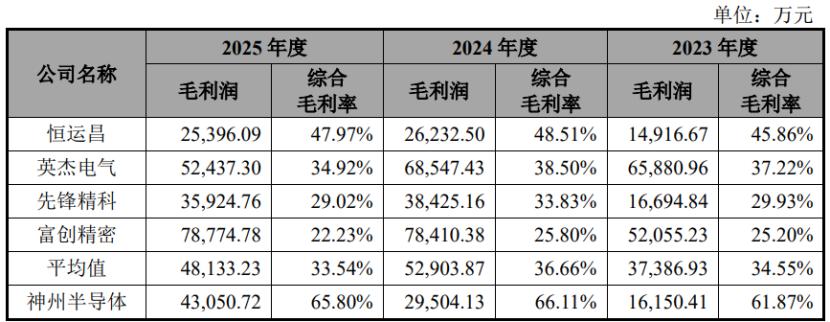
Comparative analysis of gross profit margins between the company and comparable peers, sourced from the prospectus
The R&D and industrialization of core semiconductor equipment components is a typical systematic project characterized by high investment, long cycle and high risks. Shenzhou Semiconductor's plasma power systems, as core semiconductor components mainly targeting advanced manufacturing processes, require continuous high-intensity R&D investment.
During the reporting period, the company's R&D expenses amounted to RMB 36.67 million, RMB 57.95 million and RMB 109 million respectively, with R&D expense ratios of 14.05%, 12.98% and 16.69% respectively.
02. Supplies to AMEC and SK Hynix, with relatively high customer concentration
The upstream of the semiconductor industry chain covers semiconductor components, materials, software and technical support services; the midstream includes semiconductor equipment and semiconductor manufacturing; downstream application sectors span multiple fields such as consumer electronics, artificial intelligence, new energy, industry and military.
Shenzhou Semiconductor's main business, semiconductor plasma power system products and related technical support services, belongs to the supporting industry in the upstream of the semiconductor industry chain.
The company needs to purchase raw materials such as backup power systems, modules, electronic components, capacitors, power devices and structural parts, with suppliers including Yangzhou Shuangying Trading Co., Ltd., Nuoyuan Technology, Yunhan IC City, etc.
Since Shenzhou Semiconductor has demand for purchasing backup power systems from some international original brand manufacturers, and its technical support service clients cover many internationally renowned production lines and equipment vendors, intensified international trade frictions may affect the development of related businesses.
Shenzhou Semiconductor's self-developed products have been supplied in batches to leading domestic semiconductor equipment manufacturers such as Advanced Micro-Fabrication Equipment Inc. China, Tuojing Technology and Naura Technology Group, and its technical support services have covered mainstream domestic and international chip production lines including TSMC, Intel, Samsung Electronics, SK Hynix, Micron Technology, Texas Instruments and CR Micro.
Affected by the high concentration of the downstream industry, the company's customer concentration is also relatively high. During the reporting period, the top five customers of Shenzhou Semiconductor accounted for 39.31%, 61.55% and 72.89% of its operating revenue respectively. In addition, Intel, one of its customers, holds approximately 8.61% of the company's shares through its investment platform Intel APAC, making it a related party.
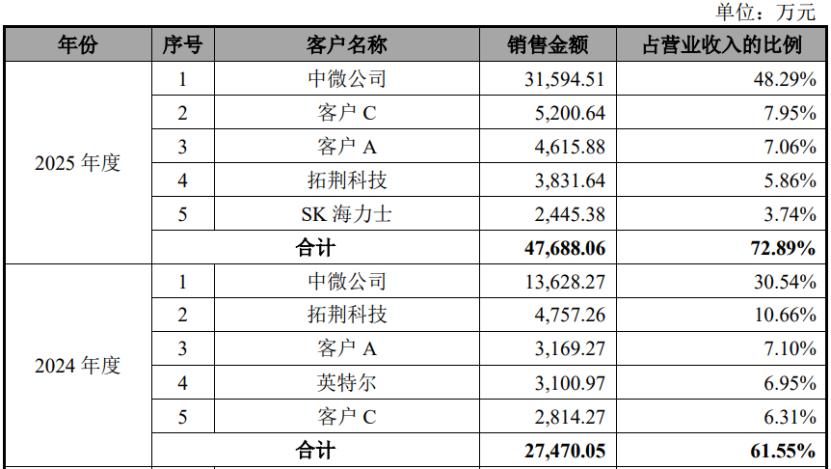
Sales performance to the company's top five customers in 2024 and 2025, sourced from the prospectus
It is worth noting that as the company's operating scale expands, the scale of accounts receivable and inventory is also increasing. From the end of 2023 to the end of 2025, the book value of Shenzhou Semiconductor's accounts receivable surged from approximately RMB 86 million to RMB 200 million, and the book value of inventory rose from approximately RMB 113 million to RMB 213 million. The company faces risks of delayed recovery of accounts receivable and inventory depreciation.
03. Business is affected by the semiconductor industry cycle, with low domestic localization rate of products
The semiconductor industry has strong cyclical characteristics. Generally, the application of new technologies and innovation of new products will drive demand in the terminal market, thereby promoting the growth of the semiconductor industry.
At present, the global semiconductor industry has entered a new growth stage driven by emerging technologies such as artificial intelligence, cloud computing, big data and high-speed communication. The application of new technologies has prompted downstream chip production lines to make strategic decisions on new capacity expansion, which affects their fixed asset investment and ultimately impacts the market demand for semiconductor equipment and core components.
According to statistics from SEMI, the global semiconductor equipment market reached USD 117.1 billion in 2024. Driven by downstream markets such as artificial intelligence and new energy, the market size is expected to climb to USD 138.1 billion in 2026.
Mainland China is the world's largest market for semiconductor equipment, with semiconductor equipment sales in Mainland China reaching USD 49.6 billion in 2024, accounting for approximately 42% of the global market share.
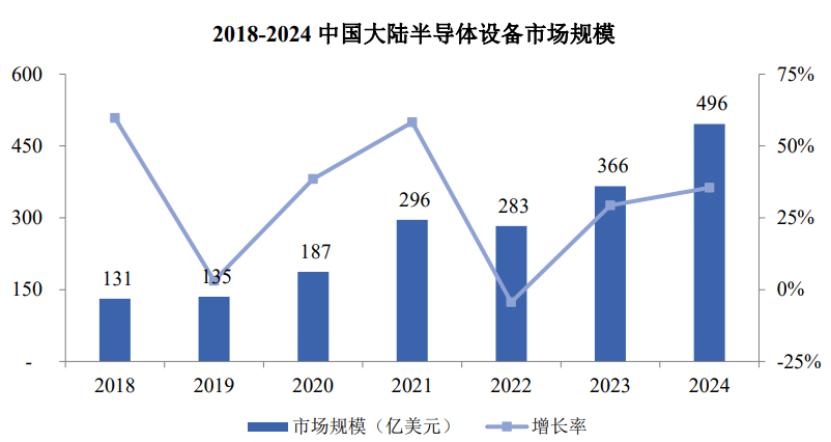
Compiled from SEMI data, sourced from the prospectus
The global semiconductor equipment industry presents a competitive landscape of high concentration and oligopoly.
According to SEMI data, the top 5 vendors in global semiconductor equipment sales in 2024 are ASML, Applied Materials (AMAT), Lam Research (LAM), Tokyo Electron (TEL) and KLA in sequence.
Among them, ASML holds an absolute monopoly in the high-end lithography machine market, while the three international giants AMAT, LAM and TEL almost dominate the main global markets for etching equipment and thin-film deposition equipment, and KLA firmly occupies the leading position in the global semiconductor metrology and inspection equipment market.
In recent years, with the continuous advancement of technical breakthroughs in China's semiconductor "chokepoint" areas, China's semiconductor equipment and semiconductor manufacturing industries have made certain progress, and a positive cycle of coordinated development between upstream and downstream has initially taken shape.
In the semiconductor equipment sector, leading domestic manufacturers such as Naura Technology, Advanced Micro-Fabrication Equipment Inc. China, ACM Research (Shanghai), Tuojing Technology, Huahai Qingke and Zhongke Feice have achieved domestic breakthroughs and large-scale mass production of equipment in multiple segmented tracks;
In the semiconductor manufacturing segment, China already has leading chip manufacturing and semiconductor device manufacturers covering both mature and advanced processes, including SMIC, HuaHong Group, Yangtze Memory, ChangXin Memory Technologies, Shanghai Huali Microelectronics and CR Micro.
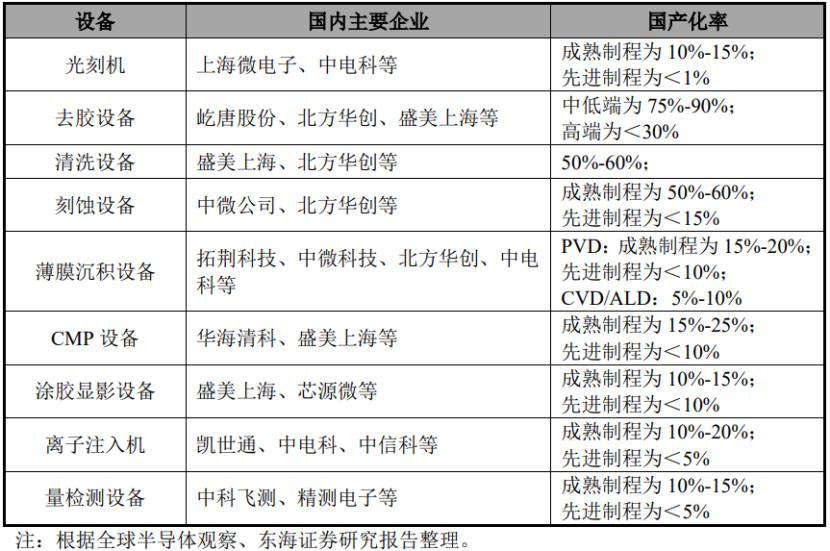
According to the "Research Report" released by Donghai Securities in October 2025, the domestic localization rate of various types of semiconductor equipment in China and the profile of core participating vendors, sourced from the prospectus
At present, the localization rate of plasma power systems is relatively low, with market share long monopolized by semiconductor giants from countries like the United States and Japan, and there are relatively few domestic enterprises with large-scale revenue.
According to statistics from QYResearch, the localization rate of remote plasma source systems in the semiconductor sector in Mainland China was less than 7% in 2025. The related market is mainly occupied by vendors such as MKS, AE and NPP, with only a small number of domestic players including Shenzhou Semiconductor, Hengyunchang, Yingjie Electric and Huacheng Electronics participating in the competition.
Among them, in 2025, the market share of Shenzhou Semiconductor's plasma radio frequency power systems was close to that of Hengyunchang; in the same period, the company ranked first among domestic enterprises in the market share of remote plasma source systems.
Although Shenzhou Semiconductor is a leading domestic enterprise in both self-developed products and technical support services, there is still a certain gap compared with international giants. Moreover, with the rapid growth of China's semiconductor industry and the continuous advancement of domestic localization, industry competition may also intensify.
For this IPO, Shenzhou Semiconductor plans to raise approximately RMB 2.5 billion to invest in projects including the R&D and industrialization of power components for integrated circuits at advanced process nodes, the upgrading and expansion of the technical support service system, the construction of the Shanghai industrialization base, the construction of the R&D and innovation center, and supplementary working capital.
Disclaimer: All views in this article come from the original author and do not represent the views or positions of Gelonghui. Special reminder: Investment decisions should be based on independent thinking. The content of this article is for reference only and does not constitute any practical operation advice. Trading risks are borne by the investor.
This article is sourced from the WeChat Official Account "Gelonghui New Stocks", authored by "Fage Talks About New Stocks", and published by 36Kr with authorization.