Unlocking the Evolutionary Closed-Loop for Embodied Fine Manipulation, Proception Raises $11M in Seed Round
Fine manipulation is the final hurdle for embodied intelligence to enter real-world production environments. However, most current robots sacrifice dexterity to simplify their structures when interacting with the physical world, and many still rely on basic grippers.
These grippers and low-DOF (degrees of freedom) dexterous hands can function in structured environments, but their limitations become apparent when tasks require tactile feedback or near-human-level manipulation capabilities.
Two entrepreneurs who were deeply involved in key projects on Tesla's Optimus team, Jay Li and Jack Xu, founded the dexterous hand company Proception, and recently released their products ProHand and ProGlove.
ProHand is a tendon-driven dexterous hand with 22 degrees of freedom, supporting a wide range of dexterous movements; ProGlove, meanwhile, uses "skin" with tactile sensing capabilities. It is a wearable human hand data collection system that can capture human hand interaction data without requiring robots to participate in the closed loop.
Recently, Proception closed a $11 million seed round, led by First Round Capital, with participation from Y Combinator and BoxGroup.
A Closed-Loop Evolution of Fine Manipulation: Dexterous Hand + Data Collection Glove
The two members of Proception's founding team, Jay Li and Jack Xu, have experience working on Tesla's Optimus and hardware engineering. Jay Li (CEO) graduated from Harbin Institute of Technology and earned his master's degree from Stanford University. He previously served as a technical lead on Tesla's Optimus humanoid robot project, deeply contributing to modules such as robot hand motion, actuators, tactile sensing, forearm actuator modeling, and glove strategy and architecture design.
Jack Xu previously worked at Tesla on the Optimus humanoid robot and Model S/3/X/Y vehicle systems, was involved in medical exoskeleton robots at Trexo Robotics, and led a team to develop autonomous driving racing robots at the University of Waterloo.
After years of rapid development, robots have been deployed in specific scenarios (factories, warehouses, homes), capable of perceiving the world through vision systems and even running marathons.
But for robots to truly enter the real physical world and unleash their productivity, unlocking human-hand-level dexterous manipulation capabilities is one of the key prerequisites.
Most existing robots simplify their hand structures to reduce size and complexity, sacrificing some dexterity. Many even rely on basic grippers for operation. These robots can perform relatively simple tasks like grasping or moving hard objects in controlled, enclosed scenarios or laboratory settings.
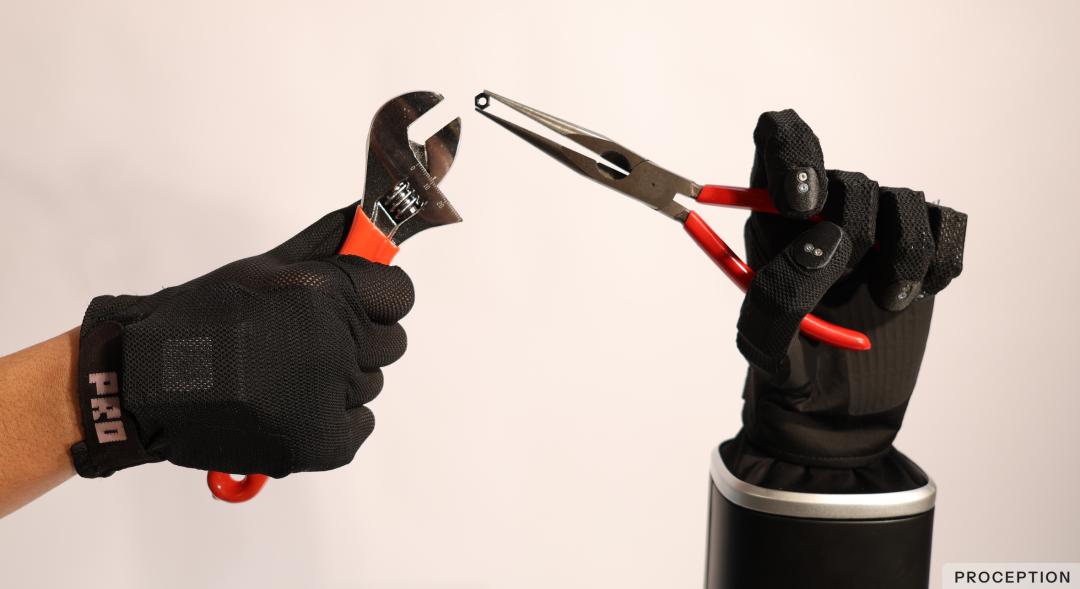
Prohand 1.0, Image source: Proception
However, tasks like tying shoelaces, opening packages, using tools, plugging in cables, folding clothes, or repairing electronic devices — which are trivial for humans — are not just vision problems but also contact problems. Traditional robot hands reveal their shortcomings in these scenarios.
In contrast, the human hand possesses extraordinary fine manipulation capabilities: with over 20 degrees of freedom, dense tactile sensing, and tendon-driven actuation, it can perform a vast range of tasks from tying shoelaces to repairing electronics.
The key to a dexterous hand lies in multiple degrees of freedom and tactile feedback. Proception's recently launched dexterous hand product, Prohand 1.0, combines both. This dexterous hand has 22 degrees of freedom (18 of which are actuated), uses human-like tendon-driven fingers, each with 4 joints that can flex approximately 90 degrees and support slight hyperextension.
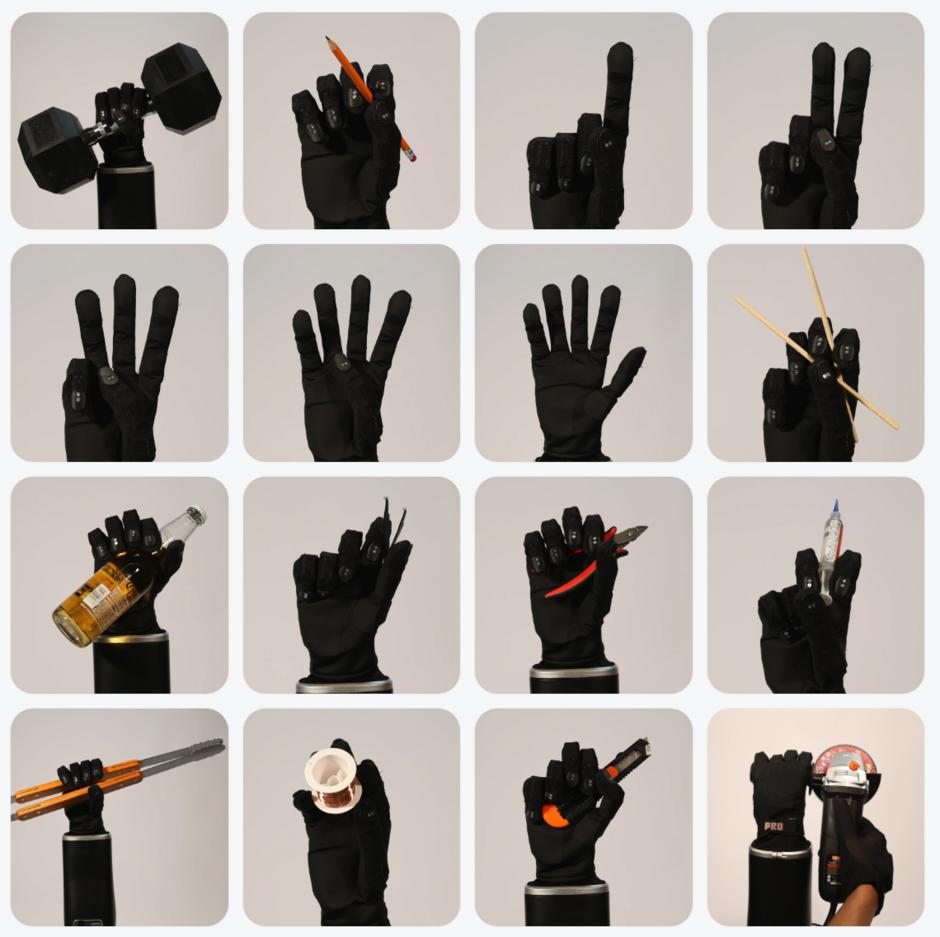
Image source: Proception
Moreover, its thumb supports a rotation angle of approximately 120 degrees, and its wrist has 2 degrees of freedom, including flexion/extension (−30° to +65°) and ±30° abduction. These capabilities enable a wide range of dexterous movements. In addition, its control system supports 10-millisecond real-time response.
In terms of tactile feedback, it is equipped with integrated skin-like sensors that can detect contact and support grip control during operation. It has a total of 96 tactile units, capable of sensing pressure with a resolution of 0.1N.
Dexterous hand picking up and rotating a data cable, Video source: Proception
When a dexterous hand combines multiple degrees of freedom and tactile feedback, it can perform fine manipulations such as twisting a data cable or repeatedly moving a fragile egg.
Two dexterous hands working together to move and place eggs, Video source: Proception
Beyond Prohand 1.0, Proception's other product is ProGlove 1.0, which addresses the data challenge. Currently, most fine manipulation data for robots is collected through teleoperation, which has two main limitations: it is difficult to scale easily. Data collection is restricted by the number of available robots and typically takes place within robot laboratories.
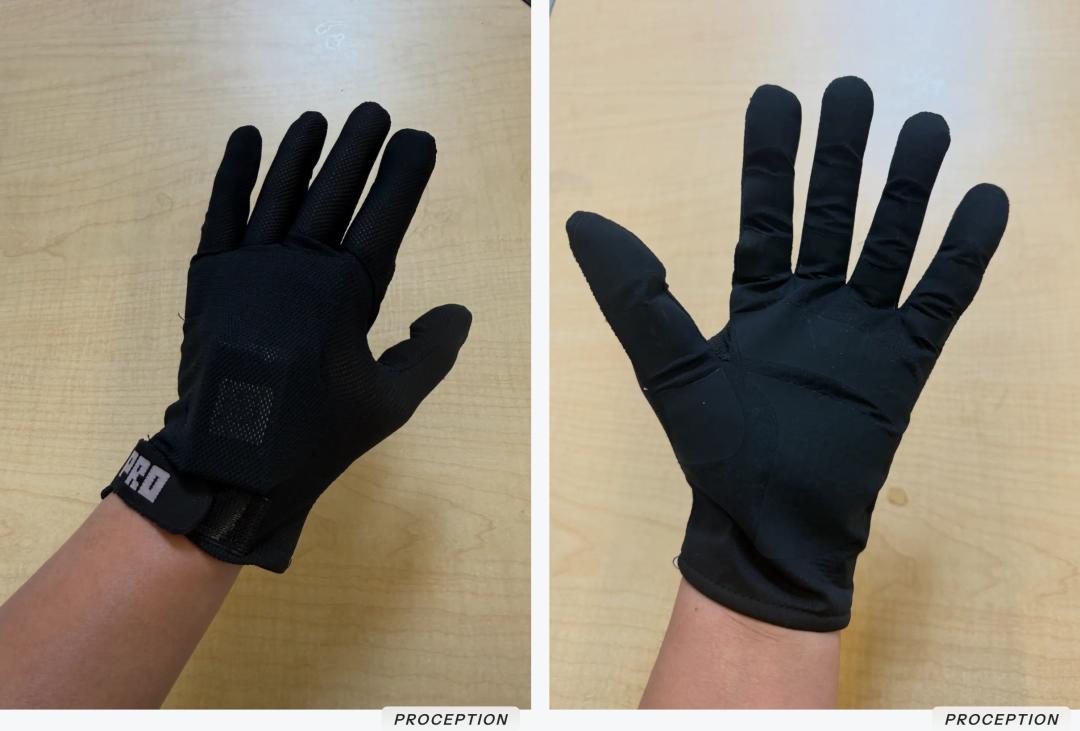
ProGlove 1.0, Image source: Proception
It also loses important human interaction signals. When a human operates a robot remotely, the operator does not directly touch the object, so the data often lacks the subtle contact, pressure changes, and adjustment strategies that humans use during manipulation.
Proception aims to build a data platform that can be trained using real human data. ProGlove can capture human hand interaction data without requiring robots to participate in the data collection closed loop.
With ProGlove and a head-mounted display that provides visual context, robotics researchers only need to wear the sensing glove to collect real human manipulation data, and directly transfer these actions and skills to the robot.
In terms of form, ProGlove is a textile glove with a thickness of only 1.3 millimeters, capable of sensing 0.1N of force, with a total of 96 tactile units on the fingertips and palm (similar to Prohand). It is designed for human wearers, with a next iteration targeted at humanoid robot hands.
Proception's Prohand 1.0 and ProGlove 1.0 have already been shipped to researchers and robotics companies.
Proception has also announced its Master Plan: according to its roadmap, it will train a foundational tactile-driven AI model (the data collection problem is solved by ProGlove) within 2026, build a humanoid robot prototype in 2027, and elevate the dexterous hand's manipulation capabilities to perform complex bimanual skills. In 2028, it will bring the humanoid robot to market and deploy it in real work processes.
A Full-Stack Company Combining Dexterous Hand, Model, and Data Is Well-Positioned to Build Competitive Barriers
Data is becoming a critical issue in the embodied intelligence industry. Whether for embodied brains, embodied cerebellums, systems responsible for locomotion, or those for dexterous manipulation, their models all lack sufficient data beyond hardware.
The embodied brain is relatively better off: in addition to teleoperation-collected data, first-person video and game video data can meet the volume requirements.
But in other fields, especially fine manipulation, there are few current ways to obtain high-quality data at low cost. The approach Proception uses — a glove with tactile sensors that captures human operations (similar to DexUMI) — is already relatively efficient.
In the field of precise manipulation for embodied intelligence (including but not limited to dexterous hands and models), there are multiple players overseas and in China. For example, Genesis AI overseas raised $105 million in early financing and released the GENE-26.5 fine manipulation model in May 2026. There is also Mimic in Europe, which adopts a model-centric approach to fine manipulation.
Domestic companies, meanwhile, have stronger hardware capabilities: the dexterous hand product of one leading startup has achieved a maximum of 25 degrees of freedom, while another has captured over half of the global high-DOF dexterous hand market, and also features tactile sensing capabilities.
However, in the fine manipulation domain of embodied intelligence, the real competitive barrier does not come from a single high-DOF hardware piece, but from the integration of hardware, models, and a real-data closed loop. Hardware provides the execution carrier, models enable skill generalization, and the data flywheel continuously feeds back to training and control.
Genesis AI is already following this path, Proception is moving in this direction, and Chinese startups clearly possess the potential to do the same.
This article is from the WeChat public account "Alpha Startup" (ID: alphastartups), authored by Discovering Extraordinary Entrepreneurs, and republished with authorization from 36Kr.