How to revitalize the urban existing housing stock?
China's urban development is shifting from the stage of large-scale incremental expansion to a phase focused on improving quality and efficiency of existing assets. The real estate industry is also gradually transitioning from an increment-dominated era to one that balances both incremental growth and stock optimization, with some cities already entering a stock-focused era. Revitalizing existing assets such as underutilized land and unsold commercial properties is no longer an optional task for local governments—it has become an essential requirement to support high-quality urban development. In recent years, top-level designs for revitalizing existing assets have been continuously implemented, various central ministries have accelerated the improvement of policy systems, and local governments have actively executed these policies by introducing tailored supporting measures, resulting in increasing momentum for unlocking the value of existing assets.
In April 2024, the Political Bureau of the Central Committee explicitly proposed to "coordinate the research on policies and measures for digesting existing housing stock and optimizing incremental housing", marking the launch of a new round of "destocking" policies. Since then, the central government has systematically deployed policy frameworks including purchasing existing commercial housing for affordable housing use and accelerating stock revitalization in conjunction with urban renewal, while local governments have actively followed up with location-specific supporting policies. This article systematically reviews the relevant policies and cases related to revitalizing existing commercial housing for reference by governments and various market entities.
Central Deployment: Revitalizing Existing Housing Becomes One of the Key Real Estate Tasks in the Next Five Years
Since 2022, the central government has continuously introduced systematic policies focused on revitalizing existing assets. In May 2022, the General Office of the State Council issued the Opinions on Further Revitalizing Existing Assets and Expanding Effective Investment, which for the first time made a systematic national-level deployment for revitalizing existing assets, clarifying three key priority areas and seven revitalization approaches, explicitly identifying "affordable rental housing" and "old industrial plants" as critical assets to be unlocked.
On April 30, 2024, the Political Bureau of the Central Committee emphasized the need to "coordinate research on policies and measures to digest existing housing stock and optimize incremental housing", marking the launch of a new round of "destocking" policies, followed by the continuous introduction of more policies to revitalize existing housing. At the end of 2024, the Central Economic Work Conference explicitly stated that it would "advance the work of disposing existing commercial housing". In the same month, the General Office of the State Council optimized and improved the management mechanism for local government special bonds, clarifying that special bonds are permitted to support urban governments in purchasing existing commercial housing for use as affordable housing, further expanding funding sources for acquiring existing commercial properties. In 2025, the acquisition of existing commercial housing was included in the Government Work Report, which also noted that "greater autonomy will be granted to urban governments in terms of acquisition entities, prices, and usage purposes". Subsequently, the April meeting of the Political Bureau of the Central Committee further emphasized "optimizing policies for the acquisition of existing commercial housing". In August, the Opinions on Promoting High-Quality Urban Development called for a comprehensive baseline survey, stressing the need to "renovate and utilize existing housing such as old industrial plants, low-efficiency office buildings, and idle traditional commercial facilities, and establish a planning adjustment mechanism adapted to the needs of building function conversion and mixed utilization", while also highlighting the revitalization of existing commercial and office properties. The December Central Economic Work Conference emphasized "encouraging the acquisition of existing commercial housing primarily for affordable housing and other purposes".
The 2026 Government Work Report for the first time proposed "exploring multi-channel approaches to revitalize existing commercial housing", indicating that more pathways will be expanded to unlock stock assets. The release of the 15th Five-Year Plan Outline dedicated a separate section to "revitalizing and utilizing existing resources", stating that "policies for mergers and acquisitions, bankruptcy, and replacement will be improved, to revitalize and make good use of low-efficiency land, idle real estate, and existing infrastructure", and explicitly requiring "promoting the revitalization and utilization of existing commercial housing and idle commercial office properties". The 15th Five-Year Plan for Urban Renewal clearly specifies "revitalizing idle and low-efficiency old industrial plants, commercial office buildings, commercial housing, and public housing". During the 15th Five-Year Plan period, revitalizing existing housing will become one of the key priorities for governments at all levels.
Ministry Implementation: 300 Billion Yuan Affordable Housing Refinancing and Local Government Special Bonds Support Acquisition of Existing Commercial Housing
Since 2023, multiple central ministries have continuously introduced supporting policies for revitalizing existing housing, clarifying revitalization pathways for local governments and providing financial support.
In early 2023, the People's Bank of China established the "Rental Housing Loan Support Program" with a quota of 100 billion yuan, supporting financial institutions to issue rental housing purchase loans in 8 pilot cities: Chongqing, Jinan, Zhengzhou, Changchun, Chengdu, Fuzhou, Qingdao, and Tianjin, enabling these pilot cities to use the loans to acquire existing commercial housing for conversion to rental properties. In January 2024, the People's Bank of China and the State Administration of Financial Regulation officially issued the Opinions on Financial Support for the Development of the Housing Rental Market, establishing group purchase loans for rental housing to meet the reasonable financing needs of bulk group purchases of rental housing.
In May 2024, at a regular State Council policy press conference held by the State Council Information Office, the People's Bank of China explicitly supported local governments in acquiring existing commercial housing at reasonable prices for use as affordable housing, while launching a 300 billion yuan affordable housing refinancing facility to provide low-cost funding for local acquisitions of existing commercial properties. The implementation of this policy marked that acquiring existing commercial housing for affordable housing became one of the key focal points for local revitalization efforts. In June, the Ministry of Housing and Urban-Rural Development convened a video conference to promote the orderly and effective implementation of acquiring completed existing commercial housing for affordable housing in cities at and above the county level. In September, the People's Bank of China announced it would raise the central bank's support ratio for the 300 billion yuan affordable housing refinancing from 60% to 100%, further expanding the scale of commercial bank loan support. In October, the Ministry of Finance announced that government special bonds and affordable housing project subsidy funds would be permitted to be used for acquiring existing housing.
In December 2025, the National Development and Reform Commission issued the 2025 version of the industry scope list for REITs projects, including commercial office facilities and urban renewal facilities in the application scope, expanding funding sources for revitalizing existing commercial and office assets as well as urban renewal stock properties. The National Housing and Urban-Rural Development Work Conference explicitly called for promoting the acquisition of existing commercial housing for use as affordable housing, resettlement housing, dormitories, and talent housing. In the same month, the Ministry of Natural Resources and the Ministry of Housing and Urban-Rural Development issued the Notice on Several Measures to Further Support Urban Renewal Actions, introducing optimized transition period support policies and promoting temporary utilization of existing spaces to revitalize existing housing. The document states that "for existing land and real estate resources used to develop state-supported industries and sectors, a transition period policy that does not change the land use entity and planning conditions can be enjoyed for a certain number of years, with the transition period in principle not exceeding 5 years" and "formulate temporary utilization management rules for existing buildings (structures) without increasing floor area ratio and height, implementing positive list management for usage purposes, where items included in the positive list do not require planning permit procedures". In January 2026, the People's Bank of China lowered the interest rates of various structural monetary policy tools by 0.25 percentage points, which means the affordable housing refinancing rate dropped to 1.25%, better supporting local governments in advancing the acquisition of existing commercial housing.
Local Implementation Execution: Multiple Methods to Revitalize Existing Housing, Progress Continues Across Regions
From the perspective of revitalization approaches across different regions, local governments mainly adopt multiple methods including acquiring existing commercial housing for affordable housing, implementing housing "trade-in" programs, "housing voucher resettlement", in-situ reconstruction, converting non-residential properties to rental use, and promoting functional compatibility to revitalize existing commercial residential properties and existing commercial and office properties (this article temporarily excludes industrial plants). According to data disclosed by the Ministry of Housing and Urban-Rural Development, during the 14th Five-Year Plan period, China cumulatively constructed and raised over 11 million units (rooms) of various types of affordable housing and resettlement housing for urban village redevelopment and dilapidated urban housing renovation, a significant portion of which were raised through renovating or acquiring existing housing.
Acquiring newly built commercial housing for affordable housing represents the category of revitalizing existing housing with the strongest financial support and the most policy tools implemented. From the funding perspective, since 2023, the central government has established funding mechanisms such as the Rental Housing Loan Support Program, group purchase loans for rental housing, and affordable housing refinancing. In 2024, the 100 billion yuan Rental Housing Loan Support Program was merged into the 300 billion yuan affordable housing refinancing. In practice, local governments flexibly utilize various funding sources based on their own circumstances to carry out the acquisition of existing commercial housing.
Among them, Zhengzhou and Chongqing, as the first batch of pilot cities for the "Rental Housing Loan Support Program", launched existing commercial housing acquisition work early with large-scale acquisitions. According to data released by the Zhengzhou Housing Administration Bureau, as of November 2025, Zhengzhou has cumulatively invested approximately 41.5 billion yuan in bulk acquisition of unsold existing properties from real estate developers; total acquisition payments reached 21.2 billion yuan, including 5.7 billion yuan in capital funds and 15.5 billion yuan in loan funds; 36 talent apartment projects with 56,000 units (rooms) have been put into operation, serving over 60,000 young talents with a rental occupancy rate of 99%. In Chongqing, according to data released by the Chongqing Branch of the People's Bank of China, as of November 2025, driven by the affordable housing refinancing policy, Chongqing has issued 1.31 billion yuan in group purchase loans for rental housing, covering 8 districts and counties, supporting the acquisition of 13 projects with 4,938 completed existing commercial housing units for use as affordable rental housing.
Table: Cases of revitalizing existing housing through acquisition of existing commercial housing in selected regions
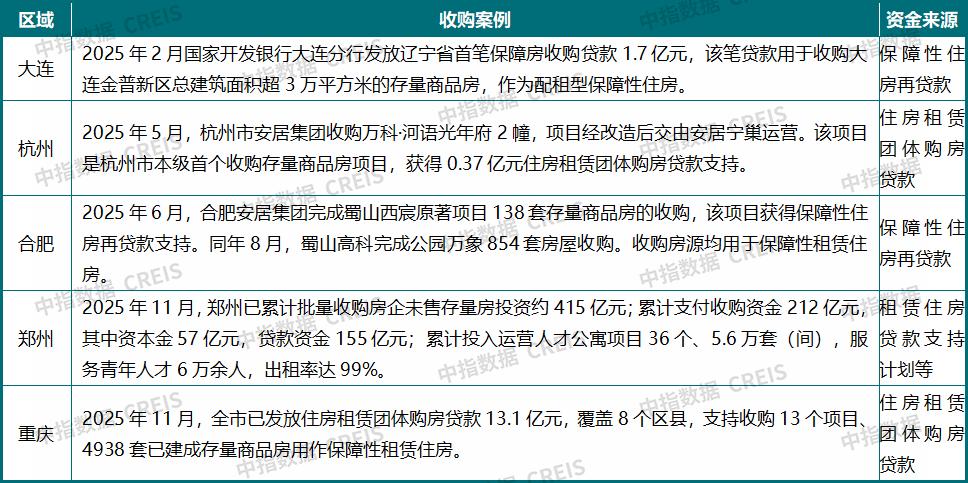
Data Source: China Index Academy Comprehensive Compilation
Since 2025, local government special bonds have also become one of the important funding sources for local governments to acquire existing commercial housing. Provinces and cities including Zhejiang, Sichuan, and Hunan have successively issued special bonds for acquiring existing commercial housing. According to incomplete statistics from the China Index Academy, as of the end of June 2026, provinces and cities have issued or plan to issue over 124 billion yuan in related special bonds, acquiring more than 20,000 units of existing commercial housing with a total floor area exceeding 1.68 million m². Among these, Zhejiang and Hunan have relatively faster progress in issuing relevant special bonds, with Zhejiang issuing over 40 billion yuan and Hunan over 35 billion yuan. Since 2026, overall issuance has accelerated to some extent, with local governments cumulatively issuing 6.6 billion yuan: Hunan issued 2.79 billion yuan in May, Guangdong 2.23 billion yuan in June, and Xinjiang 1.02 billion yuan.
1. Revitalizing Existing Commercial Residential Housing
(1) Acquiring second-hand housing to implement housing "trade-in" programs
The proportion of second-hand housing in market transaction volume continues to rise, making it an increasingly significant existing asset that cannot be ignored. On one hand, based on the acquisition of unsold newly built commercial housing, acquiring second-hand housing for functions such as affordable housing has gradually become an important tool for many cities to revitalize the real estate market stock and fill gaps in the housing security system. On the other hand, original second-hand housing owners will re-enter the market as purchasing power after their old properties are acquired, which also accelerates the destocking and revitalization of unsold existing commercial housing.
According to incomplete statistics from the China Index Academy, since 2026, over 60 housing "trade-in" policies have been implemented across various regions. Multiple cities including Shanghai and Guangzhou have explicitly supported the acquisition of second-hand housing, with continuously expanding usage purposes for the properties. For example, Guangzhou clearly specifies that acquired properties can be used as affordable housing, talent housing, market-oriented rental housing, resettlement housing, and for resale. Foshan promotes the work through a dual model of "acquisition for resale" and "acquisition for revitalization", and the expansion of property usage after acquisition also helps increase enterprises' willingness to participate in the acquisition.
Shanghai launched a pilot program for acquiring second-hand housing for affordable housing in Jing'an, Xuhui, and Pudong New Area in February this year. As of May 21, the pilot areas in Jing'an, Xuhui, and Pudong New Area have cumulatively acquired over 500 housing units, among which Xuhui District has acquired more than 450 units with the fastest progress. Xuhui District combines old housing acquisition with the "two old areas and one village" renovation, converting some old properties that do not meet renovation conditions into "New Era Urban Builders and Managers Homes" through government acquisition and renovation, realizing the functional transformation of existing housing stock. Since the second quarter, the second-hand housing acquisition pilot has been gradually expanded to all central urban districts. Guangzhou launched a second-hand housing acquisition pilot in May, explicitly targeting second-hand residential properties with a total acquisition price within 3 million yuan, a floor area below 70 square meters, and located within Guangzhou's Ring Expressway, while issuing "sell old and buy new" subsidies. As of the end of June, the first batch of pilot signings in Guangzhou has been completed, with 3 cases successfully signed.
(2) Implementing "housing voucher" resettlement, supporting in-situ reconstruction, and promoting revitalization of existing housing in conjunction with urban renewal
Many cities are currently revitalizing existing housing in combination with urban renewal, through methods such as "housing voucher" resettlement and supporting in-situ reconstruction.
The "housing voucher" resettlement method is implemented in conjunction with urban village redevelopment across regions, using housing vouchers to convert some completed unsold commercial housing into resettlement housing for expropriated residents. This approach avoids redundant construction of resettlement housing while also realizing the revitalization of existing commercial housing. Some cities have achieved good results through innovative measures: for example, in 2025, Guangzhou newly issued 2,852 housing vouchers with a total distribution amount of 3.9 billion yuan, which have been used 1,716 times totaling 2.133 billion yuan. Huangpu District issued over 2,400 housing vouchers in urban village redevelopment projects covering five villages and seven areas, with 6,671 units of properties subscribed via housing vouchers, covering a floor area of over 680,000 square meters with subscribed funds of approximately 11.8 billion yuan. The subscribed properties across different districts now cover regions including Haizhu, Tianhe, Baiyun, Nansha, Conghua, and Zengcheng. In addition, some cities have recently continued to optimize supporting policies for "housing voucher" resettlement, expanding the scope of housing voucher usage, improving acceptance among enterprises and expropriated residents, accelerating the implementation of housing vouchers, and better completing the destocking of existing commercial housing. For example, Guangzhou has explicitly implemented policies to promote "cross-district usage and city-wide applicability" of housing vouchers.
In-situ reconstruction takes property owners as the main responsible and funding entities for the project. With policy support in finance and approval processes, the reconstruction is promoted through a funding model dominated by owner self-financing and supplemented by policy subsidies. In-situ reconstruction of old housing can effectively revitalize existing residential stock. Local governments generally specify that appropriate increases in floor area are permitted in supporting policies, while providing financial subsidies. Recently, Shandong and Hunan have combined in-situ reconstruction with housing "trade-in" programs, launching a "demolish old and trade for new" model.
(3) Converting self-held properties to salable status
Between 2016 and 2021, multiple cities across China added the "land price cap, competitive self-holding" rule to land auctions, generating a