A new business in the AI circle: not selling courses, but establishing a distinct academic school
An AI community with a publicly reported user base of around 9 million hosts a fixed event every last Sunday of the month. It is not called an open class, not a training camp, not an exclusive sharing session, but the "AI Dueling Assembly" — "dueling" is a term borrowed from martial arts novels. This community is named "Way to AGI" (WaytoAGI), founded by AJ, who was dubbed the "Underground Sect Leader" by 36Kr.

This nickname is no joke. When an industry starts replacing classroom language with martial arts world jargon, the underlying business logic has already shifted: the previous generation of AI entrepreneurs stood on podiums to collect tuition fees, while the savviest players of this generation are founding sects, establishing schools, and building dojos — without rushing to charge fees first.
This is not an isolated case of a single sect. Looking deep into the AI landscape, numerous strongholds have sprung up. Of course, scammers who have infiltrated the scene have also changed their disguises — these two developments are inseparable and must be discussed together.
I. Course Sales Died From Content Inflation, But Anxiety Found a New Breeding Ground
AI courses have flopped repeatedly, yet the business has grown increasingly lively — only the rhetoric has been completely revamped.
Everyone has witnessed the fate of the old playbook. In early 2024, Li Yizhou's "Everyone's AI Course" sold roughly 250,000 copies at a promotional price of 199 yuan, generating about 50 million yuan in revenue within a year. It later collapsed due to padded content and absent after-sales support, with its mini-program suspended and WeChat Channel banned. A year later, he resumed selling courses. This cycle will continue — after all, there is no end to the anxiety that can be monetized.
But the phrase "cutting leeks" misses the core point. The real death of the course-selling model was not moral failure, but content inflation: large language models have driven the marginal cost of "explanation" to zero. Anyone who spends an afternoon asking AI questions can get beginner-level guidance that is no worse than a pre-recorded paid course. When a central bank prints unlimited currency, people hoarding cash inevitably go bankrupt; when AI generates unlimited content, people hoarding content to charge for access face the same fate. In April this year, the Ministry of Education and four other departments issued the "AI + Education Action Plan", which means AI literacy is becoming part of institutionalized public services. The business model that relies solely on charging for "AI literacy basic training" is narrowing.
The course-selling model is dead, but anxiety has not died — it has found a new breeding ground.
The anxiety in the first phase was the information gap: "Everyone else gets it, only I don't." The anxiety in the second phase is the certification vacuum: "Everyone claims to know AI, but no one can clearly define what it actually means to be proficient." Does writing prompts, using Cursor, or building an Agent Demo count as proficiency? Or does it only count if you can truly help the company save real money? Programmers have GitHub, designers have portfolios, but AI skills evolve too fast, have too blurry boundaries, and their results are too hard to standardize: today's tutorials become outdated in three months, and today's valuable prompts turn into default product buttons tomorrow. Certificates can only prove that you submitted assignments.
Courses solve the problem of "understanding", but what people in this era lack is "being seen" and "being recognized". Understanding can be taught by AI itself; being seen requires a venue; being recognized requires a community — the ancient organizational form of "sect" has been revived in the AI era right in this gap. It is inherently a certification system: who is a beginner, who is advanced, who has works, who is worth recommending, who is just a spectator. The information gap was the business of the first phase, while a sense of identity, a real combat arena, and like-minded peers are the truly scarce resources in this round.
II. Portraits of the Community: Five Paths to Founding a Sect
Looking at the top communities in today's AI circle, "founding a sect" is not a sudden inspiration from a single person, but a collective route choice by a generation of players — they just use different methods to establish their presence.
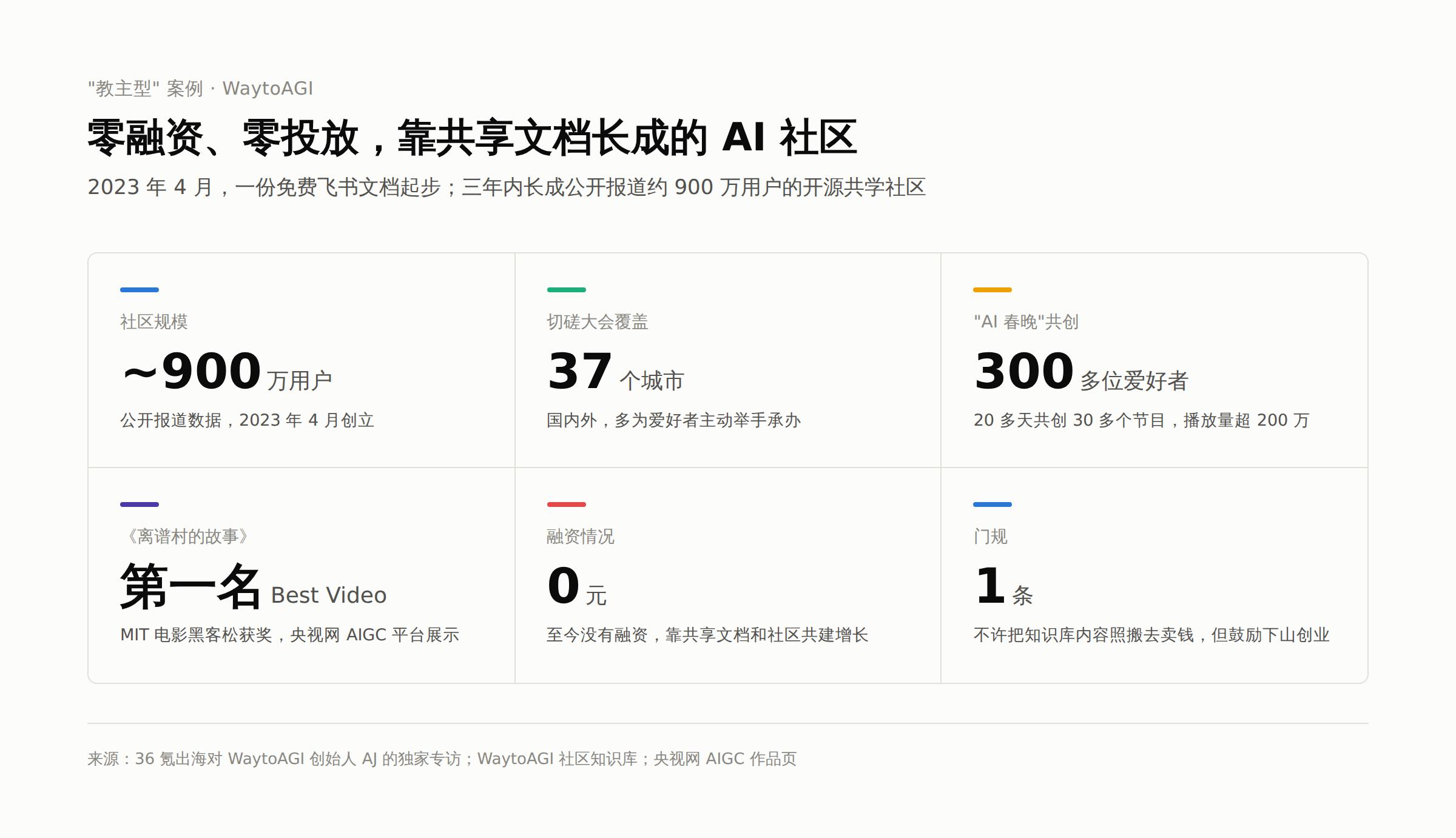
1. Sect Leader Type · WaytoAGI. On April 26, 2023, former product manager AJ organized the AI tools and tutorials he collected into a Feishu document, insisting on making it free and open-source. This document exceeded one million views in two to three months, has not raised any funding to date, and grew into a community of about 9 million users relying on shared documents and community co-creation. There is only one rule: no one is allowed to directly copy the knowledge base content for profit, but members are encouraged to master the skills and go out to start their own businesses. Disciples advance through duels rather than exams: more than 300 people spent over 20 days co-creating the "AI Spring Gala" with over 30 programs, which recorded more than 2 million video views; the co-created animation "Tales of Ridiculous Village" won first place for Best Video at the MIT Film Hackathon; the "AI Dueling Assembly" has spread to 37 cities at home and abroad, with many non-tier-1 cities voluntarily applying to host local chapters; WaytoAGI has even brought the assembly to Tokyo, aiming to export the connectivity of Chinese AI communities to overseas markets. It does not sell knowledge, but a sense of direction — organizing a group of people who fear falling behind from spectators into practitioners.
2. Academy Type · Datawhale. A sect older than this current AI boom — founded in December 2018, a full four years before ChatGPT. Its core method is "team learning": regular sessions, team check-ins, senior members guiding new members, paired with GitHub open-source textbooks like "Pumpkin Book", covering more than 400 universities at home and abroad during the pandemic. If WaytoAGI resembles a rising sect gathering in the mountains, Datawhale is more like a traditional academy: it does not rely on the charisma of a leader, but on the inherited structure of syllabi and academic systems. It proves that open-source collaborative learning is not a reactive product to AI anxiety, but an organizational form that can survive through technological cycles.
3. One-Trick-Pony Type · LangGPT. Yunzhong Jiangshu's LangGPT focuses on only one skill — structured prompts. With this single trick, it has earned over 10,000 GitHub stars, becoming the most popular prompt paradigm in the Chinese-speaking world, and its founder was invited to speak at the Yunqi Conference. By refining one skill into an industry standard, a sect can naturally establish itself. LangGPT's methodology was later included in WaytoAGI's knowledge base, and Li Jigang's prompt works circulate across multiple communities. Top talents move freely between different strongholds, with their reputations mutually recognized — the martial arts world thrives on mutual recognition, not territorial competition.
4. Alliance Leader Type · Founder Park. GeekPark's approach is to transform from a media outlet: instead of selling information, it acts as the organizer of grand martial arts assemblies. Its community serves AI entrepreneurs, and the annual AGI Playground brings together entrepreneurs, large tech companies, and investors for peer exchanges, while collaborating with Alibaba Cloud to support startup acceleration. Instead of mastering a single skill, it builds arenas, sets agendas, and issues hero invitations. Controlling the refereeing power over "who qualifies to take the stage" means controlling the discourse power of the entire community. When information is flooded by AI-generated content, the only way out for media is to shift from selling content to building their own strongholds.
5. Official-Academy Type · Vendor-Run Dojos. Every major large language model vendor has established their own developer community, the largest of which globally is Hugging Face — it disclosed that the platform had grown to around 13 million users and over 2 million public models by 2025. The unique feature of official-academy communities is that they are not just comment sections for content, but marketplaces for works: models are downloaded, fine-tuned, and derived, and their value does not depend on self-introduction, but on whether others reuse them. OpenAI's developer forum has evolved into a "troubleshooting community" — research shows that the unresolved rate of LLM-related questions on Stack Overflow is as high as roughly 79%, and real practical experience is not in the official documentation, but in the community's shared problem-solving records. The community has become half of the platform's after-sales department. However, official-academy sects have a weakness: disciples are loyal to resources rather than the sect itself, so if funding is cut off, people scatter. This explains why vendors are eager to collaborate with civilian sects: official academies have resources, while civilian sects have community loyalty, and both sides clearly know what they are missing.
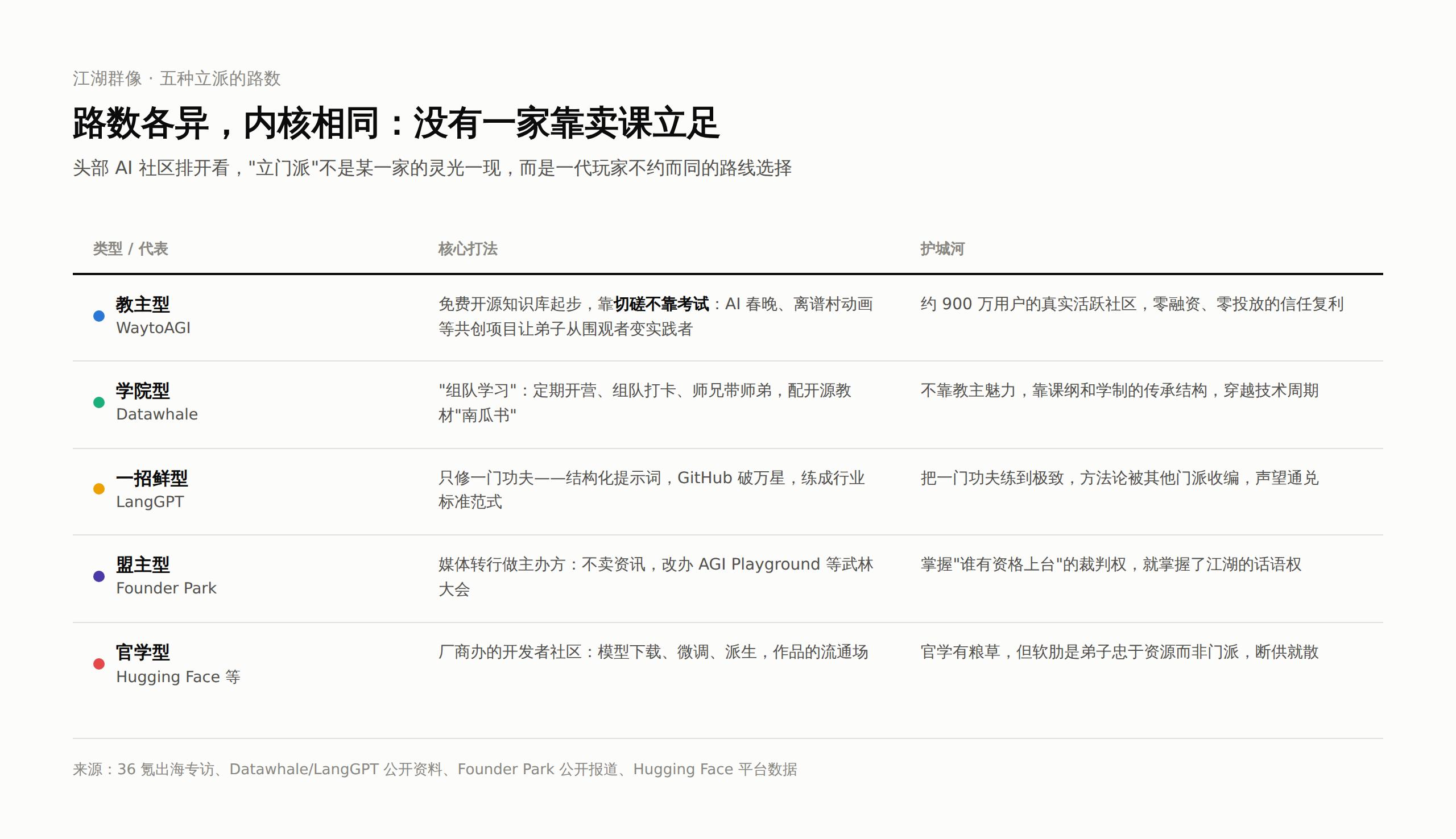
Of course, this is a list of surviving communities — countless groups and knowledge bases died quietly: abandoned by inactive leaders, rushing to monetize too early, or only having a chat group with no real activities. The five surviving communities have different approaches, but share one common trait: none of them rely on selling courses for survival, all of them are built on "organizing a group of people to grow stronger together". All their secret manuals are fully open to the public. The Shaolin Temple never makes money by selling copies of the "Yi Jin Jing" manual, but how much is the phrase "all martial arts under heaven originated from Shaolin" worth? In an era where everyone can print maps, the only thing that cannot be counterfeited is the temple gate itself.
III. Four Observations: What Exactly Are Sects Earning?
If we only stop at the point that "communities are more caring than courses", there is nothing new. Looking back at mid-2026, what really matters are the following four points.
1. User Organization Density. The paradox of this round of AI competition is that model capabilities are oversupplied while real-world usage scenarios are scarce: what vendors are most anxious about is not benchmark scores, but "who is actually using our products". App stores cannot deliver deep engagement, advertising cannot build trust, but sects hold organized, highly active armies of real users who can create their own use cases. Overseas investors paying attention to WaytoAGI's Tokyo conference, and Alibaba Cloud partnering with Founder Park, essentially both are "borrowing troops" from sects.
2. Profits Lie Down the Mountain, Not On It. The revenue formula for course sellers is "traffic × conversion rate × unit price", all three of which are declining; sects' revenues are hidden in their ecosystem niches: when enterprises want to implement AI solutions, their first stop is to find "the group of people closest to real practice"; when vendors host hackathons, they need influential organizers; Datawhale's open-source textbooks are published as formal books by publishing houses; WaytoAGI acts as a bridge for domestic projects expanding to Japan. Linux is free, yet Red Hat has a market cap of tens of billions of dollars. Free does not mean non-profitable, it just shifts the revenue point from content to the ecosystem — a step that the course-selling mindset can never take, because it requires you to not monetize for three years, slowly building trust over time. To be clear: this is completely different from "free first, then harvest later". Real sects keep their mountain venues free forever, their paying customers are never disciples, but enterprises and vendors down the mountain.
3. Taking Over the Definition Power of "What It Means to Be Proficient in AI". This is the flip side of the certification vacuum. When the AI industry has no standard job descriptions, no unified certifications, no mature evaluation system, questions like "who is proficient, whose works are worth viewing, who is worth recommending" remain unresolved. Whoever answers these questions will seize the industry's interpretative power. Sects make capabilities "visible" through duels, co-creation, and work circulation: resumes prove which companies you have worked for, while community records prove what you are doing right now and what you have accomplished. Traffic-based business earns attention, while interpretative power-based business earns standards, which is the real source of a sect's valuation.
4. The Most Visionary Point: A New Organizational Form Prototype. Sects may be the new organizational form prototype after the traditional company. Economist Ronald Coase explained why companies exist: repeatedly finding people, negotiating, and fulfilling contracts on the market is too costly, so it is more efficient to hire people in-house. But AI is driving this collaboration cost to the floor, making the classic reason for companies to exist increasingly irrelevant.
Behind this lies a more specific mechanism: companies exist not only because finding people is expensive, but also because turning a group of strangers into a team that can deliver results requires a dedicated layer of coordinators — project managers and management who break down tasks, review quality, and take responsibility. AI is precisely replacing this layer. Over 300 unknown volunteers can produce an "AI Spring Gala" in over 20 days not because someone breaks down tasks and reviews every layer, but because each person using AI tools can independently complete work to a deliverable standard, and the community only needs to provide a venue where "everyone is working on the same thing". In other words, AI is not just eliminating the marginal cost of knowledge, but also the marginal cost of coordinating a group of people to work — this is the real reason why sects can operate lighter and faster than companies.
The members of WaytoAGI who resigned from large tech companies and describe their lives as "wandering street drifters" are living examples: they do not belong to any company, but belong to a sect; they have no employment contracts, but share common skills, dueling venues, and community reputation. People like Li Jigang do not carry job titles from a certain company, but the identity of "prompt master".
When super individuals become the mainstream narrative, what individuals need is no longer an employer, but three things provided by a sect: skills (knowledge system), dojos (practical scenarios), and status (community identity). Whoever can deliver these three things at scale will hold the gateway to the AI-era talent market.
IV. Counterfeits Are Already On The Market: "Closed-Door Disciple" For 3299 Yuan Each
Every validated business model will see its counterfeits emerge within 90 days. Sects are no exception. And sect counterfeits are far more dangerous than course-selling counterfeits.
In November 2025, People's Daily and China News Service successively reported on a type of "AI training" scam targeting the elderly, whose price list is worth recording: free trial classes show screenshots of "earning 10,000 yuan a month", students pay 1,580 yuan as a "deposit" first, 2,680 yuan for the first phase of tuition, and then another 3,299 yuan for advanced classes — note that it is not called an "advanced class", but a "closed-door disciple" course. Old Liu from Hebei was pulled into a 1,200-person WeChat enterprise group, where the so-called skill was "earning 20 yuan by posting an ad"; Aunt Zhao from Hunan signed up for "one-on-one teaching", but it turned out to be one teacher for nearly 200 students, and she only got a 500-yuan refund — on the condition that she signed an agreement promising "no complaints, no disclosure to others". On the other side, the youth market is equally hot: a 4-day "AI illustrator" offline course priced at 2,980 yuan targets administrative staff, secretaries, and design practitioners who fear losing their jobs — the greater the professional anxiety, the wider the hunting ground for counterfeits.
