Is the physical AI premium of Momenta too high?
On the HKEX's giant electronic screen, the ticker 06880 flickered for the very first time. On July 8, five companies struck the gong for their Hong Kong listings, and Momenta was the largest among them in terms of scale.
Priced at HK$295.6 per share, the stock opened at HK$301, pushing its total market capitalization above HK$70 billion. Its public offering was 414 times oversubscribed, while the international offering drew over HK$100 billion in institutional orders. Fourteen cornerstone investors collectively subscribed for roughly HK$3 billion, with GIC and Fidelity International each investing US$100 million, in a rare coordinated move by Mercedes-Benz and BYD to boost their exposure.
In 2026, a year marked by broad stagnation across Hong Kong's tech sector, this level of market enthusiasm qualified as a clear standout against the trend.
Yet flipping through Momenta's prospectus reveals another set of figures: accumulated losses exceeding 9 billion yuan over three years, with the company still not having turned a profit. What makes a persistently loss-making firm so compelling that the world's most discerning long-term capital providers compete to place their bets?
Momenta's story began with an unconventional, rule-breaking decision.
In 2004, 18-year-old Cao Xudong was admitted to Tsinghua University from Gansu, majoring in Engineering Mechanics. After completing his undergraduate studies, he earned direct admission to the doctoral program, but during his PhD studies he developed a deep fascination for artificial intelligence, and made the unorthodox choice to drop out.
He later joined Microsoft Research Asia and then SenseTime, establishing deep roots in the AI industry, until 2016, when the 30-year-old Cao Xudong founded Momenta.
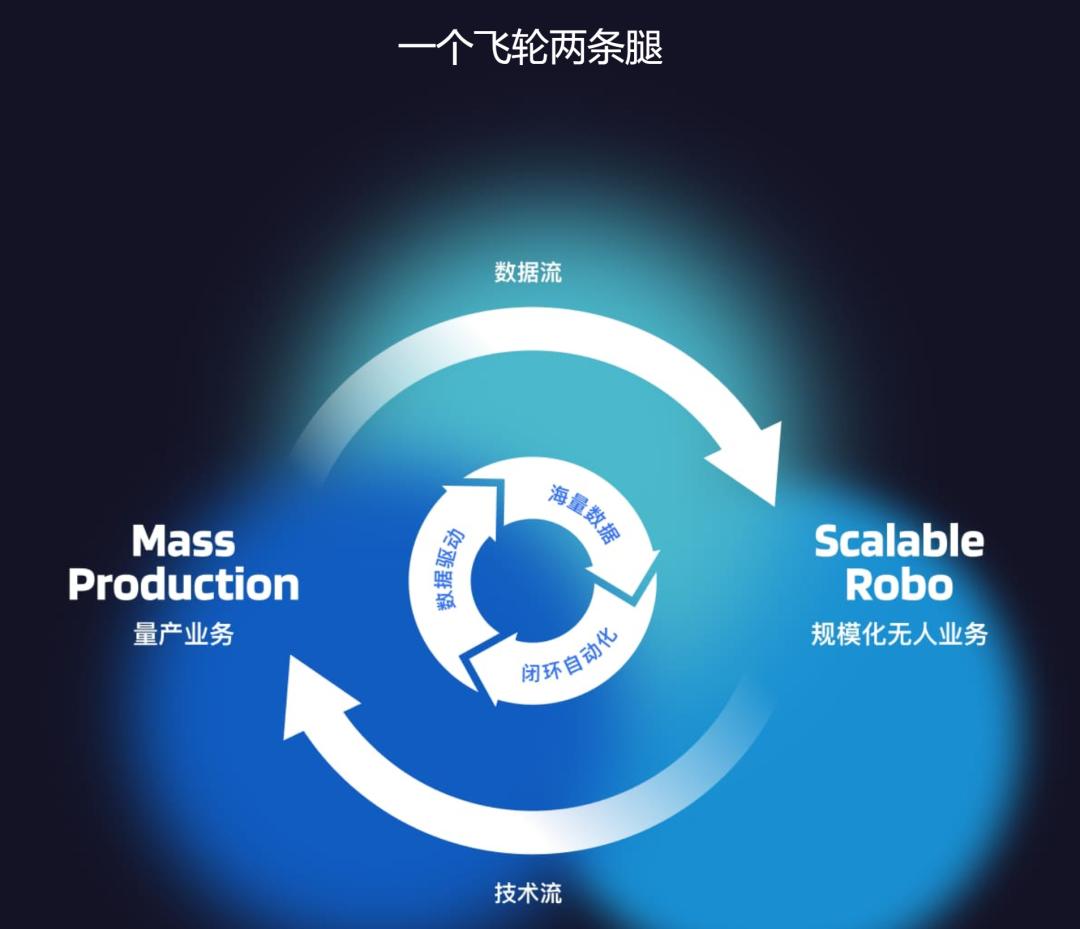
One flywheel, two pillars. Source: Momenta official website
At the early stage of his entrepreneurial journey, Cao Xudong set a strategy that was far from opportunistic: one flywheel, two legs.
The plan was to deliver L2+ assisted driving solutions for mass-produced vehicles, accumulate real-road driving data to refine algorithms, and then leverage these iterated algorithms to support the deployment of L4-level Robotaxi. Back then, the industry was caught up in a frenzy of betting on L4, with every company showcasing demos and rolling out test vehicles—pursuing L2 was nowhere near as glamorous as chasing L4.
In hindsight, it was this unglamorous path that Momenta successfully navigated. A decade later, Momenta stepped onto the stage of the Hong Kong Stock Exchange, branding itself as the "first stock of Physical AI."
This label sparked considerable debate across the industry. Yu Kai, founder of Horizon Robotics, posted a Weibo message shortly after Momenta launched its IPO roadshow, stating that Horizon "isn't very good at playing social games," has never engaged in the "XX first stock" gimmick, and jokingly referred to his company as "a rather boring enterprise." Though Yu Kai didn't name names, the timing and wording of his remarks led the public to widely interpret them as a veiled jab at Momenta's narrative packaging.
Is the title "first Physical AI stock" a genuine technological assessment, or a carefully packaged capital narrative? Behind its HK$70 billion market value, can Momenta's business model sustain such lofty expectations? Amid the accelerating in-house R&D efforts by automakers and intensifying industry competition, how will it defend its competitive moat?
1. Why has its gross margin outpaced CATL's?
The most eye-catching figure in Momenta's prospectus is its gross margin.
Between 2023 and 2025, its gross margin surged from 17.5% to 71.6%, a rarity in the automotive industry value chain. During the same period, Horizon Robotics recorded a gross margin of roughly 64.5%, CATL around 26%, and Tesla's automotive business approximately 18%.
For a company specializing in intelligent driving software to achieve a gross margin higher than the leading battery maker defies the logic of traditional manufacturing.
As disclosed in the prospectus, Momenta's revenue is split into two major segments: technology development services and licensing services. The former involves developing and customizing tailored intelligent driving solutions for automakers, generating revenue per project and requiring dedicated engineering teams for each engagement, with income tied to headcount. The latter collects royalty fees per vehicle sold after a model enters mass production; the R&D costs for software licensing are incurred upfront during the development phase, so every additional vehicle sold generates almost zero incremental costs.
In 2023, technology development services accounted for 96.8% of total revenue, while licensing services contributed only 3.1%. By 2025, the share of technology development services fell to 59.9%, while licensing services rose to 40.1%, skyrocketing from 23 million yuan to 968 million yuan—a 42-fold increase in three years.
Momenta's licensing service follows a "one-time R&D, full-cycle reuse" model, which inherently delivers high marginal returns. As such, the jump in gross margin from 17.5% to 71.6% is essentially not the result of cost control, but a transformation of its revenue structure.
While revenue and gross profit are on the rise, the company's net book losses are also expanding.
From 2023 to 2025, Momenta's net profit attributable to shareholders recorded losses of 25.70 billion yuan, 32.06 billion yuan, and 34.58 billion yuan respectively, totaling 92.34 billion yuan over three years. At first glance, this figure seems to contradict all positive indicators—how can a company with a gross margin above 70% still lose money at such a scale?
The bulk of these losses comes from "fair value changes of preferred shares and other financial liabilities." Simply put, this is a financial instrument provided to investors during pre-IPO financing. Preferred shares are accounted for as liabilities under accounting rules, and every time the company's valuation rises, this corresponding liability increases, with the incremental portion recorded as a loss. This item amounted to 11.90 billion yuan in 2023, 19.68 billion yuan in 2024, and 28.43 billion yuan in 2025.
The more valuable the company becomes, the larger its book losses appear—but this is not actual cash outflow, but a digital illusion created by accounting standards.
After excluding this item and other non-cash items such as share-based payments, the adjusted net loss narrowed from 10.93 billion yuan and 9.59 billion yuan to 3.03 billion yuan over the three-year period. Net operating cash outflow also shrank from 10.69 billion yuan in 2023 to 2.81 billion yuan in 2025.
While Momenta remains loss-making, its losses are narrowing rapidly.
The real cash drain comes from R&D. From 2023 to 2025, R&D expenses reached 12.81 billion yuan, 15.08 billion yuan, and 18.69 billion yuan respectively. In 2025, R&D expenditure accounted for 77.5% of revenue, with these funds invested in building three core technological moats: Physical AI, end-to-end autonomous driving, and reinforcement learning models.
2. Momenta adopted a higher-value brand positioning
Given that its operational performance is steadily improving, why did Momenta choose to rebrand itself on the eve of its IPO?
A frequently overlooked timeline: Momenta initially planned to list in the U.S. In June 2024, the China Securities Regulatory Commission approved its filing to issue no more than 63.35 million ordinary shares on the NASDAQ or New York Stock Exchange, positioning itself then as an "intelligent driving solution provider." That filing expired in June 2025, however, putting its U.S. listing plan on hold.
In March 2026, Momenta submitted a confidential prospectus to the Hong Kong Stock Exchange. When it re-emerged in the capital market, its new title was "the first stock of Physical AI." At the Beijing Auto Show in April that year, following the launch of its R7 reinforcement learning world model, Momenta formally introduced the "Physical AI" concept to the public for the first time in a systematic manner.
The timing of this brand switch perfectly aligned with the peak of the "Physical AI" concept's market hype.
In July 2025, Jensen Huang first explicitly stated that "Physical AI is the next wave of growth," and at the 2026 CES, he delivered a 90-minute speech declaring that "the ChatGPT moment for Physical AI is just around the corner." The market's enthusiasm for Physical AI stood in stark contrast to its growing fatigue toward the generic "intelligent driving" narrative.
The predicament of its peers speaks volumes: Pony.ai and WeRider both saw their share prices tumble below their issue prices immediately after listing, with market capitalizations falling to roughly HK$20 billion and HK$10 billion respectively. Horizon Robotics' stock price halved from its peak, at one point dropping below its IPO price, as the market's patience with the "intelligent driving" label was wearing thin.
Listing as an "intelligent driving solution provider" would have limited the market's valuation to its current operational performance, leaving little room for imagination. The "Physical AI" narrative, however, elevates Momenta from "a component in the automotive supply chain" to a player in the "AI infrastructure layer," shifting its valuation logic from "a company selling algorithm solutions" to "a platform player defining the next-generation computing paradigm."
GIC, Fidelity, and BlackRock are willing to take large positions in this unprofitable enterprise precisely by betting on this narrative.
Meanwhile, Momenta's IPO price was set at HK$295.6, giving it a post-IPO total market capitalization of HK$696 billion (approximately US$90 billion) excluding the greenshoe option. Based on its 2025 revenue of 2.413 billion yuan, its price-to-sales ratio stands at roughly 25x.
In comparison, Horizon Robotics has a market capitalization of around US$7.58 billion, and Pony.ai roughly US$3.017 billion—both lower than Momenta's valuation. With its "Physical AI" positioning, Momenta has secured a higher valuation than all other publicly listed intelligent driving peers.
This valuation premium essentially reflects the market's preference for one valuation logic over another.

Momenta corporate overview. Source: Momenta official website
A company can self-claim a label, but market acceptance is a separate matter. Momenta's "first Physical AI stock" positioning has gained market traction thanks to its solid foundations: data scale, technological implementation, and commercial closed loop.
Data scale: The core of Physical AI is to enable machines to understand the physical world, which requires exposure to a sufficient number of real-world samples. By the end of 2025, over 900,000 mass-produced vehicles equipped with Momenta's systems had accumulated a total driving mileage exceeding 120 billion kilometers. These vehicles function as mobile data collectors, a data acquisition capacity that pure L4 autonomous driving companies cannot match.
Technological implementation: In April 2026, the R7 reinforcement learning world model made its mass-production debut. Momenta became the world's first third-party intelligent driving company to achieve nationwide coverage of map-free urban NOA, the first to mass-produce an end-to-end large model, and the first to deploy a reinforcement learning model in mass-produced vehicles. While most Physical AI players are still stuck in lab demonstrations and proof-of-concept phases, the R7 has already been integrated into production vehicles.
Commercial closed loop: Cao Xudong adheres to a "ticket theory"—to achieve general Physical AI, a company must maintain cash-generating businesses. Momenta's L2++ mass-production business generates revenue and real-road driving data, while its L4 autonomous driving business validates upper technological limits and feeds back into its mass-production system. Currently, the only Physical AI scenario that simultaneously enables data scaling and business scaling is autonomous driving, and Momenta has already established a complete closed loop from data generation to model development to commercialization in this domain.
Judging from its first day of trading, the market has given Momenta a vote of confidence: its share price rose over 6% at the open, pushing its market capitalization above HK$70 billion.
3. Why is Horizon Robotics growing uneasy?
The most thought-provoking episode surrounding Momenta's listing is not its winding path to going public, but the Weibo post from Horizon Robotics founder Yu Kai.
Yu Kai wrote on social media, "Horizon isn't very good at socializing, we've never hyped the 'XX first stock' gimmick—we're a pretty boring company." Later that afternoon, he commented on a netizen's post, "It's not that we've softened our stance; we're just busy serving clients and have no time to play with stock prices."

Horizon Robotics founder Yu Kai's social media remarks. Source: Yu Kai's personal Weibo
The tensions between the two companies are not unfounded. The competition between Horizon Robotics and Momenta is shifting from differentiated positioning to direct head-to-head rivalry, centered on the collision of two distinct business models within the same market.
Horizon Robotics started its journey with chips.
Founded in 2015, Horizon Robotics has focused on developing automotive-grade AI chips. Its Journey series chips are its core products, with total shipments exceeding 4 million units in 2025, representing a 39% year-on-year increase. Shipments of chips supporting mid-to-high level intelligent driving functions reached 1.8 million units, nearly 5 times the volume of the same period in 2024, accounting for 45% of total shipments. As of August 2025, cumulative shipments of the Journey series surpassed 10 million units.
A defining feature of the chip business is that once adopted by automakers, chips become deeply embedded in the vehicle's electrical and electronic architecture, resulting in extremely high switching costs. Even if automakers develop algorithms in-house, it is difficult to replace a widely deployed chip platform. This physical lock-in effect forms Horizon Robotics' core competitive moat.
In 2025, Horizon Robotics generated 3.76 billion yuan in total revenue, a 57.7% year-on-year increase. Its overall gross margin reached 64.5%, with the automotive business segment recording a 67.2% gross margin. Its revenue structure is split into two parts: product and solution revenue reached 1.622 billion yuan, a 144.2% year-on-year increase, raising its share of total revenue from 28% in 2024 to 43%; licensing and service revenue hit 1.935 billion yuan, a 17.4% year-on-year increase.
Notably, the licensing business boasts a gross margin of 94.5%, serving as a stable profit source for Horizon Robotics. By contrast, the gross margin for product solutions is only 34.5%. In other words, Horizon Robotics is leveraging chip hardware to expand its market presence and generating profits through software licensing