A long-overdue violent rebound
Entering July, new shifts have emerged in the global capital markets.
A typical manifestation is that the once red-hot memory semiconductor sector, which dominated the market over the past six months, has fallen into deep correction. The stock prices of related concept stocks including Samsung Electronics, SK Hynix, Micron, and SanDisk have all retreated from their highs, with some already stepping into a technical bear market (a pullback of more than 20%).
On the other hand, markets that had previously underperformed are seeing sustained rebounds, such as the Hong Kong stock market.
The Hang Seng Tech Index, after hitting its bottom on June 26, has led the gains among major global indices.
01
Why the Rebound?
A close analysis of the recent Hong Kong stock market reveals a series of key signals:
First and foremost is the policy front.
On July 7, the Hong Kong Fixed Income & Currency Summit and Bond Connect Forum was grandly held. Pan Gongsheng, Governor of the People's Bank of China, made an extremely significant public statement at the event:
"Going forward, the national foreign exchange reserves will continue to increase their asset allocation proportion in Hong Kong, injecting more momentum into the development of Hong Kong's capital market."
The Governor also focused on supporting the development of Hong Kong as an international financial center by outlining four core directions of arrangements and measures, namely:
Deepen the interconnection of financial markets to support the prosperity and development of Hong Kong's capital market; support Hong Kong in developing a diversified financial market; consolidate Hong Kong's status as a hub for offshore RMB business; and firmly safeguard Hong Kong's financial stability and security.
Second is the valuation front.
Over the past six months, the Hong Kong stock market has clearly underperformed the South Korean, Taiwanese, Japanese, US, and A-share markets, with the Hang Seng Tech Index posting a year-to-date decline.
This trend has not only widened the AH share premium but also pushed the price-to-earnings ratio (PE) of the Hang Seng Tech Index to a historical low at the 28.71th percentile since its launch. Calculated based on the index's low point in late June (4,229 points), the historical percentile was even lower than the current level.
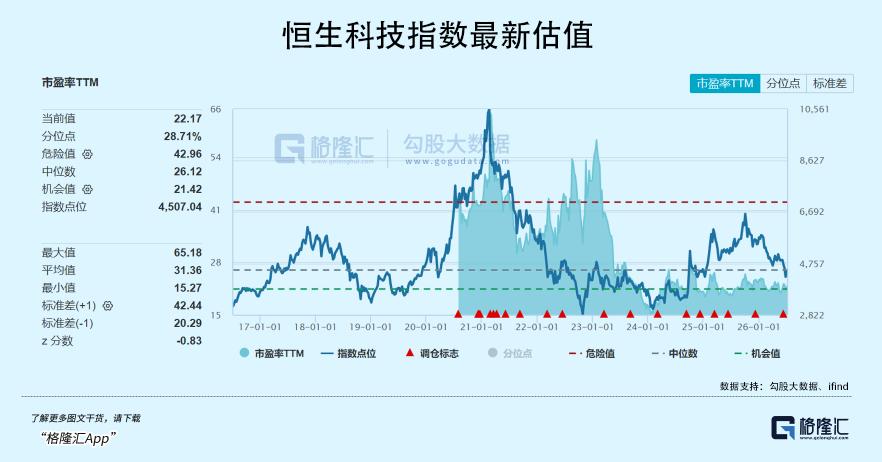
In comparison, the Nasdaq 100 Index has a latest valuation of 33x, located at the 69.58th percentile of its 10-year historical range.
On the fundamental front, although the Hong Kong stock market still lacks memory semiconductor targets like Samsung Electronics, SK Hynix, and Micron, there has been no shortage of AI-related news recently.
These include:
Meituan launched LongCat-2.0, a trillion-parameter large model that is the world's first trillion-parameter model fully trained using domestic computing power throughout the entire process.
Tencent's newly released Hunyuan Hy3 on July 6 delivers performance in its small model that matches flagship large models with 2-5 times more parameters in multiple evaluations.
Around the same period, Kuaishou's Kling AI completed an independent financing round of $3 billion, with a post-money valuation of up to 18 billion RMB, directly setting a new global record for the largest financing in the video large model sector.
Behind Meituan, Tencent, and Kling lies a wealth of AI application scenarios.
Notably, the "AI content" of the Hang Seng Tech Index has risen sharply.
On June 8, Zhipu AI and MiniMax were included as constituent stocks of the Hang Seng Tech Index, while Kingdee International and Kingsoft Software were removed.
According to estimates from Soochow Securities, the AI-related weighting will rise from around 25% to 40%, which is expected to drive $1.25 billion to $1.75 billion in passive capital inflows.
On the capital front, over the past six months, global capital has almost collectively piled into the AI hardware sector (memory, computing power, optical modules, PCBs, etc.) for speculative gains.
However, after hitting the June highs, the memory sector began to correct. Even in the face of Samsung Electronics' latest earnings report showing a 1,800% year-on-year profit surge, its stock price plummeted with massive capital outflows.
Morgan Stanley's latest research report also put forward the view of "selling chips, buying cloud technology."
This Monday, southbound capital's net buying of Hong Kong stocks exceeded 20 billion RMB, and net buying surpassed 7 billion RMB again this morning.
All these factors combined have created a resonance that collectively shapes the trend of the Hong Kong stock market.
02
How to View Morgan Stanley's "Sell Chips, Buy Cloud" Call?
When talking about shifts in global capital styles, it is necessary to revisit Morgan Stanley's perspective.
Michael Wilson, Chief US Equity Strategist at Morgan Stanley, presented new views to global clients in his latest weekly report:
Underweight semiconductor chips and fully shift to hyperscale cloud service providers.
The analyst used a metaphor:
Previously sought-after semiconductors and memory chips are trending like "silver" in commodities, with their parabolic surge having already peaked; the next phase will belong to "cloud and application giants" that possess real scenarios and ecosystems.
The impact of these views on capital styles operates on two levels:
1. Valuation Front
Morgan Stanley points out: The demand for chip manufacturers fundamentally depends on the willingness of cloud giants to spend on capital expenditures.
While cloud giants' capital expenditures have surged this year and may continue to rise next year due to chip price hikes, given that the market is increasingly strict and less tolerant of cloud giants' ROI requirements, valuations and stock prices have continued to fall, and the giants themselves are facing severe ROI pressure.
This is why many cloud service providers are actively promoting various cost reduction measures, innovating financing methods, and accelerating the return of profits and cash flows.
As the construction of computing power centers advances, more and more centers will be put into operation. At that point, capital expenditures will gradually be converted into realized assets, contributing to revenue, profits, and cash flow.
Coupled with the simultaneous expansion of new chip production capacities, if the upward trend in chip prices hits an inflection point due to the release of new capacity, the cost side of cloud service providers will also see new changes.
These trends are not limited to the US stock market but will also spill over to other markets.
The Hong Kong stock market is home to many cloud giants, such as Tencent Cloud and Alibaba Cloud, whose overall company PE stands at 16-17x, lower than the valuations of US giants like Microsoft and Meta (22-23x).
2. Business Model
Cloud technology and application companies do not exhibit the obvious cyclicality of hardware businesses; instead, they are more like businesses built on "ecosystems and user stickiness."
China's internet giants have solid fundamentals and near-monopolistic positions in the application layer. Even without the AI narrative, their existing businesses deliver high profit margins and strong cash flows.
Although they have been overlooked for the past six months, as the hardware sector pulls back from highs and risk appetite shifts, Hong Kong-listed tech stocks, backed by cloud and application ecosystems, are offering the market a new alternative.
Of course, whether Morgan Stanley's latest view will materialize as expected ultimately depends on the market and capital trends, requiring further data validation.
03
Key Focuses Going Forward
Although the Hong Kong stock market has seen a strong rally recently, with particularly impressive performance today, investors should maintain a balance between optimism and caution.
This is because two core factors will influence the market going forward.
Factor 1: Interim Financial Reports
If this rebound is driven by "sentiment recovery," "AI investment style shift," "valuation repair," and "official policy signals," then whether Hong Kong-listed tech stocks can hold their ground will depend on the upcoming earnings season.
The market wants to see whether major large models can genuinely reduce operating costs, improve profit margins, and boost cash flow levels in their financial results. It also wants to verify whether these models have brought tangible incremental revenue from advertising and enterprise-level SaaS, and what the actual willingness of users to pay is, among other metrics.
If the interim reports show that capital expenditures remain high and profits still lack flexibility, the upward momentum of this round of rebound is likely to weaken.
Factor 2: Liquidity
The net buying of Hong Kong stocks by southbound and foreign capital over the past few months has been weaker compared to the same period last year.
Although southbound net buying has increased this week, its sustainability remains to be observed. Even if net buying continues, it is necessary to examine the flow structure: if capital only flows into the "high-dividend traditional state-owned enterprise" sector instead of AI technology, the tech sector will easily face a phase of "insufficient endurance."
On the foreign capital side, trends are constrained by the Federal Reserve's monetary policy, which currently shows significant uncertainty, with mixed voices supporting both rate hikes and rate cuts. Geopolitical conflicts, oil prices, and inflation also remain volatile. Leading global institutions such as Goldman Sachs have pushed back their forecasts for the Fed's next rate cut to the end of 2026 or even 2027.
As long as the Fed chooses to stay on hold with interest rates in the 3.50%-3.75% range, it means the high-yield dividend of the US dollar will continue to exert a strong siphon effect, compressing the "risk premium" of tech stocks.
Therefore, close attention must be paid to the Fed's policy signals.
In addition, the recent wave of IPO unlocks in the Hong Kong stock market involves a large amount of capital, requiring vigilance against the market's "capital drain" effect.
04
Conclusion
The Hong Kong stock market, which has been in the doldrums for far too long, has finally embarked on a rebound driven by the resonance of multiple factors.
Hong Kong-listed tech giants, which have been suppressed for too long, are finally gaining market attention as they enter the era of AI cloud computing and applications.
However, there are still many tests ahead. It remains to be seen how they can turn their AI narratives into tangible profits through solid financial statements and real profitability.
As investors, it is advisable to maintain a calm mindset and observe the market as it evolves.
This article is from the WeChat public account "Gelong", written by Shen Peng, and published with authorization from 36Kr.