The return of the founder ushers a new stage for a high-growth company.
In late June in Zurich, the Limmat River flows past the rear of the On Labs building. Olivier Bernhard, one of the three co-founders of On, stood before a group of running and business journalists and opened with a slightly apologetic line: "This is not the kind of glossy, polished showcase space."
He reminded the visitors that they would soon see engineers wearing safety goggles, designers with blue dye on their fingertips, and athletes pushing themselves to their limits, sweating profusely on treadmills. This marked the first time On had pulled back the curtain on its innovation engine — the usually tightly closed doors of On Labs — for external media.
The choice to open its doors at this moment was no coincidence. Founded in Switzerland in 2010 by former triathlete Olivier Bernhard alongside David Allemann and Caspar Coppetti, the company now finds itself at a delicate juncture.
Just over a month ago, the company completed a major leadership reshuffle. Co-founders David Allemann and Caspar Coppetti took over from Martin Hoffmann, who had served as CEO for five years, to return as co-CEOs, bringing the founding team back to the front lines of operations.
At the same time, the company delivered its strongest set of results since going public. In the 2025 fiscal year, On's full-year net sales surpassed 3 billion Swiss francs for the first time, reaching 3.014 billion, a 30% year-on-year increase; at constant exchange rates, the year-on-year growth hit 35.6%. Gross margin rose to a record high of 62.8%.
Entering 2026, this growth trajectory has continued. In the first quarter, the company recorded net sales of 831.9 million Swiss francs, a 43% year-on-year increase; net profit surged by more than 80% year-on-year, and gross margin further improved to 64.2%. For a sportswear brand, this level of profitability is extremely rare, even approaching that of some luxury goods groups.
More notable than the profit figures, however, is the source of this growth. In 2025, revenue from the Asia-Pacific market jumped 96.4% year-on-year, surpassing 500 million Swiss francs for the first time and accounting for more than one-fifth of global revenue, making it the company's fastest-growing region.
Within this region, China remains the most critical growth engine. Over the past year, On secured a spot in the top five best-selling running shoes in the price bracket above 140 Swiss francs (approximately 1,177 RMB) during Tmall's Double 11 shopping festival; during the Spring Festival, foot traffic at many of its stores doubled; after the opening of its flagship store at Shenzhen MixC World, apparel sales have exceeded 20% of total in-store revenue.
For a brand that has long relied heavily on its footwear business, this means consumers are beginning to embrace its full lifestyle product range, rather than just a pair of running shoes.
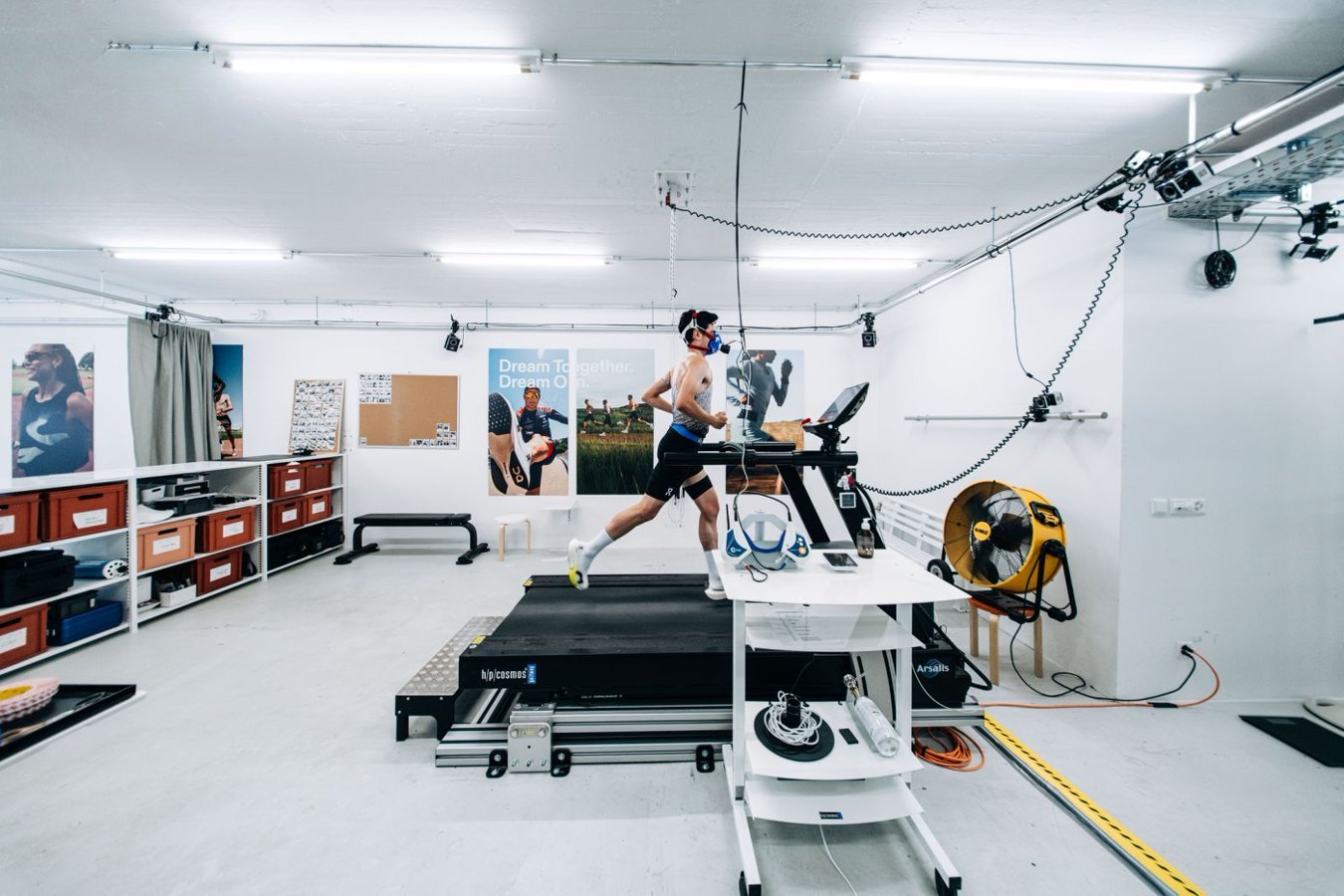
On Labs
When discussing the Chinese market, David Allemann did not directly address sales figures, but instead spoke about his most recent visit to China, where he saw many elderly people in their 70s and 80s sticking to morning exercise in a park at dawn.
"Many Europeans don't start taking exercise seriously until they retire, but in Asia, movement is far more integrated into daily life as a natural part of lifestyle."
In his view, this is the very reason behind On's "Movement Class" philosophy — the company aims to reach not just professional runners, but the growing number of people who see physical activity as a core part of their everyday lives.
On is exactly the newcomer that has challenged Hoka's dominant position in the premium running shoe segment. For comparison, the running shoe business of Hoka's parent company Deckers has seen its growth rate slow from 24% to the mid-teens, with around 80% of its total revenue still dependent on the running shoe category. Amid dual pressures from tariffs and cautious consumer spending, analysts have begun to express concern that Hoka's iconic thick-soled design may have "passed its peak". On, by contrast, seeks to tell a development story that is not constrained by a single product category or a single design aesthetic.
What is truly worth documenting, however, is not these growth metrics, but the counterintuitive statement that On emphasized repeatedly during the event.
When Caspar Coppetti took the floor, he said: "When people think of On, the first thing that comes to mind is usually the 'holes' in our midsoles. But we hope that after today, you will understand that the core of On is not the holes — it is something entirely different: structural engineering."
Behind this statement lies a revolution that has swept through the entire running shoe industry over the past three to four years. Carbon plates and super foams have accelerated the widespread accessibility of top-tier competitive performance. In Caspar's words: "This is the best era ever to be a runner, and the best era to be a running brand, because for the first time, technology has made running easier for everyone." The trade-off, he added, is that "no world record is absolutely safe anymore."
The flip side of this coin, however, is that when every brand can source similar super foams, the foam itself no longer creates meaningful differentiation. "Simply having foam is no longer enough to stand out," he explained.
This reality has pushed On to dig deeper to build its competitive moat: structural foam engineering. A single solid block of foam molded directly into a midsole will only produce a shoe that is soft but lacks support, and even drains away energy with each step. On's solution uses geometric structures to give the foam distinct mechanical properties — soft at landing, yet explosive during toe-off.
According to the company, its new-generation foam is nearly half the weight of previous versions, with energy return improved by 60% to 100%. The foam competence center that supports this R&D system is the only one of its kind outside Asia. The company has even built an acoustic laboratory to test the quietness of running shoes during foot strike, a practice more commonly seen in luxury automobile development.
Olivier Bernhard summed up this logic succinctly: "If you only have foam, you just keep swapping out materials — that's simple. But once you introduce structure into the mix, you open up a whole new toolkit of possibilities." In his view, this represents both On's greatest potential and its biggest challenge, as the real difficulty lies in striking the perfect balance between materials and structure.
If structural engineering is On's defensive bulwark, then LightSpray is its offensive breakthrough.
David Allemann held up two pairs of Cloudmonster 3 Hyper that looked almost identical from the outside, differing only in their uppers. Traditional upper manufacturing requires roughly 200 separate processes, but LightSpray uses a single continuous 1.5-kilometer fiber to spray-weave the upper in one step, creating a seamless, glue-free production process that reduces the shoe's carbon footprint by 65% compared to its woven counterpart.
More importantly, this technology rewrites the rules of the supply chain. Robotic production units can be deployed in Switzerland, South Korea, or any market close to consumers. At a time when tariffs and nearshoring have become shared concerns for global brands, this flexible manufacturing capacity — enabling rapid production wherever demand arises — is just as significant as the weight and carbon reductions it delivers.
Of course, On has no intention of keeping LightSpray confined to concept demonstrations. Six elite female runners, including Hellen Obiri, have already set new personal bests wearing the Cloudboom Strike 2, equipped with the brand's new Sphere midsole. Allemann urged journalists not to "judge LightSpray only with their eyes", but to see it as a full-fledged technology platform that will bring elite competitive performance to mass-market products in the future.
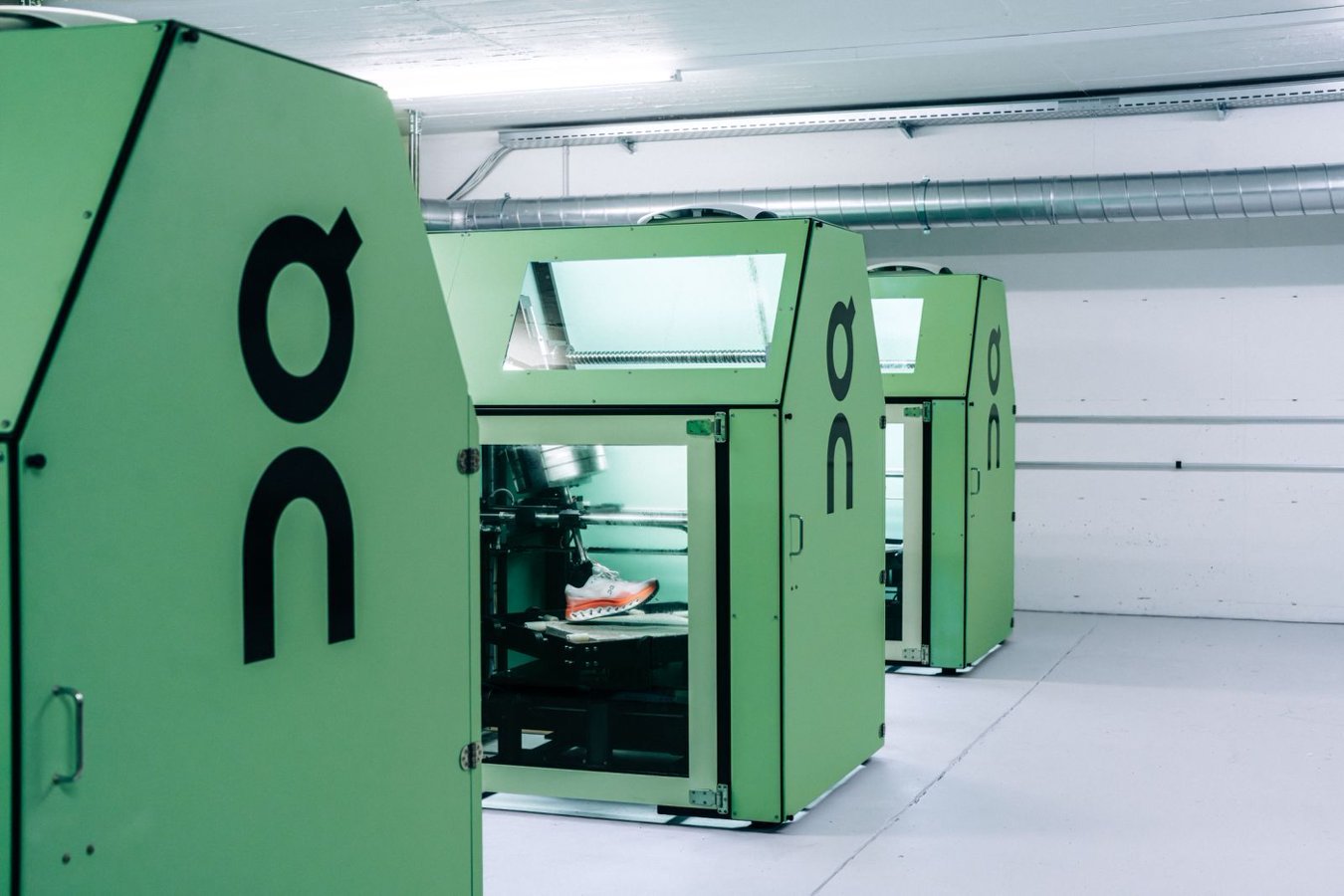
On's LightSpray factory in Busan
This entire approach ultimately leads to On's unique definition of "premium". In an exclusive interview with 36Kr, David did not frame premium positioning as a pre-set price target, but as a natural outcome of innovation. "A premium position is itself a byproduct of continuous innovation." From CloudTec to super foam, and now to LightSpray, sustained innovation has forged the brand's premium identity; the fact that partners like Roger Federer, Zendaya, and Loewe have all proactively sought collaborations has further reinforced this cultural influence.
He prefers to talk about "Engineering an Emotion" — an emotion that draws half its power from function and half from aesthetics, two pillars that have developed in parallel since the brand's very founding.
As for how "crazy" projects like LightSpray ever came to life, Olivier offered a surprisingly simple answer: a culture that tolerates failure, and the non-negotiable free exploration time that the innovation team enjoys every Friday. He recalled an early experience in China where a group of engineers spent half an hour discussing a problem before putting down their pens and saying "this is impossible" — and his response was "Perfect." Because the very fact that no one has done it before is exactly what makes it worth doing.
Over the past five years, Martin Hoffmann led the company through its public listing and built a more mature global operational system. Now, with the two co-founders back at the helm, the company must preserve the innovative agility of its startup days while also managing the increasingly complex operational demands of a global consumer enterprise.
By choosing this moment to open On Labs to the public for the first time, On is in many ways showcasing its core thesis: when foam is no longer a secret, and materials become ever more accessible, what is truly irreplicable is not any single proprietary formula, but the ability to integrate materials, structure, manufacturing, and brand into a continuously operating innovation ecosystem.
For the capital markets, this remains an ongoing validation process. For the entire running shoe industry, however, this may very well be where the next round of real competition begins.