Finally, the market has gained a full picture of Alipay's AI strategy.
By | Wang Yi
After three consecutive months of product launches, Alipay's strategic blueprint for the Agent business era has finally been fully unveiled to the market.
From releasing a full-stack AI payment product in May to build a trust foundation for agent transactions, to revolutionizing the C-end interaction paradigm with the "most significant overhaul in history" AI-powered Alipay in June, and now opening its platform to connect the entire industry's full-service ecosystem, three core capabilities—the underlying payment trust system, user interaction entry point, and cross-device open ecosystem—have been successively implemented.
In the just-concluded June, NVIDIA CEO Jensen Huang publicly declared that "the Agentic AI era has fully arrived," while Qualcomm CEO Cristiano Amon went a step further by defining this year as the "Year of the AI Agent." Across China, major tech companies are ramping up investments in their own large models, end-devices, and application ecosystems.
Against this backdrop, Alipay's recent series of moves are far more than isolated feature updates—they represent a strategic bet rooted in the fundamental logic of the Agent economy. While the industry is generally focused on its own ecosystems and competing for short-term existing market share, Alipay has stepped away from the immediate rivalry over traffic and scenarios, choosing a path of full-domain openness anchored in long-term incremental growth.
01. The Interaction Revolution Has Arrived
The starting point of this new transformation is a complete reversal of the interaction logic between people and services.
In the mobile internet era, commercial activities relied on apps and mini-programs. Users typically had to proactively open apps, search, and navigate through multiple layers to complete the one-way interaction of "people seeking services," with platforms competing primarily to seize centralized traffic entry points.
In the agent era, however, the interaction medium shifts from software apps to agents with autonomous execution capabilities. Users only need to issue a natural language command, and the agent can independently complete requirement breakdown, multi-service integration, and payment fulfillment—gradually moving the market toward task-based transactions where "services find people."
This fundamental transformation is also the core logical origin of Alipay's three-step product layout.
The AI-powered Alipay "Abao" launched in June is defined as Alipay's "most significant overhaul in history": the product interface has been completely simplified, retaining only the conversation entry and asset overview. Tens of thousands of lifestyle, government, and transportation services have all been integrated into the conversation system, allowing users to complete complex needs like checking provident fund balances, booking charging sessions, and purchasing tickets with a single command.
Through "Abao," Alipay has validated the C-end interaction paradigm and truly implemented the product form of "services finding people."
Prior to that, at the AI Payment Ecosystem Conference in May, Ant Group CEO Han Xinyi's public speech previewed the commercial transformation spawned by this interaction revolution.
Han Xinyi believes that agents are reshaping commercial decision-making power, shifting the market from traditional product and individual service transactions to complete task transactions. The market structure will also evolve from a two-sided platform consisting of users and merchants to a multi-party collaborative network including users, merchants, large model vendors, smart end-devices, and payment networks.
"Today China has 1.4 billion people. I believe in the future, there may be 14 billion, or even 140 billion agents active in economic activities," Han Xinyi noted at the conference, adding that a large number of interactions will occur between humans and agents, and between agents themselves. This will directly weaken the existing traffic logic while the logic of trust will rise to prominence.
In other words, a full-link trust system will become the core benchmark for new commercial competition.
The reason why many current agents excel at information processing but lack capital flow capabilities is that they are missing a supporting payment trust foundation.
In this context, Alipay's full-stack AI payment product released in May is designed to build an underlying trust foundation for massive agent interactions.
Specifically, the upgraded 2.0 ACT Agent Commercial Trust Protocol collaborates with more than 20 industry chain vendors to build the A2A and A2M agent transaction framework, clarifying standards for agent authorization, fund deduction, behavior tracing, and accountability. This addresses the compliance and security pain points of AI autonomous transaction execution, making payment an indispensable trust layer for the agent economy.
After establishing the trust foundation for agent transactions and effectively implementing the "services find people" entry point, the newly launched AI Open Platform connects the entire industry, all end-devices, and all large models through an agent interoperability channel, completing the external output layout of Alipay's AI strategy.
Currently, smartphones, car infotainment systems, AI glasses and other wearable devices, IoT smart devices, and third-party large models operate independently. Merchants need multiple adaptation systems to integrate their services, resulting in high R&D and operation costs. Leveraging the MIIT-certified AHA cross-device protocol, Alipay's AI Open Platform enables one-time integration, multi-device distribution, and unified management.
In short, Alipay's AI Open Platform builds a full-stack agent cross-device interconnection infrastructure that covers the entire lifecycle of agents from generation, distribution, interaction to payment.
For the industry, this full-domain interoperability logic represents the proper form of future agents, driving the large-scale expansion of the agent network.
02. Collective Bet on Agents: Giants Return to the Starting Line
In the Year of the AI Agent, the consensus among global capital and tech companies is that agents represent the core incremental growth area for the next phase of AI. Overall, leading domestic tech companies have transitioned from large model R&D to full-scale implementation of agent scenarios and ecosystem construction, making the agent track a direction with high certainty and rapid implementation pace across the entire industry.
Observing the previous layouts of leading tech giants, clear mainstream trends have emerged.
Tencent, deeply relying on WeChat's social and mini-program ecosystem, launched a gray-scale beta test for "Xiaowei," WeChat's built-in AI assistant, in June. It aims to build smart assistants adapted to private domain operations and daily service scenarios, keeping all service flows and scenario operations within its own ecosystem.
Huawei focuses on building a software-hardware integrated agent system, leveraging its Pangu large model, Ascend computing power foundation, and HarmonyOS end-device ecosystem to develop agent capabilities. It continues to implement solutions with built-in agents on end-devices and industry scenarios, improving hardware-side agent adaptation capabilities.
Baidu and ByteDance lean more toward lightweight tools and ecosystem openness, centering on large model capability output, developer platforms, and traffic distribution to continuously lower the barriers for agent development and integration, providing basic AI capabilities and scenario plugins for the industry.
While each company has its own focus, a shared trend is evident: most are building on their own ecosystem scenarios to strengthen their existing advantages. On July 7, Alipay launched its AI Open Platform, introducing a new commercial agent infrastructure that is oriented toward the entire industry and enables cross-ecosystem interoperability.
From the perspective of long-term industry development rules, closed ecosystems can reap short-term dividends, but they will continuously increase merchants' full-domain operation costs. The past scenario where e-commerce platforms operated in isolation and merchants had to build duplicate stores across multiple platforms is repeating itself in the agent track. As end-device hardware and large model ecosystems continue to expand, merchants' demand for full-domain operations is irreversible. Agent tools limited to a single ecosystem will face obvious long-term ceilings.
Alipay has chosen a differentiated path of open infrastructure, with its core competitive advantage lying in three irreproducible underlying capabilities.
The first is a trusted and secure transaction foundation. The platform provides full-link protection, including a secure and reliable authentication system that ensures key capability archiving, key process logging, and traceability of all critical behaviors.
The second is the integration of three unified standardized protocol interfaces—MCP, ACT, and AHA—covering the entire process of agent service integration, transaction trust, and cross-device collaboration. This addresses the industry's common issues with authorization, accountability, and fund risks, establishing universally accepted rules for agent interoperability and trusted transactions.
The third is the accumulation of 22 years of resources: millions of mini-programs, over 8,000 lifestyle services, and 1 billion users. This has built a sufficient supply-demand market for Alipay in the agent era, serving as the commercial foundation for merchants, institutions, and end-devices to carry out AI-powered operations. It also represents massive transaction scenarios that other vendors cannot replicate in a short period. With the realization of cross-device interconnection, its ecosystem scale will continue to expand.
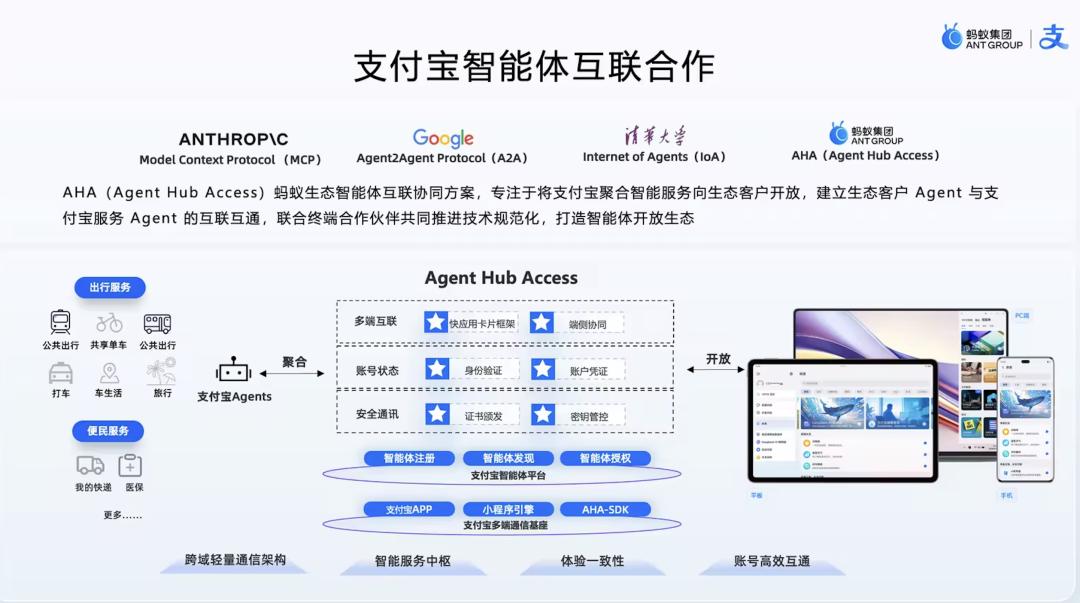
Looking at the competition in the Year of the AI Agent, the rivalry is shifting from upper-layer model capabilities like conversation and reasoning to underlying infrastructure such as transactions, trust, and cross-device interconnection. Alipay's decision to focus directly on underlying infrastructure may seem to miss the early dividends of consolidating existing users, but as the industry transitions from AI demonstration phases to large-scale real transactions, it has become one of the pioneers who made early preparations.
03. The Agent Economy Unlocks a 10-Trillion-Level Market
Moving beyond product features to business models, at a time when the commercialization of consumer-facing AI is difficult to validate, Alipay's three-tier product matrix seems to have found a feasible path to monetization for the AI industry.
Currently, global consumer-facing AI commercialization is facing bottlenecks. Pure conversation products monetize through token top-ups and subscription plans, but lack sufficient consumption scenarios to support user willingness to pay, resulting in a clear market size ceiling.
Based on this strategic layout, Alipay has made breakthroughs in its core payment foundation.
Data shows that over 70% of small agent transactions are less than $0.3, making traditional payment fee frameworks clearly unsuitable for these micro-value, high-frequency agent transactions.
At the AI Payment Ecosystem Conference in May, Han Xinyi put forward the judgment that "tokens have become the smallest unit of value in the AI era." With the full implementation of Alipay's agent infrastructure, this vision has become an executable closed-loop business model: every service call by an agent corresponds to a real consumption intention, enabling "call equals revenue" through tiered billing and a unified settlement system.
The subsequent ecosystem cycle is clear and predictable: merchants list standardized services on the resource market, and every cross-device agent call generates revenue that feeds back into service optimization, forming a positive cycle of supply, calls, and monetization.
A deeper industrial transformation lies in the upgrading of transaction forms. Users can complete the entire chain of services for transportation, dining, and entertainment with a single command, meaning merchants' business goals will shift from selling individual products to providing complete task solution packages, evolving the market from two-sided buying and selling to a multi-party collaborative network.
A typical scenario would be a user requesting to drive to a restaurant and then watch a movie—the agent can simultaneously arrange ride-hailing, table reservations, and ticket purchases, allowing transportation, dining, and entertainment merchants to share the same user demand. Under this model, the Agent economy no longer relies on a single platform's traffic, but creates incremental value through full-domain service collaboration. Its market size will break through the boundaries of traditional online retail, covering all scenarios including transportation, domestic services, government services, and local lifestyle.
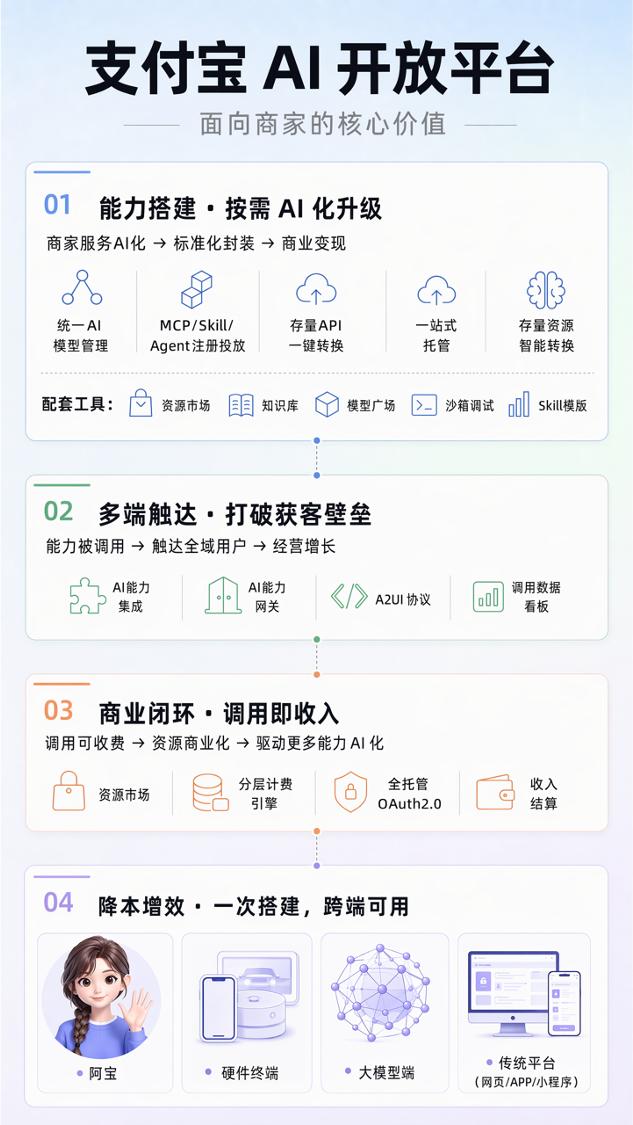
Currently, it is evident that the first batch of merchants are proactively accelerating their agent layouts. Brands and institutions including KFC, Mixue, Luckin Coffee, Gaode Maps, Didi, and Wansu Mountain Martial Arts City have been among the first to integrate with Alipay's AI Open Platform. This indicates that leading merchants have anticipated that future traffic competition will no longer focus on search exposure within platforms, but on whether their services can be called by agents across the entire network. Proactively laying out full-domain distribution channels is the key to long-term growth.
Leveraging cross-industry collaboration capabilities, large models can integrate services from multiple merchants based on users' complex requirements, creating incremental conversion scenarios that were impossible on traditional shelf-based internet platforms, while opening up new traffic sources for small and medium-sized merchants.
Institutional analyses have also defined the incremental potential of the Agent economy. According to McKinsey's report "The Agentic Commerce Opportunity," the global transaction volume of agentic commerce could reach $3-5 trillion by 2030.
While many vendors limit AI commercialization to software and tool payments, the market has finally seen a business paradigm that deeply integrates AI calls, agent behaviors, and real offline transactions, connecting commands, services, fulfillment, payment, and settlement. This fills the long-missing transaction monetization loop for the entire AI industry, representing Alipay's distinct industrial contribution compared to many large model vendors.
04. What Will the Next Generation of Digital Commerce Look Like?
Alipay's continuous launches to build an open infrastructure provide the industry with a window to glimpse how digital commerce will evolve in the Agent era.
For all physical merchants and service providers, the entire agent infrastructure is fundamentally rewriting the rules of the full operation chain. On one hand, customer acquisition logic has been completely reconstructed. In the past, merchants focused on competing for centralized traffic resources like search rankings and homepage recommendations on a single platform, with traffic pools fragmented and locked by different ecosystems.
With the cross-device interconnection system, merchants' services can simultaneously reach multiple channels including car infotainment systems, AI glasses, and third-party large models. Traffic no longer depends on a single platform, shifting the industry's competition focus from "seizing exposure entry points" to improving the general usability and callability of services.
On the other hand, the cost structure of commercial operations will be further optimized. Merchants can authorize agents to handle the entire process including order placement, reservations, payment, and verification. After transactions are completed, agents automatically accumulate cross-device member, foot traffic, and repurchase data, generating operation review reports, intelligently pushing promotions, and recalling lost customers—significantly reducing manual operation costs.
The R&D and operation costs for merchants to connect to the Agent era will also be greatly reduced. Through Alipay's AI Open Platform, existing mini-programs and offline standardized services only need one-time encapsulation and transformation to be simultaneously distributed across all types of smart end-devices, with a unified backend managing orders, data, and settlement. This eliminates the inefficiency of repeated development across multiple channels and separate maintenance of multiple backends.
On this basis, Alipay's Open Platform is building a complete agent network ecosystem covering all dimensions of supply, consumption, and transactions.
First, the supply side is fully open. All market entities with standardized AI service capabilities can join, including offline physical merchants, various service institutions, smart end-device hardware vendors, and large model development platforms—continuously expanding the total number of callable services in the network.
Second, the consumption side, leveraging Alipay's 1 billion user base combined with cross-device and cross-model distribution capabilities, theoretically has the ability to deliver smart services to consumers globally online and offline, opening up a boundless user market.
Third, the AI Open Platform breaks the scenario limitations of traditional apps and mini-programs, integrating internet applications, native large model platforms, vehicle-mounted end-devices, and wearable IoT devices into a unified transaction space. Transaction scenarios will achieve full-domain coverage.
In simple terms, the future Agent business ecosystem will likely be an open service network that is universal across all smart devices, oriented toward massive users, and capable of completing transactions anywhere. It will create a unified smart market where "everyone can access all services, and all services can reach everyone."
This open ecosystem oriented toward the entire industrial chain also reflects Alipay's long-term layout philosophy that sets it apart from other vendors. While most platforms focus on the short-term digital transformation needs of merchants within their own ecosystems, Alipay has chosen to build unified payment trust standards and cross-device interconnection protocols, creating a full-domain operation foundation for merchants that is not constrained by a single platform.
In the long run, as more end-device vendors, large model companies, and small and medium-sized merchants continue to integrate, this multi-party agent network will likely form a positive feedback loop: continuous enrichment of supply-side services drives the expansion of full-domain consumption scenarios, while massive real transaction data in turn continuously optimizes agent matching efficiency—ultimately forming a self-growing, self-circulating next-generation digital commerce system.
Conclusion
Looking back at Alipay's 22-year growth trajectory, every round of digital commerce transformation has relied on underlying infrastructure to empower the industry. Escrow payment supported the maturity of e-commerce, mobile payment promoted the digital transformation of offline physical businesses. Now, in the Year of the AI Agent, Alipay is starting anew to build a trusted and interoperable industrial foundation for hundreds of billions of agent interactions.
With the official implementation of the AI Open Platform, Alipay's full AI strategic blueprint has been unveiled. Breaking away from the traffic involution of a single platform, it uses an open and interconnected agent network to bring fundamental transformations to the operation