"First Publicly Traded Visual Embodied Intelligence Stock" Debuts on HKEX: A Scenario-First Commercialization Path
On July 8th, Rayturn Technology, dubbed "the first visual embodied intelligence stock" on the Hong Kong Stock Exchange, officially debuted on the Main Board of HKEX. Its Hong Kong public offering saw an oversubscription rate of 3,646.06 times, while the international tranche recorded 3.08 times subscription.
This is no isolated IPO event. Placed within the 2026 landscape of the AI industry, it reflects a far more notable signal: the capital market's evaluation criteria for AI companies is undergoing a fundamental shift.
Over the past two years, AI and embodied tech firms dominated headlines by touting "parameter scale" and "technical demonstrations". But by mid-2026, the secondary market has begun measuring enterprise value with a new metric, shifting valuation logic toward "commercialization capability" — the focus is no longer on "how big your model is" or "how smoothly it can move", but rather "whether your technology can operate effectively in real-world scenarios".
Unlike its peers, Rayturn Technology presents a "scenario-first" paradigm. The company does not follow the common approach of "developing algorithms before finding use cases". Instead, it starts from the actual B2B demands of airports and commercial spaces, first solving the problem of enabling machines to "perceive and understand", then extending along business workflows to develop embodied robots, and gradually building out decision-making and execution capabilities.
Rayturn founder Zhan Donghui sums up this philosophy in one sentence: "AI must evolve from being a human's intellectual assistant to a human's productivity assistant."
Starting from "Vertical Scenarios"
Rayturn's entry into the embodied intelligence sector was no impulsive decision. Founded in 2012 with a mission to enable machines to "see", the company has spent 14 years progressing sequentially: first developing perception capabilities, then advancing to cognitive understanding, and finally moving into execution systems. Zhan Donghui describes this roadmap as "building the brain first, then crafting the hands and feet".
This sequential approach distinguishes Rayturn from other embodied intelligence companies. Currently, the embodied intelligence track broadly features two mainstream paths: the first category consists of robot hardware manufacturers, whose strategy is to penetrate scenarios through products — starting from motion control, complete machine engineering, and mass production capacity, they aim to drive down costs via large-scale manufacturing and deploy robots into more use cases. The second category comprises general AI companies, which seek to equip robots with "brains" using more powerful models to enhance generalization capabilities. However, both approaches face a shared challenge: their capability evolution has not yet caught up with the practical demands of general-purpose scenarios.
Rayturn has taken the third path — defining products based on specific scenarios. It first identifies which industrial tasks are suitable for machines to perform, then backtracks to develop the required perception, decision-making, and execution capabilities. This methodology is closely tied to the team's core DNA. Founder Zhan Donghui graduated from Nanjing University with a degree in Electronics and Information Systems, and spent nearly nine years working at Huawei. The company's CTO, chief scientist, and other senior technical executives all hold doctoral degrees. This background determines Rayturn's "engineering-focused" path: starting from concrete scenario pain points, then expanding product offerings according to customer requirements.
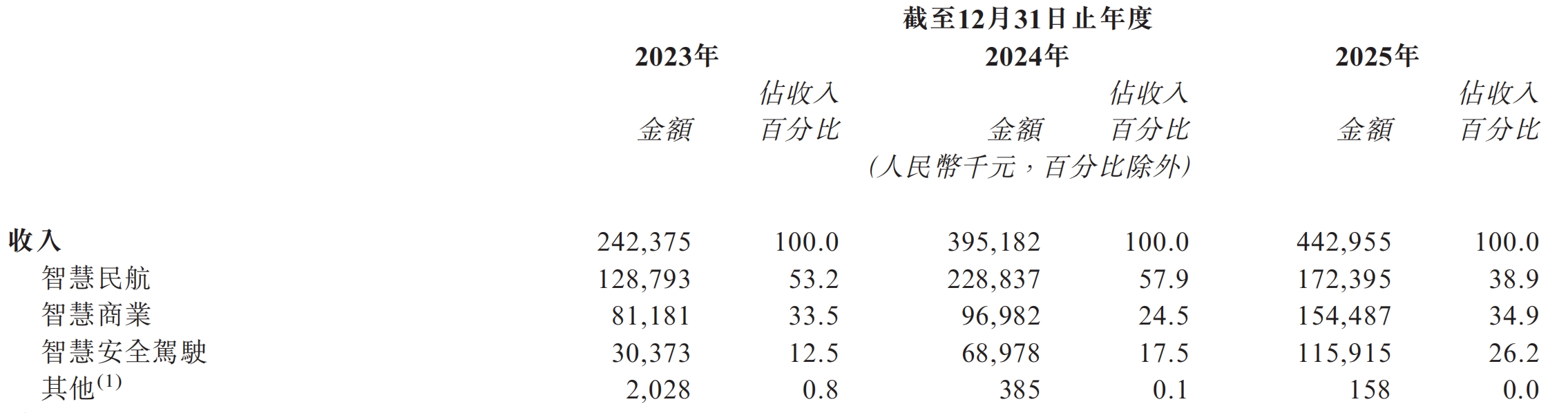
This strategy has already been validated in its existing visual intelligence business. According to the prospectus, Rayturn's revenue grew from 242 million yuan to 443 million yuan between 2023 and 2025; in 2025, its smart civil aviation, smart commercial spaces, and smart safe driving segments contributed 172 million yuan, 154 million yuan, and 116 million yuan in revenue respectively.
This also demonstrates that first entering real scenarios, understanding task requirements, refining products, and then extending toward more advanced execution capabilities, can equally serve as a viable commercialization path for embodied intelligence.
Productivity-Focused: Will B2B Applications Become the Main Battlefield?
In Zhan Donghui's judgment, over the next three to five years, embodied intelligence will first see large-scale adoption in enterprise-level scenarios. Although B2B implementation has higher barriers, compared with the consumer market — where demands are fragmented and scenarios are unstructured — sectors like industry, logistics, and transportation have far clearer task boundaries, more standardized workflows, and efficiency gains that are easier to quantify.
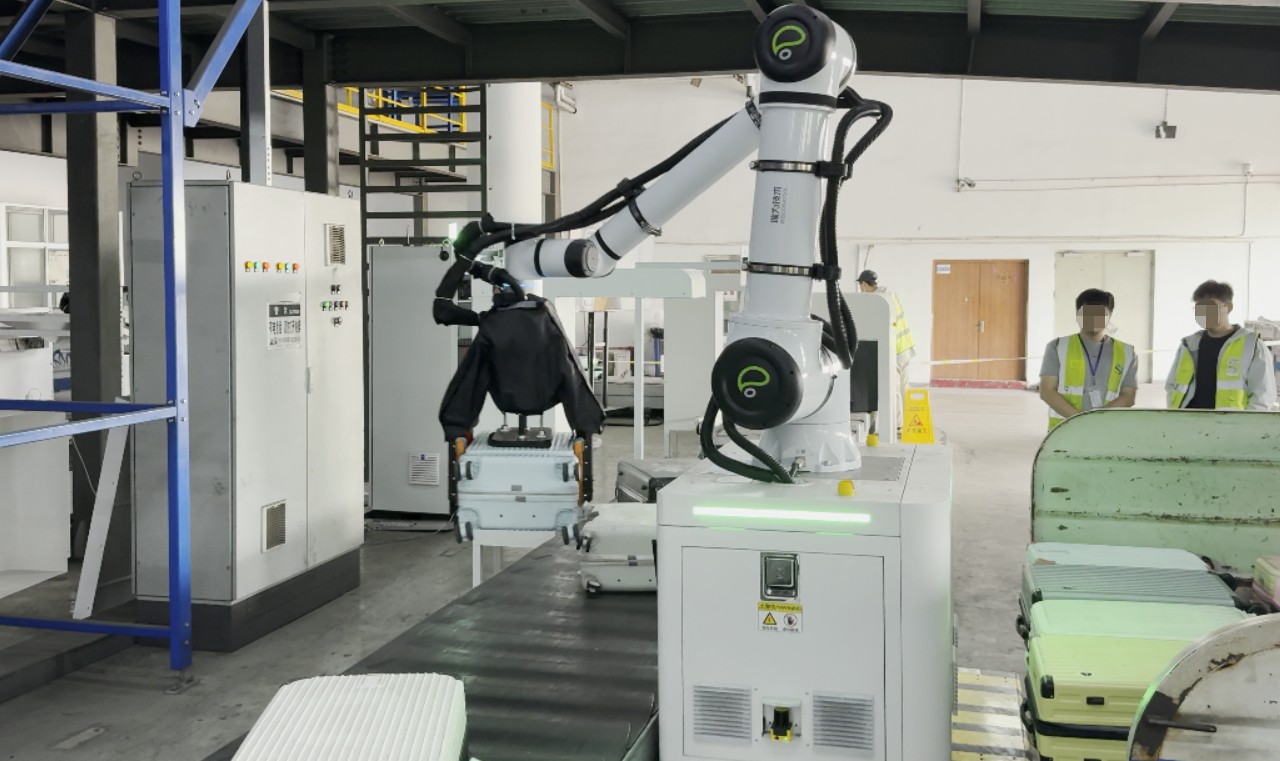
Airport baggage handling is a prime example of such a scenario. In 2025, Rayturn combined cognitive decision-making capabilities with robotic execution to launch the "Xiao Yi" baggage transfer robot. The company's self-developed composite actuator integrates suction cups, grippers, and pulling hooks, enabling it to handle different types of luggage through combined operations — a design very different from traditional dexterous hands, which embodies the same practicality-first mindset. As Zhan Donghui puts it, "For B2B customers, whether a robot looks human-like is not the top priority. What matters more is whether it can reliably complete tasks, reduce costs, and continuously generate productive value."
In April 2026, Rayturn launched the VTFLA multimodal embodied large model, adding tactile and force feedback to the traditional VLA framework, which allows robots to assess whether a grasp is stable and whether applied force is appropriate, and adjust their movements in real time. Rayturn is focusing its independent R&D efforts on end-effectors, complete machine engineering, and hardware-software co-design. Zhan Donghui specifically emphasizes a rarely discussed metric in the embodied intelligence field: robustness. "To truly operate 24/7 in enterprise customers' production environments, the engineering design, robustness, safety, and reliability of the robot itself will become absolutely critical factors."
Compared with companies that start from models or robot hardware before seeking application scenarios, Rayturn's advantage lies in its existing integration into real production workflows, where it has accumulated massive industry datasets, customer insights, and engineering delivery experience through years of serving civil aviation, commercial spaces, and safe driving scenarios.
Cross-Scenario Replication: From "Vertical Deep Cultivation" to "Horizontal Expansion"
If the first step of embodied intelligence commercialization is entering scenarios, the second step is extracting replicable capabilities from individual use cases. Currently, many robotics firms have successfully completed pilot deployments in factories, warehouses, and airports, but there remains a significant gap between "successfully delivering one project" and "scaling a category of products" — entering each new industry typically requires re-adapting models and hardware, keeping R&D and delivery costs stubbornly high, and trapping businesses in a highly customized, project-based operating model.
In other words, the key to large-scale embodied intelligence adoption is not deploying the exact same robot unchanged across every industry, but identifying which capabilities can be reused, and which components must be reconfigured.
Rayturn's differentiated strategy offers a fresh perspective. Founder Zhan Donghui summarizes the company's development philosophy over the past decade as a "market remains constant, products evolve" vertical deep cultivation strategy: expanding product lines within its core markets of civil aviation, commercial spaces, and safe driving. Now, as it advances into embodied intelligence, the company is transitioning to a "products remain focused, markets expand" horizontal growth strategy, deploying its refined robotic products into a broader range of use cases.
The feasibility of this horizontal expansion hinges on cross-scenario capability reuse. Technical modules such as visual, tactile, and force perception, multimodal models, end-effectors, and complete machine engineering all offer certain transferability, but customer requirements, business workflows, and safety constraints across different industries cannot be directly copied.
To address this, Rayturn aims to reuse not just specific technologies and products, but also its methodologies for identifying customer needs, building trust with clients, and operating within vertical scenarios and real business workflows. This explains why it chose to expand its embodied product line starting from airports: Rayturn has deep roots in the civil aviation sector, with intimate scenario knowledge and transferable trusted relationships — giving it a far shorter path to robot deployment than any competitor.
According to its prospectus, industrial logistics and warehouse automation are already on the product roadmap, sharing the same technical platform as its airport solutions — the extension of visual agents from perception to execution represents a natural expansion of its unified technical foundation into adjacent scenarios.
Under this roadmap, what Rayturn seeks to replicate is not the specific form of a single robot model, but a productization methodology of "reusing underlying capabilities while adapting to specific scenarios".
Furthermore, distinct from cloud-based general large models, Rayturn has maintained a clear positioning from the very beginning — focusing on edge-side intelligence, committed to achieving performance comparable to trillion-parameter models under constrained computing power and cost budgets.
Doubling Down on R&D, Supply Chains, and Global Expansion: A New Journey Post-Listing
Frost & Sullivan projects that by 2030, the potential market size for airport embodied intelligence products alone will reach 30 billion yuan — far exceeding the approximately 6.3 billion yuan market for civil aviation visual intelligence products.
New business lines also demand greater investment, and this IPO has secured Rayturn an extended runway for R&D and commercialization. The prospectus states that the raised funds will be allocated to R&D, channel expansion, and production facility construction. Upon full operation, the facilities are expected to deliver an annual capacity of 600 smart boarding gates, 120 security screening portals, and 200 baggage transfer robots. Meanwhile, the company plans to deploy a portion of the capital to expand its overseas sales networks. In Zhan Donghui's vision, overseas markets will become Rayturn's next major growth priority over the coming decade.
Moving forward, the capital market will closely watch whether Rayturn's diverse embodied intelligence products can transition from pilot trials to large-scale delivery, whether its accumulated capabilities can extend beyond airports into logistics, manufacturing, and special operation scenarios, and whether its technical investments can ultimately translate into sustainable revenue, profits, and cash flow.
For Rayturn, the listing marks a milestone that summarizes its more than ten years of achievements in the visual intelligence sector; the journey from "perceiving and understanding" to "taking actionable steps" is a new campaign that has only just begun. Whether Rayturn can successfully execute this scenario-first path will provide the entire industry with a critical reference point for evaluating the commercial direction of embodied intelligence.