Reconova fell below its offering price in the grey market, closing 17% lower | The Bell-Ringing Moment
The "Bell Ringing Moment" column focuses on the critical moment when an enterprise officially enters the capital market. After every bell rings, the market delivers its first verdict on a company's growth, valuation, and fundamental quality.
On the after-hours grey market on the afternoon of July 7th, Ruwei Technology (07656.HK), the first stock in visual embodied intelligence, fell below its issue price. The grey market closed at HK$17.99, down 16.94% from the HK$21.66 issue price, corresponding to a market capitalization of HK$5.492 billion.
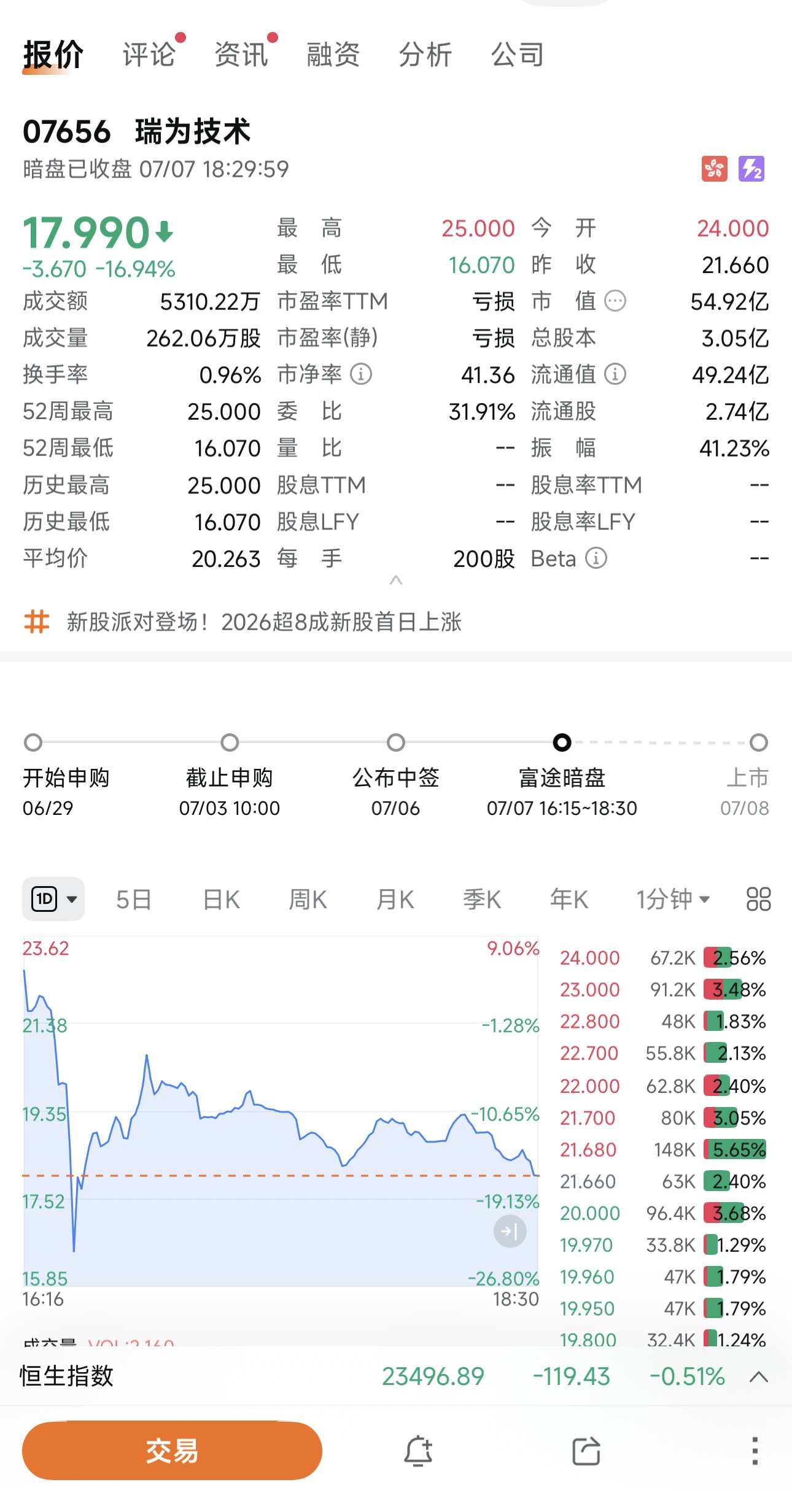
Throughout the grey market trading session, the intraday peak hit HK$25, up 15.4%; the lowest point plunged to HK$16.07, down 25.8%; the amplitude reached as high as 41.23%, with an average trading price of HK$20.26 and a full-day turnover of HK$53.1 million.
For this IPO of Ruwei, neither cornerstone investors were introduced, nor was a greenshoe (over-allotment option) mechanism established. The ripple effect of having no cornerstone investors is: full tradability, and an extremely thin float.
This global offering totals 28.087 million shares, accounting for only 9.20% of the total share capital after issuance. Calculated at the issue price, the absolute tradable market value is only about HK$608 million. Since there is no cornerstone lock-up, this 9.20% of shares are fully tradable freely from the very first moment of listing.
A thin float + full tradability + no price stabilization mechanism forms a combination that naturally amplifies volatility. With a small number of tradable chips, even a minor buying spree can drive prices sharply higher, and a slight selling pressure can also push prices down significantly. The huge trading range from HK$25.00 to HK$16.07 in the grey market is exactly the two-way swing of these thinly distributed chips in an environment without price stabilization. This dynamic can fuel price rises when market sentiment is positive, but it will equally accelerate declines when sentiment weakens.
Apart from market sentiment and share structure, there is also the matter of valuation. Calculated at the issue price of HK$21.66, with approximately 305 million shares after issuance, the post-issue market capitalization stands at around HK$6.61 billion, corresponding to a static price-to-sales ratio of about 12.9x. Yet Ruwei's revenue only grew 12.1% year-on-year in 2025, with annual revenues of RMB 242 million, RMB 395 million, and RMB 443 million recorded in 2023, 2024, and 2025 respectively.
The last round of Series E financing before the IPO, completed in August 2025, had a post-money valuation of RMB 3.55 billion. The post-issue market capitalization is roughly 1.61 times that figure, and even after the grey market broke the issue price, the multiple still remains at 1.34x.
As a new stock listing under the 18C regulatory regime, Ruwei recorded net profits of -RMB 32.58 million, +RMB 8.29 million, and -RMB 68.15 million in 2023, 2024, and 2025 respectively, with only a brief period of profitability in 2024.
But accounts receivable is a massive burden weighing on the company's financial statements. By the end of 2025, Ruwei's net accounts receivable reached as high as RMB 587 million, exceeding the full-year revenue of RMB 443 million; its receivables turnover days surged all the way to 440 days (and once hit 1047 days in the first half of 2025).
The smart civil aviation segment, which boasts the highest gross margin (59.2%), saw its 2025 revenue decline by 24.7% instead of rising; taking its place are government-driven safe-driving orders with a low gross margin of 16.4%.
The grey market is an over-the-counter trading venue. The real test for this company has never been those two hours of grey market trading, but the period following its official listing. We will continue to pay close attention to its performance on the first trading day tomorrow.