On the Eve of Listing | After Cashing Out Billions, He Steers Mining Cards Toward the Hong Kong Stock Market
This article is approximately 3,100 words long, with an estimated reading time of 7 minutes
Author | Peng Xiaoqiu
Editor's Note: The "Eve of Listing" column focuses on the critical moments when enterprises sprint toward the capital market. Within every prospectus lie an enterprise's ambitions, operational cycles, and hidden concerns before going public. This is the third installment—Yikong Zhijia.
Around 2017, 36-year-old Lan Shuisheng completed his first major full exit in his career.
That company was Guangzhou E-Huan Network, a firm focused on overseas game distribution. It was acquired by A-share listed firm Baotong Technology for over 1.7 billion yuan. Based on public transaction terms and subsequent share reduction arrangements, the total exit value for parties related to Lan Shuisheng was roughly 1.5 billion yuan.
Following the typical startup storyline, the narrative could have largely concluded there. After all, a serial entrepreneur who graduated from Jiangxi University of Finance and Economics had achieved significant wealth growth through the overseas gaming business. Moving forward, he could have become an investor, continued scaling operations within his familiar gaming industry, or simply rested on his accumulated assets to enjoy the rest of his life.
Instead, Lan Shuisheng chose a path that seemed entirely out of character: the mining industry. In 2018, he founded Yikong Zhijia and fully dedicated himself to developing autonomous driving solutions for mining operations. This was no polished office-based venture—it was a world defined by dust, gravel, heavy-duty trucks, steep slopes, blasting operations, extreme cold, high altitudes, and long-distance transportation routes.
Eight years later, the company arrived at the doorstep of the Hong Kong Stock Exchange with 2,580 active autonomous mining trucks. On July 8, Yikong Zhijia will officially ring the listing bell on the HKEX. If this IPO is priced at the upper limit of HK$87.92, the corresponding market capitalization will reach HK$130 billion. Notably, this listing is being conducted under the HKEX 18C regime for specialized technology companies.
According to data from Sullivan & Frost, based on 2025 revenue, Yikong Zhijia ranks first among China's commercial vehicle intelligent driving companies; in terms of the number of active autonomous mining trucks, it operates the world's largest unmanned mining fleet.

Gross Margin Just Exceeds 10%
This is no simple story of an "autonomous driving company going public"—it is more akin to a second high-stakes gamble by an individual who had already achieved financial freedom.
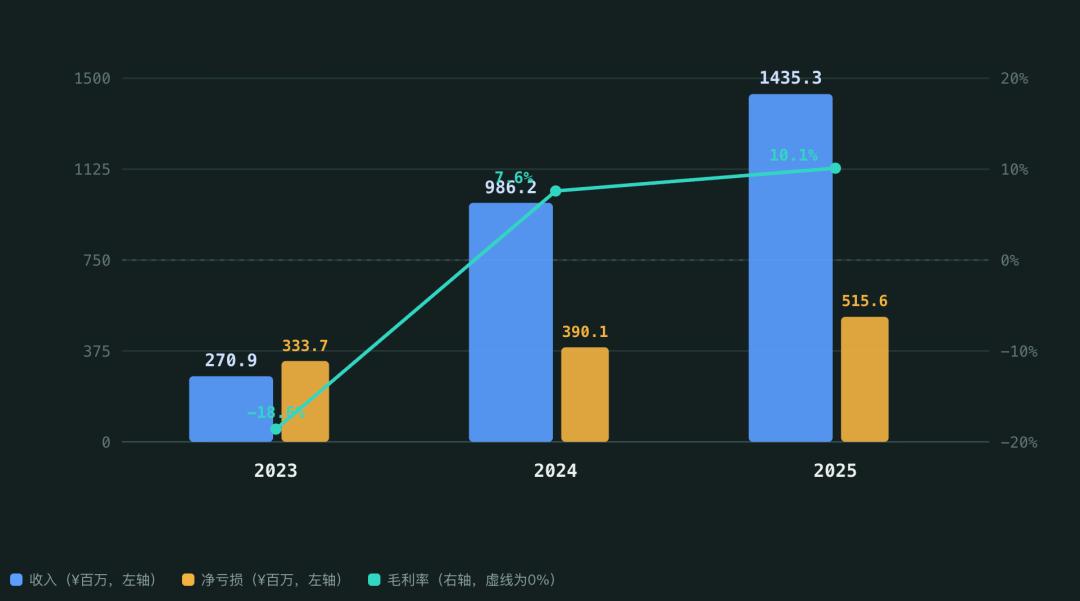
First, let's look at the impressive side of the business. Yikong's revenues from 2023 to 2025 were 271 million yuan, 986 million yuan, and 1.435 billion yuan respectively, representing a more than 5x increase over two years with a staggering compound annual growth rate of 130.2%, with an extraordinary 264% year-over-year growth rate in 2024 alone. Even across the entire HKEX 18C sector, this growth trajectory is exceptionally rare.
(Source / Arranged by 36Kr)
Yikong operates two core business lines: ZhuShan, which provides autonomous mining truck products and solutions for enclosed operational environments; and MuYe, its digital transformation solution for mining sites. MuYe generated only 698,000 yuan in revenue in 2025, a negligible contribution to total earnings.
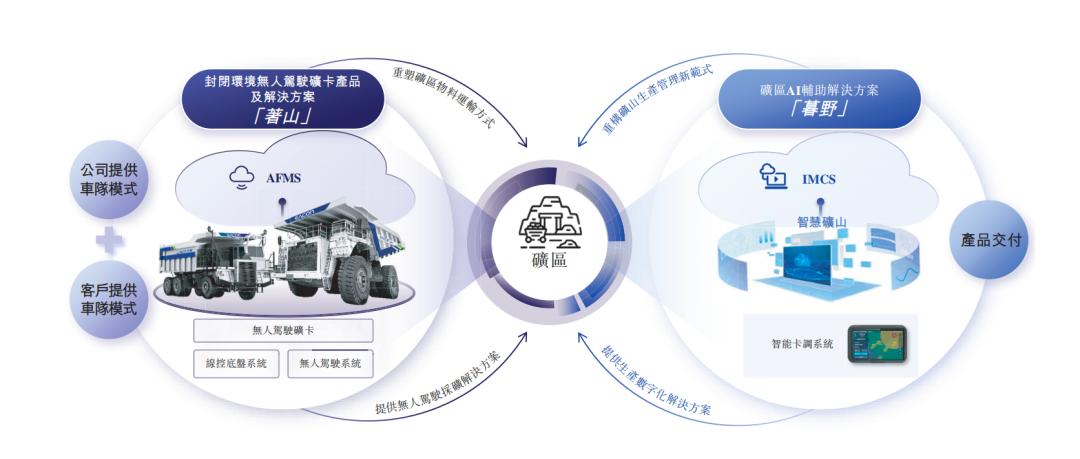
This means Yikong's core business operations are entirely centered around ZhuShan, which itself operates under two distinct models:
(Source / Arranged by 36Kr)
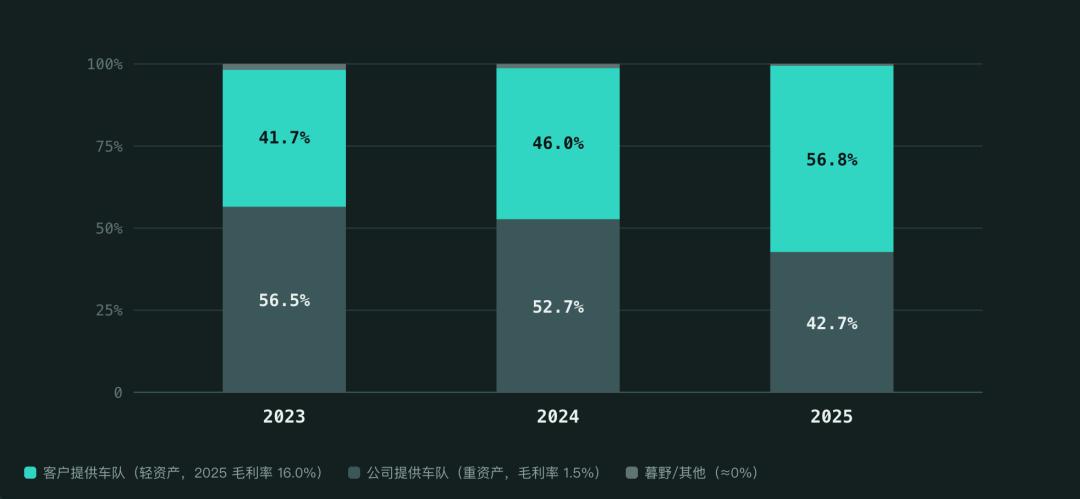
The first model is the company-operated fleet model (asset-heavy), where Yikong purchases the trucks, maintains the fleet independently, and charges mining enterprises service fees based on transportation volume (per cubic meter / per ton). This is a capital-intensive model requiring substantial upfront investment, which recorded a gross margin of only 1.5% in 2025.
The second model is the customer-operated fleet model (asset-light), where customers purchase mining trucks pre-installed with Yikong's systems, while Yikong only provides software, technical support, and operational maintenance services. This is the model Yikong prioritizes, delivering a 16% gross margin in 2025 with far greater profit potential.
Yikong's core operational focus in recent years has been shifting from the asset-heavy model to the asset-light model. The revenue share of the customer-operated fleet model has risen from 41.7% in 2023 to 46% in 2024, then to 56.8% in 2025. This transformation directly drove Yikong's gross margin back into positive territory in 2024. However, the transition remains ongoing, with 42.7% of 2025 revenue still generated from the asset-heavy company-operated fleet model.
Fortunately, the company's economies of scale are clearly materializing. Annual transportation distance surged from 4.6 million kilometers in 2023 to 61.8 million kilometers in 2025, annual transported material volume grew from 30.6 million cubic meters to 308 million cubic meters, and the average monthly number of active autonomous mining trucks increased from 159 units in 2023 to 1,617 units in 2025. The prospectus also highlights a standout technical advantage: a proprietary engine trained on over 100 real-world mining scenarios that reduces new mine deployment time from 3 months to just 3 days. This means larger fleets and more operational scenarios generate richer datasets, enabling even faster deployment speeds.
Now turning to the less favorable aspects. Over the past three years, net losses reached 334 million yuan, 390 million yuan, and 516 million yuan respectively, totaling approximately 1.24 billion yuan in cumulative losses. Moreover, losses are not narrowing—they are expanding. The 2025 loss figure is nearly 50% higher than the 2023 level. Even after excluding share-based compensation, listing expenses, and fair value changes in preferred shares, adjusted net losses for the three years still show a continuous upward trend at 284 million yuan, 303 million yuan, and 484 million yuan.
Where does the core issue lie? It stems directly from gross margins. Yikong recorded a gross margin of -18.6% in 2023, meaning it lost 18 yuan for every 100 yuan of revenue generated. Gross margin barely turned positive at 7.6% in 2024, only reaching 10.1% in 2025. In response, the prospectus explains that the company adopted an aggressive market expansion strategy in the early commercialization phase, prioritizing rapid deployment and broad market coverage to secure high-quality clients, which directly resulted in gross losses in 2023 and suppressed gross margins in 2024 and 2025.
In fact, Yikong also recorded a 118 million yuan asset impairment charge. In late September 2025, the company signed a letter of intent to sell 190 first-generation mining trucks that were originally used for pilot testing, demonstration, and early operational validation. The company classified these vehicles as non-current assets held for sale, measured them at the lower of carrying value and fair value, and recognized a one-time 118 million yuan impairment loss recorded in that year's financial results.
This single impairment charge accounted for a substantial portion of the 2025 net loss. Looking at EBITDA, Yikong's operational performance is indeed improving: figures for 2023 to 2025 were -277 million yuan, -263 million yuan, and -224 million yuan respectively. However, adjusted EBITDA deteriorated slightly in 2025, widening from -176 million yuan in 2024 to -193 million yuan.
Additionally, Yikong's trade receivables turnover days have continuously extended from 48.8 days in 2023 to 86.9 days in 2024, then to 168.5 days in 2025. Within two years, the collection period for outstanding payments stretched from less than two months to nearly half a year. Correspondingly, the company's trade receivables and notes receivable balance skyrocketed from 115 million yuan in 2023 to 1.042 billion yuan in 2025 (as of April 30, 25.5% of which has been collected). The prospectus attributes this trend to large-scale new projects launched in 2025 and an increasing proportion of customer payments settled via notes.
Cash flow data further validates this trend. Yikong has recorded negative operating cash flow for three consecutive years: -251 million yuan, -713 million yuan, and -394 million yuan.

11 Rounds of Financing: Who Emerged as the Biggest Winner
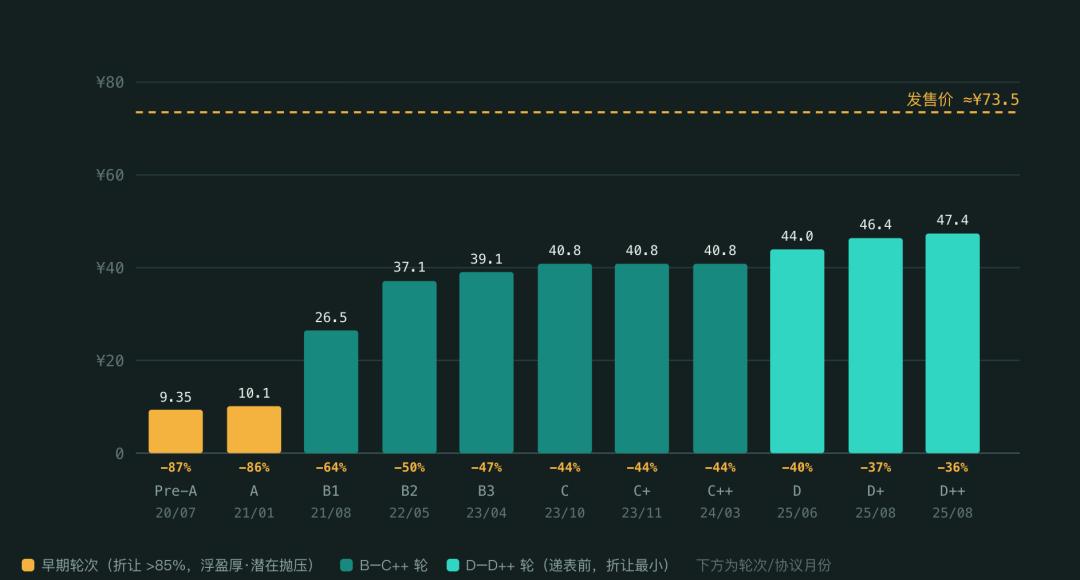
Prior to listing, Yikong completed a total of 11 full rounds of financing spanning from Pre-A to D++.
(Source / Arranged by 36Kr)
Pre-A Round (July 2020): Minxi Xinghang and Xinghang Chaozhi entered the investment at approximately 9.35 yuan per share, representing an 87.28% discount to the IPO offer price;
A Round (January 2021): Entities affiliated with Tencent Steed (Fidelity / Steed Capital) and NIO Capital participated at 10.13 yuan per share, an 86.22% discount;
B1 Round (August 2021): Investors including Zijing Group's Ziniu Investment joined at 26.45 yuan per share, a 64.02% discount;
B2 Round (May 2022): Priced at 37.10 yuan per share, representing a 49.52% discount;
B3 Round (April 2023): Priced at 39.06 yuan per share, representing a 46.86% discount;
C / C+ / C++ Rounds (October 2023 - March 2024): Investors including Zidi Investment (Zijing Group) and Zhengzhou High-Tech Zone Fund invested consecutively at a uniform price of 40.83 yuan per share, raising a combined 550 million yuan at a 44.45% discount;
D Round (June 2025): CATL (Ningbo Wendin) and Puoquan Fund participated at 43.95 yuan per share, raising 65 million yuan total at a 40.21% discount;
D+ Round (August 2025): Investors including Desay SV, Tongli, and entities affiliated with Yankuang Group of Shandong joined at 46.37 yuan per share, raising a combined 397 million yuan at a 36.92% discount;
D++ Round (August 2025): Investors including Ge Weidong, Hony Capital, CDH Investments, and numerous state-owned entities from Luoyang, Fujian, Longyan, and Qingdao participated at 47.35 yuan per share, representing a 35.59% discount. This single D++ round alone raised 714 million yuan.
Pre-A round investors emerged as the biggest winners, acquiring shares at 9.35 yuan each and booking nearly 8x paper profits based on the IPO pricing, with a discount approaching 90%. The lead investors behind this round—Minxi Xinghang and Xinghang Chaozhi—are linked directly to the Shanghang County Finance Bureau and the Zijing Group ecosystem. While the D++ round prior to listing had the smallest discount, it still delivered over 35% of paper profit potential. This means all early investors' entry prices were significantly lower than the final IPO offer price.
Another notable investor is Zijin Mining Group. As a shareholder, it controls approximately 3.87% of total shares through parent entity Minxi Xinghang plus affiliates Zidi, Ziniu, Zixing, and Qihang. As a key customer, Zijin's own Zijinshan Gold-Copper Mine and the 5,000+ meter high-altitude Julong Copper Mine both deploy Yikong's solutions. Yikong's headquarters is even located within Zijin Mining's corporate building complex.
Renowned private equity investor Ge Weidong personally subscribed for 100 million yuan worth of shares. The investor roster also includes a long list of local state-owned funds such as Zhengzhou High-Tech Investment, Luoyang State Assets, Fujian State Assets, Longyan State Assets, and Qingdao/Shandong Guohui.
The cornerstone investor lineup is equally robust. 11 cornerstone investors collectively subscribed for 146 million USD (approximately 1.144 billion HKD), accounting for roughly 50% of total offered shares with a 6-month lock-up period. These investors include Fidelity International (the largest single investor with 30 million USD), JPMorgan Asset Management, Baring Private Equity Asia, Jain Global (the new platform founded by former Millennium Management CEO Bobby Jain), CDH Investments, GF Fund Management, Zijin-affiliated ZIJINNING, and XCMG-linked Aurora SF (whose ultimate beneficiary traces back to XCMG Construction Machinery).
While founder, co-chairman and CEO Lan Shuisheng does not have an