The Golden Hub Rises in the East, Hong Kong Anchors Asia's Gold Market
The restructuring of global official reserve assets, the eastward shift in the focus of gold supply and demand, the loosening of the traditional gold landscape in Europe and America, and a new round of competition for Asian gold hubs have all begun.
With the goal of anchoring itself as an Asian gold trading center, Hong Kong, China has entered a critical phase in the development of its gold-related infrastructure. On May 27, Joseph Chan, Deputy Secretary for Financial Services and the Treasury (hereinafter referred to as "the FSTB") of Hong Kong, China, revealed in response to a query from a member of the Hong Kong Legislative Council that the operational preparations for Hong Kong's central gold clearing system have entered their final stage, with a trial operation planned for 2026.
Hong Kong, China is also improving its gold industry ecosystem by relaunching gold futures trading, expanding gold storage facilities, and deepening cooperation with the Shanghai Gold Exchange (hereinafter referred to as "SGE").
This structural adjustment in global official reserve asset allocation is fully supported by authoritative data. In early June, the European Central Bank released a report showing that by the end of 2025, gold's share of global official reserves had risen to 27%, while US Treasuries had fallen to 22%. Gold has officially surpassed US Treasuries to become the world's largest reserve asset.
A subsequent central bank gold reserve survey released by the World Gold Council further confirms this trend: 10% of surveyed central banks have further diversified the overseas storage locations of their gold reserves in the past 12 months — a significant increase from the previous 2%.
The desire of multiple central banks to diversify gold storage is shaking the long-standing global gold influence structure.
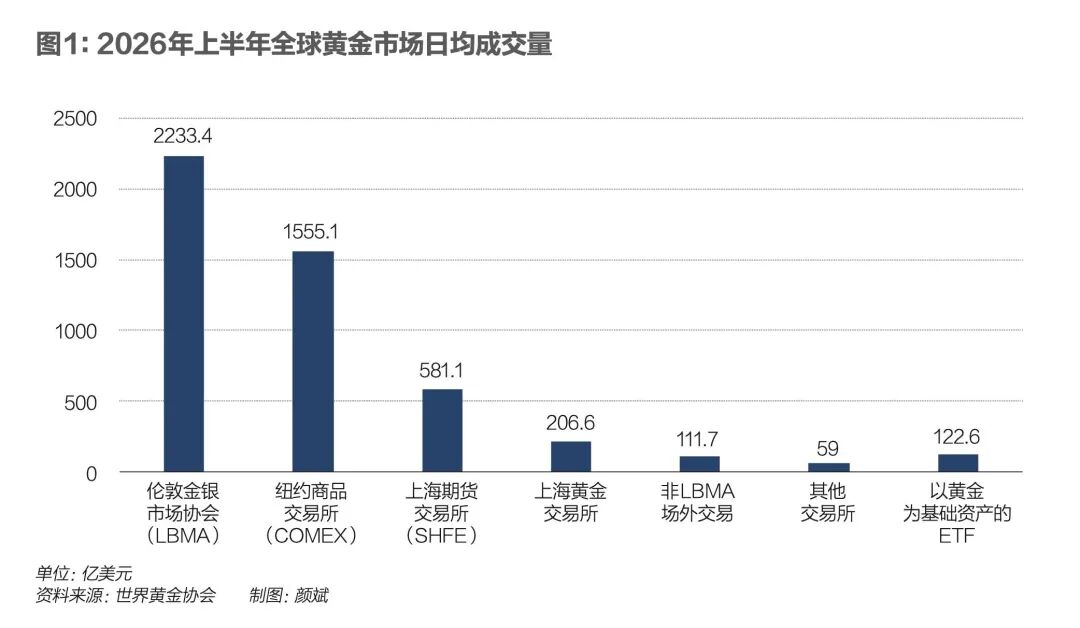
For a long time, London and New York have firmly dominated global gold trading, liquidity, and price discovery. In the first half of 2026, the two cities together accounted for over three-quarters of the global gold market's average daily trading volume; Singapore-based precious metals trader Bunker Group estimates that gold stored in the United States and the United Kingdom together accounts for approximately 53% of global gold reserves.
The center of supply and demand continues to shift eastward. Data from the World Gold Council shows that in the first quarter of 2026, mainland China's gold jewelry and investment demand accounted for over 28% and 43% of total global demand respectively, and China has been the world's largest gold producer for many consecutive years. Supported by huge physical demand, Shanghai has grown into the third pole of global gold trading. In the first half of 2026, Shanghai accounted for approximately 16% of the global gold market's average daily trading volume, though a gap still remains compared to London and New York.
Against the backdrop of this shifting dynamic between old and new forces, the competition for gold hubs in the Asian time zone has officially begun. Hong Kong, China and Singapore have successively accelerated their layout to compete for the position of regional gold hub.
In June 2025, the SGE launched a designated international board warehouse in Hong Kong, introducing offshore RMB gold contracts for delivery in Hong Kong; in early 2026, Shanghai-Hong Kong cooperation was further deepened, with the SGE deeply participating in the construction of Hong Kong's central gold clearing system. In the future, the two sides will also explore interconnectivity in physical warehousing and launch more RMB-denominated gold products.
On June 15, 2026, Singapore announced that it will launch a local over-the-counter gold clearing system before the end of the year, while simultaneously planning central bank gold vault services and interbank gold trading businesses.
In this regional hub competition, Hong Kong, China possesses irreplaceable unique advantages and has entered a critical window to consolidate and enhance its competitiveness as an international financial center. The outline of China's 15th Five-Year Plan explicitly states its support for Hong Kong to build a commodity trading ecosystem, providing top-level policy support for Hong Kong to develop its gold hub and expand related financial businesses.
"The Asian time zone needs a more active gold trading center, but its purpose is not to compete with New York and London for pricing power — rather, it serves as a useful complement to the existing international gold pricing mechanism," Ding Meng, Chief Economist of CITIC Bank (International), told *Caijing*.
Multiple interviewees noted that Hong Kong is located in the core Asian time zone, which can fill the trading gap between the close of New York markets and the opening of London markets. As a "super-connector that backs the motherland and connects the world," Hong Kong can link the massive physical gold supply and demand in the mainland with international capital, addressing the shortcomings of the Asian gold market.
Hong Kong remains the world's largest offshore RMB hub, processing over 70% of global offshore RMB payments. By the end of May 2026, Hong Kong's RMB deposit balance reached 1.13 trillion yuan, hitting a record high.
Yan Gang, a member of the Hong Kong Legislative Council, believes that Hong Kong is best positioned to integrate its gold market with RMB internationalization, develop RMB-denominated gold products, cross-border clearing, and offshore hedging tools, and create a demonstration of RMB participation in international commodity pricing.
A relevant official from the Bank of Communications told *Caijing* that the Shanghai-Hong Kong gold interconnectivity drives China's gold market to evolve from a rule-taker to a rule-maker, providing unprecedented convenience for global investors to participate in RMB-denominated gold trading.
Multiple interviewees suggested building a complete Shanghai-Hong Kong cross-border gold trading chain, relying on the mainland's ample gold inventories to support Hong Kong market liquidity.
Yan Gang believes that if cross-border gold trading is denominated and cleared in RMB, offshore RMB will gain stable investment outlets; gold financing, pledge, and wealth management products can retain offshore RMB in Hong Kong, forming a complete closed loop of "issuance — usage — investment — return."
The outline of the 15th Five-Year Plan points out that efforts will be made to promote RMB internationalization, expand RMB usage in international trade, investment, and financing, and develop the RMB offshore market.
Clearly, building an international gold hub will become a new starting point for Hong Kong's latest financial upgrade and a key driver for the in-depth development of RMB internationalization.
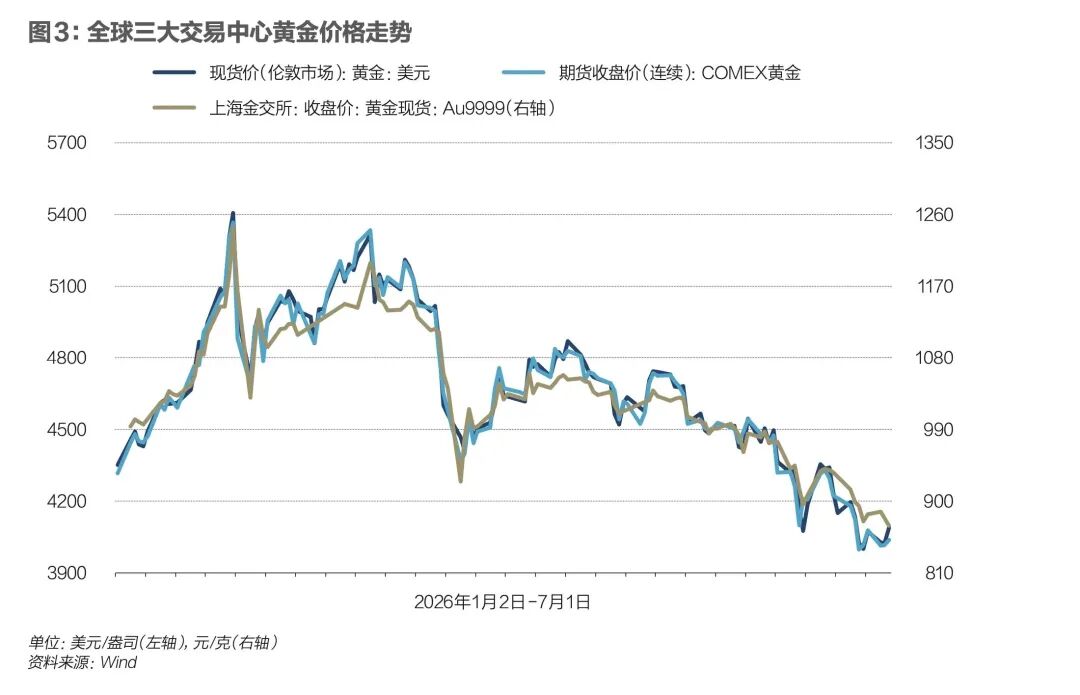
Starting from the global central banks' massive gold purchases in 2022, gold prices have risen for four consecutive years. On January 29, 2026, the London spot gold price broke through $5,400 per ounce, reaching the peak of this cycle, nearly tripling from the start of 2022. Since the end of January 2026, gold prices have continued to correct, once approaching the $4,000 per ounce level with an annual decline of over 7%, though prices still remain double their early 2022 level. Since July, gold prices have rebounded to around $4,150 per ounce, narrowing the annual decline to less than 4%.
"Gold remains among the best-performing assets over the past 12 months," the World Gold Council stated in its *2026 Mid-Year Outlook for the Global Gold Market* report.
01
Hong Kong's Multi-Dimensional Layout: Consolidating the Foundations of Warehousing and Clearing
In 2026, the construction of Hong Kong as a gold center has accelerated.
On May 27, Joseph Chan, in response to Hong Kong Legislative Council member Yao Zuhui, stated that the operational preparations for Hong Kong's central gold clearing system have entered their final stage, with a trial operation planned for 2026.
Paul Chan, Financial Secretary of the Hong Kong Special Administrative Region Government, previously wrote in his essay *Seizing Development Opportunities in a Complex and Volatile International Situation* that current over-the-counter spot gold transactions in Hong Kong require buyers and sellers to conduct clearing on their own, which creates obvious inconveniences. Therefore, Hong Kong is stepping up efforts to establish a central gold clearing system as critical financial infrastructure, to enhance the reliability and efficiency of Hong Kong gold trading and physical delivery, reduce transaction costs, and boost liquidity.
Prior to this, the FSTB had established the Hong Kong Precious Metals Central Clearing System Limited (hereinafter referred to as "HK Gold Clearing"), a wholly owned entity of the Hong Kong SAR Government, to serve as the clearing system's management body. Its board members include representatives from the Shanghai Gold Exchange (the Secretary for Financial Services and the Treasury, Christopher Hui, will serve as board chairman, while the SGE's representative will be vice chairman), regulatory bodies, and 11 banks including Bank of China (Hong Kong), Citigroup, JPMorgan Chase, Standard Chartered (Hong Kong), HSBC, and UBS.
As a board member of HK Gold Clearing and a direct participant in the central gold clearing system, a relevant official from the Bank of Communications told *Caijing* that the bank will actively engage in proprietary trading, agency clearing, and physical warehousing operations. In the initial phase of the business, proprietary trading products will cover spots, forwards, and swaps. As the market matures, the bank will further expand its full product system including client agency services, physical gold, lending, and vault management.
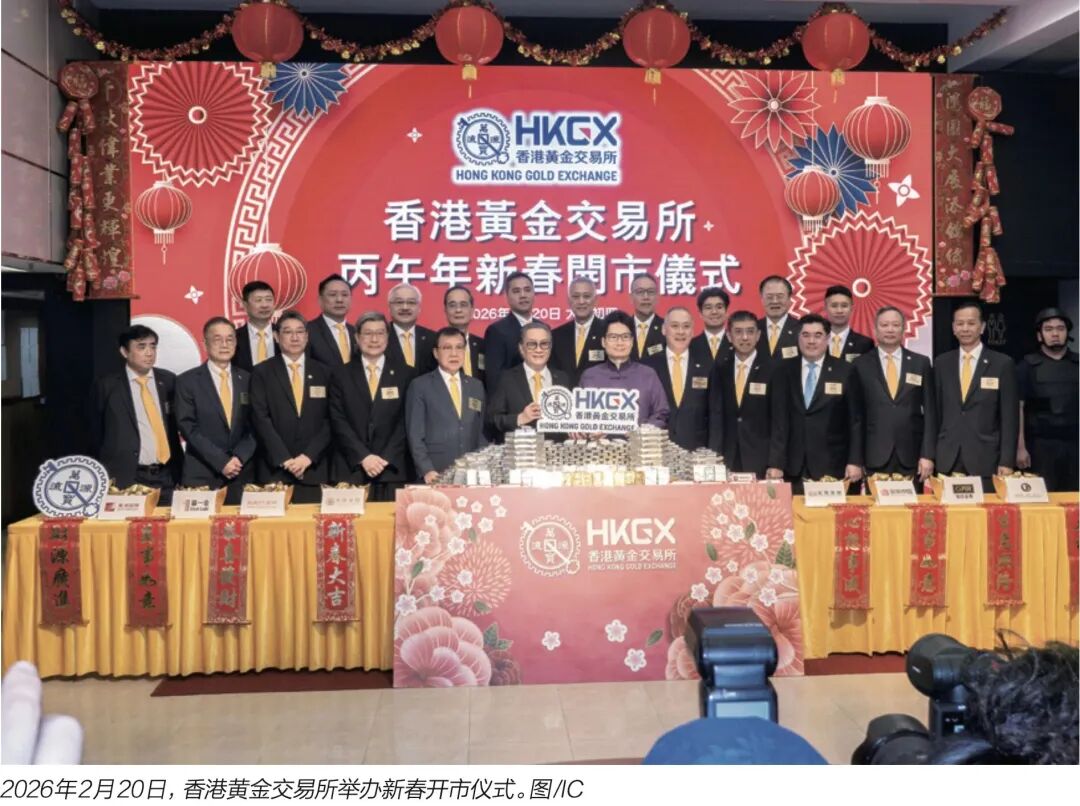
At the 2026 Asian Financial Forum in January, the FSTB and the Shanghai Gold Exchange signed a cooperation agreement, a key milestone in the operational preparation of the clearing system.
Christopher Hui, Secretary for Financial Services and the Treasury, stated that this landmark cooperation agreement focuses on two forward-looking arrangements: first, establishing a high-level collaborative governance structure for Hong Kong's central gold clearing system. SGE representatives will participate in the HK Gold Clearing board to oversee the system's preparations, rule-making, and institutional accreditation, while providing professional advice on system construction and risk management.
Second, exploring new pathways for physical infrastructure coordination and market interconnectivity. The two sides will explore leveraging the SGE's physical warehousing management system to provide physical storage services for gold businesses of market participants in Hong Kong and globally, thereby driving interconnectivity between on-exchange and over-the-counter businesses.
In addition, as one of the board members of HK Gold Clearing, Standard Chartered (Hong Kong) recently stated that it is studying the feasibility of building its own gold storage facility in Hong Kong and evaluating different site selection plans. Hong Kong is expected to become the first market in the world where the group establishes a self-owned gold storage facility, making the bank one of the few financial institutions with its own gold storage in Hong Kong. Currently, the bank already provides physical gold trading and related options financing services to corporate and investment banking clients. If the self-owned gold storage facility is established, the bank can extend its services from trade execution and clearing to comprehensive gold trading services that cover warehousing.
This is a microcosm of Hong Kong's massive push to develop gold storage infrastructure.
You Yang, Assistant Professor of Finance at the University of Hong Kong's Faculty of Business and Economics, believes that Hong Kong's top priority at present is to ensure smooth local delivery. To achieve this goal, Hong Kong must first possess sufficient warehousing capacity, verify that it can meet trade demands, ensure that all parties are willing to transport gold to Hong Kong, then find buyers through the spot market, and finally allow buyers to pick up gold from the central vault.
At the Asian Financial Forum, Christopher Hui stated that the FSTB is working with the Hong Kong Airport Authority (HKAA) and financial institutions to expand Hong Kong's gold storage capacity, with a three-year target of exceeding 2,000 tonnes, to establish Hong Kong as a globally trusted gold storage hub. The HKAA has launched a project to expand its airport storage facilities, which will reach a thousand-tonne scale to meet local storage, delivery, and transit needs.
In September 2025, the FSTB's official website revealed that the HKAA had increased the precious metals vault capacity at Hong Kong International Airport by one-third to 200 metric tonnes, and is planning to expand it to 1,000 metric tonnes in phases.
At the same time, Hong Kong is continuously enriching its gold investment instruments, assisting issuers in launching gold funds, and supporting the development of new products such as tokenized gold products.
In May, Joseph Chan revealed that the Hong Kong Stock Exchange is preparing to relaunch gold futures trading in the coming months.
Chong Tai Leung, Associate Dean of New Asia College at the Chinese University of Hong Kong and Executive Director of the Lau Chi Pak Institute for Global Economic and Financial Research, stated that the gold market is cyclical: in bull markets, investors generally buy gold, while buying interest is relatively weak during downward cycles. Therefore, more gold-related financial products need to be launched to stimulate market activity.
Prior to this, on April 21, Hong Kong's largest gold exchange-traded fund (hereinafter referred to as "gold ETF") — the CSOP Gold ETF — was officially listed, supporting physical gold subscription and redemption to enable trading and storage within Hong Kong. As early as January 29, the Hang Seng Gold ETF was listed on the Hong Kong Stock Exchange, becoming the first ETF in Hong Kong that allows investors to redeem physical gold through banks.
Yan Gang stated that the Hong Kong SAR Government has a clear development roadmap, planning to use warehousing and clearing as the foundation, product and institutional innovation as key drivers, and mainland interconnectivity and international links as the direction, to gradually upgrade Hong Kong from an "international gold trade node" to an "international gold trading center."
Regional cooperation is also advancing simultaneously: in November 2025, the FSTB and the Shenzhen Local Financial Regulatory Bureau signed a cooperation memorandum, supporting Hong Kong gold merchants to develop processing trade cooperation with qualified Shenzhen refining enterprises. On the market mechanism front, the SGE established a designated international board warehouse in Hong Kong in June 2025 and launched local delivery contracts, marking its first offshore delivery warehouse.
02
Expanding the Gold Hub: Closing the Asian Time Zone Gap
Approximately 2,500 kilometers southwest of Hong Kong, China lies the garden city of Singapore, which is the world's second-ranked international financial center after Hong Kong.
As Hong Kong's central gold clearing system nears completion, Singapore announced that it will launch an over-the-counter gold clearing system by the end of the year and add interbank trading next year.
Furthermore, Singapore plans to launch central bank gold vault services by October 2026, with major vault providers currently offering over 2,000 tonnes of secure storage; on the taxation front, the 5% cap on physical investment in precious metals under the fund tax incentive scheme will be removed; in the derivatives sector, Singapore is exploring gold futures contracts that allow physical delivery.
From clearing systems and gold storage to tax incentives and trading instruments, the competition between Hong Kong, China and Singapore for the position of international gold hub is self-evident.
"Asia's gold market infrastructure has not fully kept pace with changing demand, with trading, liquidity, and price discovery still concentrated in global centers such as London and New York. This creates a real gap in the Asian time zone," Tharman Shanmugaratnam, Chairman of the Monetary Authority of Singapore (MAS), recently explained, shedding light on the global gold landscape shifts behind the Hong Kong-Singapore competition.
For years, global gold market trading, liquidity, and pricing have been highly concentrated in the London and New York markets.
Data from the World Gold Council shows that in the first half of 2026, the global gold market recorded an average daily trading volume of $486.95 billion. Among this, the London Bullion Market Association (LBMA) over-the-counter (OTC) market saw an average daily volume of $223.34 billion, and the New York Commodity Exchange (COMEX) recorded $155.51 billion, accounting for approximately 46% and 32% respectively, combining to exceed three-quarters of the total.
Global gold inventories are also highly concentrated in European and American markets. Taking central bank gold reserves as an example, Singapore-based precious metals trader Bunker Group estimates that gold stored in the United States and the United Kingdom together accounts for approximately 53