Cross-province alliance, three trillion-yuan cities in northern China join forces
Recently, the human resources and social security authorities of Jinan, Qingdao and Zhengzhou jointly signed the "Cooperation Agreement for the Coordinated Development of Social Security in the Three Cities of Jinan, Qingdao and Zhengzhou", simultaneously launching over 20 social security convenience service items. This means the three cities and their radiating metropolitan areas are expected to take the lead in realizing social security interconnection, accelerating cross-provincial resource flow and efficient allocation.
Nationwide, this move is highly groundbreaking. According to local media reports, the three cities jointly released the country's first "Application Catalogue of 'One Card for All' Resident Services on Social Security Cards" covering three cities across two provinces, pressing the "start button" for the integrated development of cross-provincial social security among the three cities; previous cases of cross-provincial social security services, such as the Beijing-Tianjin-Hebei social security integrated handling and the Yangtze River Delta "One-Network Office", were mostly concentrated within major urban agglomerations.
In comparison, the competition and cooperation between Jinan and Qingdao within Shandong province has a long history, and behind the partnership of Zhengzhou, Jinan and Qingdao lies the coordination issue between Shandong and Henan provinces. Taking this step is truly no easy feat.
However, the three cities moving closer to each other is an inevitable trend. The "Opinions of the Central Committee of the Communist Party of China and the State Council on Promoting High-Quality Urban Development" issued last year clearly states that "support the Beijing-Tianjin-Hebei region, the Yangtze River Delta, and the Guangdong-Hong Kong-Macao Greater Bay Area to build world-class urban agglomerations, and promote the Chengdu-Chongqing twin-city economic circle, the middle reaches of the Yangtze River urban agglomeration and other regions to become high-quality development growth poles". Shandong was not included in the list, which once prompted reflection from local media: Shandong needs to move faster.
Now, Shandong has proactively invited Henan into this "group chat", and the three northern cities with GDP exceeding one trillion yuan are accelerating their joint efforts. Can they forge a new regional coordinated development landscape?
01
Joint Efforts to "Break the Deadlock"
In recent years, discussions on Zhengzhou-Jinan cooperation have emerged in official documents from time to time. In the mutual outreach between the two cities, the "Shandong-Henan Partnership" has evolved from a unilateral appeal to a consensus between both sides.
Jinan was the first side to "take the initiative". In 2020, Jinan made a groundbreaking proposal in its official documents to aim for the status of a "national central city" and promote the construction of the "Lower Yellow River Urban Agglomeration", with one core measure being "promoting the docking and cooperation between the Jinan Metropolitan Area and the Zhengzhou Metropolitan Area, leading and driving the coordinated development of central-western Shandong and the Central Plains region".
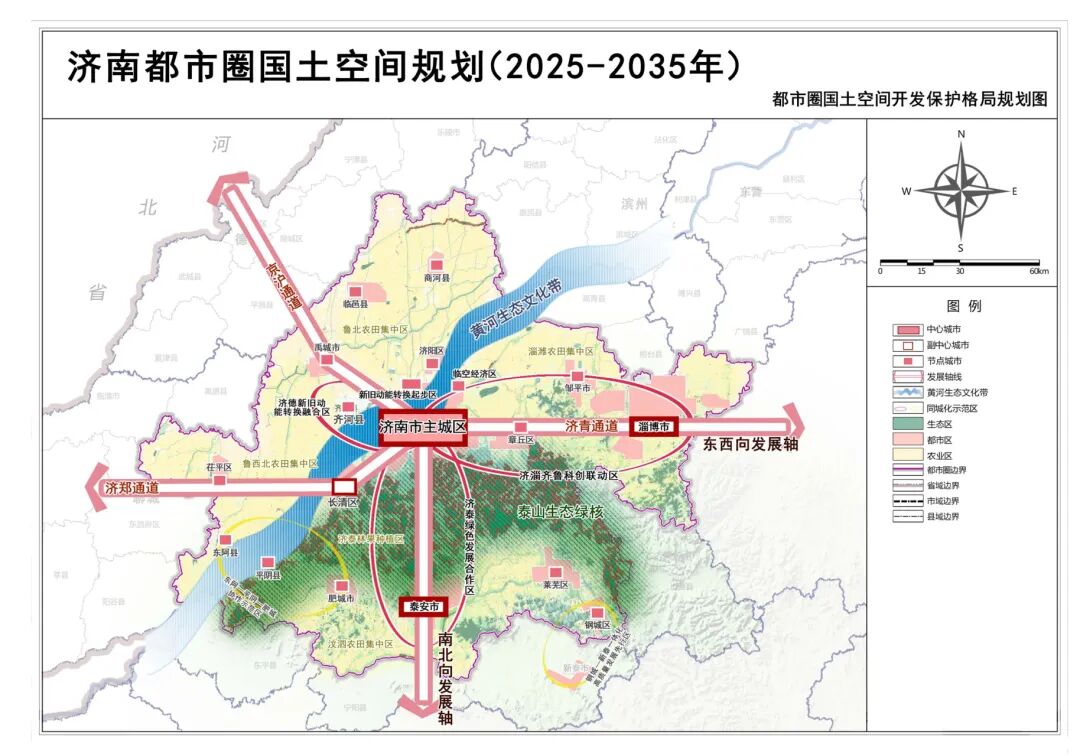
Image source: Draft for Public Comments of "Land Spatial Planning of the Jinan Metropolitan Area (2025-2035)"
Frequent actions to "go global" further demonstrate Jinan's urgency. According to incomplete statistics, since 2017, the Jinan Party and government delegation has visited Zhengzhou for inspections at least three times, discussing cooperation in fields such as joint prevention and control of ecological protection, collaborative industrial development, mutual sharing of scientific and technological resources, and promoting win-win opening-up cooperation.
In contrast, Zhengzhou's response was not very proactive for a time, until the opening of the Jinan-Zhengzhou high-speed railway at the end of 2023 became an important milestone. It not only promoted Zhengzhou and Jinan to jointly step into the "mi"-shaped high-speed railway hub, but more importantly, ended the history of no direct high-speed railway connection between the two large northern cities, ushering in a new stage of the "2-hour life circle", making further cooperation inevitable.
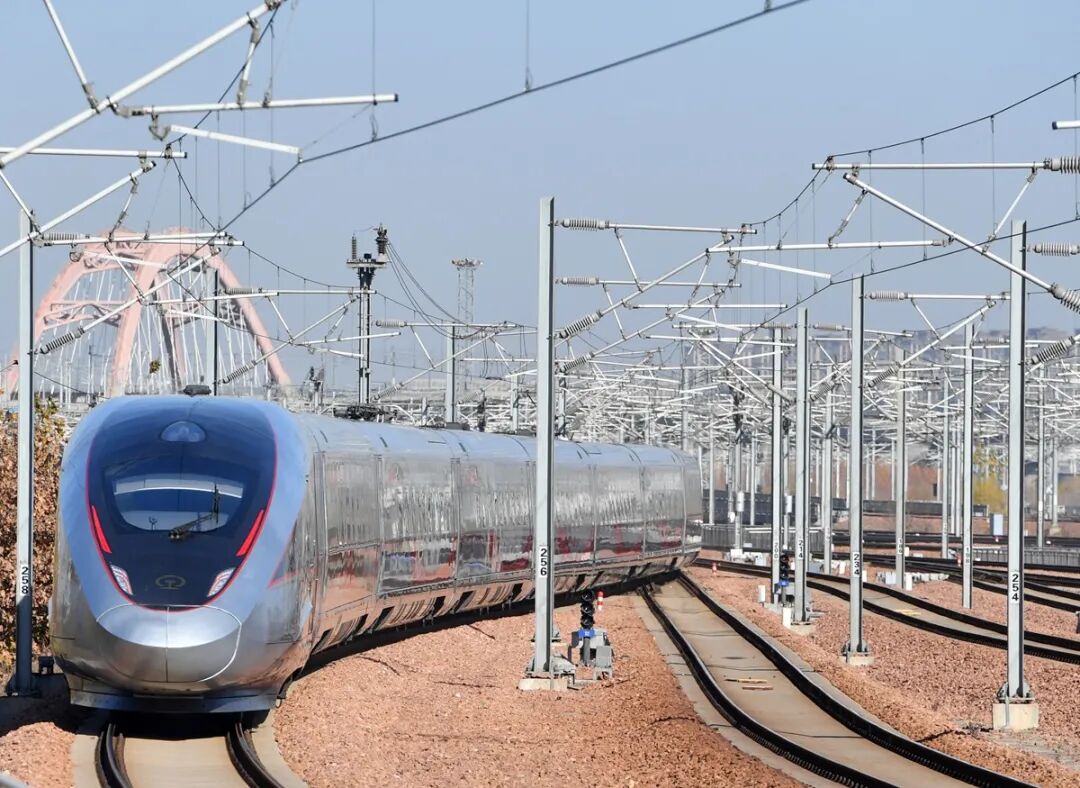
Image source: Xinhua News Agency
After that, Zhengzhou began to seek in-depth "participation". The "2024 National Economic and Social Development Plan of Zhengzhou" mentions striving to build the Shandong-Henan National Regional Science and Innovation Center with Zhengzhou, Jinan, Qingdao and Luoyang as the core. According to media reports, this is the first time Zhengzhou's official documents have publicly extended an invitation to Jinan and Qingdao.
Although there is no further progress in the planning of the regional science and innovation center, as the two cities move closer, Jinan's initial vision for metropolitan area cooperation has finally yielded practical results.
The first driving force comes from a higher administrative level. In the "15th Five-Year Plan" outline of Shandong and Henan provinces, it is clearly proposed to promote the linked development of the Jinan and Qingdao metropolitan areas with the Zhengzhou Metropolitan Area. This means the Qingdao Metropolitan Area has been officially included in the "circle of friends" of Zhengzhou-Jinan cooperation. Beyond "linked development", Shandong has added the expression of "collaborative opening-up", which, as Henan local media put it, is the "ideal model" for bilateral cooperation.
Social security cooperation serves as the breakthrough point for metropolitan area linkage. Back in March this year, Jinan and Qingdao took the lead in signing a cooperation agreement to promote the coordinated development of the two core cities in Shandong in the social security field; this time, Zhengzhou has further joined in, pushing the scope of cross-regional social security services beyond provincial boundaries. The outside world expects this move to "break down regional public service barriers, remove obstacles to the cross-provincial and municipal flow of labor and talent, and realize efficient matching of people and posts as well as shared public services across different regions".
02
Core Variable
Whether it is the new changes brought by the Jinan-Zhengzhou high-speed railway, or the breakthrough of metropolitan area cooperation in the social security field, "people" are undoubtedly the core variable.
Tian Dazhou, Director of the Human Resources Research Office of the Chinese Academy of Labor and Social Security Sciences, once analyzed in an interview that the smooth transfer and continuation of social security relationships and "cross-provincial integrated handling" essentially use institutional reform, information interconnection and sharing, and rights protection to fundamentally eliminate hidden barriers such as interrupted social security payments, reduced benefits, and cumbersome procedures in labor mobility, setting up an institutional safety net for the free flow of labor.
Looking at the flow of people between Zhengzhou and Jinan, and even between Shandong and Henan, this topic has always attracted much attention. On the first anniversary of the opening of the Jinan-Zhengzhou high-speed railway, a Shandong media outlet made a comparison: the Zhengzhou Bureau of China Railway had cumulatively dispatched 10.962 million passengers, while the Jinan Bureau of China Railway had cumulatively handled over 8 million passengers in terms of departures and arrivals. The passenger flow gap between the two provinces reached two million. "Although this cannot directly prove that the number of passengers going to Shandong is far higher than that to Henan, it can indirectly reflect Henan residents' preference for Shandong."
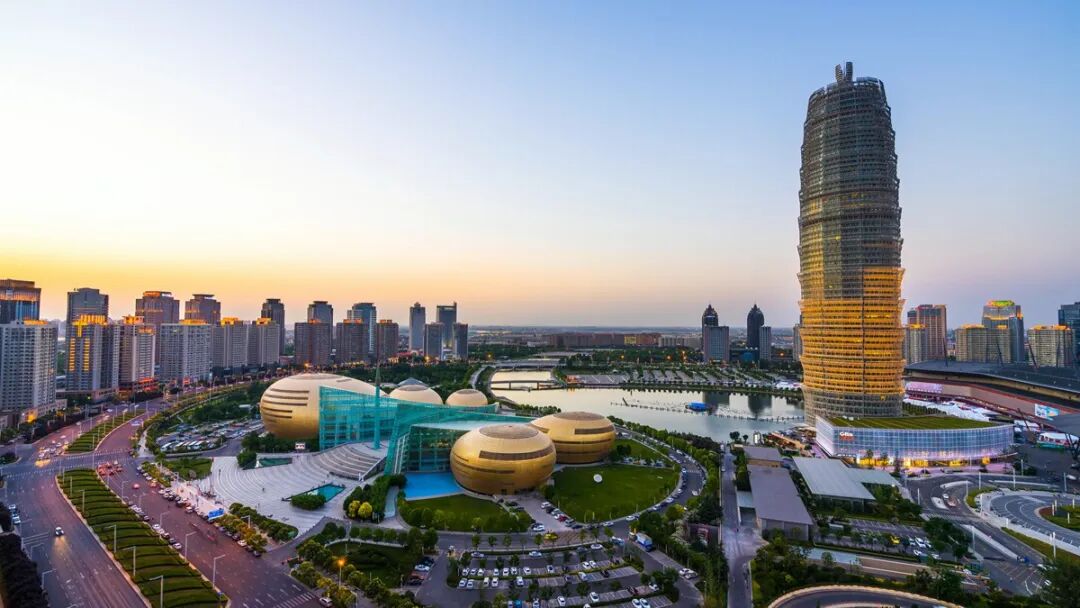
Image source: 501614438 from Sheying.com
Another set of data comes from the 7th National Population Census: more than 620,000 people migrated from Henan to Shandong, ranking 7th among all destinations for Henan's out-migrating population. Shandong is one of the northern provinces with the largest number of Henan migrants.
At the same time, many people regard the obstacles to population mobility as a barrier to cooperation between the two provinces. Huang Shao'an, a distinguished professor at Shandong University, once pointed out that besides the high economic isomorphism between the two provinces and the relatively backward border areas, Shandong lacks sufficient economic attractiveness to draw Henan's production factors, at least labor, to Shandong. Moreover, Shandong has a certain sense of superiority in geographical location, the mainstream status of traditional culture, and self-image recognition, leading to "limited economic exchanges and cooperation" between the two provinces.
At the city level, as a strong promoter of Zhengzhou-Jinan cooperation, Jinan faces a stronger demand for attracting talent.
Data shows that last year, Jinan's permanent resident population increased by 101,000 to 9.619 million, hitting a five-year high in increment and making it the northern city with the largest population growth. However, compared with the plan of "reaching around 10 million permanent residents by 2025", Jinan still needs 381,000 more people to meet the target on schedule. More importantly, Jinan's natural population growth has turned negative in recent years, and its population growth relies heavily on in-migrants, especially from within the province.
The situation of the Jinan Metropolitan Area is even less optimistic. "Zeping Macro" previously counted the average annual population changes of 33 metropolitan areas. The Jinan Metropolitan Area saw negative average annual population growth from 2021 to 2023, with its population increment ranking the fifth from the bottom.
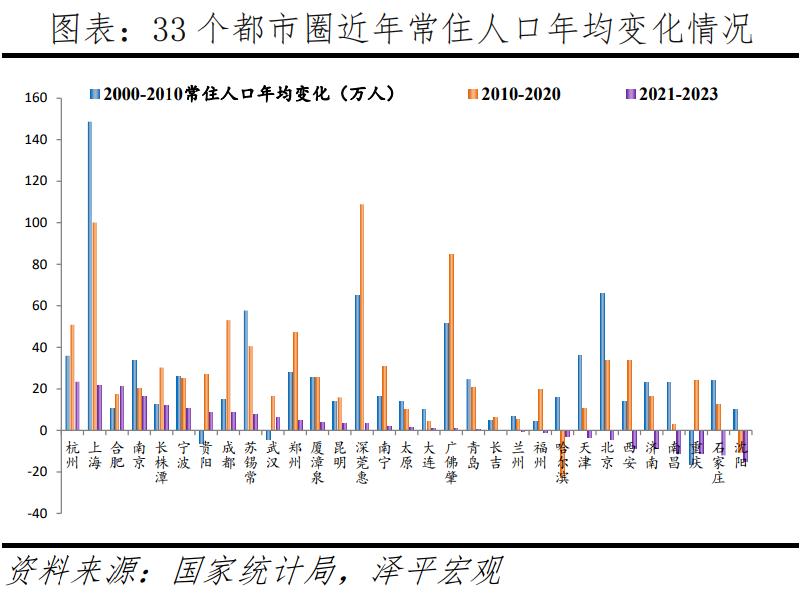
In comparison, Zhengzhou has a larger population base. Its permanent resident population broke through 10 million long ago, and further increased by 52,000 to 13.138 million last year. The Zhengzhou Metropolitan Area ranked 11th in average annual population increment from 2021 to 2023, far higher than the Jinan Metropolitan Area.
03
Strategic Breakthrough
It should be noted that population mobility is not a simple zero-sum game. The key lies in revitalizing various resources such as science and innovation and industries through the optimal allocation of people, ultimately driving the economic growth and status improvement of the entire region.
For example, many Henan experts are concerned about Shandong-Henan science and education cooperation, behind which lies a significant gap in science and education strength between the two provinces: Shandong's science and education strength ranks at the forefront nationwide, while Henan, due to historical reasons, ranks relatively low, directly affecting its high-quality economic development momentum. A widely held view is that through scientific researcher exchanges, collaborative scientific and technological innovation, and off-site transformation of achievements, Henan's traditional industries are expected to achieve transformation, and Shandong's scientific and technological resources can also find broader room for growth.
The mutual exchanges may catalyze deeper chemical reactions. Wang Peng, then an associate researcher at the Beijing Academy of Social Sciences, once mentioned in an interview that the gathering of scientific research forces can form a combined force for scientific and technological innovation. Under the optimal allocation of scientific research resources, the scientific and technological innovation capacity of the entire region will be enhanced, driving the incubation of more high-tech enterprises and forming a driving force for sustained regional economic growth.
This may well be the fundamental reason for Zhengzhou, Jinan and Qingdao to "unite".

Image source: 501771751 from Sheying.com
At an inter-provincial seminar after the opening of the Jinan-Zhengzhou high-speed railway, a relevant official from the Henan Development and Reform Commission once stated bluntly that the current problem facing Shandong and Henan is that "neither has been included in the country's major economic layouts". Only through bilateral cooperation to form an important development region can they have the strength to compete with more important growth poles in the next step.
There have long been discussions in public about the "absence" of Shandong and Henan in major national economic layouts. Five years ago, the national-level regional development strategies mainly covered three regions: Beijing-Tianjin-Hebei, the Yangtze River Delta, and the Guangdong-Hong Kong-Macao Greater Bay Area. At that time, Shandong and Henan, the two largest northern provinces, being left blank once drew widespread attention.
Last year, the "Opinions of the Central Committee of the Communist Party of China and the State Council on Promoting High-Quality Urban Development" focused on 5 urban agglomerations, and Shandong was once again "not on the list". Local media analysis pointed out that "in the 14th Five-Year Plan, the Chengdu-Chongqing and middle Yangtze River urban agglomerations have shifted from 'growing and developing' to 'optimizing and upgrading'. This transformation not only recognizes the strength of these urban agglomerations, but also means they have stepped onto a new stage, ushering in new strategic positioning and development opportunities." Shandong deserves to achieve such a leap too.
From Jinan's proposal to build the "Lower Yellow River Urban Agglomeration" five years ago, to the proposal in Shandong's "15th Five-Year Plan" outline to "promote the open cooperation between the Shandong Peninsula Urban Agglomeration and the urban agglomerations along the Yellow River", "unity" has always been regarded as the key to breakthrough. In the science and innovation field, the creation of the "Shandong-Henan National Regional Science and Technology Innovation Center" is a specific starting point, and some people even regard it as a "reserve force" for another regional economic demonstration zone following the Yangtze River Delta and Pearl River Delta.
As the core cities of the two provinces, promoting the facilitation of population mobility between Zhengzhou, Jinan and Qingdao is undoubtedly a milestone node. Facing greater expectations, this is just the first step.
This article is from WeChat official account "City Evolution", written by Yang Qifei, and published with authorization from 36Kr.