On the Eve of Listing: Shenzhen's Dark Horse in Storage Tech Targets Hong Kong IPO with 4-Month Net Profit of 3.84 Billion Yuan
This article is approximately 3,400 words long. It is recommended to take 7 minutes to read.
Author | Peng Xiaoqiu
Editor's note: The "On the Eve of Listing" column focuses on the critical moments when enterprises rush into the capital market. Every prospectus hides a company's ambitions, cycles, and concerns before going public. This is the first issue - Shenzhen Hongxinyu Electronics.
On July 3rd, a Shenzhen-based company named Hongxinyu Electronics submitted a prospectus to the Hong Kong Stock Exchange. The sole sponsor for this IPO is China Securities Construction Investment.
The most eye-catching figures in the prospectus are as follows: In the first four months of 2026, Hongxinyu's net profit was 3.841 billion yuan, a staggering 3,020.8% increase compared to 123 million yuan in the same period of the previous year. The overall gross profit margin soared from 13.8% a year ago to 62.0%.
A module factory that lost 118 million yuan in 2023 and had an operating cash flow deficit of 1.05 billion yuan suddenly became a cash cow. From this 481-page prospectus, Hard Krypton found that what's more complex than the 30-fold increase in net profit is - how much of it is due to its capabilities and how much is brought by this super cycle of storage price increases.
In fact, in this company's technical foundation and equity lineage, there is a name that almost everyone would overlook: Phison Electronics, the leading NAND controller manufacturer in Taiwan, China.

Net profit of 3.84 billion yuan in the first four months of this year, but an operating cash flow net outflow of 2.7 billion yuan
Looking at Hongxinyu's performance:
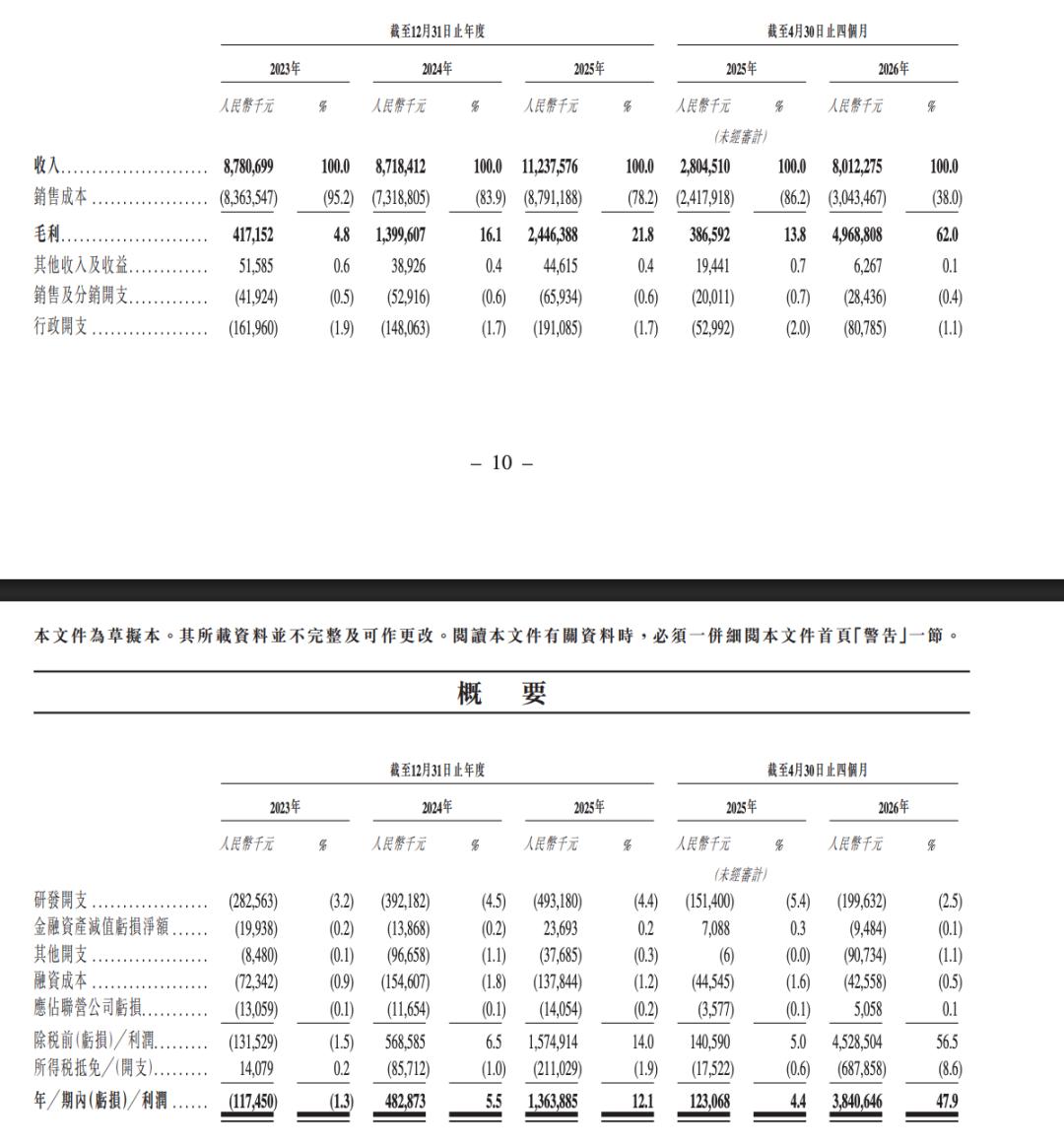
Revenue: 8.781 billion yuan in 2023 → 8.718 billion yuan in 2024 → 11.238 billion yuan in 2025;
Net profit: A loss of 118 million yuan in 2023 → a profit of 483 million yuan in 2024 → a profit of 1.364 billion yuan in 2025 (a year-on-year increase of 182.5%);
In the first four months of 2026, the revenue was 8.012 billion yuan (2.805 billion yuan in the same period of the previous year, a 186% increase), and the net profit directly soared to 3.841 billion yuan.
That is to say, the net profit earned in four months this year is nearly three times that of the whole year in 2025. How did it achieve this? The answer lies in the price of storage wafers.
Hongxinyu is an independent memory manufacturer. It doesn't produce storage wafers but buys NAND Flash and DRAM wafers from original storage manufacturers such as Samsung, SK Hynix, and Micron. After matching with controller chips, packaging, and testing, it makes eMMC, UFS, solid-state drives, and memory modules for sale, earning money from the processing and integration of midstream modules. The prospectus also refers to it as a light-asset model: wafer processing, packaging, and testing are all outsourced to third parties.
This business is highly sensitive to raw material prices. Since the second half of 2025, the storage industry has started to enter a major cycle driven by AI. AI servers have spurred the demand for storage instead of computing. Leading original manufacturers have concentrated their production capacity on high-profit products such as HBM and DDR5, reducing the production capacity of traditional DRAM and NAND. The mismatch between supply and demand has directly driven up the prices. The monthly increase of some DRAM products exceeded 30%.
What does this mean for Hongxinyu? Look at the average price per GB of its DRAM products: from 12.24 yuan/GB in the first four months of 2025 to 34.98 yuan/GB in the same period of 2026, a 1.86-fold increase. The value of its inventory has increased accordingly, and that's how the 62% gross profit margin came about.
So this 3.8 billion yuan in net profit is mainly brought by the cycle, not by efficiency. The prospectus also repeatedly warns that the storage industry has always been cyclical, and there is no guarantee that such demand growth or price trends will continue. During the last cycle reversal (downward from 2022 - 2023), Hongxinyu lost 118 million yuan in 2023 and had an operating cash flow of -1.05 billion yuan. The cycle can turn from optimism to pessimism just as quickly.
If you only look at the profit statement, Hongxinyu is indeed a cash cow. But when you look at the cash flow statement, the situation is completely different.
In the first four months of 2026, the net cash flow from the company's operating activities was -2.691 billion yuan. While the net profit on the book is 3.8 billion yuan, the net operating cash outflow is 2.7 billion yuan. Where did the money go?
The prospectus makes it clear: in these four months, the inventory increased by 3.76 billion yuan, prepayments and other receivables increased by 3.129 billion yuan, and trade accounts receivable increased by 1.279 billion yuan. In other words, the company is desperately stockpiling goods, preparing materials, and delaying payments.
This is a classic move of cyclical stocks in the upward period: frantically stockpiling raw materials while prices are rising, and the book profit and inventory both inflate. If the market continues, the value-added inventory will be realized as profit in the next period; if the market starts to decline, the high-priced inventory in hand will become a devaluation. The prospectus also directly points out this in the risk factors: the company may also need to recognize impairment losses on goodwill (and other intangible assets) in the future, and the industry's economic downturn and falling average selling prices have already and may again have a significant adverse impact.
Looking at the past three years, indeed only in 2025 was the operating cash flow positive, at 717 million yuan. The first four months of 2023, 2024, and 2026 were all negative, at -1.05 billion yuan, -1.12 billion yuan, and -2.69 billion yuan respectively. Its ability to generate cash has not been stable so far.
Hongxinyu labels itself as one of the few independent Chinese memory manufacturers with the ability to independently design controller chips, which it calls the "brain" of storage products. It sounds on par with first-tier original manufacturers, but when you break down the revenue structure, you'll find two levels of disparity.
First level: What really drives the revenue is the low-margin modules, not the high-tech controller chips. In the revenue composition of 2025, embedded storage accounted for 5.37 billion yuan, or 47.8%; DRAM accounted for 2.784 billion yuan, or 24.8%; storage particles accounted for 1.719 billion yuan, or 15.2%; solid-state drives accounted for 964 million yuan, or 8.6%; and the self-developed controller chips were grouped into the "other" category. In 2025, the entire "other" category was only 54.641 million yuan, or 0.5%.
That is to say, the controller chips are currently more like a technical story and potential, and their contribution to revenue can almost be ignored. The prospectus reveals that in addition to the mass-produced ones, there are still 8 models of self-developed controller chips, which are in different R & D stages such as sample submission, tape-out, back-end design, and front-end design. That is, the most advanced ones haven't come out yet.
Second level: 99% of the diverse application scenarios are still consumer-grade. According to the breakdown by downstream in the prospectus, consumer-grade accounted for 99.6% in 2025, enterprise-grade accounted for 0.1%, and automotive-grade accounted for 0.3%. Enterprise-grade and automotive-grade are elaborately described in the advantages and strategy sections, but the real revenue almost all comes from consumer electronics such as mobile phones, tablets, and PCs, which are the most competitive and most affected by the cycle. Moreover, most of the customers' revenue comes from the Chinese mainland.
Hongxinyu repeatedly emphasizes that based on the 2025 revenue, it is the fifth-largest independent memory manufacturer globally and the second-largest in the Chinese mainland.
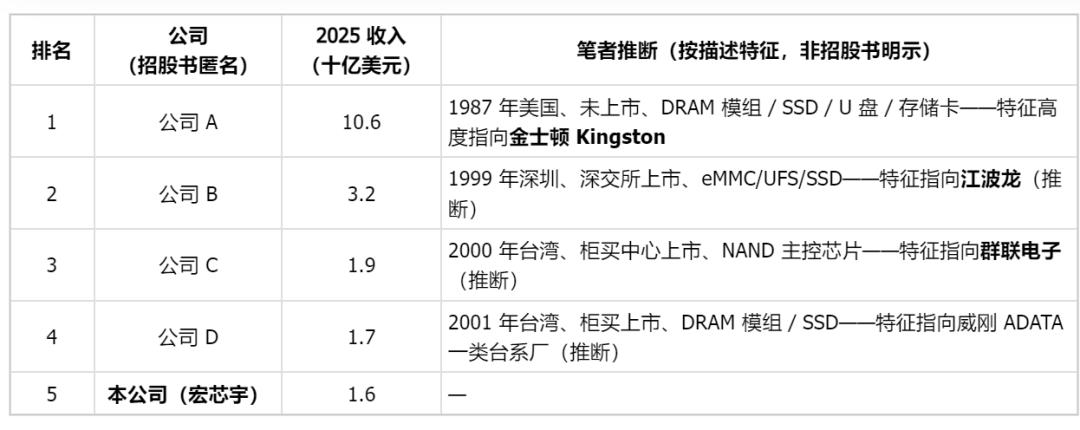
But the first place (Kingston) with 10.6 billion US dollars is 6.6 times that of Hongxinyu's 1.6 billion US dollars. What's even more disparate is the entire market: in the entire storage product market, Hongxinyu ranked 12th globally in 2025, with a market share of about 0.6%; while the original storage manufacturers that control the wafers accounted for more than 95% of the share. The overall share of domestic independent manufacturers only increased from less than 1.5% in 2021 to just over 3% in 2025.

The valuation increased from 800 million yuan to 10.8 billion yuan in five years
Hongxinyu has relatively strong financing capabilities. From 2020 to 2025, it completed a total of six rounds of financing, namely A, B, C, C1, C2, and D. The post-investment valuation has been pushed from hundreds of millions to the tens of billions level.
Round A (2020): The post-investment valuation was 816 million yuan, and the price per share was 6.00 yuan;
Round B (2021): The post-investment valuation was 5.126 billion yuan, and the price per share was 14.00 yuan. The prospectus explains that the more than six-fold increase in one year was due to strong business growth and product mass-production capabilities;
Round C (2022): The post-investment valuation was 8.294 billion yuan, and the price per share was 21.00 yuan. One of the factors contributing to the significant increase in valuation in this round was that several industry peers successfully went public and had valuations exceeding 50 billion yuan, which boosted investors' expectations;
Round C1 (2022): The post-investment valuation was 8.641 billion yuan, and the price per share was 21.27 yuan;
Round C2 (2023): The post-investment valuation was 9.229 billion yuan, and the price per share was 22.27 yuan;
Round D (2025): The post-investment valuation was 10.76 billion yuan, and the price per share was 23.00 yuan.
The valuation increased by about 13 times in five years. In the latest Round D, the company was valued at 10.76 billion yuan. However, the funds for Round D were only fully paid in March 2025, long before this round of storage price surge.
Who is the biggest winner in this IPO? Looking at the investment cost, you'll know it's the Round A investors, with only 6 yuan per share, about a quarter of the 23 yuan per share in Round D. The institutions that bet on the company in 2020 have seen their book profits multiply. The earlier you enter and the lower the cost, this is the common script for all Pre-IPO stories.
In Hongxinyu's shareholder list and technical foundation, there stands Phison Electronics, the leading NAND controller manufacturer in Taiwan, China. Phison Electronics indirectly holds shares in Core Storage (11.81%) and Ruiyuan Investment (10.69%) through two platforms, with a total of 22.50%, making it the second-largest shareholder group after the founder Wu Yisheng.
It's worth mentioning that when the company was founded in 2018, Ruiyuan Investment (wholly-owned by Phison) held 40% of the shares; after Round A, Phison and its related parties once held as high as 44.35% of the shares, but were later diluted to 22.5% after multiple rounds of financing.
Phison Electronics has four identities:
Founding shareholder: It was the second-largest shareholder from the start. The founder Wu Yisheng met Phison's CEO PUA KHEIN SENG (Pan Jiancheng) through long-term industry connections;
Supplier: Since April 2019, Hongxinyu has been purchasing NAND Flash, controller chips, and testing fixtures from Phison;
Technology licensor: Phison provides firmware development services (from 2020 - 2025) and background technology licenses to Hongxinyu. In 2017, it also transferred three mature technology patents to related parties, and Hongxinyu obtained them in 2020. During the performance period, Hongxinyu paid a total of about 31.8 million yuan in license fees for these arrangements. The prospectus states that in Hongxinyu's products such as eMMC, ePOP, and USB flash drives, some controller chips are developed based on historical business arrangements with Phison;
Competitor on the same list: Its revenue in 2025 ranked ahead of Hongxinyu.
In addition to Phison, Hongxinyu also introduced Wei Chuan Corporation in 2024, which is the parent company of Master Kong.
Hongxinyu's founder, chairman, and general manager Wu Yisheng, 56 years old, holds about 36.68% of the voting rights in the controlling shareholder group and has over 25