Chased by Huawei, Alibaba and Meituan, why is this "Token Factory" in a rush for IPO?
[Core Tip]
With a 70-fold surge in users in a year, why is Silicon Flow still "burning money for scale"?
Another AI infrastructure company has reached the door of the capital market.
Recently, Beijing Silicon Flow Technology Co., Ltd. (hereinafter referred to as "Silicon Flow") submitted a listing application to the Hong Kong Stock Exchange. This company, which has been established for less than three years, will enter the public market without making a profit and even with a negative gross profit margin.
In this round of AI boom, the outside world is more familiar with large model companies, cloud providers, and chip enterprises. Silicon Flow is located closer to the middle layer, positioning itself as an "open and independent token supply platform" that connects computing power, models, and developers.
Silicon Flow has a rapid financing rhythm. Its valuation has increased from 280 million yuan to 7.74 billion yuan in two and a half years. Industrial capital such as Alibaba, Huawei, 360, and SenseTime have successively entered the game. However, during the same period, although the company's revenue has increased rapidly, its gross profit margin has slipped from 83.3% to -24.0%, and the cumulative loss has exceeded 400 million yuan.
Currently, Silicon Flow's market share is 1.5%. Against the backdrop that giants have already mastered computing power, cloud services, and customer access, can an independent AI infrastructure company find its own position through efficiency, ecosystem, and neutrality?
Rapid financing and rapid listing
Silicon Flow is listing under Chapter 18C of the Hong Kong Stock Exchange.
This is a green channel specifically for technology companies that "haven't made money but have strong technology." The prospectus doesn't hide the fact and directly states that the company is still losing money.
From August 29 to December 31, 2023, in 2024, and in 2025, the company's losses during the period were 1.2223 million yuan, 8.1915 million yuan, and 345 million yuan respectively. The prospectus admits that as the company expands its business scale, the absolute R & D expenses and recent net losses will continue.
Silicon Flow was established in August 2023 and has been around for less than three years, but its development and financing rhythm are quite fast.
In the year of its establishment, the company completed its angel round. Investors included Sinovation Ventures, Glory Ventures, MiraclePlus, and Wang Huiwen. The common feature of these investment institutions or individuals is that they dare to bet on underlying technologies in the early stage.
Yuan Jinhui, the 45-year-old founder of Silicon Flow, is a Ph.D. from Tsinghua University. He and Wang Huiwen are also old acquaintances.
In 2017, after resigning from Microsoft, Yuan Jinhui started his own business and established Beijing OneFlow Technology Co., Ltd., focusing on improving algorithm R & D efficiency and hardware utilization.
In April 2023, "Beyond Light Years" founded by Wang Huiwen acquired OneFlow through a share swap. Yuan Jinhui thus became one of the co-founders of Beyond Light Years. In June 2023, Wang Huiwen left his position due to health reasons, and Beyond Light Years was subsequently acquired by Meituan. After leaving, Yuan Jinhui started his business again with Silicon Flow.
It can be said that Wang Huiwen's investment in Silicon Flow is his second bet on the same technical partner.
It should be noted that Silicon Flow's revenue in 2023 was only 6,000 yuan. These early investors valued Yuan Jinhui's team and their belief in technology.
In the subsequent six rounds of financing, Silicon Flow attracted many investors, including Hubble Technology under Huawei, Biren Technology, Zhipu, Meituan Group, Alibaba, and SenseTime. Its valuation soared from 280 million yuan after the angel round to 7.74 billion yuan after the B + round, which took only two and a half years.
What exactly is Silicon Flow doing to attract so many giants to invest real money?
In the prospectus, the company positions itself as "an open and independent token supply platform that provides token supply based on computing power resources and models with different cost - performance ratios," and it is engaged in the key infrastructure in the global AI value chain.
To put it in a popular way: if we regard chips as hardware such as stoves and ovens in the kitchen, which determine the theoretical production capacity of the kitchen; and compare large AI models to chefs who can make finished dishes with ingredients. Then the inference engine and computing power orchestration done by Silicon Flow can be regarded as the work of preparing and delivering dishes in the back kitchen and the coordinated scheduling between multiple stoves.
It determines how many dishes can be stably produced per unit time, how quickly the first dish can be served, and whether the ingredients and firepower are wasted under the same chef and the same set of equipment.
In fact, the investors behind Silicon Flow are not simply making financial investments. They are all deeply related to the industry itself.
For example, Huawei is not only a shareholder who entered in the angel + round of Silicon Flow but also a supplier and customer of the company.
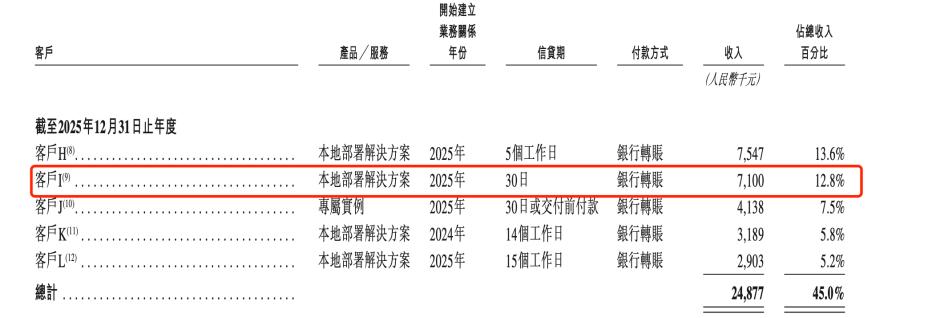
According to the information in the prospectus, Customer I (also Supplier J) was the second - largest customer of Silicon Flow in 2025. The company provided AI model chip adaptation services to it, with sales revenue of 7.1 million yuan, accounting for 12.8% of the company's total revenue in 2025.
Similarly, this company was also the fifth - largest supplier of Silicon Flow in 2025, mainly providing computing power resources to Silicon Flow through different entities within the group. The prospectus shows that Silicon Flow's procurement amount from this supplier in that year was 12.6 million yuan.
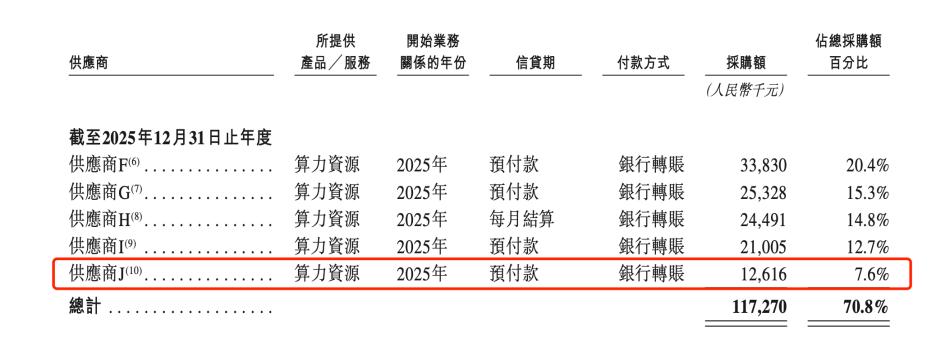
The related - party transaction section of the prospectus reveals that Customer I should refer to Huawei, and Supplier J should refer to Huawei Ascend.
Users surge 70 - fold, but the losses on the books are getting worse
If user growth is the facade of Silicon Flow, then more of its essence can be seen in the financial statements.
Let's look at a set of numbers: From the end of 2024 to the end of 2025, the number of registered users on the platform soared from 127,000 to 9.197 million, a full increase of more than 70 times. The revenue has skyrocketed: In 2023 (the year of establishment), it was only 6,000 yuan, 7.3 million yuan in 2024, and directly jumped to 55.3 million yuan in 2025, with year - on - year revenue growth rates of 122333.3% and 653.2% respectively.
However, the company's gross profit margin has declined from 83.3% to 39.4%, and in 2025, it turned negative, becoming -24%. For each business deal, instead of making money, the company has to pay extra. The adjusted net loss has also expanded from 1.22 million yuan, 5.4 million yuan to 187 million yuan. Simply put, the more users there are, the higher the revenue, and the greater the loss.
Obviously, this is an early commercialization sample of "burning money for scale."
Silicon Flow's money is mainly burned in two black holes: computing power construction and marketing.
To ensure that the rapidly expanding user group "has access to computing power and the service does not fail," the company needs to lease a large amount of computing power resources. The cost of computing power resources in the cost of sales reached 59.627 million yuan in 2025.
To acquire customers, Silicon Flow's marketing expenses are actually greater than its investment in computing power costs.
In 2025, its marketing expenses were 83.7 million yuan, of which 64.7% (54.213 million yuan) was spent on issuing free token vouchers. In essence, this is using subsidies to acquire users.
The prospectus shows that Silicon Flow's business has two models: public cloud and on - premise deployment.
In the public cloud model, Silicon Flow purchases computing power from suppliers such as Huawei Ascend, processes it with this operating system, and then sells it to customers. Public cloud services also include serverless token services and dedicated instances. The former meets the needs of general model calls, similar to shared tables in the lobby; the latter serves customers with higher requirements for performance, stability, and resource isolation, similar to private rooms.
In the on - premise deployment model, customers have their own computing power, and Silicon Flow only provides this efficient operating system, earning software license fees, professional implementation fees, and maintenance service fees.
Among them, the public cloud that requires self - construction of computing power is a money - losing business. In 2024, its gross loss rate was 271.6%, and it narrowed to 119.0% in 2025. The above - mentioned free token vouchers are also used in this business.
The on - premise deployment business is quite profitable. In 2024 and 2025, the gross profit margin has always been stable between 82.5% and 92.4%. The company states directly in the prospectus that this high - profit business is a stable source of operating cash flow, enabling the company to ensure its overall cash - generating ability even when making large - scale investments in public cloud expansion.
On the surface, the public cloud is burning money and the on - premise deployment is making money, like two independent business lines. However, the prospectus explains the logic behind this. The company hopes that customers will first try it out at a low cost on the public cloud, and then upgrade to dedicated instances or on - premise deployment after the scale expands or the requirements for data storage location and security increase.
That is to say, the negative gross profit margin of the public cloud is not only buying the current user numbers but also buying a possibility, the possibility of continuously guiding users to the high - profit on - premise deployment business.
It sounds like a closed - loop can be formed, but the reality is more complicated.
From the current data, the number of new users of on - premise deployment has not increased. Instead, it has decreased from 28 in 2024 to 20 in 2025. The revenue growth of the on - premise deployment business is mainly achieved by in - depth exploration of old customers.
In addition, the revenue of the unprofitable public cloud business is growing faster, and its proportion in the revenue is getting higher. During the three reporting periods since the establishment of Silicon Flow, the proportion of the high - profit on - premise deployment business has decreased from 100% to 85.4% and was diluted to 47.1% in 2025. The revenue of public cloud services has increased from 0 to 29.261 million yuan in two and a half years, with an extremely fast growth rate.
Moreover, in order to achieve revenue growth, this situation will continue.
Silicon Flow promises in the prospectus that by the end of 2026, it will meet the requirements of the Hong Kong Stock Exchange for "commercialized companies." The Hong Kong Stock Exchange has a clear standard for identifying "commercialized companies": the revenue in the most recent audited fiscal year must reach HK$250 million (approximately RMB 230 million). This means that the revenue in 2026 needs to be more than four times that in 2025.
And a large part of this growth may have to be filled by the loss - making business.
What are the chances of winning in the game with giants?
From an industry perspective, Silicon Flow's "token factory" is somewhat similar to the common "token transfer stations" in the market: both are doing model aggregation, summarizing the capabilities of multiple model companies on a single platform for unified external provision. Customers do not need to connect to the APIs of DeepSeek, Zhipu, Kimi, etc. separately and can get everything done in one stop.
However, they are fundamentally different.
The prospectus states that Silicon Flow's "proprietary inference engine can reduce inference latency by up to 70%," which means the model can answer questions faster; "increase throughput by three to five times," which means the total number of tokens that the same chip can process and output within the same time can be increased by three to five times, greatly improving production capacity; "dynamic quantization technology can reduce inference computing requirements by 60% to 80%," which means it can actively reduce the numerical operation precision inside the model, cutting the computing requirements by 60% to 80%, while the quality of the answers is basically unaffected.
It's like the same chef in this kitchen can serve more dishes faster and use less gas.
The transfer stations do not control the underlying computing power and model deployment rights. They only forward requests, do not touch chips, do not run models, and are just token carriers. There is almost no competition at the same level between the two.
So, who are Silicon Flow's current competitors in the industry?
The company states in the prospectus that in 2025, in terms of annual token throughput, Silicon Flow was the fourth - largest token supply platform in China, with a market share of 1.5%. According to public information, the top three are ByteDance's Volcengine, Alibaba Cloud, and Baidu Smart Cloud, with market shares of 42.7%, 32.5%, and 11.8% respectively, accounting for a total of 87% of the entire market.
Without exception, all three are backed by giants, packaging AI model services into their own cloud infrastructure. Even if the token supply business doesn't make money, it doesn't affect their survival. They can rely on the profits brought by their main "cash - cow" businesses to significantly reduce prices to compete for customers, while Silicon Flow doesn't have such a capital cushion for the time being.
However, from a long - term business model perspective, the "independent neutrality" that Silicon Flow repeatedly emphasizes in the prospectus is very meaningful. As an independent ecological platform, it doesn't "do both models and applications" like these giants. If an AI application company relies on a giant for its capabilities, the giant may become its competitor one day in the future. But Silicon Flow doesn't have these businesses, and this "structural neutrality" cannot be provided by any giant that has other businesses in the industrial chain.
In addition, model companies lack the natural motivation to be "neutral." Among the more than 170 models supported by Silicon Flow, such as DeepSeek, GLM, Kimi, and Qwen, all come from different companies. Why would a model company invest engineering resources to optimize the inference efficiency of its competitors' models?
So, the commercial logic of Silicon Flow is sound in itself, and the problem lies in time.
The value of structural neutrality is real and long - term. Giants can afford to lose money for three years, but can Silicon Flow survive until the day of break - even? This may be the reason why it is financing rapidly, submitting its listing application rapidly, and hoping to quickly enter the capital market.
This article is from the WeChat official account "Bao Bian" (ID: baobiannews), author: Zhan Fange. It is published by