Within a single day, Guizhou province first revoked approvals for 4.147 million kilowatts of wind and photovoltaic projects, then granted new approvals for 3.86 million kilowatts. From a national perspective, the wind power and photovoltaic industries are moving toward a virtuous cycle marked by increasingly strict regulation.
Domestic efforts are being made to clean up idle wind and solar energy project indicators, aiming to promote the healthy development of the industry through a "cage - for - bird" strategy.
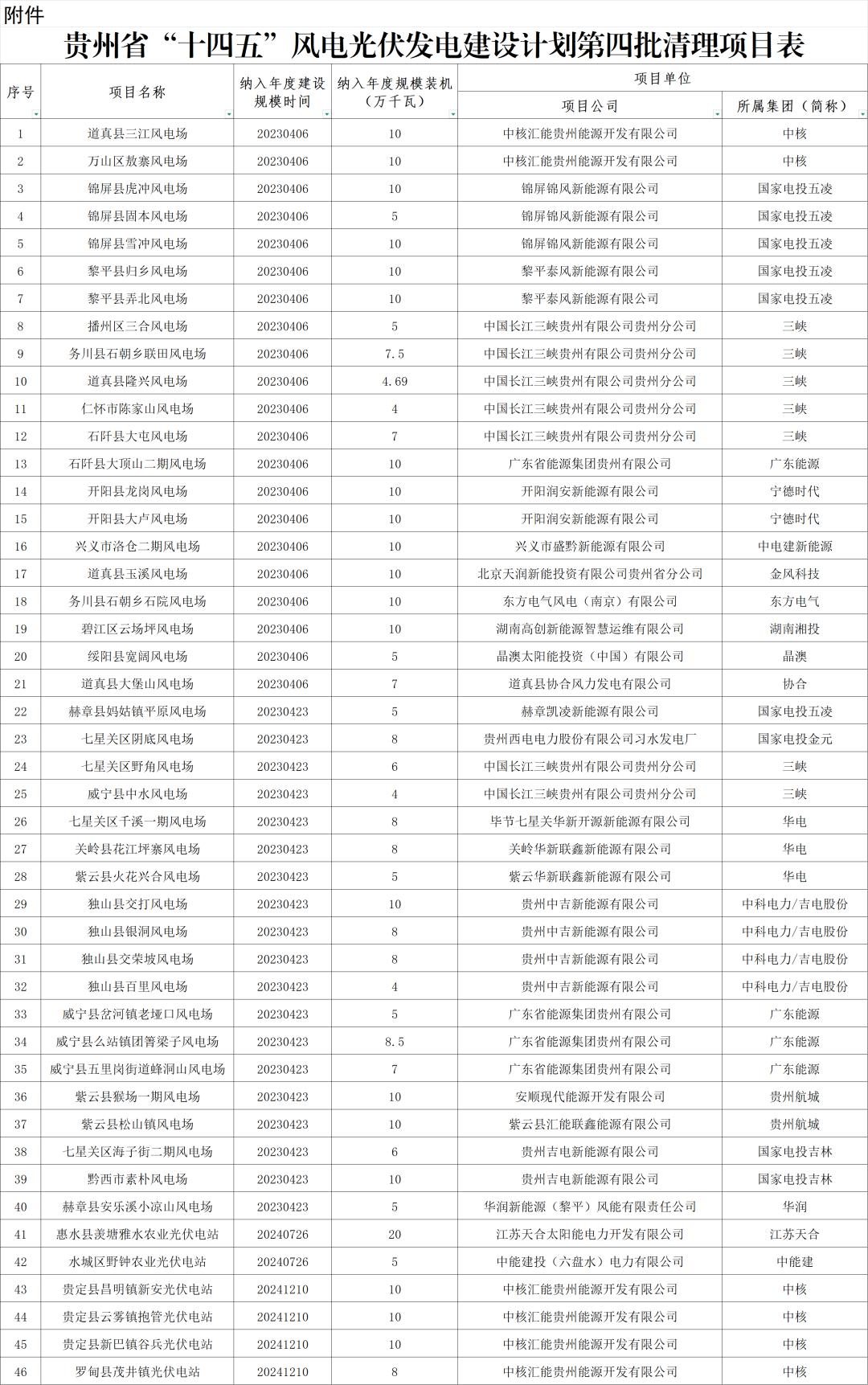
According to Yujian Energy, on July 1st, the Guizhou Provincial Energy Bureau issued the "Notice on Cleaning up the Construction Plan of the First Batch of Wind and Photovoltaic Power Generation Projects in Guizhou Province in 2026". A total of 53 projects with a capacity of 4.147 million kilowatts were removed from the plan.
On the same day, another document, the "Notice on Issuing the Annual Construction Plan for 44 Wind and Photovoltaic Power Generation Projects such as Shengtuan Wind Farm in Qixingguan District", was published online. A total of 44 new projects with a capacity of 3.86433 million kilowatts were approved.
On the same day, projects were first cancelled and then new ones were approved. This is not a coincidence.
Looking across the country, Guizhou is not an isolated case. According to statistics from Wind Power Headline, since 2025, Xinjiang Production and Construction Corps, Guizhou, Shaanxi, Shanxi, Hebei, Fujian, Ningxia, and Inner Mongolia have cumulatively cancelled or removed 217 wind and photovoltaic projects, with a total capacity of 22.51 million kilowatts. Meanwhile, new project indicators are still being issued in various provinces.
The cleaning up and the issuance of new indicators are carried out simultaneously. This is not a self - contradictory move but a well - designed "cage - for - bird" strategy. The removed indicators are those that have been idle, and the new projects brought in are those with a countdown and a need to move forward rapidly.
This nationwide cleaning up signals the end of an old era: the practice of hoarding project indicators and gambling on policies has come to an end.
The ledger of the cleaning up: who has the most projects removed
Let's first look at the cleaning - up list in Guizhou. Among the 53 projects, wind power accounts for 3.057 million kilowatts and photovoltaic power accounts for 1.09 million kilowatts. State Power Investment Corporation had 1.058 million kilowatts of projects removed, China National Nuclear Corporation had 0.58 million kilowatts removed, and Anshun Energy had 0.55 million kilowatts removed. The total capacity of the projects removed from these three companies accounts for more than half of the total.
Looking at the whole country, the projects being cleaned up are far more than just this batch in Guizhou. In early 2026, Shandong removed 63 centralized photovoltaic projects with a capacity of 5.84 million kilowatts from the list of market - connected projects. The project owners include 35 companies such as State Power Investment Corporation, China Huaneng Group, and China General Nuclear Power Group. Shandong's approach is not to clean up "projects that have not been built on schedule" but to directly adjust the grid - connection qualifications. The projects still exist, but the grid - connection quotas are gone. Of course, Shandong also left some leeway. It included 29 projects with a capacity of 2.978 million kilowatts that have already started construction in the first batch of centralized photovoltaic construction list for 2026 and required them to be fully commissioned by the end of the year.
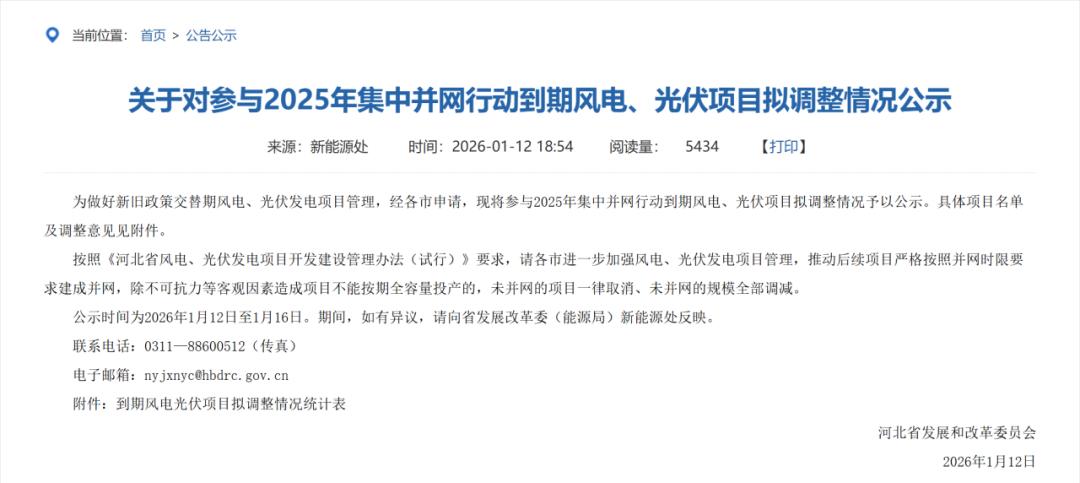
Hebei's adjustment scale is even larger. In December 2025, Hebei publicly announced the adjustment of wind and solar projects with a total capacity of 14.9 million kilowatts at the expiration. Among them, 1.22 million kilowatts were cancelled, 0.5 million kilowatts were reduced, and the rest were postponed until the end of 2026. In January 2026, Hebei adjusted another 31 projects with a capacity of 3.39 million kilowatt - hours. In total, the scale involved exceeded 18GW.
Generally speaking, Hebei's approach is "to postpone if possible and to cut if necessary", leaving a buffer for existing projects but also setting a deadline.
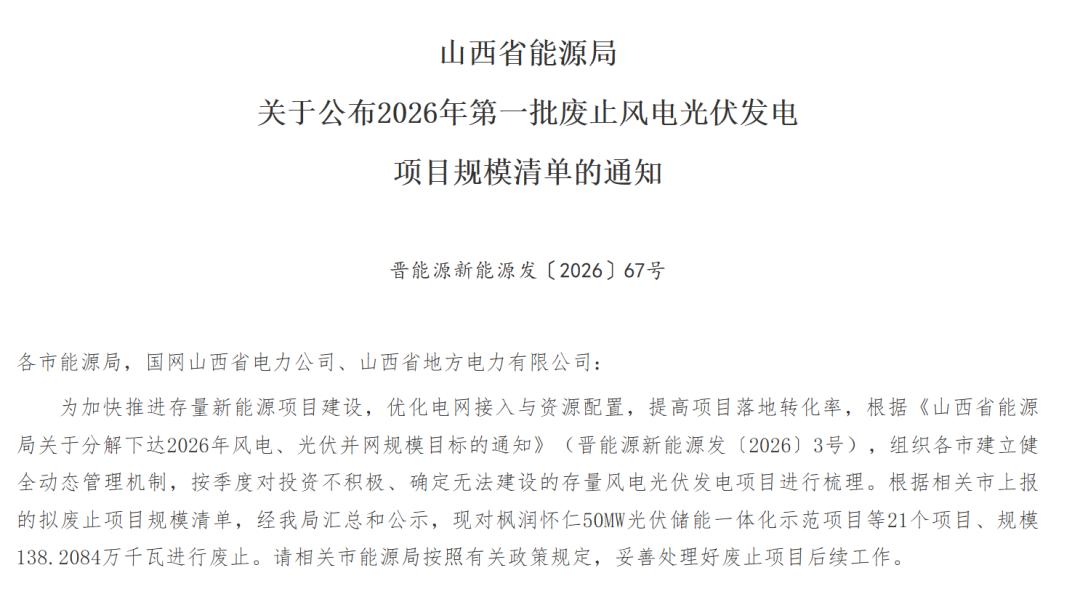
In March 2026, Shanxi publicly announced the first batch of proposed cancellation list, including 22 projects with a capacity of 1.472 million kilowatts. When the official list was released in May, it became 21 projects with a capacity of 1.382 million kilowatts. One project was saved during the one - month public notice period. However, this kind of "lucky" situation will not happen every time.
From the perspective of project owners, State Power Investment Corporation has suffered the most in this cleaning - up storm. According to statistics from Wind Power Headline, the scale of wind and solar projects cancelled by State Power Investment Corporation reached 1.5018 million kilowatts, followed by China Three Gorges Corporation with 1.382 million kilowatts and China National Energy Investment Group with 1.0777 million kilowatts.
Behind these figures are the real - money upfront investments of central enterprises, including wind measurement data, feasibility study reports, land pre - approval, and access system design, all of which have been sunk.
Why the cleaning up? The accounts don't add up
The cleaning - up list is like a mirror. It not only reflects the lagging progress of projects but also the deep - seated collapse of the investment logic in the new energy sector.
In February 2025, relevant policies proposed to cancel the guaranteed purchase of new energy power and comprehensively promote the marketization of new energy electricity prices. In principle, all the electricity generated by wind and solar power projects should enter the power market, and the electricity prices should be formed through market transactions. The previous "guaranteed quantity and price" support is gone.
Once the support is removed, the real economic viability of the projects is exposed. According to the public data of the Shandong Provincial Energy Bureau, in 2025, the mechanism electricity price of photovoltaic power in Shandong was only 0.225 yuan per kilowatt - hour, a 43% decline compared with the local coal - fired benchmark electricity price. During the peak output period of photovoltaic power at noon, the electricity price even dropped below 0.05 yuan per kilowatt - hour, far lower than the comprehensive cost per kilowatt - hour of 0.3 to 0.35 yuan for photovoltaic projects. It means losing money for every kilowatt - hour generated. How can the accounts be balanced?
Power consumption is another constraint. According to the data of the National Energy Administration, the utilization rate of photovoltaic power across the country has dropped to 94.8%, and the power curtailment rate of some stations in Xinjiang, Heilongjiang and other places exceeds 30%. "Being able to generate electricity but unable to transmit it or sell it at a good price" is becoming the norm in the industry.
Central enterprises also found something wrong when calculating the detailed accounts. Generally, the internal rate of return on the capital of new energy projects should not be less than 6.5%, and some enterprises have even stricter internal requirements. Currently, the rate of return of wind and photovoltaic projects is generally under downward pressure. Facing the electricity prices and power consumption realities in 2026 with the economic calculations made in 2022 and 2023, the projects simply cannot pass the project approval process.
There is also an overlooked signal: the strategic contraction of central enterprises. In 2025, the number of new energy companies newly established by the "Five Big and Six Small" power generation groups dropped sharply from about 1,590 in the previous year to 850, almost halving year - on - year. China Southern Power Grid Energy clearly stated that it "will no longer hold new photovoltaic and other smart green power projects". The era of large - scale expansion is over.
Those projects that were rushed to be declared just to occupy a position are now showing their true colors in the face of the rate of return calculations. Being cleaned up is not accidental but inevitable.
What happens after the cleaning up? Where will the resources flow
Cleaning up is not the goal. Improving the efficiency of resource utilization is the real aim.
On July 1st, Guizhou newly approved 44 projects with a total installed capacity of 3.86433 million kilowatts. Among them, there are 33 wind power projects with a capacity of 2.45 million kilowatts and 11 photovoltaic projects with a capacity of 1.41433 million kilowatts. Looking at the distribution of project owners, Guizhou Energy Group obtained 2.35 million kilowatts (1.4 million kilowatts of photovoltaic power and 0.95 million kilowatts of wind power), State Power Investment Corporation obtained 1 million kilowatts of wind power, and Sichuan Port Investment obtained 0.5 million kilowatts of wind power.
Note a detail: State Power Investment Corporation, which had the most projects removed, got another 1 million kilowatts in the newly approved list. It gave back with one hand and received with the other.
However, Yujian Energy believes that what State Power Investment Corporation gave back this time is the old accounts, and what it received is the entry ticket under the new rules.
The "shelf - life" of new projects has been greatly compressed.
The notice clearly requires that wind power projects must be approved by December 22, 2027, and photovoltaic projects must be registered by June 22, 2027. If not completed on time, the project indicators will be directly cancelled. The window period for wind power project approval is only 17 months, and the window period for photovoltaic project registration is only 11 months.
Yujian Energy noticed that it's not only Guizhou that has shortened the project shelf - life. This "short shelf - life" is becoming the standard across the country. Since 2026, all provinces have fully implemented the "dynamic validity management of project registration". If a project has not started construction within 12 months after the issuance of the registration certificate, it will automatically become invalid. Gansu stipulates that if a new energy project gives up the mechanism electricity quota or fails to be put into operation within 6 months after the due date, it will be permanently prohibited from participating in the mechanism bidding.
When cancelling projects, Shanxi clearly stated that the cleaning up is to "further revitalize the existing resources and make room for high - quality new energy projects".
Hebei wrote in an adjustment notice at the beginning of the year that "except for projects that cannot be fully commissioned on schedule due to objective factors such as force majeure, all unconnected projects will be cancelled, and all unconnected project capacities will be reduced".
Although the expressions in different provinces are slightly different, the direction is highly consistent: if you get a project but do nothing, it will be taken back and given to others.
Through this process of "removing the old and bringing in the new", the ecological environment of the new energy industry is changing. The speculative logic of "getting the indicators first" in the past is no longer effective. The signal released by the regulatory authorities is clear: from "emphasizing installed capacity and seizing scale" to "emphasizing power consumption, strengthening supervision, and promoting integration", the wind and photovoltaic industries are moving towards a virtuous cycle with stricter supervision!
The two documents issued by Guizhou on July 1st are one for the settlement of old accounts and one for the declaration of new rules. When "building after getting the project and returning it if unable to build" becomes the norm in the industry, and when the downward trend of electricity prices compresses the profit margin of each project, the new energy industry will truly return to the essence of business. The practice of hoarding project indicators and gambling on policies has come to an end. The 22.51GW of cancelled projects across the country may be the best footnote.
This article is from the WeChat official account "Yujian Energy", author: Wang Mengjiao. Republished by 36Kr with permission.