Another AI "shovel seller" goes public, with Alibaba and Hubble Investment from Huawei placing their bets
On June 30, 2026, Beijing Silicon-based Flow Technology Co., Ltd. (hereinafter referred to as Silicon-based Flow) submitted a listing application to the Main Board of the Hong Kong Stock Exchange, planning to list in Hong Kong under Chapter 18C. The joint sponsors are Huatai International and Guotai Haitong.
Silicon-based Flow was founded in August 2023 by Dr. Yuan Jinhui, the former founder of OneFlow. It is sprinting for a Hong Kong IPO just three years after its establishment.
Investment highlights: Silicon-based Flow's customer structure is continuously optimized, with a gross profit margin of up to 82.5% for local deployment, and it is supported by industrial capital such as Alibaba and Huawei. However, the core risk is that the gross profit margin has turned negative to -24.0%, burning about 14.8 million yuan per month on average, and the cash can only support about one year. Whether the gross profit margin can turn positive after listing is a key verification indicator.
Silicon-based Flow positions itself as "China's leading open and independent token supply platform". Its core business is to aggregate and optimize heterogeneous computing power resources from different suppliers and different hardware architectures through its self-developed inference engine and computing power resource orchestration system, and then convert them into standardized "tokens" for customers. In essence, it is a "Token factory" in the era of AI inference.
According to Frost & Sullivan data, in terms of the annual throughput of tokens in 2025, Silicon-based Flow is the largest independent ecological token supplier in China, ranking among the top five among all token suppliers, with a specific market share of about 1.5%.
In terms of platform operation data, as of April 30, 2026, Silicon-based Flow had more than 10 million registered users.
In April 2026, the company's average daily token throughput was about 578.5 billion times, and the highest single-day token throughput was about 1,071.4 billion times. As of the last practicable date, it had provided services to more than 13,000 enterprise customers, and the platform had cumulatively supported more than 170 models.
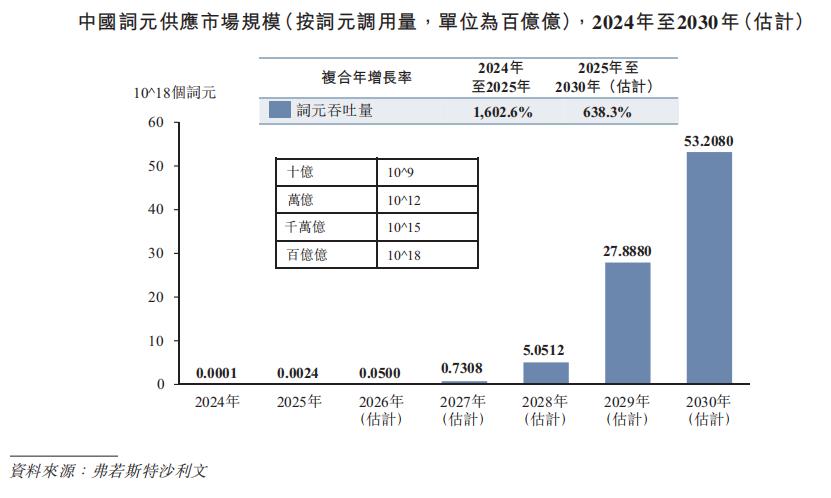
In terms of industry growth, China's token supply market is in an explosive period. In terms of token throughput, the market size increased by 1,602.6% from 2024 to 2025, and it is expected to reach about 53.2 hundred million trillion tokens in 2030, with a compound annual growth rate of 638.3% from 2025 to 2030.
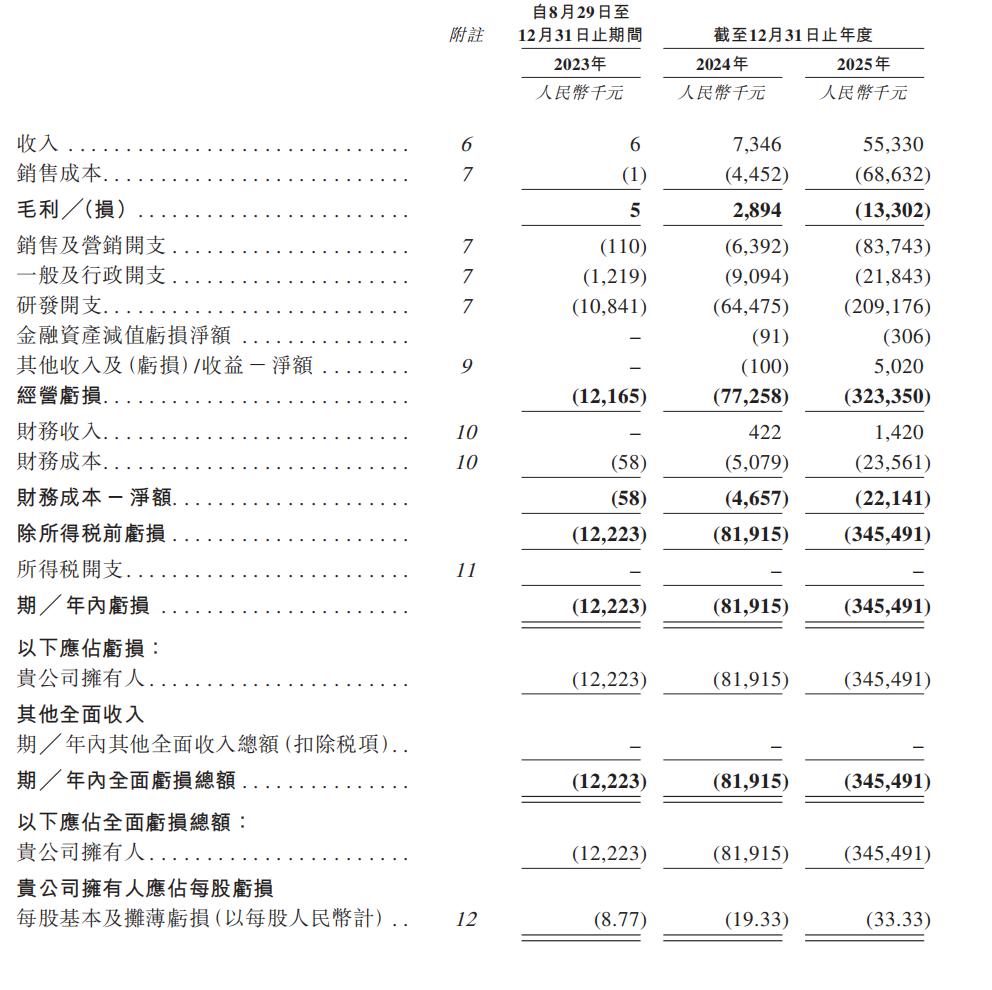
In terms of revenue, Silicon-based Flow achieved revenues of 6,000 yuan, 7.3 million yuan, and 55.3 million yuan from 2023 to 2025 respectively. The revenue in 2025 increased by 653.2% compared with that in 2024.
The cost of sales increased from 4.5 million yuan in 2024 to 68.6 million yuan in 2025, an increase of 1,441.6%.
In terms of profit, from 2023 to 2025, Silicon-based Flow's losses during the period were 12.2 million yuan, 81.9 million yuan, and 3.455 billion yuan respectively; the adjusted net losses were 12.2 million yuan, 54 million yuan, and 187.1 billion yuan respectively. The loss in 2025 was about 4.2 times that in 2024.
In terms of the annual gross profit margin during the reporting period, Silicon-based Flow's gross profit margin was 83.3% in 2023, 39.4% in 2024, and further turned negative to -24.0% in 2025, with a gross loss of 13.3 million yuan.
Specifically, the gross loss rate of the public cloud business was -271.6% in 2024 and -119.0% in 2025, still in a state of deep loss.
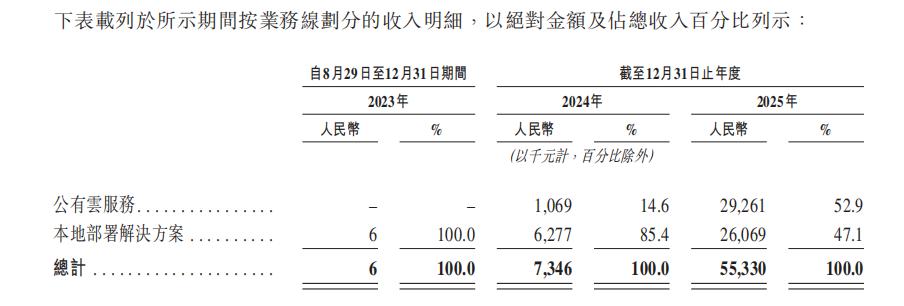
Silicon-based Flow's revenue comes from two major segments: public cloud services and local deployment solutions.
Public cloud services are the traffic entrance. In May 2024, the serverless token service was launched, marking the entry of public cloud services into the large-scale commercialization stage. The revenue share in 2024 was 14.6%, and it jumped to 52.9% in 2025, with a revenue of about 29.261 million yuan.
Public cloud services exchange losses for scale, with a gross loss rate as high as -119.0%, but they undertake the strategic function of acquiring a large number of users. The number of registered users soared from 127,000 at the end of 2024 to 10.28 million at the end of April 2026.
Local deployment solutions are the source of profit. Silicon-based Flow deploys the inference engine and computing power resource orchestration system in the customer's own data center or private computing power environment, mainly targeting large enterprises and institutional customers.
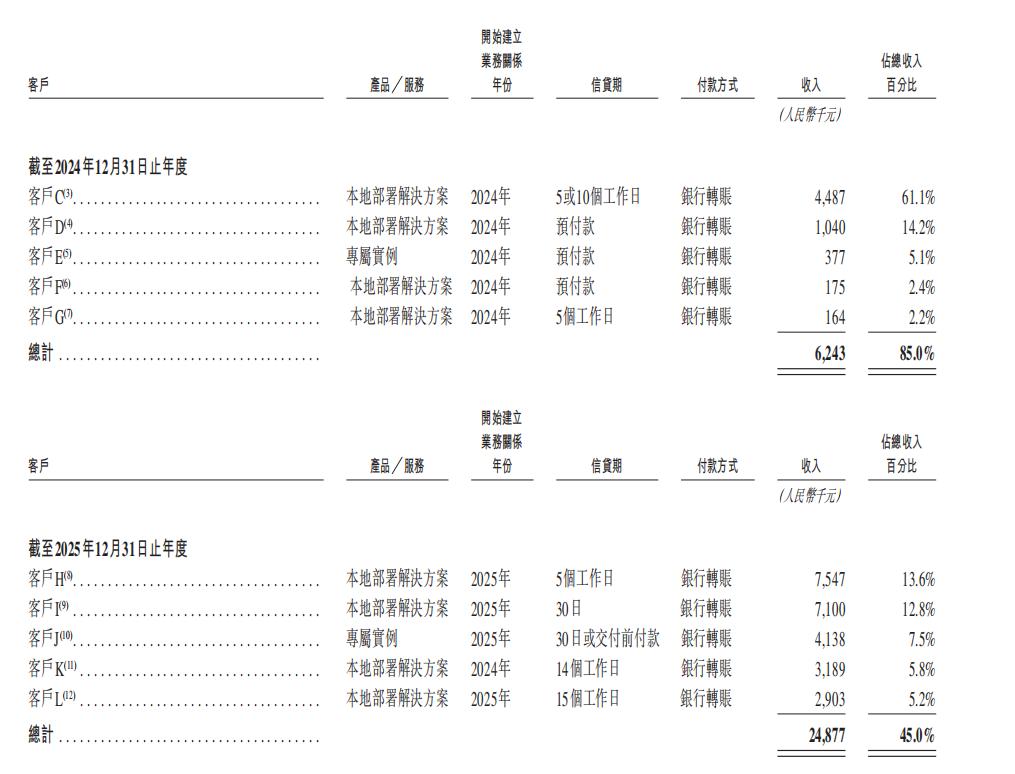
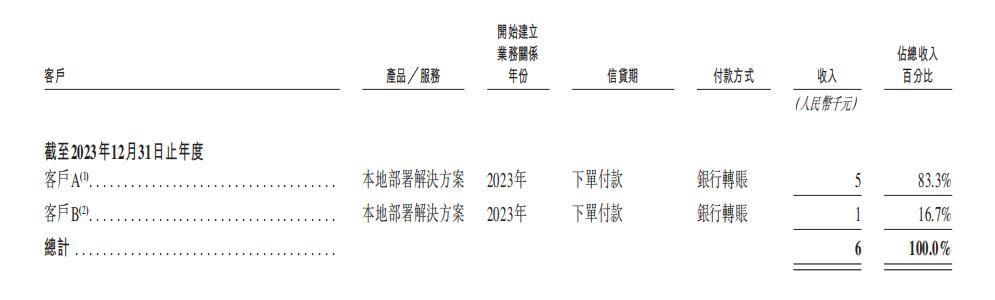
The customer concentration shows an improving trend. From 2023 to 2025, the top five customers accounted for 100.0%, 85.0%, and 45.0% of the revenue respectively; the proportion of the single largest customer was 83.3%, 61.1%, and 13.6% respectively, and the customer concentration continued to decline.
The supplier concentration has decreased but is still at a high level. From 2023 to 2025, the top five suppliers accounted for 100.0%, 87.6%, and 70.8% of the total procurement respectively; the proportion of the single largest supplier was 100.0%, 52.1%, and 20.4% respectively.
In terms of trade receivables, as of December 31, 2025, it was 10.6 million yuan, a significant increase compared with 3.6 million yuan in 2024.
As of December 31, 2025, Silicon-based Flow held 172 million yuan in cash and cash equivalents and 100 million yuan in time deposits. The average monthly cash consumption rates from 2023 to 2025 were 81,500 yuan, 4 million yuan, and 14.8 million yuan respectively.
The operating cash outflow in 2025 was 172 million yuan. Based on the cash-burning rate in 2025, the existing capital reserve can only support about 12 - 18 months.
In terms of R & D investment, the R & D expenses from 2023 to 2025 were 10.8 million yuan, 64.5 million yuan, and 20.92 million yuan respectively, showing continuous high-speed growth.
In terms of the financing history, according to the prospectus, Silicon-based Flow has received multiple rounds of financing since its establishment.
In February 2025, the company completed a Pre-A round of financing of 71.48 million yuan, with a post-investment valuation of 985 million yuan; in June 2025, it received 286 million yuan in financing, with a post-investment valuation of 2.286 billion yuan.
In March 2026, the company completed 220 million yuan in financing, with a post-investment valuation of 3.12 billion yuan; in June 2026, it completed a Series B round of financing of 520 million yuan, with a post-investment valuation of 5.02 billion yuan; in June 2026, it completed 740 million yuan in financing, with a post-investment valuation of 7.74 billion yuan. The two rounds of financing totaled 1.26 billion yuan. Silicon-based Flow has completed 7 rounds of financing, with a valuation of 7.74 billion yuan.
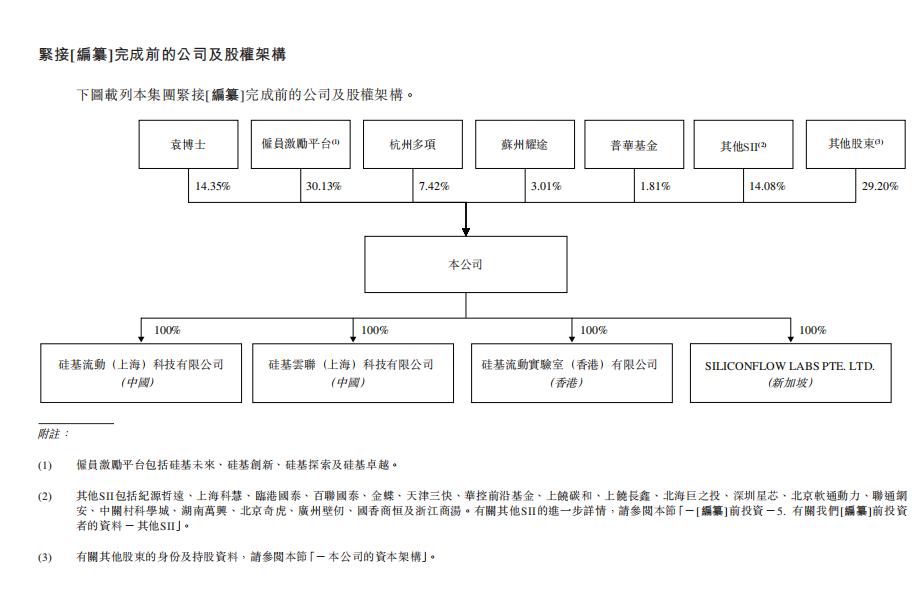
In terms of the shareholder structure, before the IPO, Dr. Yuan Jinhui, the founder, and the employee incentive platform jointly controlled about 44.48% of the total voting rights of the issued shares.
Yuan Jinhui directly holds 14.35% of the shares; Silicon-based Innovation, Silicon-based Future, and Silicon-based Exploration each hold 7.85%; Silicon-based Excellence holds 6.59%.
Among external shareholders, Hangzhou Multiple, a subsidiary of Alibaba, holds 7.42%, and Hubble Technology, a subsidiary of Huawei, holds 4.07%. Beijing Innovation Works also holds shares. In addition, industrial players such as Meituan, SenseTime, NIO, Zhipu, and 360, as well as star AI investment institutions, have all made bets.
In terms of management, Dr. Yuan Jinhui holds a doctorate in computer science and technology from Tsinghua University and studied under Professor Zhang Bo, an academician of the Chinese Academy of Sciences and the founder of China's artificial intelligence research field.
He was a principal researcher at Microsoft Research Asia. He invented the LightLDA algorithm in 2014, founded the distributed deep learning platform OneFlow in 2017, and founded Silicon-based Flow in 2023. The core team has a profound technical background, but the test of commercial operation has just begun.
In terms of risks, Silicon-based Flow faces the challenge that its business model has not yet achieved profitability, and there are also uncontrollable computing power costs and prominent risks of upstream dependence. Computing power resource costs account for 86.9% of the revenue cost.
If the computing power price rises, Silicon-based Flow may not be able to pass on the increased costs to customers - large customers have stronger bargaining power, making it difficult to raise prices.
In addition, the US chip export control to China may affect suppliers, which in turn will have a significant adverse impact on the business.
Moreover, the company faces the risk of relying on open-source models. Most of the tokens generated and sold by Silicon-based Flow are derived from open-source AI models. If the open-source models become closed-source or start charging in the future, the company's business growth will be significantly affected.
In addition, the company also has problems such as an extremely short operating history and insufficient commercial verification. The company was founded in August 2023, and it has been less than three years. As a rapidly growing company with a limited operating history, there are significant uncertainties in whether it can continuously maintain its technological advantages, retain customers, and expand the market.