New Forces in June: Leapmotor Tops with 90,000 Units, Nio and Xpeng Chase 40,000 Mark, Li Auto and Xiaomi Trapped Around 30,000
On July 1st, the new electric vehicle startups released their sales reports for June as usual.
June was the last month of the first half of the year and also the month with the most new car launches this year. Six automakers, including Leapmotor, Hongmeng Smart Mobility, NIO, XPeng, Li Auto, and Xiaomi, had basically played all their cards, and the rankings were reshuffled again.
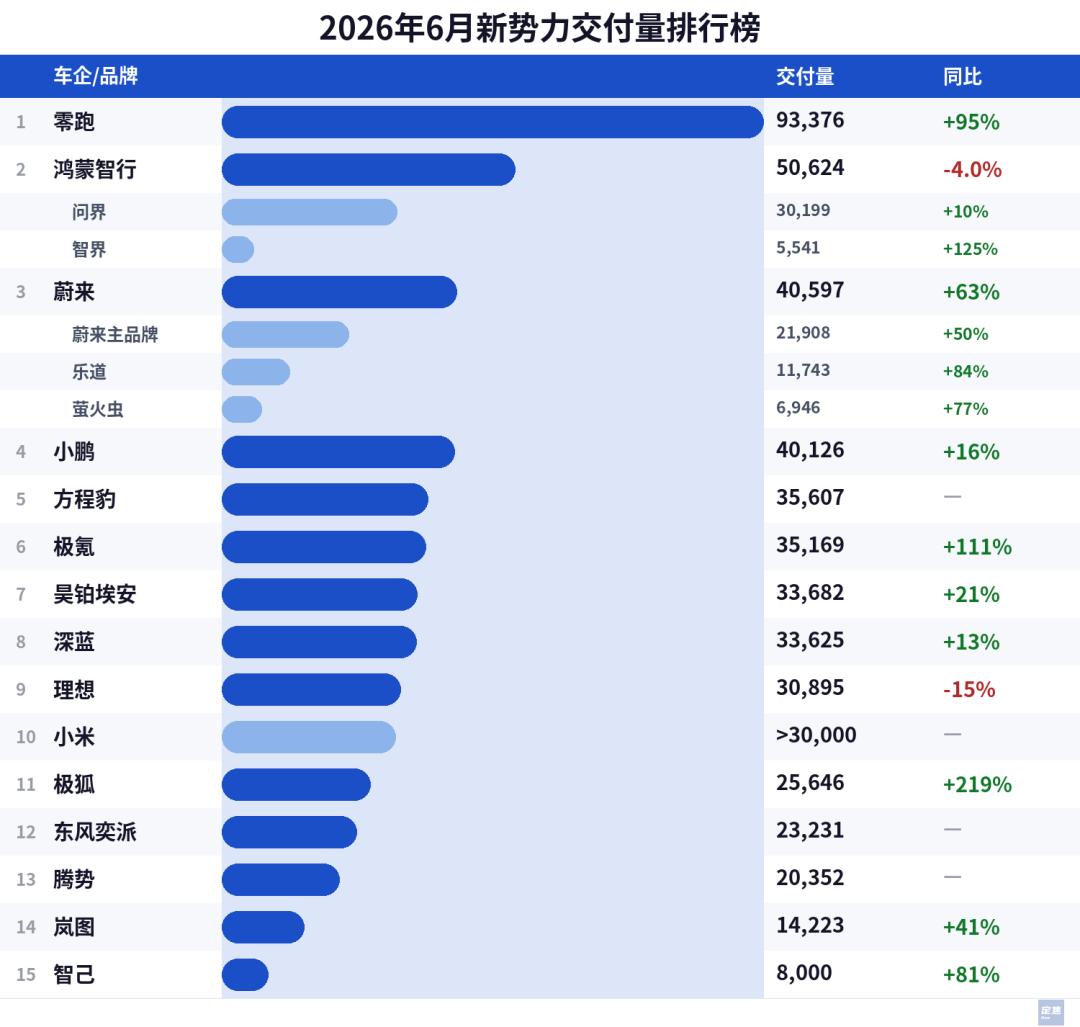
Leapmotor stood out from the competition, delivering 93,376 vehicles and leading by a large margin. This figure was more than 40,000 units higher than that of Hongmeng Smart Mobility, which ranked second.
Below Leapmotor, 40,000 units became the new dividing line. NIO delivered 40,597 vehicles, and XPeng delivered 40,126 vehicles. It was the first time this year that both companies exceeded 40,000 units, with a difference of less than 500 units between them.
Next was the threshold of 30,000 units. Li Auto delivered 30,895 vehicles, showing a year - on - year and month - on - month decline. It was the only automaker among the six with negative growth. Xiaomi delivered "over 30,000 units," maintaining this level for the third consecutive month.
While the overall sales of new energy vehicle manufacturers were on the rise, their market values were declining, which was another notable trend this month. In the Hong Kong stock market in the past month, the stock prices of Xiaomi, XPeng, and Li Auto all dropped by more than 20%, and those of Leapmotor and NIO fell by 19% and 15% respectively. Some automakers were telling stories about AI and embodied intelligence, while others were not. However, the capital market believed that the automobile manufacturing business was still a heavy - asset, long - cycle, and low - margin business. Recently, funds in the Hong Kong stock market have been flowing into the AI sector, objectively depressing the market values of new car - making companies.
Among traditional automakers, the gap between the leading players was widening.
BYD's total sales in June reached 403,500 vehicles. Its sub - brands Fangchengbao and Denza sold 35,600 and 20,400 vehicles respectively, both maintaining high - growth rates. Its overseas exports were nearly 175,000 vehicles, almost doubling year - on - year, and the proportion of overseas sales exceeded 43% for the first time.
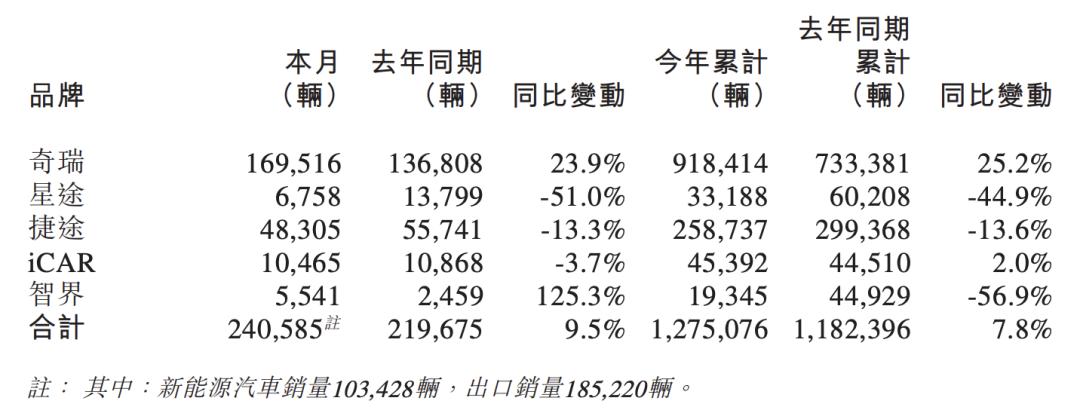
Chery's sales exceeded 250,000 vehicles, and its exports exceeded 190,000 vehicles in a single month for the first time. Its sub - brand Zhijie delivered 5,541 vehicles in June, a year - on - year increase of 125.3%. However, the cumulative sales in the first half of this year were 19,345 vehicles, a year - on - year decrease of 56.9%.
Geely's sales exceeded 240,000 vehicles. Its sub - brand ZEEKR sold 35,000 vehicles, doubling year - on - year and achieving year - on - year and month - on - month growth for five consecutive months.
SAIC sold nearly 395,000 complete vehicles, with new energy vehicle sales exceeding 200,000 vehicles. Its sub - brand IM Motors sold 8,000 vehicles, a year - on - year increase of 81%.
In addition, Shenlan sold 33,600 vehicles, exceeding 30,000 vehicles for four consecutive months. Hyper GT (Aion) sold 33,700 vehicles, and ARCFOX sold 25,600 vehicles, a year - on - year increase of 219%, setting a new brand record. These three brands had reached the same level as Li Auto and Xiaomi.
In a broader context, the penetration rate of new energy passenger vehicles in June was approximately 63.6%, reaching a new historical high. The China Passenger Car Association (CPCA) preliminarily estimated that the retail sales of narrow - sense passenger vehicles in June were about 1.65 million, of which new energy vehicles accounted for about 1.05 million. The promotion during the "Dragon Boat Festival + 618" period and the concentrated launch of new cars boosted the car market in June. However, the penetration rate data also indicated that the new energy market was shifting from "expanding the market" to "dividing the market," and the competition in the existing market was intensifying.
01. Leapmotor Approaches 100,000, Hongmeng Smart Mobility Only Succeeds in Two of the Five Brands
Leapmotor: Still in the Lead, but Far from the Target
Leapmotor's sales just exceeded 80,000 in May and soared to 93,000 in June, a year - on - year increase of 95%.
Its latest delivery structure was quite representative. Zhu Jiangming, the founder of Leapmotor, revealed at a media communication meeting at the end of June that the monthly global sales of the C series exceeded 30,000 vehicles, and the monthly delivery of the A10 exceeded 20,000 vehicles. The former was the main model in the price range of 100,000 to 200,000 yuan, while the A10 opened up a large - scale sales space below 100,000 yuan.
The D99 was Leapmotor's model for upward market penetration (priced from 249,800 to 319,800 yuan, an MPV). It was launched on June 25th and the delivery started on July 20th, so it did not directly contribute to the sales in June.
On the one hand, Leapmotor's core competitiveness had always been extreme cost - effectiveness. Whether consumers were willing to pay for its brand premium still needed to be verified by the market. On the other hand, the domestic MPV market was shrinking. According to CPCA data, the retail sales of MPVs in May were only 66,000 vehicles, a year - on - year decrease of 30%. More importantly, the D99 was attacked by a large number of negative articles on the Internet as soon as it was launched. Leapmotor began to experience the side effects of being in the spotlight.
The overseas market was the biggest highlight for Leapmotor in the first half of the year. It exported about 21,000 vehicles in June, accounting for 22% of the total. The overseas exports in the first half of the year were nearly 100,000 vehicles, exceeding the whole - year figure of last year. In Italy, Leapmotor's share in the pure - electric vehicle market exceeded one - third, ranking first continuously. In the second half of the year, its Spanish factory in cooperation with Stellantis would start local production.
However, Alex, an investor who focused on new energy vehicles, mentioned that Leapmotor was facing increasing pressure in terms of sales targets and profitability.
Based on the sales target of 1.05 million vehicles, Leapmotor had delivered 356,000 vehicles in the first half of the year, achieving 34% of the target. In the second half of the year, it needed to deliver more than 115,000 vehicles per month on average, which was more than 20% higher than the 93,000 vehicles in June. Alex said that it would be quite challenging to achieve this goal in an environment where the overall industry growth rate was slowing down and the price war was intensifying.
The pressure on the profitability side was even more urgent. Leapmotor's gross profit margin in Q1 dropped from 14.9% in the same period last year to 9.4%, and it had a net loss of 390 million yuan. Zhu Jiangming said at the media communication meeting at the end of June that the "all - round cost increase" of raw materials such as lithium carbonate, copper, and aluminum had brought great challenges. Leapmotor chose not to raise prices for consumers for the time being and tried to digest the cost through cooperation with suppliers and internal management. Many automakers were facing this dilemma: if they did not raise prices, the gross profit margin would be under pressure; if they raised prices, the sales volume would be affected.
At the beginning of June, the China Securities Regulatory Commission also issued four consecutive questions to Leapmotor. One of the core doubts was why the gross profit margin (8.4% in 2024, 14.5% in 2025, and 9.4% in Q1 this year) fluctuated so much. Meanwhile, Leapmotor's stock price had been cut in half since its peak in August last year. Zhu Jiangming and Fu Liquan (an early major shareholder of Leapmotor) had increased their holdings by a total of HK$720 million in two months, but they still failed to stop the decline. The capital market was most concerned about whether Leapmotor's scale could be converted into profits and cash flow.
Hongmeng Smart Mobility: The Growth Rate of Wenjie Slows Down, and the Pressure of "Five - Brand Strategy" Increases
Hongmeng Smart Mobility achieved a new high this year in June, delivering 50,624 vehicles, a month - on - month increase of 9.7% and a year - on - year decrease of 4%. The cumulative sales in the first half of the year were 240,000 vehicles, a year - on - year increase of 18.6%. Against the backdrop of a year - on - year decline in the retail sales of the entire passenger vehicle market, this result could be regarded as a counter - trend growth. However, compared with Leapmotor (95%) and NIO (63%), the growth rate of Hongmeng Smart Mobility was not fast.
Wenjie remained the main contributor to the sales. It delivered 30,199 vehicles in June, a year - on - year increase of 10.2%. The product structure within Wenjie was also changing. The best - selling model was the M6. Its cumulative delivery exceeded 30,000 vehicles 54 days after its launch, and it contributed about 12,000 to 15,000 vehicles in June alone. On June 16th, the M6 also added a pure - electric Max version (priced at 229,800 yuan) and a pure - electric Max+ version (priced at 249,800 yuan), with the starting price directly reduced by 50,000 yuan compared with the previous model. "The competition in the 250,000 - yuan SUV market is too fierce. We have to reduce the price," said Ryan, a channel insider who focused on new electric vehicle startups.
The M9 (with a starting price of 479,800 yuan) was still the most profitable model for Wenjie. The large - order bookings exceeded 42,000 vehicles one month after its launch. After the large - scale delivery started on June 16th, more than 8,000 vehicles were delivered in two weeks. In the "Top 100 Global Automobile Brand Values in 2026" released by Brand Finance, Wenjie was selected with a brand value of $3.448 billion, ranking first among Chinese luxury automobile brands.
However, the situation of the M8 was not optimistic. This model was priced from 359,800 to 459,800 yuan. "Many consumers choose to pay a little more for the new M9 instead of the top - end M8," Ryan analyzed. The delivery of the M8 in May was only about 5,109 vehicles, a significant decline compared with the previous monthly sales of 20,000 vehicles. This was an internal adjustment of the product matrix, not a fatal flaw, but it indicated that Wenjie needed to re - evaluate its price range.
The biggest surprise in June came from Shangjie. The monthly delivery of the Z7 series exceeded 10,000 vehicles. It was the second time for the Shangjie brand to reach the monthly sales of 10,000 vehicles since the H5 exceeded 10,000 vehicles in November last year.
Picture / Chery Automobile's June sales announcement
According to Chery Group's data on the Hong Kong Stock Exchange, Zhijie delivered 5,541 vehicles in June. Although it had a year - on - year increase of 125.3%, the cumulative sales in the first half of the year were 19,345 vehicles, a year - on - year decrease of 56.9%. "The doubling of the monthly sales was a rebound from a low base," Ryan said. Zhijie had a good performance in 2025 but then declined.
According to Ryan's estimate, the monthly sales of Xiangjie were 2,000 - 3,000 vehicles, with a limited scale. The monthly sales of Zunjie were about 1,000 vehicles, mainly playing the role of a brand benchmark.
A greater challenge came from the outside. Huawei's intelligent driving technology was once an exclusive advantage. Now, with the expansion of the five - brand strategy and the "Jing" series jointly created by Huawei Qiankun and automakers, even the Yijing X9 (with a pre - sale price starting from 380,000 yuan, directly competing with the M9) and Yipai M8 (targeting the price range of the M7) under Dongfeng were coming to compete in the same price range. A securities research report pointed out that when "Huawei technology" became a standard in the industry, each brand under Hongmeng Smart Mobility faced the same problem: intelligent driving was no longer a differentiating selling point. Then why should consumers choose the "Jie" - branded models instead of the "Jing" - branded models? This was not only the anxiety of Wenjie but also the common pressure faced by the entire Huawei automobile ecosystem.
02. NIO Relies on Benefits, XPeng Relies on GX, Both Exceed 40,000
NIO: The Three Brands Show Obvious Differentiation, and Q2 Target Not Met
NIO delivered 40,597 vehicles in June, a year - on - year increase of 62.9%, breaking through the 40,000 - vehicle mark. All three brands contributed to the growth: the main brand delivered 21,908 vehicles, LeDao delivered 11,743 vehicles, and Firefly delivered 6,946 vehicles.
Alex noticed that the growth rate of NIO's main brand was actually lower than the overall growth rate of the company. "The growth was mainly contributed by LeDao and Firefly." This was due to the intense competition in the price range of 300,000 to 500,000 yuan. The Wenjie M8 and M9, Li Auto L8 and L9, XPeng GX, and the high - end models of ZEEKR were all potential competitors of the ES8 and ES9.
LeDao was the highlight this month. After the L80 and the new L90 were launched in mid - May, LeDao's sales increased by 83.5% year - on - year. The growth logic of LeDao was clear. It used battery swapping as a differentiating selling point, and the BaaS (Battery - as - a - Service) rental plan significantly lowered the purchase threshold, creating a differential competition in the family SUV market. However, this year - on - year growth rate needed to be noted because LeDao had just started not long ago in the same period last year, with a relatively low base.
Firefly's sales increased by 76.7% year - on - year. The BaaS plan lowered the purchase threshold to 79,800 yuan, entering the price range of BYD Dolphin and Wuling Bingo, helping NIO open up a new user group.
However, even though NIO set a record in June, it still fell short of the lower limit