AI hardware sells like hotcakes during the 618 shopping spree, brimming with the anxiety and loneliness of young people
1
If you're planning to buy your first AI hardware product in life, what might you use it for?
This year's 618 shopping festival has just ended, but the consumption boom of AI hardware seems to have just begun.
Let's first look at the platforms.
Tmall data shows that during this year's 618 period, the overall sales of AI intelligent hardware increased by 80% year - on - year. Among them, the sales of AI glasses increased by 900% year - on - year, AI companion elves by 270%, and smart rings by 280%.
In the first 52 hours of JD.com's 618 kick - off, the transaction volume of 3C digital AI categories such as AI glasses, AIPC, and large - screen AI mobile phones increased by 200% year - on - year. The transaction volume of sub - categories such as AI mini workstations and AI sensing devices increased by more than 20 times year - on - year. After the entire 618 ended, the full - cycle transaction volume of JD.com's AI trend products doubled, with a 100% year - on - year increase.
Now let's look at the overall market.
On June 18th, the "618 Consumer Insight Report (2026)" jointly released by institutions such as the National Advertising Research Institute showed that during this year's 618 promotion, the market popularity of various AI intelligent products continued to rise. Among them, AI headphones, AI companion toys, and smart cooling fans were particularly prominent, with their online retail sales increasing by 227.3%, 131.3%, and 99.7% year - on - year respectively.
The category - specific monitoring data from Magic Mirror Insight showed that AI intelligent hardware has become a new growth pole in this year's 618. All sub - tracks are booming. AI recorders increased by 347.02% year - on - year, AI toys by 202.4%, AI rings by 163.2%, AI glasses by 82.3%, and AI headphones by 42.2%.
If you think these figures are nothing special, then look further.
Among all AI hardware products, AI glasses, AI recorders, and 3D printers are the standard items in young people's shopping carts during this year's 618. They are now the default "big three" of AI intelligent hardware.
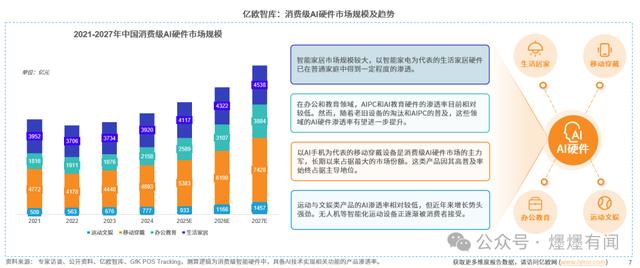
Magic Mirror Insight data shows that on e - commerce platforms (Taobao, Tmall, Douyin, and JD.com), the sales of AI glasses and AI recorders on e - commerce platforms soared by 4759% and 4580% respectively year - on - year in 2025. The sales of 3D printers on e - commerce platforms also increased by 68% year - on - year.
IDC data shows that the shipment volume of smart glasses in China increased by 87.1% year - on - year in 2025. According to Gongyanwang statistics, the market size of recorders in China was about 1.5 billion yuan in 2025, a 25% year - on - year increase. The National Bureau of Statistics disclosed that the output of 3D printing equipment increased by 52.5% year - on - year in 2025, with a growth rate exceeding that of industrial robots.
These figures mean that AI hardware, as a separate category, has overall caught the wave of development.
Undoubtedly, the main group creating this wave is the young people.
CNNIC data shows that 37% of Generation Z online shopping users have bought smart wearable devices, 14 percentage points higher than the overall online shopping users. They are also the group with a generative AI usage rate of 71.4%. From using AI software to buying AI hardware, they are always at the forefront.
This group of consumers includes students, young workers who have just entered the workplace, and young entrepreneurs. They are also the first generation to be impacted by the AI wave.
When more and more young people start to spend their limited money on expensive AI hardware in their shopping carts, what exactly do they really want to buy?
2
Some people want to find a solution to "making money".
According to Similarweb data, the global AI usage in 2025 was 9 times that of two years ago, but the main growth has shifted from entertainment - oriented AI chat tools to productive activities such as programming, design, and content creation.
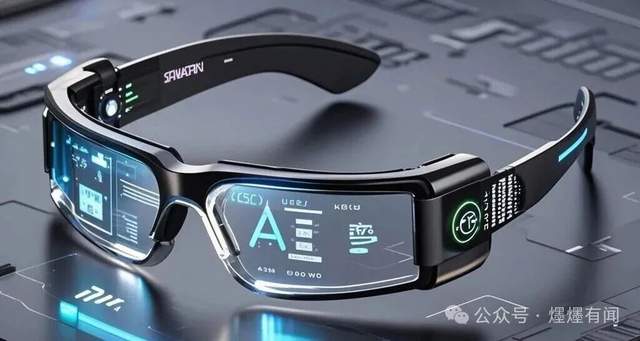
If you look at the evaluation content about AI hardware on platforms such as Bilibili and Xiaohongshu, many don't focus on product parameters. Instead, they tell you that it's a productivity tool and list various specific usage scenarios:
Making vlogs, cross - language communication in foreign trade or academia, quickly generating meeting minutes, running a one - person company, operating a one - person factory...
What people are most concerned about in the bullet comments and comment sections is how to use these AI hardware to take orders, do side jobs, improve efficiency and make money. They also want to know how to use lower production costs to leverage greater productivity and get greater returns.
Take AI glasses for example.
You don't need to spend time learning a language or studying photography composition and shooting techniques. As long as you spend a few thousand yuan on a device, you can immediately seem to "keep up with the times" and "maximize your productivity".
Take 3D printers for another example.
The price of an entry - level 3D printer has dropped from five or six thousand yuan a few years ago to just over two thousand yuan now, which is equivalent to the price of an affordable mobile phone. But it gives people the feeling of "owning a small factory". There are always comments like "Go set up a stall after learning it", "How about opening a figurine/cultural and creative studio?", "Can I make money by doing 3D printing on demand?" under relevant content.
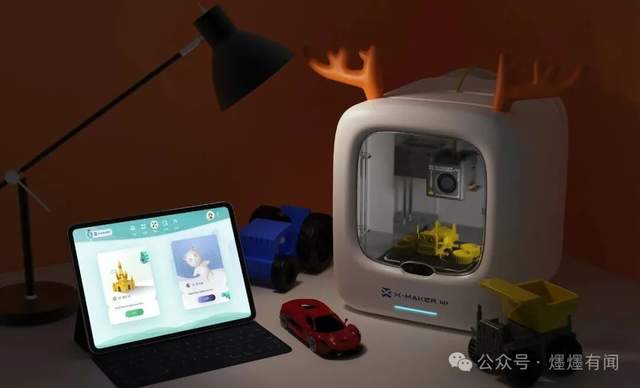
The value of AI hardware depicted in such content is that after having it, you can expand your professional field, do things you couldn't do before, and earn money you couldn't earn before...
Many people's desire to buy AI hardware is stimulated by these specific money - making imaginations.
TMTPost calls this change in consumption motivation the underlying driving force of the "second wave of AI hardware".
The first wave sold "laziness". Products like floor - cleaning robots, dishwashers, and smart speakers helped people be liberated from housework.
The second wave sells "ability". AI recorders, AI glasses, and 3D printers enable people to do more things and expand the boundaries of skills that can be monetized.
In the eyes of more and more young people, the core value of AI hardware has changed from "saving effort" to "empowering". The former makes you more comfortable lying around, while the latter makes you more efficient in the competitive environment.
And efficiency is exactly what is most sought after in this era.
These AI hardware products that seem to help you make money more efficiently and make more money will make people feel that with these tools, they can be further away from the anxiety of being eliminated and closer to a more competitive self.
Even just one step closer is enough.
This feeling itself is enough to make people pay.
3
Some other people want to find a solution to "companionship".
The data from the "618 Consumption Report (2026)" shows that during this year's 618 period, the online retail sales of AI companion toys increased by 131.3% year - on - year. In the 2026 Tmall 618 event, "Fuzozo", which was rated as the champion in the "AI companion robot track", was launched in June 2025, and its cumulative sales exceeded 120,000 units that year.
What does a sales volume of 120,000 units in half a year mean?
In 2017, the sales volume of China's smart speakers in the first eight months just exceeded 100,000 units.
Looking at the entire Chinese market, according to the Ministry of Industry and Information Technology, the market size of China's AI toy market reached 24.6 billion yuan in 2024 and is expected to increase to 29 billion yuan in 2025, with a growth rate twice that of traditional toys.
Here is a key point that subverts the perception:
The main group of AI companion toys is not children, but adults.
The "2026 China AI Toy Industry Development and Consumer Behavior Survey Data" from iiMedia Research shows that from the perspective of the consumer group structure, the Chinese AI toy market is obviously dominated by middle - aged and young people. The group aged 26 - 35 accounts for the highest proportion, reaching 53.45%, the group aged 36 - 45 accounts for 36.45%, and the group aged 18 - 25 accounts for 7.66%. At the same time, 56.05% of consumers use AI toys 3 - 5 times a week, indicating that AI toys have gradually integrated into daily consumption life.
In short, more than 97% of the people who play with AI toys are adults over 18 years old, and more than half of them play regularly. They don't just buy them and let them gather dust at home.
If you look at those who show off AI toys on Douyin and Xiaohongshu, most of them are young people living alone in cities.
Looking at the data from the 7th National Population Census by the National Bureau of Statistics, the number of single - person households has exceeded 125 million, accounting for more than 25% of all family households. The unmarried rate of people aged 25 - 29 is 51.3%. That is to say, one out of every two young people of this age is single, and one out of every four families has only one person living in it. Even in Beijing, Shanghai, Shenzhen, and Guangzhou, the proportion of single - person households is close to 30%.
There are many young people in big cities, and many of them are single.
A news article published by Guangming Daily in June this year said that a college student bought six AI companion products one after another in a year, spending more than 7,000 yuan. When asked what he bought them for, he said it wasn't to solve problems, but to give himself an emotional buffer. "With their company, I'm no longer at a loss when I'm alone. My mindset is more peaceful, and even my study rhythm has become much more stable."
To be honest, if he spent money to hire six human companions, he might not have such an emotionally stable experience.
An AI toy that costs a few hundred yuan is cheaper than keeping a cat and more hassle - free than dating. It doesn't have the troubles of eating, drinking, and excreting, and can provide emotional value tirelessly 24 hours a day.
Isn't this exactly what contemporary single young people want?
Of course, young people who spend money on AI companion toys also know that AI can't provide real companionship. But in the face of high - pressure work, cramped living spaces, and increasingly difficult - to - maintain in - depth social interactions, having a companion who is always online and always patient to listen, understand, comfort, and encourage them means that their real emotional needs are being met.
It's enough as long as their needs are met, even if it's by AI.
4
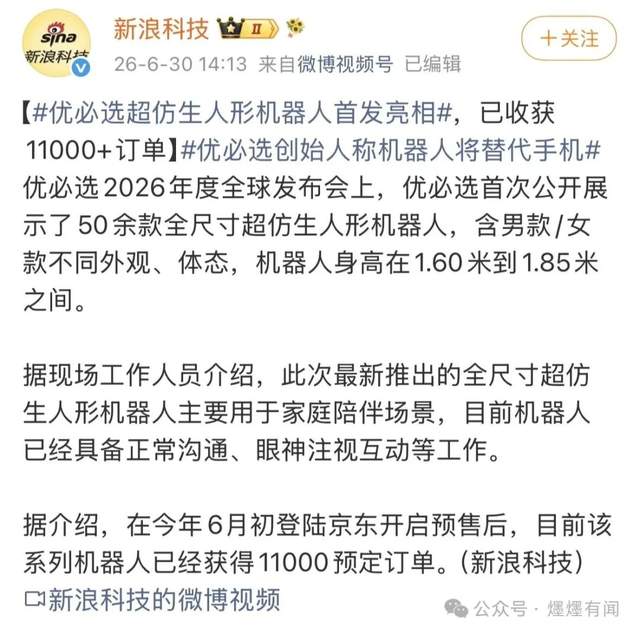
Yesterday, the news of the official release of UBTECH's hyper - realistic humanoid robot hit the hot search. The entry - level model costs 119,800 yuan, and the top - end model costs 990,000 yuan. On the day of the release, it was announced that the total orders across all channels had exceeded 11,000 units.

Is UBTECH crazy, or is it betting on the loneliness of young people?
A realistic robot with a price close to the down payment for a house, whose main function is pure family emotional companionship and can't do any housework. Even though there are a lot of controversies, it can't stop the orders from pouring in like a tide.
This shows that the price that people are willing to pay for AI hardware is still soaring.
But this may just be the beginning.
When young people spend their limited money on expensive AI hardware in their shopping carts, they are also voting with their consumption, looking for new solutions in an era of rapid change.
Some people buy it as an offensive weapon, using tools to arm themselves to be stronger.
Some people buy it as a defensive shield, looking for a container to hold their vulnerability.
Even if the solution is just a pair of glasses that make you look more capable, or a box that can talk to you.
As long as it can make you closer to the person you want to be and further away from the loneliness of being alone.
That's enough.