Exclusive Interview with Wu Xinhong, CEO of Meitu: Developing AI Products Is a Game That Can Hardly Be Planned in Advance
Interview | Zhou Xinyu, Lan Jie
Text | Zhou Xinyu
Editor | Zhang Yuxin
As of mid - June, Wu Xinhong's flight distance in 2026 has exceeded 230,000 km, and the flight duration is nearly 300 hours. His trajectory spans Asia, North America, Europe, and South America, and the farthest places he has reached are Brazil and Argentina.
The places along the flight routes are the market territories that Meitu has expanded with AI products in the past three years.
Meitu's 2025 financial report shows that the overseas MAU has returned to 100 million after many years. Among them, the AI video editing tool Wink and the imaging creation Agent RoboNeo have grown rapidly in Southeast Asia, Mexico, Brazil and other places, and have frequently topped the iOS download list.
Along with the global expansion, the profit has also increased. In 2025, Meitu's revenue reached 3.858 billion yuan, and the net profit reached 965 million yuan, a year - on - year increase of 64.7%. Among them, the imaging and design products reconstructed by AI have become the main source of profit, and the revenue proportion has increased from 35% a year ago to 76.6%.
A few years ago, Meitu was still struggling on the profit - loss line. Facing the surging wave of AI, Wu Xinhong talked with "Intelligent Emergence" about the "sense of crisis" of being impacted and said bluntly that he was "walking on thin ice".
In the past two years, Meitu has also made many organizational innovations in response to the AI era. Wu Xinhong set up a number of small AI innovation studios in the company of more than 2,000 people, providing up to 10 million yuan of AI innovation funds for a single team to encourage the rapid incubation of AI products internally.
Moreover, the team spent several months building an imaging product middle - platform and a growth middle - platform. The purpose is to reuse pipelines such as technical engineering, cold start, and traffic investment in different products, and shorten the product R & D and verification cycle.
"In the AI era, you must be fast to have a chance to win." Wu Xinhong told us.
For this reason, Meitu has formulated a rather strict product assessment mechanism internally: from project establishment, R & D, to market verification and launch, the time is controlled within 1 month; the standard for PMF (Product - Market Fit) verification is that the ARR must reach 100,000 US dollars within six months after launch.
In addition, Wu Xinhong also proposed that old products such as "Meitu Xiuxiu" with a large user base are prohibited from providing a large - scale traffic diversion for new products, which is to test the natural growth ability of new products.
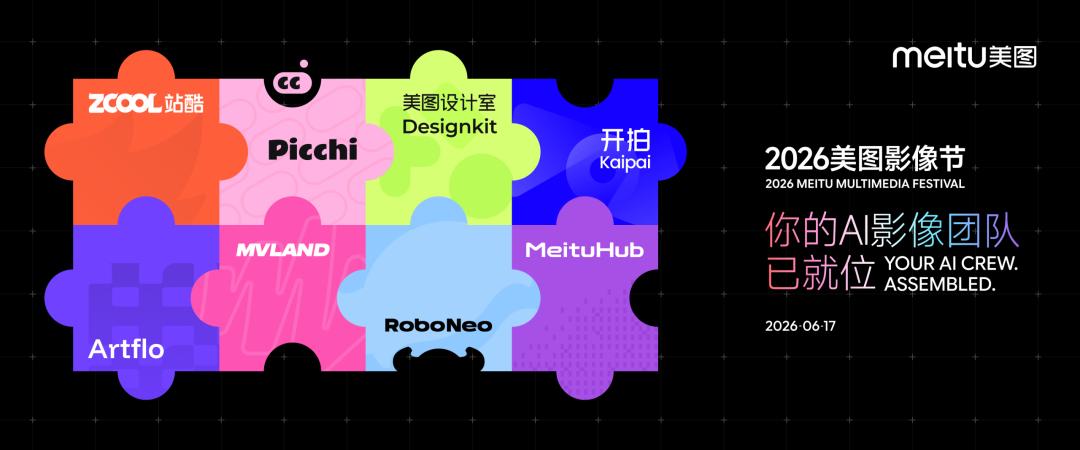
△ Four new products were released at the "Meitu Imaging Festival" in 2026. At the same time, four old products completed the iteration of AI functions. Image source: Provided by the enterprise
Among the four new AI products released at the "Meitu Imaging Festival" in 2026, the AI portrait retouching tool Picchi and the imaging workflow building platform MeituHub are products that "naturally grew".
For example, Picchi originated from Meitu's team's insight into the high - frequency usage behavior of "Meitu Xiuxiu" users. "Every time users retouch a picture, they want to make themselves look ideal, but it's very troublesome to repeat the retouching process every time. Is it possible for users to upload the previously retouched pictures for the AI to learn the user's retouching techniques automatically?" Xiaobai, the CPO of Meitu, mentioned.
The other two slightly "niche" products, the MV generation tool MVLAND and the concept video creation tool Artflo, originated from Wu Xinhong's personal love and the bet on the "non - consensus" field.
"Most successful products start from scenarios without competition." Wu Xinhong told "Intelligent Emergence".
Regarding the insight into emerging markets, the competition in the tool track, and the methodology of product - driven by "love", recently "Intelligent Emergence" had a conversation with Wu Xinhong, the founder, chairman and CEO of Meitu, and Chen Jianyi (nicknamed "Xiaobai"), the CPO and the president of the imaging product business group of Meitu.

△ Wu Xinhong (middle), the founder, chairman and CEO of Meitu; Chen Jianyi (nicknamed "Xiaobai", second from the left), the CPO and the president of the imaging product business group of Meitu. Image source: Provided by the enterprise
The following is a summary of the conversation, with the content slightly edited:
Products that grow naturally have stronger vitality
Intelligent Emergence: Is the competition in the imaging track more intense this year?
Wu Xinhong: For a long time, imaging tools have not been paid attention to by VCs, large companies, and entrepreneurs because it is difficult to monetize.
Now, imaging products have shown commercial effects. Because imaging has very rich productivity scenarios, including images, videos, 3D, etc. Many industries have imaging needs, but the imaging track is very fragmented. With more and more people entering, it is difficult for one company to dominate.
We are now racing against time.
Intelligent Emergence: Why was it difficult to monetize imaging products before?
Wu Xinhong: Before the popularization of the subscription model, many tool products could only rely on advertising. The problems with the advertising model are: first, the monetization efficiency is not high, especially for brand advertising. You need to form a professional team to serve customers; second, advertising placement is contrary to the user experience.
Intelligent Emergence: The imaging track is very fragmented. How do you choose which scenarios to enter first? For example, the newly released MVLAND is in a very niche track.
Wu Xinhong: Speaking of this, I bought a domain name: mv.com many years ago, which may become the website of MVLAND in the future.
Intelligent Emergence: Did you want to make products related to MV many years ago?
Wu Xinhong: I'm an art student and have been painting since childhood, so I'm very interested in artistic things. I've always been thinking about how to combine my hobbies with products and my long - term accumulation in imaging and vision.
In addition to MVLAND, Artflo released this year is also out of my hobby. It's hard to imagine that other Chinese companies would make a product that transforms inspiration into works because it seems to have no market.
Intelligent Emergence: Can it make money?
Wu Xinhong: We don't know either. But I just like it very much.
Intelligent Emergence: Aren't you a company that prioritizes PMF or data?
Wu Xinhong: I hope there is a private area in Meitu's product matrix for me to do what I like. This is my own selfishness. Turning interests into a career will be more interesting. I can also do things just for making money, but it will lack some passion.
We now have two ways of making products. One is bottom - up innovation. We identify a demand and a trend through data, then conduct some verification, and gradually scale up the product; the other is top - down strategic promotion.
There is no contradiction between the two. Doing so helps to form a healthy product ecosystem: young colleagues have the opportunity to verify their ideas, and I can realize my interests.
Xiaobai: In fact, there is no contradiction between PMF - driven and passion - driven. MVLAND is the best - performing among all new products in the past year. Its ARR reached 100,000 US dollars within two or three months of internal testing and is now close to 500,000 US dollars.
Intelligent Emergence: Among the products and functions released this time, which are driven by passion and which are bottom - up?
Wu Xinhong: In fact, it's quite difficult to distinguish. But in most cases, bottom - up products have stronger vitality because they grow naturally rather than being forced.
For example, "Kaipai", which has a rapid revenue growth rate, is a bottom - up product. At the beginning, we didn't plan to make an application for voice - over videos. It "grew" from the teleprompter function of "Meiyan Xiangji". At that time, we just found that there were a large number of users using this function.
Intelligent Emergence: When you proposed products out of your passion without data verification, did anyone in the team object at the beginning of the project?
Wu Xinhong: We finally let the product data speak. If the product data is still not good after multiple tests, we have to end the business. So we basically don't waste too much time on agreement or opposition, but quickly verify.
Meitu is a medium - sized company of about 2,000 people, with certain scale advantages. We can invest a lot of manpower in the construction of the product middle - platform and establish a set of reusable product R & D pipelines, thus shortening the time for product creation and iteration.
Intelligent Emergence: How much can you shorten the time?
Wu Xinhong: For the newly launched Agent Teams of RoboNeo, we completed it in one month.
Theoretically, Agent is a product with quite complex technology and engineering. Because we have an imaging product middle - platform, a growth middle - platform, etc., we can efficiently reuse mature experience in technical engineering, cold start, marketing, growth, etc. in new products or new functions to quickly verify PMF.
In this era, theoretically, the shorter the time for verifying PMF, the better. No one knows how technology and the market will change in a month. So we control the product verification cycle within one month.
Intelligent Emergence: What is the standard for verifying PMF?
Xiaobai: The ARR should exceed 100,000 US dollars within six months after the product is launched - this is the baseline. After all, there are too many products with a million - dollar ARR in Silicon Valley.
Launch products first, then find the market
Intelligent Emergence: I heard that you are going to fly to Brazil soon.
Wu Xinhong: Yes. I'll take the team there to experience it and communicate with local users and creators. We also plan to visit some excellent Chinese companies that have gone global to learn from their experience.
Intelligent Emergence: What are Meitu's key markets now?
Wu Xinhong: The key market is always China. China has the largest user base in the world and the most unified language, and Meitu has local advantages.
Although the Chinese market is highly competitive, competition has its advantages. It can train the team's combat ability and help us compete overseas. After breaking through the competition in the domestic market, when we go to other countries overseas, we will find that the competition intensity is much lower than in China.
We started to go global in 2013. Now, the market share of Meitu's products in some Asian countries, especially in East Asia and Southeast Asia, has approached that in China.
Intelligent Emergence: Which markets do you most want to develop at present?
Wu Xinhong: South America. Countries like Brazil and Mexico also have a large absolute population. For example, Brazil has a population of 210 million, and they have a strong demand for social sharing, which will lead to a series of imaging creation needs. For some products such as RoboNeo and Airbrush, the number of Brazilian users is the largest, exceeding that in China.
In the future, we also attach great importance to the African market. In the stereotype, African users are relatively marginal and seem to have no strong imaging creation needs. But in fact, we have received a lot of user feedback from Africa. So if there is a chance, I also want to take the team to understand the African market.
Intelligent Emergence: Did you decide to target markets like South America and Africa from the very beginning?
Wu Xinhong: No. We usually launch products first and then dig out new markets and new growth opportunities based on user feedback.
Because the marginal cost of imaging products, or Internet products, is relatively low, they can serve global users lightly and quickly. So after we prepare language packs for different regions, we just wait for users to download, use, and give feedback.
Gradually, we will build a heat map to know in which countries and regions the products are more popular. Then we will keep looking for reasons. If we can find a good fit between the product and the market, we will try our best to expand.
So many things are not planned but grow naturally. After they grow, we water them and take better care of them to make the products grow stronger.
Intelligent Emergence: The market is often post - hoc. What judgments can be made a priori?
Xiaobai: Emotional judgments are definitely a priori. MVLAND is Xinhong's "little selfishness" (laughs).
But PMF cannot be verified a priori in the early stage. It needs a subsequent value measurement system for commercial delivery. Taking MVLAND as an example, we conducted a lot of research on music studios, clarifying the production volume of songs, the production cost of MVs, and how many songs have MVs.
Many music studios mentioned that if they are given a low - cost production method to match each song with an MV, they can distribute content on platforms such as Douyin and YouTube to earn advertising fees or package more singer IPs - these are the specific and quantifiable commercial values for target users, and we can infer the PMF of MVLAND.
Intelligent Emergence: How do you find seed users? Will super - creators be your core seed users?
Xiaobai: Try not to include "super - creators" as seed users. They are too versatile and not typical users. So including "super - creators" will contaminate the usage behavior of seed users.
The role of "super - creators" is to help us reach more seed users and promote the brand.
Intelligent Emergence: Which demands have you "falsified" so far?
Xiaobai: AI clothing try - on. There are two scenarios for clothing try - on. One is the commercial scenario for e - commerce platforms. Currently, technology is the biggest bottleneck, and we are still working on problems such as clothing consistency and material restoration.
The other is the consumer scenario, which helps users with AI - based dressing. But we found that we overestimated users. People won't take pictures of all the clothes