WeChat and Alipay enter the fray, and the competition for AI assistants enters a new phase
The competition among AI assistants has finally gathered all the players. Those who gain more task - orchestration power will ultimately take the center stage.
Throughout June, new news has been constantly emerging in the AI assistant arena.
The initial stir came from several native AI applications. Doubao launched a paid professional version while there were rumors of its testing for integration with Feishu; Qianwen is also integrating with third - party services, taking its service - handling capabilities to a deeper level; DeepSeek has started recruiting talents to enhance its product and application capabilities.
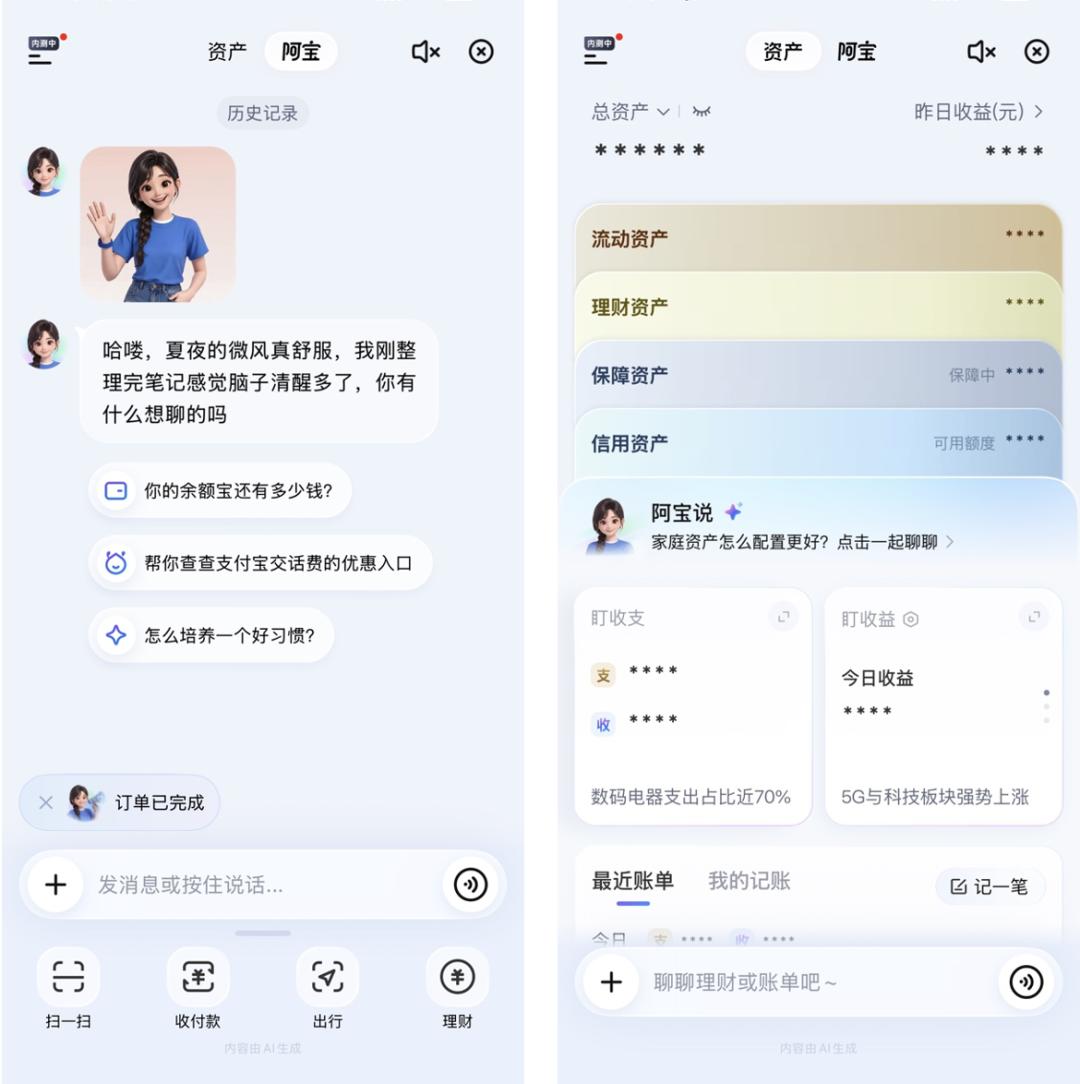
The more recent changes come from super apps and hardware entrances. Alipay placed "Abao" on the home page of its new version, attempting to rearrange tens of thousands of services through dialog boxes; WeChat's internal AI assistant, "Xiaowei", has also started a gray - scale test. Meanwhile, mobile phone manufacturers are linking their system assistants to WeChat through the A2A protocol.
In the initial Chatbot stage, AI assistants were essentially enabling models to answer questions, write copy, make summaries, modify images, and search for information like humans. Subsequently, AI assistants began to explore service - handling: booking tickets, ordering takeaways, checking express deliveries, creating PPTs, writing code, and generating small tools.
Now, AI assistants have taken another step forward. They are no longer just giving suggestions or generating results but trying to take over a complete task, directly advancing a one - sentence requirement to the transaction, fulfillment, or collaboration stage.
Technology is also becoming more capable of supporting new evolutions. The inference, Agent, and Coding capabilities of models have been qualitatively improved. AI can understand requirements more accurately, break down steps, call tools, operate interfaces, and even generate a dedicated mini - program or Skill for a specific task in real - time.
This gives AI assistants more hope of evolving from novelty - seeking applications to truly productive products. Although the service - handling capabilities of AI assistants have not yet achieved mass popularity, and some flaws have been exposed after real - world experiences, the general direction of competition towards Agent is already certain.
In this new development stage, integration will be the keyword.
First, native AI assistants and super apps will move towards integration. The former has models and a general assistant mindset, while the latter has users, payment, services, content, and relationship chains.
Second, large companies will conduct more extensive ecological integration around AI assistants. Doubao will continue to extend from Chatbot to personal office and productivity scenarios and introduce e - commerce, local life, and taxi - hailing capabilities; Tencent and Alibaba will further integrate third - party mini - program ecosystems and promote their AI transformation.
Third, under the vision of Agent service - handling, new interest chains will also be integrated. All parties will find their new positions: which entity the user voices the requirement to, which entity understands the task, which entity is called to provide services, which entity is responsible for payment and confirmation, and which entity ensures data security. Finally, all parties will design a new interest - distribution mechanism based on this new chain.
The competition among AI assistants has finally gathered all the players. Those who gain more task - orchestration power will ultimately take the center stage.
The stage has expanded, and the number of players has increased
Roughly speaking, the players participating in the AI assistant competition can be divided into three forces.
The first force consists of native AI assistants, including products like Doubao, Qianwen, and DeepSeek. They either serve as carriers for the implementation of model capabilities or are pioneers sent by large companies to explore AI innovation.
In the past one or two years, as the main players in the AI assistant field, they have popularized the AI interaction experience. Entering the new stage, they have also witnessed new changes.
Doubao is no longer satisfied with just dialogue and generation and has started to supplement service - handling capabilities. The most distinctive feature is the launch of a paid professional version for productivity scenarios. The latest news shows that Doubao has started to integrate with Feishu, and its accounts can be associated with Feishu's web version and enterprise - edition protocols.
Qianwen's direction is also to transform the assistant from a question - answering tool to a service - handling one. In June, Qianwen announced that it would fully open up to third - party Agents and Skills. In the future, all enterprises will not only be able to access Skills but also operate their own brand Agents on Qianwen. For Alibaba, the value of such access is not only to enrich Qianwen's functions but also to reorganize a task network that can be called by AI.
DeepSeek is also moving towards becoming a more comprehensive AI company from a model - focused one. After financing, DeepSeek launched a large - scale recruitment drive, covering positions in technology, product, and operations. This means that it doesn't want to stop at just model capabilities but also wants to enhance its application, product, and scenario capabilities. Currently, DeepSeek is the third - party AI assistant most likely to compete with large companies.
The second force consists of Agents derived from super apps. This is a more significant change that occurred in June.
First, the AI version of Alipay started internal testing. The new - version interface has been compressed into two core pages: "Abao" and "Assets". Users can use natural language to let Abao complete services such as paying bills, hailing taxis, registering for medical appointments, checking housing provident funds, keeping accounts, and making transfers. This AI transformation not only continues Alipay's tool - based nature but also improves the efficiency of service discovery and conversion, marking the beginning of Alipay's transformation into an AI assistant.
Then, WeChat's Xiaowei started a gray - scale test. Instead of reconstructing a brand - new service shelf, it uses AI to re - link relationships, content, and mini - programs in WeChat. It can not only order takeaways, hail taxis, search for official account articles, and summarize chats but also generate small tools in the form of mini - programs with a single sentence. Although Xiaowei is currently within WeChat, it may become the main interface for WeChat's open ecosystem in the future.
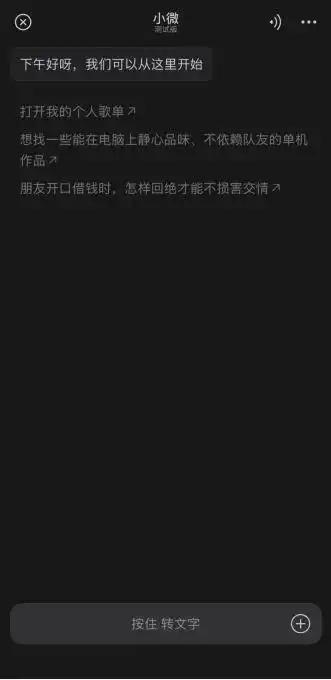
However, compared with the native camp, the AI transformation of super apps will be more cautious. WeChat's Xiaowei is still in the gray - scale test, and many key actions require user confirmation. Alipay also requires the user's confirmation for fund operations. This restraint is not due to insufficient product capabilities but because when a super app with a billion - level user base is opened up for AI service - handling, any mistake will be a major issue, and special attention needs to be paid to security and boundaries.
The third force consists of hardware manufacturers. Apple's transformation of Siri is not just to make it better at chatting but to turn Siri from a Chatbot into an Agent - based AI assistant. It can understand the user's personal context, recognize the content on the screen, and perform more actions in Apple and third - party apps. Apple's closed - loop hardware and software ecosystem gives Siri more underlying task - orchestration and execution potential.
Domestic mobile phone manufacturers and AI hardware companies are also iterating in this direction. However, companies like Xiaomi and Honor, lacking a closed - loop ecosystem like Apple's, often choose to integrate with WeChat and Alipay through the A2A protocol to obtain their support; companies like Rokid and Guangfan Technology choose to build new AgentOS and capability ecosystems relying on new hardware entrances such as AI glasses and AI headphones.
Among the three forces, native AI assistants need to supplement their service ecosystems, super apps need to transform their existing ecosystems into assistant capabilities, and hardware and system entrances want to seize the first contact point when users issue instructions. Although their paths are different, they will ultimately circle back to the same question: to whom do users entrust tasks, and who can actually complete the tasks?
Competition dimensions in the new stage
After the entry of WeChat and Alipay, the main participants in the AI assistant competition have gathered. Instead of exploring the answers to this question on their own, they are engaging in direct competition around the following five dimensions.
The most obvious competition dimension is the competition for the service - handling mindset.
The so - called service - handling mindset refers to the first app that users think of opening when they want to do something on their mobile phones. Whoever can make users think of themselves first when they "have something to do" will have a greater chance of meeting high - frequency and specific needs such as ordering takeaways, hailing taxis, booking hotels, checking express deliveries, registering for medical appointments, and checking housing provident funds.
Currently, these high - frequency needs are expected to support the story of AI service - handling. This also explains why Qianwen chose to build a "service - handling mindset" ahead of others under the leading pressure of Doubao.
However, the user mindset is just the first layer. A deeper competition dimension is who has a more complete or more differentiated capability ecosystem, which will determine the strength of service - handling capabilities.
The common advantage of Alipay and WeChat is that they both have a mature capability ecosystem. They not only have their own payment, wealth management, e - commerce capabilities, and relationship chains but also have built a large - scale third - party mini - program ecosystem in the mobile Internet era. For AI assistants, these are all atomic capabilities that can be called to complete tasks.
In addition, WeChat has a more abundant content ecosystem than Alipay. Obtaining information is a core service - handling scenario for AI assistants. The content of WeChat's official accounts and video channels are high - quality information sources, which can improve the information - obtaining efficiency of AI assistants.
Although Doubao is also integrating capabilities such as shopping, taxi - hailing, and local life services, its ecological advantage lies in personal office and productivity scenarios. The paid Doubao Professional Edition will provide high - level capabilities such as Office work, application development, data analysis, and professional design. At the same time, Doubao is also making some collaborative attempts with Feishu in the enterprise office scenario, which is essentially connecting personal and enterprise productivity.
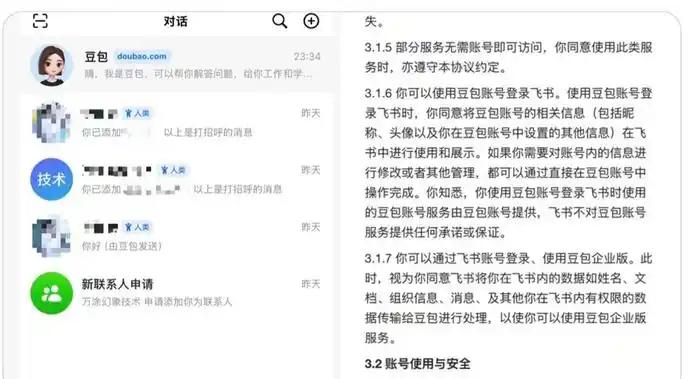
News shows that an instant messaging dialogue page has appeared on the Doubao App.
The third and more crucial competition dimension is the progress of AI transformation of the service ecosystem. Whoever can make third - party services complete Agent adaptation faster can form a service - handling network faster.
Currently, the capability ecosystem is still making mini - programs that "serve people" to "serve Agents". Although the WeChat Open Platform has released guidelines for developers to access the WeChat AI ecosystem, providing two ways for mini - program developers to access Xiaowei: automatic mode and development mode, from the actual experience, it is still using AI to imitate humans to call mini - programs.
The fourth competition dimension is the competition of model capabilities. Although it no longer solely determines the outcome, it is still a key factor affecting the experience of AI assistants.
An Agent capable of service - handling should be able to understand the user's vague requirements, break them down into executable steps, judge when to call APIs and when to operate the page, and handle exceptions such as pop - ups, logins, addresses, and payment confirmations independently. Without a powerful underlying model with strong inference, planning, code - generation, and interface - understanding capabilities, no matter how strong the ecological accumulation or how perfect the AI transformation capabilities are, it is difficult to achieve the best service - handling results.
Ultimately, the most fundamental question in the AI assistant competition is who can obtain the user's task - orchestration power. The so - called task - orchestration power, simply put, is after the user says "Help me book a restaurant suitable for dinner with clients tomorrow night", who decides which restaurant to choose, whether to call Meituan or Gaode for reservation, and who takes on the record of this context data.
In the long run, it is difficult for the entrance party or the service party to directly take away the task - orchestration power. Hardware and super apps can capture the user's first sentence, but without the support of a service ecosystem, they are just collecting an instruction and will ultimately have to transfer it. The situation of vertical service providers is the opposite - Meituan knows how to book a table, but it lacks cross - scenario intention understanding and context memory.
Currently, WeChat's Xiaowei and Alipay's Abao have the most ecological advantages in this regard, but their current implementation method is still to let AI imitate humans to call mini - programs, rather than making third - party services truly complete Agent or Skill adaptation - this adaptation progress is the bottleneck for the actual implementation of the orchestration power.
Qianwen's full - scale opening up of Agent and Skill access to third parties is essentially an attempt to be the first to achieve this transformation. Whoever can more quickly promote the adaptation of vertical services and form a callable task network can be the first to turn the orchestration power from a concept into actual distribution capabilities.
A new industrial chain is taking shape
Although we can clarify the competition dimensions of AI assistants, it is difficult to judge the final pattern based on these dimensions. The competition situation of AI assistants is still chaotic, and giants, model companies, hardware companies, and vertical service providers have not fully established their ecological niches.
However, a new industrial chain has begun to emerge, which can be roughly divided into: demand, entrance, AgentOS, vertical Agents, and security guarantee layer.
The entrance can be a mobile phone, AI glasses, AI headphones, in - vehicle infotainment systems, or super apps. The entrance is still important because it determines where the user voices a one - sentence requirement. However, the entrance is not everything. Just having an entrance but lacking service supply and task - orchestration capabilities, it is easy to become just a contact point for collecting user instructions.
This is the problem with hardware manufacturers. Companies like Apple and Huawei, which have operating systems and ecosystems, have the opportunity to build their own complete AI assistant systems; most Android manufacturers and AI hardware enterprises can create new contact points but find it difficult to supplement the service ecosystem on their own. Even by integrating with other AI assistants through the A2A protocol or cooperation, it is difficult to become a real task - orchestrator.
AgentOS is the task - orchestration layer with the highest value and the most intense competition. Doubao, Qianwen, DeepSeek, WeChat's Xiaowei, and Alipay's Abao all want to stand here.
This layer is responsible for understanding user intentions, breaking down tasks, selecting services, calling tools, managing context, and getting user confirmation at key nodes. Whoever secures this layer can influence subsequent service distribution and interest distribution. The companies participating in the competition need to integrate their originally scattered models, apps, content, and services internally, connecting with user needs on one side and feeding back task results on the other.
This layer will also include Agent, Skill, code - generation, and mini - program generation capabilities. Their role is to provide more AI - native capabilities and service - calling methods. The function of Xiaowei to generate small tools with a single sentence, products like Baidu Miaoda and Ant Lingguang all serve such a vision - in the future, service - calling may also be realized by short - lived software.
Vertical Agents are third - party applications that possess unique capabilities and resources, cannot be replaced by AI, and can only be transformed by AI. Meituan, Didi, Ctrip, Tongcheng, JD.com, Dewu, Midea, as well as service providers in the medical, financial,