Why does Kunlunxin need a "sales-driven" IPO?
On June 29, Baidu experienced a long-awaited rebound in the capital market. As of the pre-market on July 1, Baidu's Hong Kong stocks had risen by a cumulative 11% in two days.
What ignited the capital market was Kunlunxin, an AI chip company under Baidu. According to The Information, Kunlunxin plans to list in Hong Kong with a target valuation of about $50 billion, a figure far higher than Baidu's current market value of about $36 billion.
What's more intriguing than the valuation is the subscription method reported for this IPO. According to The Information, potential investors are required to purchase chips worth 3 to 7 times the amount of their subscription. This "share allotment" is quite high.
"It's not common in the market for an AI chip company to screen investors in this way during the IPO stage," a senior chip investor told "Noise Reduction NoNoise".
This sounds like putting equity subscription and product procurement on the same table, and even has the meaning of a "product-promoting IPO". However, if we only understand it as signing orders before listing to support the valuation, we may be oversimplifying Baidu's intentions.
The above-mentioned investor revealed to "Noise Reduction NoNoise" that, as he understood, the so-called "procurement + subscription" only appeared in roadshow communications and was not a hard constraint. "It doesn't limit how much must be purchased within a certain period. It's more like an intentional arrangement."
As for why it's done this way, the above investor believes that Kunlunxin wants to screen out investors with continuous procurement capabilities rather than just financial investors.
Firstly, Kunlunxin is in a relatively strong position.
Currently, the supply and demand of AI chips are tight, and the substitution of domestic computing power is accelerating. "Leading domestic AI chip companies like Kunlunxin are in a state of both tight production capacity and strong demand. To some extent, 'procurement + subscription' is also a benefit for its investors," the above investor said.
"Noise Reduction NoNoise" previously mentioned in "It's Not Easy to Be the Chinese NVIDIA" that domestic chips such as Huawei's Ascend 910 were once in short supply. Cambricon's contract liabilities in the first quarter of this year increased significantly from 1 million yuan at the end of 2025 to 396 million yuan, which also reflects the strong demand.
This trend is also reflected in Kunlunxin's performance. According to the estimates of various investment banks, Kunlunxin's revenue in 2024 was about 2 billion yuan, with a net loss of about 200 million yuan; its revenue is expected to grow to 3.5 billion yuan in 2025 and is expected to break even; its revenue may reach 6.6 billion yuan in 2026.
IDC data shows that in the Chinese cloud AI accelerator market in 2025, Kunlunxin's shipment volume reached 116,000 units, tying with Cambricon for the third place among domestic manufacturers and ranking second only to Huawei's Ascend and Alibaba's T-Head in the shipment volume of domestic AI chips.
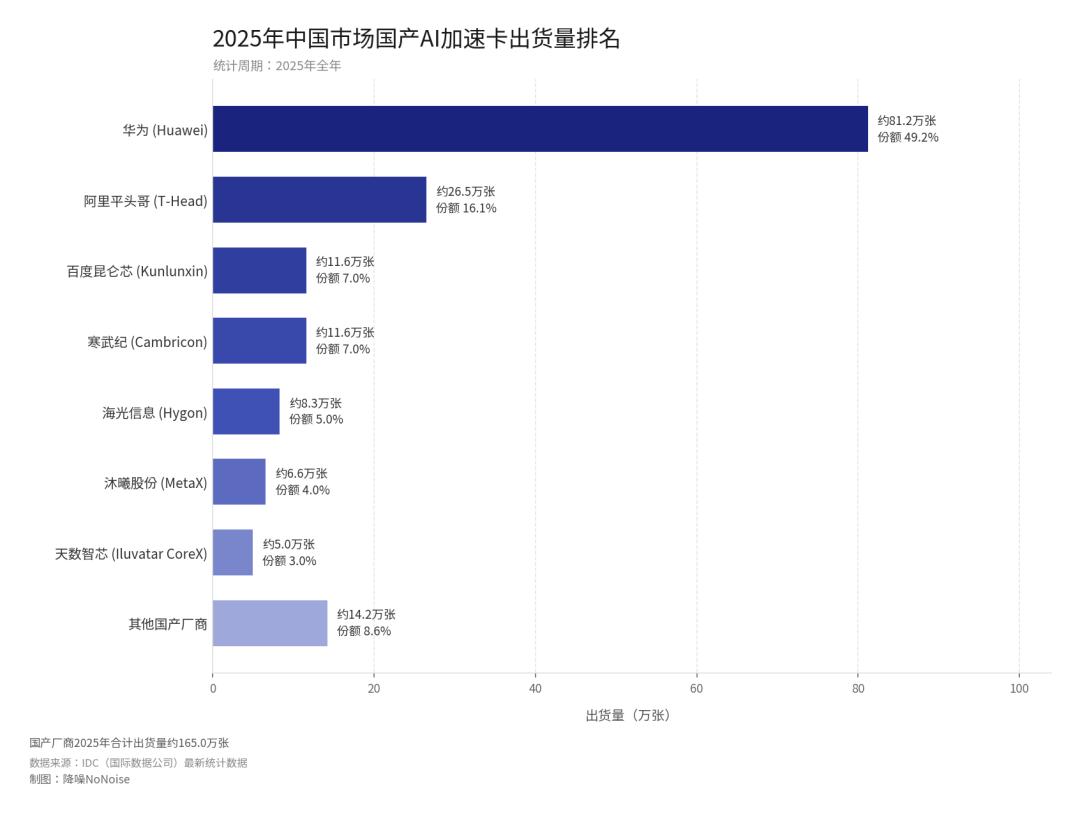
In terms of performance stability, Cambricon's major customer, ByteDance, is developing its own chips, and it's possible that Cambricon's shipment volume may fluctuate at some point in the future; T-Head's AI chips mainly serve external customers indirectly through Alibaba Cloud; if Kunlunxin can bind more external orders through the IPO, it may form a more competitive market position in the future.
Secondly, compared with funds, Kunlunxin needs external customers more to prove its independence.
Kunlunxin's predecessor was Baidu's Smart Chip and Architecture Department. When it completed independent financing and was spun off from Baidu in April 2021, its valuation was as high as 13 billion yuan. However, as an AI chip product incubated within Baidu, Kunlunxin mainly relied on Baidu's internal scenarios to provide orders in the early stage. This allowed it to skip some external market verifications and enter the large-scale stage faster, but at the same time, it also led to external doubts about whether it was overly dependent on Baidu.
Therefore, Kunlunxin needs to prove that customers outside of Baidu have a continuous willingness to purchase.
Going public is a step for Kunlunxin to dilute its Baidu label, and "procurement + subscription" is a step to strengthen the narrative of external customers during the listing process.
From public information, Kunlunxin has been accelerating the expansion of external customers in recent years. Investment bank data shows that in 2025, about 40% of Kunlunxin's revenue came from external customers. In November 2025, Shen Dou, the president of Baidu's Smart Cloud Business Group, publicly disclosed that Kunlunxin already had more than a hundred customers, including China Merchants Bank, China Southern Power Grid, Geely Automobile, vivo, an internet giant, and a super-leading operator, with delivery scales ranging from dozens of cards to more than ten thousand cards.
That internet giant was later confirmed to be Tencent, and the leading operator was China Mobile. Tencent's open attitude and the delay in its own AI layout are mutually causal, and operators have a rigid demand for domestic computing power.
It's worth noting that in 2025, China Mobile placed an order to purchase more than 1 billion yuan worth of inference chips from Baidu's Kunlunxin; in July of the same year, China Mobile's investment arm, Zhongyihechuang, appeared in the lineup of Kunlunxin's Series D investors. This shows that Kunlunxin had tested the feasibility of "procurement + subscription" before.
For these customers, participating in Kunlunxin's subscription is also an industrial layout around the domestic computing power supply chain.
Looking further, "procurement + subscription" may also form a two-way mutual benefit. If Kunlunxin performs well after listing, industrial investors have the opportunity to obtain financial returns in the capital market; at the same time, these industrial parties introduce their computing power needs into Kunlunxin's revenue system through chip procurement. New orders increase the outside world's expectations for the company's revenue growth, and revenue expectations further strengthen the secondary market's confidence in the valuation, forming a positive cycle of "subscription of shares - procurement orders - revenue increase - valuation increase".
From a broader perspective, in the past two years, more and more transactions in the AI industry have had the meaning of "circular investment": chip companies invest in customers, and customers in turn purchase chips; cloud providers bind large model companies, and large model companies then purchase cloud computing power. Capital, orders, and production capacity are put into the same growth flywheel.
For example, the investments, computing power procurement, chip supply, and cloud service orders between NVIDIA and companies such as OpenAI and Microsoft are intertwined, forming an interest network around AI computing power. AMD has also reached agreements with companies such as OpenAI and Meta that link hardware sales with equity allocation. Before its IPO, SpaceX was also reported to have required underwriting banks or specific investors to purchase enterprise services for its Grok AI model.
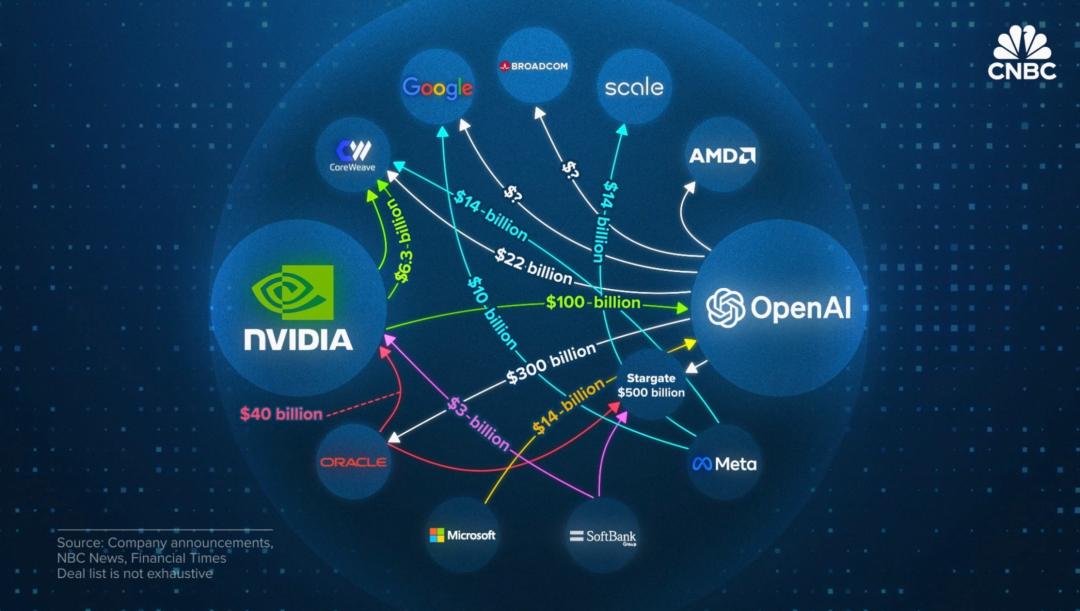
These agreements bind the upstream and downstream together through orders, allowing the entire ecosystem to jointly amplify demand, revenue, and valuation.
Although there is no such written binding in the domestic AI industry yet, the trend of alliance has emerged. For example, "Xiwang" incubated by SenseTime has investment institutions such as Huaxu Fund under Sany Group, Fourth Paradigm, and Midea Holdings behind it; among the industrial investors of Moore Threads are Tencent, ByteDance, Lenovo Capital, and Pony.ai.
From the perspective of industry trends, Kunlunxin's practice of binding the relationship between "capital + orders" at the IPO stage may have a demonstration effect on Chinese AI chip companies preparing to go public in the future.
For Kunlunxin itself, in the short term, the release of orders, delivery cycles, and revenue recognition before and after listing will continue to support the valuation imagination space of Kunlunxin.
But in the long run, it still has to return to the product itself. "We still need to see Kunlunxin's performance in application scenarios. The performance varies in different scenarios and different models, and it's difficult for the outside world to fully judge Kunlunxin's real capabilities just through public parameters," the aforementioned chip investor said.
Another hidden risk comes from the market itself. The interest bundling of the upstream and downstream of the AI chip industry is accelerating the positive cycle of the AI industry while also magnifying risks. When any link in the chain has a problem, it will affect the whole. The investor cautiously reminded that many investors in the United States have warned of the approaching peak of the AI bubble. "There is definitely a bubble in the domestic AI market. As for when it will burst, it may take some time."
Regardless of the future, Kunlunxin's IPO at this node is good news to boost the morale of Baidu.
When Kunlunxin was spun off, Baidu held 57% of the shares. If the target valuation of $50 billion reported in the market is finally realized and the procurement orders can be locked in advance, Baidu's own valuation will also have a new narrative.
Currently, Baidu is in the painful period of transforming from a traffic distribution company to an AI infrastructure platform. Previously, the search business has always been the valuation center of Baidu, but in the subsequent business model transformation, Baidu's AI business has not yet supported a high valuation - its self-developed large models and AI applications have failed to maintain the first-mover advantage, the smart cloud has entered a rapid growth space but the growth rate is not enough to excite the capital market, and Luobo Kuaipao in the Robotaxi direction is still far from profitability and is greatly affected by policies. In contrast, the low-key Kunlunxin is one step closer to a counterattack, which finally gives Baidu new confidence in its long-advocated "chip - cloud - model - ecosystem" strategy.
From this perspective, the "product-promoting IPO" is not only an early lock-in of Kunlunxin's growth space but also a rigid demand for Baidu to "stand up straight".
This article is from the WeChat official account "Noise Reduction NoNoise", author: Liu Shiyu. It is published by 36Kr with authorization.