Invested by Hinton, Li Feifei and Taiwan Semiconductor Manufacturing Co., with top talents from NVIDIA and Google teaming up to develop chips, the company is valued at 34 billion.
According to a report by Zhidx on July 1st, last night, AI chip unicorn Etched released its first progress report since its establishment, announcing that it has raised $800 million (approximately RMB 5.43 billion) through four undisclosed financing rounds. Etched also revealed to foreign media that its latest financing round was an undisclosed $500 million (approximately RMB 3.39 billion) investment in December last year, valuing the company at $5 billion (approximately RMB 33.93 billion) post - investment.
Etched has an impressive lineup of investors. Its angel investors include well - known figures in the AI circle such as Geoffrey Hinton, Fei - Fei Li, Andrej Karpathy, and tech billionaire Peter Thiel. Among institutional investors, VentureTech Alliance, a subsidiary of TSMC, and six well - known venture capital firms such as Jane Street led Etched's latest $500 million financing round.
Together with the above financing news, Etched also announced its latest business progress. Earlier this year, Etched completed the first tape - out of its self - developed chip, which uses TSMC's N4P process (based on the 5nm technology platform).
Currently, Etched is validating its first batch of rack - level products with customers, and the order demand reaches $1 billion (approximately RMB 6.79 billion). These products will be shipped this summer, and production has already started.
What exactly is the background of this company that has attracted many well - known figures in the AI circle to place their bets?
01. Once Faced a Cash - Flow Crisis, with Core Team Members Being Industry Giants
Etched was founded in 2022 and is headquartered in San Jose, California, USA. The three co - founders, Gavin Uberti, Robert Wachen, and Chris Zhu, are all Harvard dropouts and recipients of the Thiel Fellowship. This fellowship was founded by PayPal co - founder Peter Thiel, which selects a group of young people under 20 years old each year and provides each of them with a $100,000 grant, encouraging them to drop out of school and start businesses.
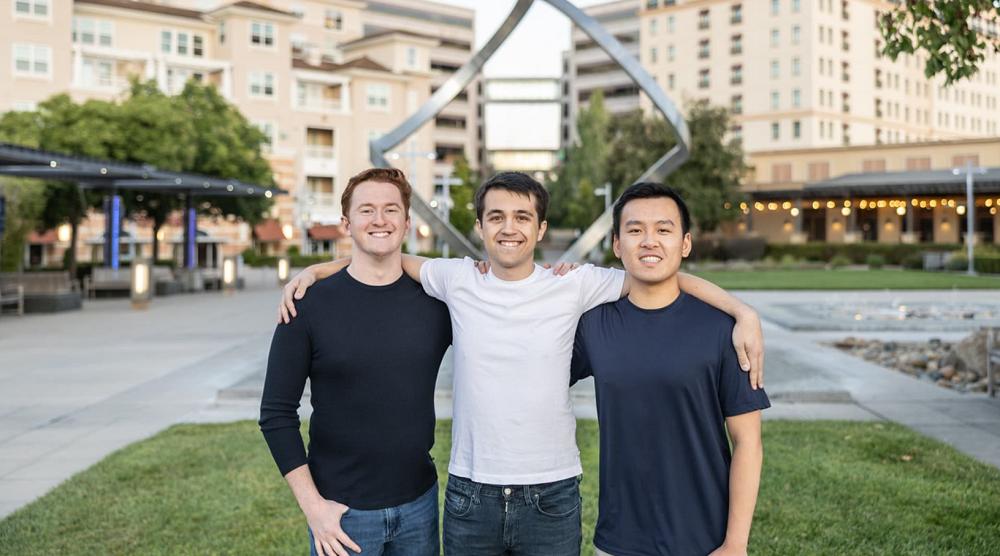
From left to right: Robert Wachen, Gavin Uberti, Chris Zhu
As early as 2023, Uberti and Wachen began to pitch Etched's concept to investors, arguing that AI would ultimately require dedicated inference chips rather than general - purpose GPUs. However, few were optimistic at that time, and all the major investment institutions they approached rejected them. Etched was on the verge of running out of cash and was barely operating month by month.
The turning point came in 2024. With the explosive growth of generative AI, inference became the largest cost item and the bottleneck for large - scale development of AI companies. Investors started to flock to chip technologies that could accelerate inference. The financing environment for Etched changed accordingly, and it raised over $125 million that year.
Now, Etched has assembled an engineering team of over 400 people. The core members are from leading chip and technology companies such as NVIDIA, Google's TPU team, Broadcom, SK Hynix, and TSMC.
Although Etched's co - founders are very young, many members of its team have decades of experience in the chip industry. Its CTO, Mark Ross, was previously the CTO of American semiconductor company Cypress, which was acquired by Infineon for 9 billion euros in 2020.
Brian Loiler, the vice - president in charge of platform business at Etched, worked at NVIDIA for 22 years. He was responsible for NVIDIA's platform engineering team and helped build NVIDIA's HGX and DGX supercomputing systems.
Saptadeep Pal, who was previously an architect in NVIDIA's H100/A100 and V100 teams, now serves as the vice - president at Etched, in charge of ASIC and architecture business.
David Munday, who built Google's TPU software team, serves as the vice - president at Etched, in charge of software business. Wayne Cao, the vice - president in charge of production at Etched, previously led the production and supply chain work of well - known products such as the first - generation iPhone, MacBook Air, and Pixel.
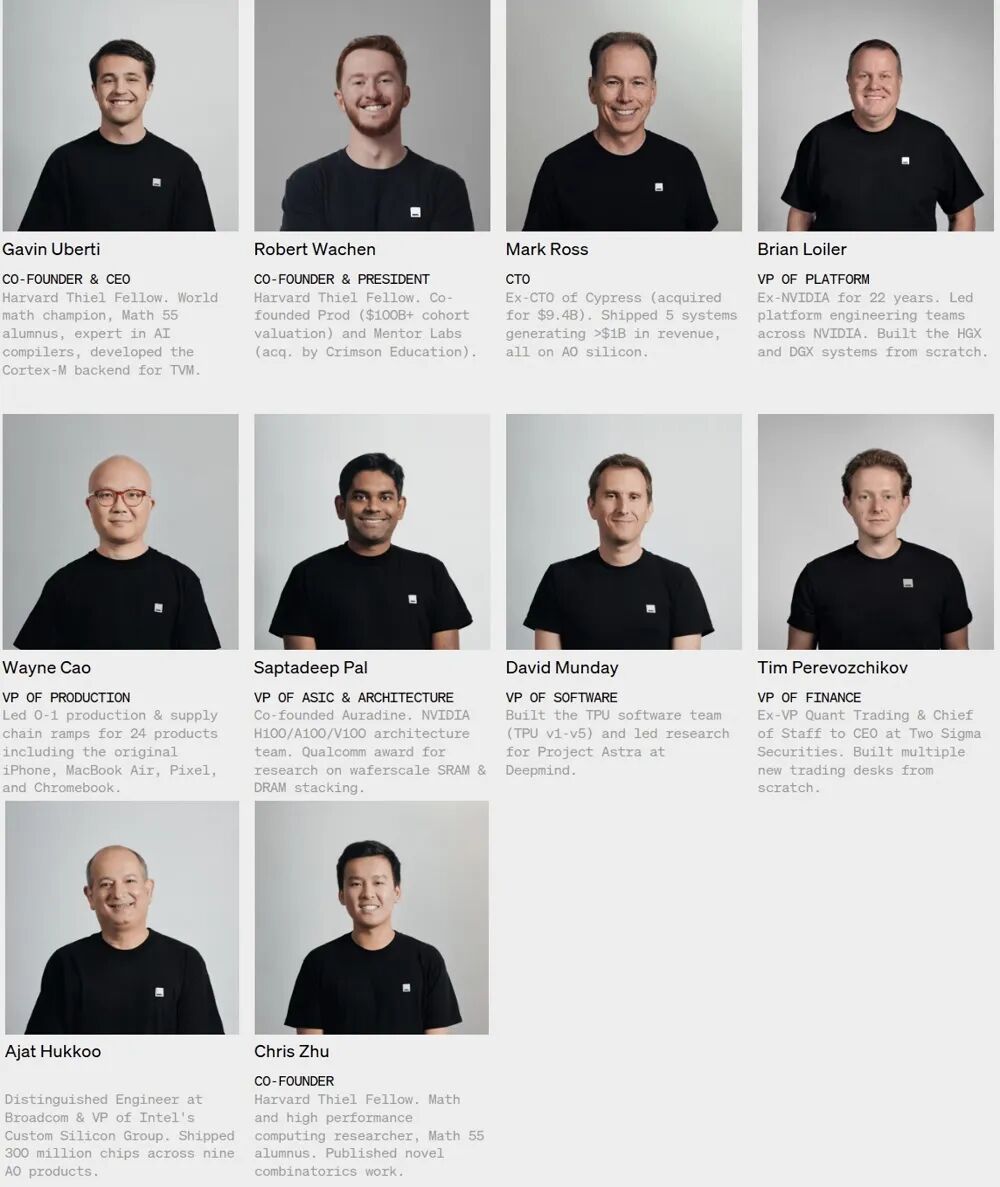
The team has deep accumulations in chip design, system architecture, and supply chain management, which supports its vertical integration from chips to racks.
02. Building a Cutting - Edge Inference Cluster and Announcing Two Core Technologies
Etched claims that its goal is to build a new "cutting - edge inference cluster" with full - stack collaborative design from transistors to tokens, achieving world - class levels in throughput, latency, cost, and energy efficiency.
In response to the core bottlenecks such as power consumption, heat generation, and bandwidth faced by AI inference chips, Etched announced two core technologies.
When the FLOPs utilization rate of traditional AI chips increases, they will trigger thermal throttling due to increased power consumption, resulting in the continuous inference throughput often being less than half of the peak FLOPs. The new low - voltage inference architecture designed by Etched allows its chip's computing modules to operate at a voltage less than half of that of most AI chips. Thus, without triggering thermal throttling, the operating efficiency of the trillion - parameter sparse MoE model can be increased to over 80% of the peak FLOPs.
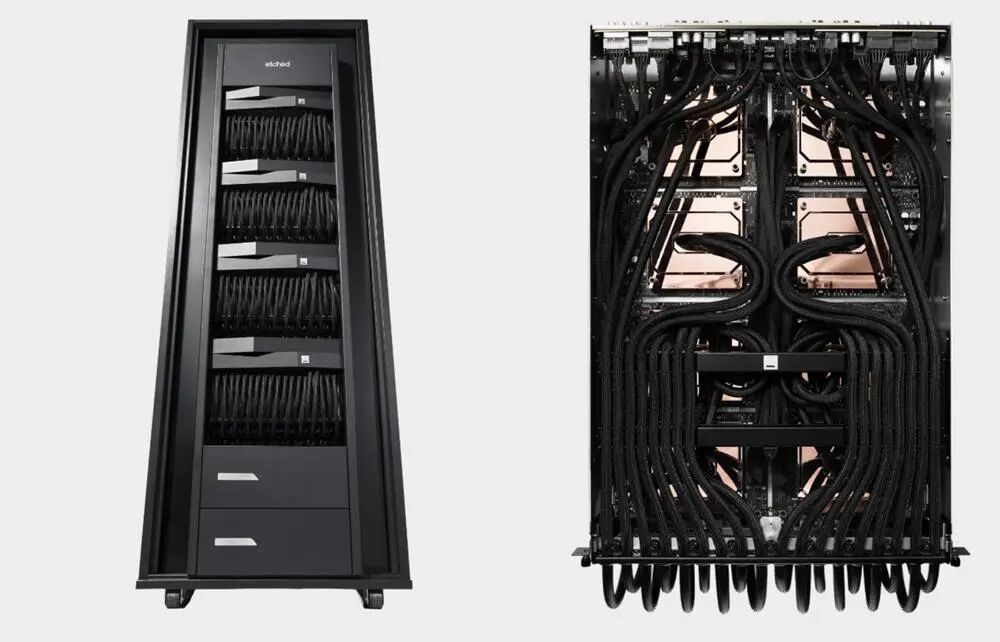
Etched's rack - level system
In response to the dilemma that the HBM of current AI chips cannot reach the decoding speed of SRAM - level, while pure SRAM chips sacrifice throughput and memory capacity, Etched created a cluster - level memory sharing pool across chips, enabling faster memory access through a proprietary ultra - low - latency and high - bandwidth interconnection.
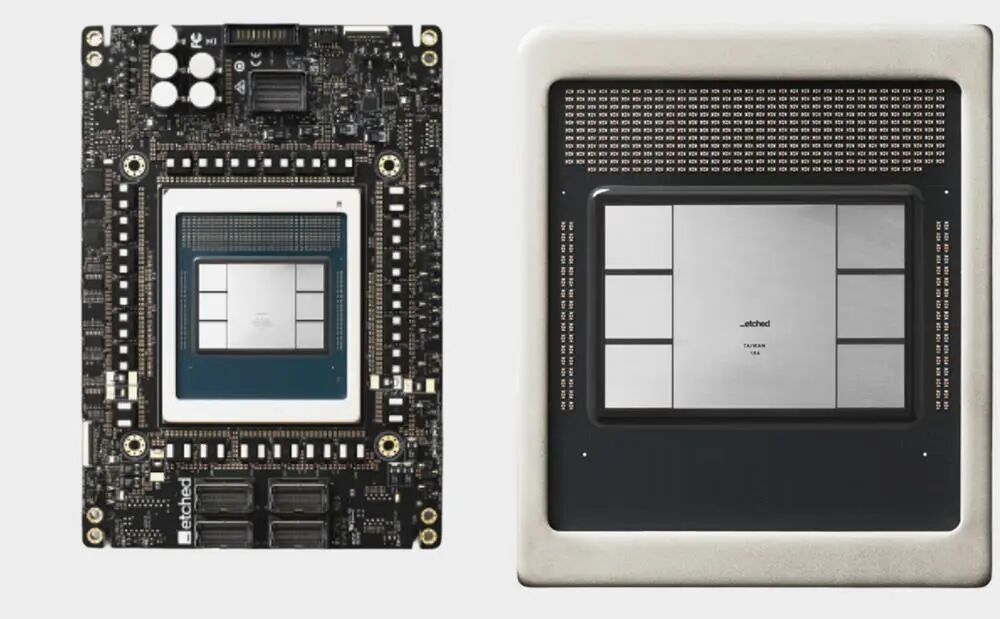
Etched's AI inference chip
Its HBM/SRAM hybrid design solves both the memory capacity and latency problems, avoiding the trade - offs in cost, reliability, and yield of pure SRAM chips, 3D DRAM, or optical solutions.
Etched emphasizes that it uses a full - stack collaborative design approach from chips, packaging, PCBs, cold plates to interconnections, and closely cooperates with leading AI companies, cloud service providers, and hyperscale users. Etched has built a 2MW data center, a test center, and an NPI prototype laboratory at its San Jose headquarters and set up a factory in Taiwan, China, integrating design, verification, and production. Its goal is to reach the gigawatt - scale by 2027.
03. Conclusion: The Cost - Effectiveness Advantage of AI Inference Chips is Prominent
As large models move from laboratories to various industries, inference is gradually becoming the main battlefield for AI computing power consumption. On the premise that the architecture of large models is relatively stable, developing dedicated AI chips for inference tasks is becoming more cost - effective. Amazon, Google, Microsoft, and even OpenAI are continuously promoting related R & D.
The market has also given more recognition to the leading players in the AI inference chip field. This year, Cerebras completed its IPO on the NASDAQ, and Groq's technology entered the NVIDIA system through a licensing agreement.
In the future, Etched's $1 billion in orders and upcoming mass shipments may verify whether this rising star in the AI inference chip field can meet the market's expectations.
Source: Etched official website, TechCrunch
This article is from the WeChat official account “Zhidx” (ID: zhidxcom). Author: Chen Junda, Editor: Yun Peng. Republished by 36Kr with permission.