Tesla FSD's China Entry Countdown: Unpacking the Survival Logic of "Huazhou Demon" in the Autonomous Driving Knockout Round
"The competition in the intelligent driving industry is expected to end in 2026, with only three players emerging victorious."
During the 2025 World Intelligent Connected Vehicles Conference, Cao Xudong, the founder of Momenta, publicly made this assertion, which soon sparked extensive discussions across the intelligent driving industry. Many believe that Cao's judgment is not without basis.
Looking at the financing scale of the intelligent driving industry last year, there has been a significant decline compared to the peak in 2021. The capital market is now more concerned about whether intelligent driving companies have the ability to achieve mass production.
Most intelligent driving companies have completed the R & D iteration from rule - driven to data - driven, and leading companies are starting to move towards physical AI, which requires higher investment costs.
The reduction of hot money and the sharp increase in R & D have led to some intelligent driving companies being eliminated from the competition, indicating that the elimination round in the intelligent driving industry has begun. This industry elimination round is expected to become even more intense this year.
According to reports from several media outlets such as Jiemian News, during the first - quarter earnings conference this year, Tesla executives revealed that Tesla's FSD is in communication with Chinese regulatory authorities and is expected to receive approval in the third quarter.
If Tesla's FSD enters the Chinese market as scheduled, the domestic intelligent driving industry will likely face a comprehensive and ruthless reshuffle. When the tide recedes, it will be clear who is engaging in empty marketing and who is focusing on practical scale expansion. The industry will be cleared out more rapidly.
Against this industry background, in the eyes of industry insiders, having a good intelligent driving solution and the engineering ability to achieve large - scale mass production has become the key for intelligent driving players to win this industry elimination round.
As the countdown to Tesla's FSD entering the Chinese market begins, only a few players in the industry currently have this ability.
In 2026, the installation volume of QCraft's intelligent assisted driving system in passenger vehicles exceeded one million. With this achievement, QCraft, along with Huawei and Momenta, has formed the "first echelon of mass production" in the domestic intelligent driving industry, and the collective term "Hua - Zhou - Mo" has gradually become well - known both within and outside the industry.
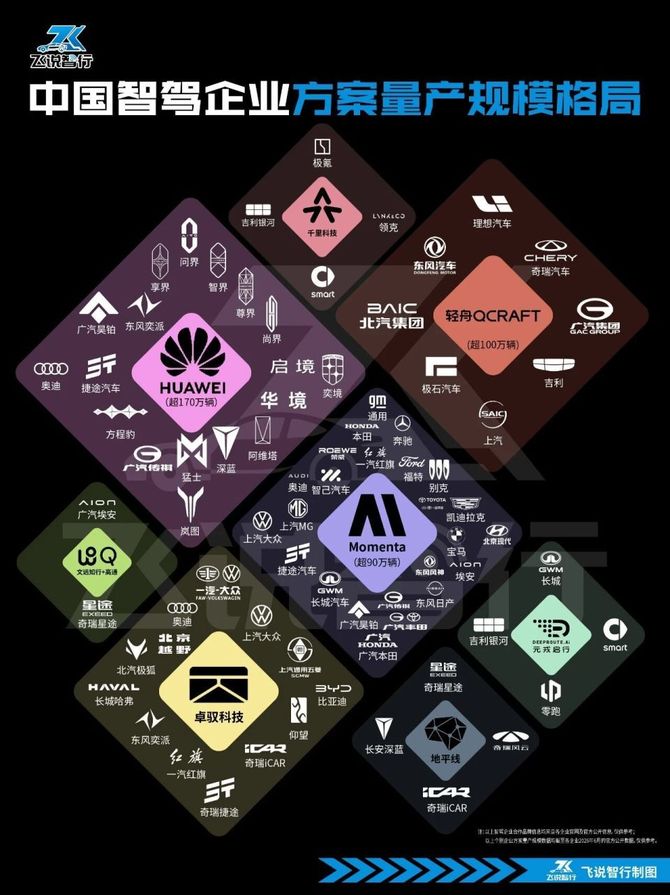
The pattern of mass - production scale of intelligent driving solutions of Chinese companies, charted by Feishuo Zhixing
Looking closely at how these three companies achieved this leading position, it can be said that they took different paths. Huawei relies on its hardware - software integrated ecosystem and brand power to accumulate scale advantages, while Momenta expands its mass - production scale by making friends globally based on its data - closed - loop system.
QCraft has become the "DeepSeek" in the intelligent driving circle. With its excellent engineering and innovation capabilities, it has achieved high - safety and good - experience intelligent driving using only a single Horizon J6M chip, which usually requires higher computing power. This has won the favor of many car manufacturers and promoted large - scale mass production.
For the intelligent driving industry, where the elimination round has begun, although the three companies of "Hua - Zhou - Mo" have obtained the "safety pass" in advance with their mass - production scale, will their advantages be maintained as the competition intensifies?
1. The industry elimination round begins, and mass - production scale becomes the "safety line"
The capital market is no longer impulsive when it comes to the intelligent driving track.
According to public data, the total financing of the intelligent driving industry (including L2 and L4) last year was about 35 billion yuan. Although this financing scale has increased compared to the three - year period from 2022 to 2024, it has shrunk by more than 60% compared to 93.2 billion yuan in 2021.
The change in the financing scale also reflects the development of the industry. In 2021, the debut of Tesla's FSD made consumers truly aware of intelligent assisted driving functions, and more and more car manufacturers began to use intelligent driving functions as a major selling point.
In the following years, led by Tesla, players in the intelligent driving industry rushed to iterate towards technical routes such as one - stage end - to - end, world models, or VLA. This year, these players have started a new journey towards physical AI. At the same time, the capital market values the mass - production scale of technical solutions more and is no longer blindly investing.
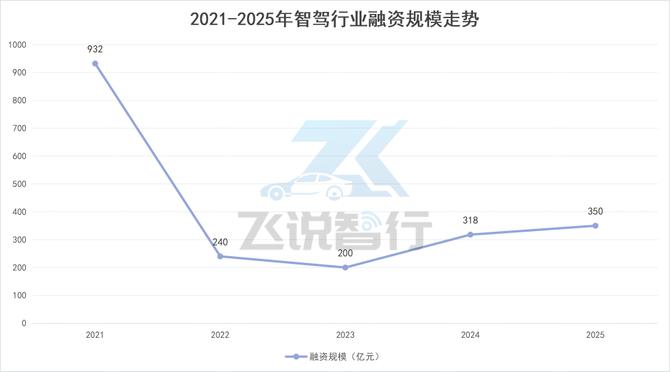
The trend of the financing scale of the intelligent driving industry from 2021 to 2025, data from public sources, charted by Feishuo Zhixing
On one hand, the capital market has become more cautious in investing in intelligent driving technologies. On the other hand, intelligent driving companies need to spend more funds to support the "arms race" of computing power, data, and model iteration. They are in a difficult situation.
In addition to the above two aspects, changes are also taking place in the market. Different from previous years when intelligent driving companies focused on creating differences in intelligent driving functions, in the future, intelligent driving functions will become a standardized product, and consumers only need good - working intelligent driving functions.
As Yu Kai, the CEO of Horizon, once told me, "Intelligent assisted driving will be like the 'baseband' of smartphones, an important standardized and universal functional module."
In other words, in the future, with the reshuffle of the intelligent vehicle industry, there will not be a large number of suppliers providing intelligent driving solutions for car manufacturers remaining in the market. Maybe only about three suppliers will be enough.
Based on the above three aspects, it can be seen that the elimination round in the intelligent driving industry has begun, and it will intensify with the likely entry of Tesla's FSD into the Chinese market. Perhaps this is why Cao Xudong made the judgment at the beginning.
To win this industry elimination round, the only chip left for industry players is to increase the mass - production scale of intelligent driving solutions.
Because achieving large - scale mass production can directly promote revenue growth and obtain more high - quality data, advance the iteration of intelligent driving algorithms and the growth of computing power, improve the experience of intelligent driving functions, and reduce overall R & D costs. After winning the favor of more car manufacturers and consumers, it can achieve larger - scale growth and run through the data - closed - loop and mass - production - closed - loop.
Currently, some players have taken the lead in the large - scale mass production of the intelligent driving industry.
First is Huawei. According to the data officially released by Huawei Qiankun, as of the end of April this year, the installation volume of Qiankun Intelligent Driving ADS in vehicles exceeded 1.7 million. It has cooperated with 25 vehicle brands and more than 50 models, represented by the "Five Realms and Three Realms".
Next is QCraft. As of June this year, the installation volume of its intelligent assisted driving system has exceeded one million. It has been installed in more than 30 models, serving more than 10 OEMs, and the cumulative mileage of assisted driving has exceeded 3.5 billion kilometers.
Its major customers include Li Auto, Chery, GAC, Geely, SAIC, Dongfeng, and BAIC. According to QCraft's plan, it is expected that by the end of this year, the number of models equipped with its intelligent assisted driving system will exceed 50, and almost all of them will have the urban NOA function.
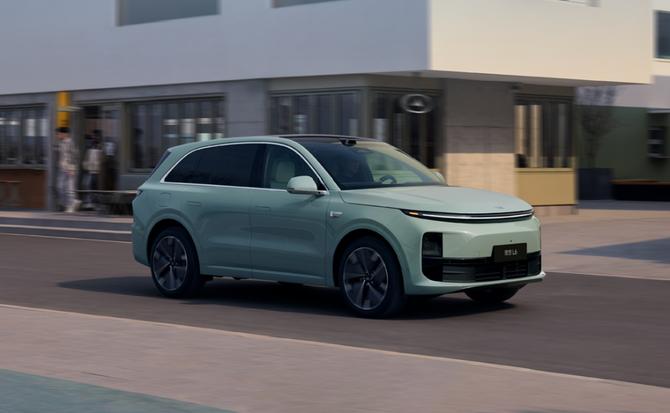
Li L6 Pro, image source: Li Auto's official WeChat account
In addition to Huawei and QCraft, there is also Momenta, which is rapidly advancing its IPO process. According to the information it disclosed, its customers mainly include domestic and foreign car brands such as SAIC, Mercedes - Benz, BMW, Audi, and Dongfeng Nissan. The mass - production scale of its intelligent driving solutions currently exceeds 900,000, approaching one million.
A mass - production scale of one million is regarded as a threshold by the industry because it means that an intelligent driving company has sufficient revenue to support long - term R & D and can establish a large - scale data - return network to support the future iteration of algorithm models.
Therefore, in this ongoing industry elimination round, I believe that Huawei, QCraft, and Momenta, with their leading mass - production scale advantages, have taken the lead in crossing the "safety line" of the elimination round compared to other players in the industry.
However, "Hua - Zhou - Mo" achieved this goal through different paths.
2. The offensive and defensive strategies of the leading players: "Hua - Zhou - Mo"
Just as Jin Yong wrote in "The Legend of the Condor Heroes" about the Sword - Discussing Conference on Mount Hua, top martial artists from all over the world gathered at the top of Mount Hua after winning many battles.
In the intelligent driving industry, Huawei, QCraft, and Momenta, which are at the forefront of the industry in terms of mass - production scale, also have their own "unique skills": Huawei focuses on the "ecosystem", QCraft pursues "extreme excellence", and Momenta bets on "globalization".
Take Huawei Qiankun Intelligent Driving ADS 5 as an example. It has a full - stack self - developed system including self - developed Ascend chips, perception hardware, MCUs, and the WEWA algorithm architecture, thus building a complete hardware - software integrated technology ecosystem including "chips - hardware - algorithms - cloud".
Based on this, it not only ensures the in - depth adaptation from chips to algorithms and then to functional experience but also can cooperate with car manufacturers through an open ecosystem, thus promoting the rapid growth of the mass - production scale of intelligent driving systems.
At the beginning of its development, Momenta set a strategy of "walking on two legs" with L2 and L4. The L2 intelligent assisted driving business provides data and cash flow, while on the other hand, it continuously promotes algorithm R & D based on its data - closed - loop ability and maintains exploration in autonomous driving and even physical AI.
Through the "flywheel" development model described by Cao Xudong, Momenta has quickly won the favor of many car manufacturers at home and abroad, thus establishing a global development positioning in the industry.
Compared with Huawei and Momenta, QCraft has taken a more extreme path.
When it comes to high - level intelligent driving, many people often think that it can only be achieved based on high - computing - power chips. However, for QCraft, this is not absolute. Because they have achieved a safe and comfortable high - level intelligent driving experience that usually requires higher computing power based on a single Horizon Journey 6M chip (128 TOPS).
I experienced QCraft's intelligent driving system in Beijing in early February this year. There were zero take - overs during the 40 - minute journey, and it could avoid obstacles by changing lanes when the vehicle in front stopped and actively avoid large vehicles. The overall experience was very smooth and safe.
"We want to be the DeepSeek in the field of autonomous driving. Instead of relying on brute - force hardware stacking, we use extreme innovation and engineering capabilities to create an experience that surpasses our peers under certain hardware resource conditions." From this perspective, what Yu Qian said at QCraft DAY in January this year is not an empty boast.
More notably, when the entire intelligent driving industry was focused on "coining new terms" and "equalizing intelligent driving" last year, QCraft was the first to focus on the iterative improvement of intelligent driving safety capabilities. It introduced a one - stage end - to - end architecture with explainable safety, and Yu Qian also put forward the view in February last year that "only those who are willing to compensate for accidents are truly good."
In his opinion, only by ensuring the safety of intelligent assisted driving can we promote the leap of intelligent driving from "functionally available" to "able to take responsibility". Facts have proved that Yu Qian's views have indeed positively promoted the development of the entire industry.
At the end of May this year, with the viral spread of the catchy song "Didi Dudu", BYD's commitment to cover the costs of urban pilot - assisted driving became widely known. According to its official introduction, BYD will cover all maintenance, compensation, and other costs that should be borne by the vehicle without any upper limit.
Two days ago, Yinwang officially announced an upgrade to the high - level function package of Huawei Qiankun Intelligent Driving ADS, adding new guarantee and service rights. It guarantees the personal injury or property damage of the vehicle itself and third parties caused by accidents during the normal use of Huawei Qiankun Intelligent Driving ADS assisted driving on legal roads and in legal areas.
Although both BYD and Yinwang adjusted the prices of their intelligent driving packages while launching the intelligent driving guarantee services, at least companies like QCraft, BYD, and Yinwang have taken the lead in taking action, further promoting the healthy development of the entire industry.
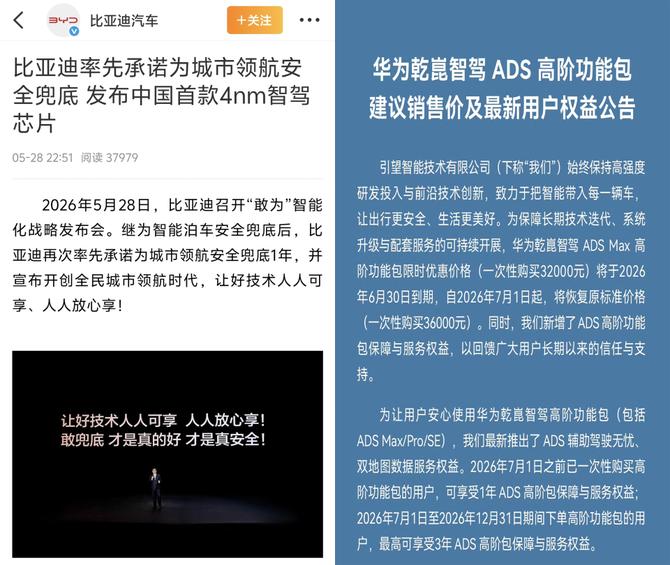
BYD and Yinwang announced intelligent driving guarantees, screenshots from the official WeChat accounts of each company
If Huawei, QCraft, and Momenta's rapid growth in the mass - production scale of intelligent driving solutions through their respective strategies can be regarded as "offense", then as the intensity of the elimination round increases, they must now "combine offense and defense" - while maintaining their scale barriers, they need to continue to expand their leading advantages.
Take QCraft as an example. In January this year, it announced that it would popularize high - level intelligent driving in 100,000 - yuan - level national models. Horizon and Huawei also have similar goals.
This is not surprising because the 100,000 - yuan - level automobile market accounts for the majority of the entire automobile market. Capturing this segment means achieving a larger mass - production scale.
In addition to equalizing intelligent driving, QCraft will also pursue a higher - computing - power intelligent driving experience. According to their plan, the "QCraft Chengfeng MAX" solution with a computing power of more than 500 TOPS will be installed in vehicles in the second half of this year. It aims to provide an intelligent driving experience comparable to that of systems with thousands of TOPS of computing power, further improving the ability to handle complex scenarios and making preparations for higher - level autonomous driving functions in the future.
Currently, this industry elimination round may have expanded beyond the intelligent driving track to a larger battlefield.
3. The new battlefield in the intelligent driving industry: Moving towards physical AI and globalization
"The next wave of artificial intelligence is physical AI."
Since Jensen Huang, the CEO of NVIDIA, uttered this statement in 2025, physical AI has gradually become a hot topic pursued by various industries, including the intelligent driving industry.
Since the beginning of this year, players in the entire industry have basically started to expand from intelligent assisted driving to fields such as Robotaxi, unmanned logistics vehicles, and autonomous trucks.
For example, QCraft announced in January this year that it would