For the first time, the construction cost of energy storage power stations falls below that of gas-fired thermal power
For the construction costs of various types of power sources globally, energy storage power stations (storage power stations) have fallen below gas-fired power stations for the first time. Due to overproduction in China and the shift of battery applications from pure electric vehicles (EVs) to energy storage, battery prices in 2025 decreased by 40% year-on-year. On the other hand, due to the tight supply and demand of turbines (prime movers), the new construction costs of gas-fired power stations have risen.
Affected by the rising price of natural gas fuel caused by the Middle East crisis, the cost gap between the two is likely to widen further after 2026. Energy storage batteries are an indispensable technology for the popularization of renewable energy whose power generation is affected by the weather. The price reduction is expected to promote the global decarbonization process.
The U.S. research firm Bloomberg New Energy Finance (Bloomberg NEF) has compiled the construction costs of various power sources in 2025. The calculation method is to divide the total costs of power station construction, financing, fuel, and maintenance by the total power generation of the power station before it is decommissioned.
This is an indicator called "Levelized Cost of Energy (LCOE)", and the unit of measurement is uniformly US dollars per megawatt-hour. The electricity cost required for charging energy storage batteries is calculated based on the electricity prices of independent power markets in each country.
The construction cost of energy storage power stations is at the same level as coal-fired power stations
In 2025, the LCOE of energy storage power stations dropped to $78 per megawatt-hour, a 27% decrease from 2024, and for the first time, it fell below that of gas-fired power stations ($102 per megawatt-hour). It is basically at the same level as coal-fired power stations ($77 per megawatt-hour). In 2020, the LCOE of energy storage power stations was as high as $185 per megawatt-hour, and the price has dropped to less than half in five years.
In 2025, the average price of energy storage batteries dropped to $70 per kilowatt-hour, a 45% decline from 2024. The year-on-year decline far exceeded that of passenger vehicle power batteries (a 1% decline) and commercial vehicle power batteries (a 7% decline).
Behind the price drop is the wave of production expansion by Chinese battery companies. The Chinese government has set a goal of reaching 180 gigawatts of installed capacity for national energy storage power stations by 2027. Local governments have increased subsidies, and as of 2025, the installed capacity of energy storage has reached 140 gigawatts, doubling every year.
Data from the South Korean research firm SNE Research shows that Chinese manufacturers accounted for 64% of the global energy storage battery market in 2025. Before 2020, it was less than 50%, achieving rapid growth. The production scale of China alone has exceeded the global installed capacity, and the oversupply has accelerated the price decline.
The slowdown in global EV sales has also had an impact. The on-board power battery market has formed a monopoly pattern of Contemporary Amperex Technology Co., Limited (CATL) and BYD, and Chinese companies together account for more than 70% of the global market share.
The overall battery investment in the industry is overheated. Data from the large U.S. consulting firm AlixPartners shows that the production capacity of Chinese EV power batteries in 2025 is about 3,600 gigawatt-hours, 5.6 times the actual demand.
Light Takaki Fujita, an analyst at Japan's Techno System Research, pointed out: "Due to the slowdown in the EV market, major battery manufacturers are shifting their investment focus to energy storage batteries for data centers and power grids with increasing demand."
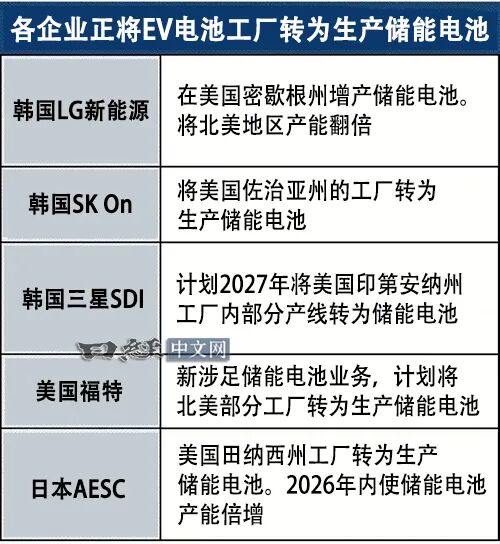
In the United States, which has the second-largest production capacity in the world, there have been successive trends of converting on-board battery factories for energy storage battery applications.
Due to the increasing policy headwinds for EVs from the Trump administration in the United States, the EV departments of various automakers have been in a slump. Ford Motor in the United States said at the end of 2025 that it would increase the production capacity of energy storage batteries.
The company will invest $2 billion in existing factories in Kentucky and other places by 2027, with the goal of achieving an annual production capacity of 20 gigawatt-hours. Including factories such as South Korea's LG Energy Solution and SK On, it is expected that about 10 battery factories in North America alone will shift from on-board applications to energy storage applications.
The revenues of South Korea's three major battery companies depend on the United States, and the consolidated profits of these companies in fiscal year 2025 (ending December 2025) have all declined significantly. Both SK On and Samsung SDI have fallen into a net loss.
Although the selling price of batteries has been continuously falling, the prices of battery materials lithium and nickel have started to rise since 2025, which is the main reason for the squeeze on corporate revenues.
Under such circumstances, Chinese battery manufacturers have not slowed down their investment pace.
Contemporary Amperex Technology Co., Limited announced in April that it would establish a new company to ensure the supply of battery materials. This move aims to reduce the impact of purchasing materials such as lithium with large price fluctuations by increasing investment in the upstream sector.
If the price competition among manufacturers persists, the degree of dependence on China may further increase.
Kazuhiro Kikuma, a senior analyst at Bloomberg New Energy Finance (Bloomberg NEF), believes that "in the future, the production of Chinese manufacturers will continue to increase, and battery prices will become cheaper and cheaper." Technological innovations to achieve greater output power and capacity for batteries of the same size are also continuing. It is expected that the LCOE of energy storage power stations will drop to $72 in 2026, an 8% decrease from 2025.
AI drives a surge in demand
On the other hand, the LCOE of gas power stations increased by 16% in 2025. The construction of data centers for AI has driven a sharp increase in power demand, and a large number of orders have poured into the world's top three companies such as Mitsubishi Heavy Industries, which produce gas turbines. Especially in the United States, the supply-demand tension is very significant. "Even if you place an order now, it won't be delivered before 2030" (Kazuhiro Kikuma).
The fuel used for gas power generation is liquefied natural gas (LNG). Iran's de facto blockade of the Strait of Hormuz has led to a sharp rise in crude oil prices. Long-term LNG contracts are often linked to crude oil prices, so the purchase price of LNG has also increased. It is believed that the power generation cost will further increase after 2026.
From the perspective of the LCOE in 2025, the cost of offshore wind power has reached $100, a 12% increase compared to 2024. It is mainly affected by rising interest rates and high material prices. Since offshore wind power is still in the popularization stage globally, its cost is more than twice that of onshore wind power ($40) and photovoltaic power generation ($39).
If the price of energy storage power stations used to regulate power generation fluctuations and stabilize the power grid drops, it will be beneficial to the popularization of renewable energy.
This article is from the WeChat official account "Nikkei Chinese Net" (ID: rijingzhongwenwang). The author is Nikkei Chinese Net. It is published by 36Kr with authorization.