To succeed in social networking, Doubao must first get its monetization logic right.
Five days after the launch of paid memberships, Doubao's next move emerged.
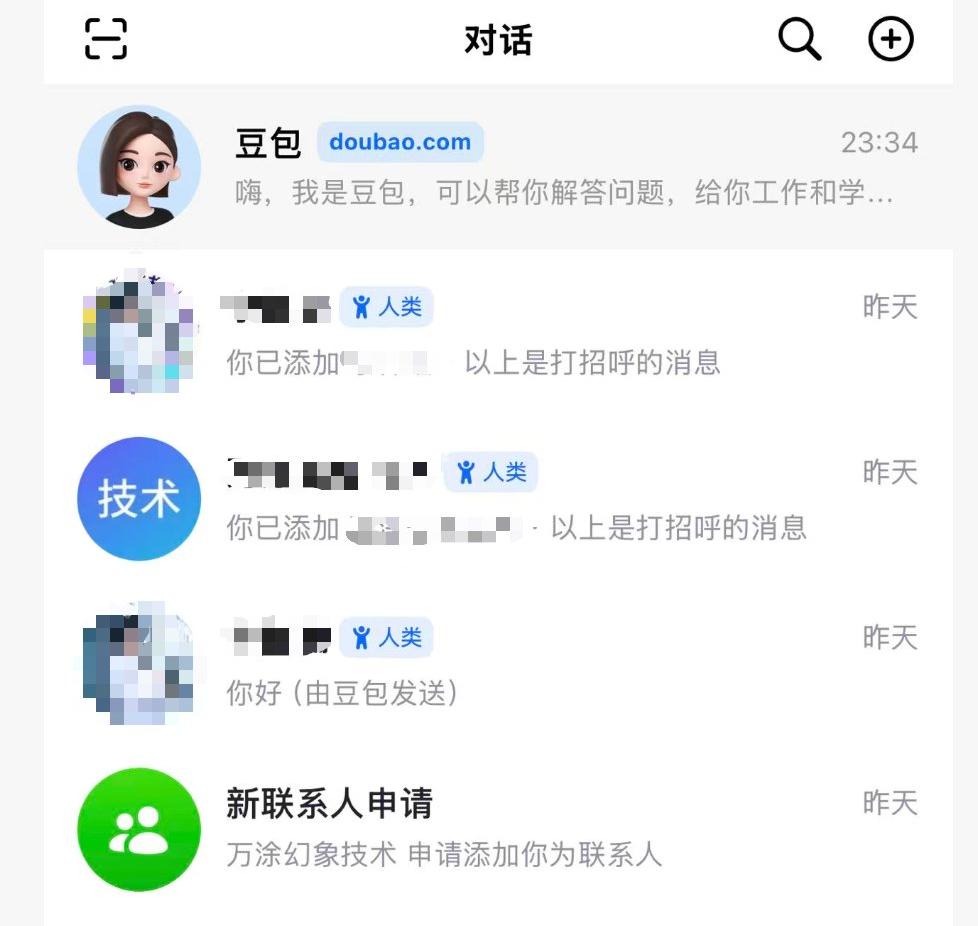
On June 29th, it was reported that Doubao had added a chat function, with a new "Conversation" feature bar that allows users to add Doubao or Feishu friends. Meanwhile, Doubao was integrated with Feishu, the collaborative office platform under ByteDance.
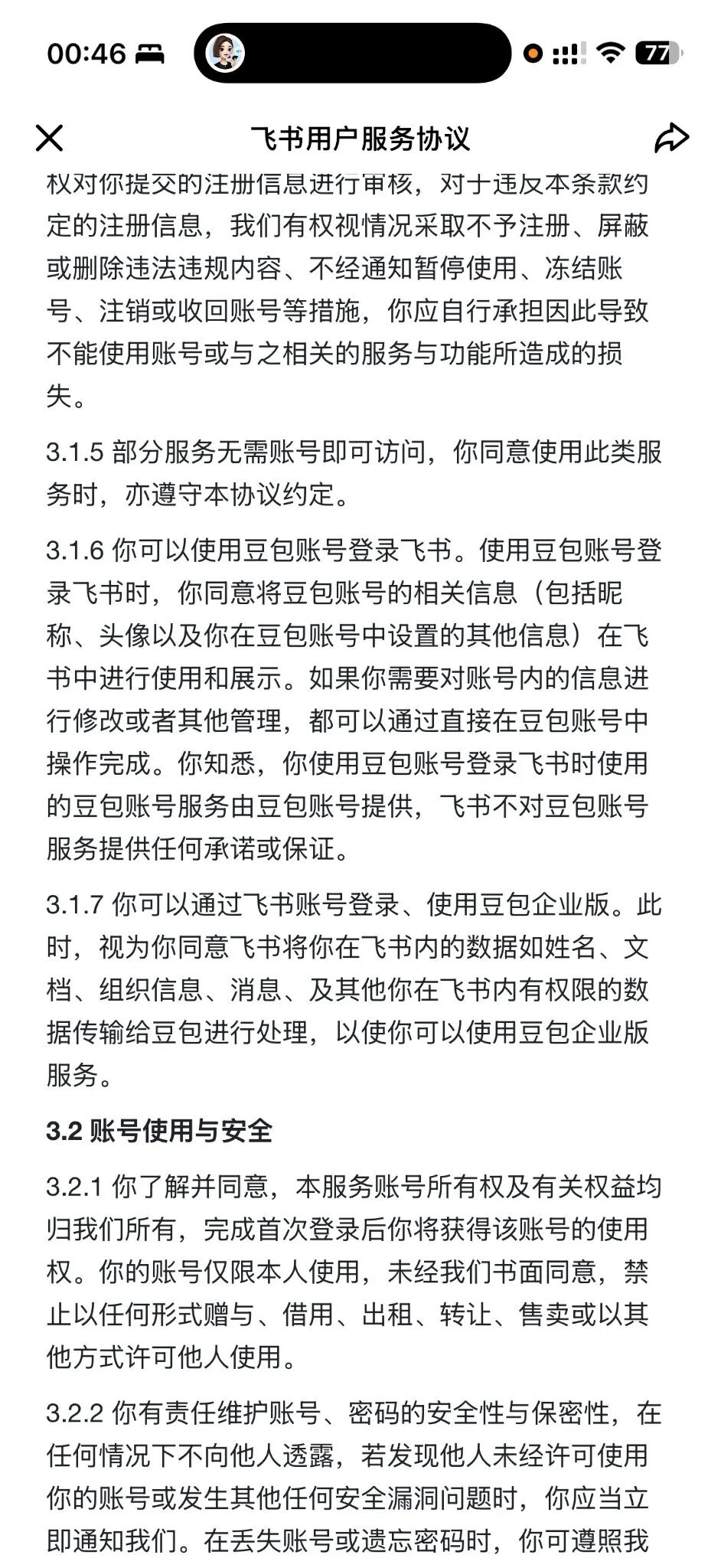
In addition, according to the exposed Feishu user agreement, Doubao is expected to launch an enterprise version. After users log in with their Feishu accounts, data such as their names, company organizational structures, documents, and chat information will be transmitted to Doubao with authorization.
Currently, Doubao's "Conversation" function and its integration with Feishu are in the gray testing phase and are only visible to some users.
Subsequently, a relevant person from ByteDance responded that in the enterprise office scenario, there have been some collaborative attempts between Doubao and Feishu, and the cooperation will be closer in the future. However, Doubao has no plans for the rumored social functions.
That is to say, at least for now, Doubao's chat function is only available to Feishu users, not extended to all Doubao users.
Zimubang (ID: wujicaijing) previously proposed in the article "Doubao Has a Secret Weapon" that Doubao should add a group chat function and preferably "create groups" before WeChat becomes Agent-enabled. However, Doubao remained inactive for a long time.
By the end of June, significant changes had taken place in Doubao's internal and external environment, making "group creation" increasingly necessary.
It launched a paid membership system and needed to introduce new functions to add value and boost sales. Meanwhile, its biggest competitor, WeChat, stepped on the gas pedal, launching two major AI functions, "Xiaoyuan" and "Dayuan," and the highly anticipated WeChat Agent is also on the verge of launch.
Although the newly added chat function of Doubao has user restrictions, it lays the foundation for subsequent group chat support.
This also marks that Doubao has taken a crucial step towards social networking.
This step is limited to Feishu's user pool, which seems a bit cautious and has been publicly denied by ByteDance. However, a Doubao that can chat and add friends has broken the long - standing user isolation state, which is of great significance as a vane. It would not be surprising if Doubao launches more social functions in the future.
However, as an AI app, every move of Doubao involves token costs, which is also an important reason why it did not fully open the chat function immediately. One day in the future, when Doubao's social functions extend beyond Feishu, it may bring unprecedented pressure on computing power costs. At that time, Doubao will truly face a test in the tough battle of social networking.
01
It is somewhat unexpected that Doubao chose Feishu, a smaller player, as the first testing ground for its chat function.
In terms of user scale, Doubao has a solid foundation to independently develop a chat function. It has an independent account system, with 345 million monthly active users and 150 million daily active users, on par with Bilibili.
Meanwhile, Doubao users have a strong demand for chatting. Many people want to send AI - generated answers, pictures, audio, and videos to others after obtaining them, but they have to "transfer" through WeChat and other means.
With a foundation and demand, it seems logical for Doubao to quickly build a complete chat and social system based on users' mobile phone numbers. However, Doubao has not taken this path for a long time.
Feishu, selected by Doubao, has far fewer users than the former, with its monthly active users remaining in the tens of millions. Even compared with similar products from Alibaba and Tencent, Feishu does not have a significant advantage.
In addition, Feishu's user scenarios are concentrated in collaborative office, which is relatively narrow. If Doubao's chat function is only open to Feishu users, its growth rate and overall scale will be significantly restricted.
It can even be said that Doubao is "lowering itself" by placing such an important chat function within the Feishu framework.
Even so, Doubao still chose to test the waters on Feishu. In addition to their sister - business relationship, Doubao saw something in Feishu that it does not have: collaborative office productivity.
Doubao's core function has always been a Chatbot. Users can query information, search for data, or simply "tease" the AI. In the past few years, it has successively added functions such as writing, photo editing, video production, PPT generation, simultaneous interpretation, audio - to - text transcription, in - depth research, and AI tables, gradually acquiring light - office capabilities.
One of the purposes of Doubao's expansion of a series of light - office functions beyond the general life scenarios is to become more "useful" and pave the way for selling memberships, as well as to be deeply embedded in the work scenario. After all, only by seizing the work scenario can AI find its real application.
However, Doubao has always faced a fundamental problem: the lack of collaboration ability.
As a Chatbot, Doubao is designed for individual scenarios and does not seriously consider multi - person collaboration scenarios. For example, Doubao's sharing function is imperfect. Users can share AI - generated content to Douyin or even send it to WeChat friends, but they cannot send it to another Doubao user. As "AI work" becomes increasingly important, Doubao's shortcoming in collaboration ability is gradually becoming prominent.
Feishu can exactly make up for this shortcoming. It builds a user system based on the enterprise organizational structure, which is naturally suitable for multi - person cooperation scenarios. In terms of function design, it comes with modules such as instant communication, meeting synchronization, document co - creation, project management, and process automation. These are difficult for Doubao to make up for in a short time.
By integrating with Feishu accounts, Doubao is not simply adding a dialogue function, but can "transfer" Feishu's user relationship network and collaborative office capabilities.
Chatting is just the starting point. It is not unimaginable for Doubao to further integrate with Feishu's functions or even achieve cross - software collaboration. For example, after two employees communicate on Doubao, they can jump to the Feishu workflow with one click; or synchronize the AI content produced by Doubao to Feishu with one click; or even "move" the Feishu group chat directly to Doubao.
This enables Doubao, which has long been only capable of "light - office," to make up for its "heavy - office" and "collaborative - office" capabilities. Whether it can create productivity is the key for Doubao to enter the agent era from the chatbot era.

For Feishu, Doubao's favor is a "pleasant surprise." After all, Feishu did not even integrate with Doubao before, and the linkage between the two business segments was not close.
For Doubao, although Feishu is not particularly powerful, it is a sister product that meets the needs, has complete productivity functions, can be "plug - and - play," and has room for further expansion of the function matrix.
02
Another important prerequisite for Doubao to integrate with Feishu is that it can make the numbers work.
Global AI companies, regardless of their size and financial situation, have entered the "accounting era." Unscrupulous investment and burning of money are a thing of the past.
One prominent manifestation is that enterprises pay special attention to the consumption of free tokens. If users consume tokens without bringing substantial returns, enterprises would rather risk losing users and impose more and more restrictions on "free - riding."
Even a wealthy company like ByteDance has to learn to do the math. When developing the chat function, Doubao also needs to consider the input - output ratio.
In this context, Feishu's relatively small user volume becomes an "advantage." Even if all these users use Doubao to chat, the token cost and computing power pressure on the latter are relatively controllable and will not increase suddenly.
If Doubao were to fully open the chat function at the beginning, the token consumption pressure from over 100 million daily active users would easily overwhelm ByteDance.
In fact, even for the new function "Xiaowei" strongly promoted by WeChat, it was not fully launched at the first time but was tested on a small scale. There are considerations for product refinement, but cost factors are also obviously taken into account.
In addition to the cost advantage, Feishu also adds a "selling point" to Doubao.
Doubao recently launched paid memberships. The monthly fee starting at 68 yuan is not very high, and there are quite a few membership rights. However, most of them are related to the latest model permissions, Agent capabilities, and the number of image generations, which are still one or two steps away from the actual office scenario. It is not easy to persuade office workers to pay.

By integrating with Feishu, enterprises and employees have an additional reason to use Doubao's professional version. After the account integration, Doubao can add more paid rights related to Feishu in the future, and the memberships will be easier to sell.
However, on the other hand, Doubao cannot restrict the chat function to Feishu's user pool forever just for the sake of "accounting" or "selling points."
As mentioned above, the cooperation between Doubao and Feishu is ultimately to meet users' heavy - office needs by leveraging Feishu's established collaborative office capabilities. However, these needs are not unique to Feishu users. Doubao users themselves also have such rigid needs, and they may not necessarily register as Feishu users first.
On the other hand, for Doubao to transform into a productivity AI app, just having a chat function is far from enough. It will eventually need to introduce more comprehensive social functions, especially group chat.
Group chat is the most common and efficient online office scenario, without a doubt. Only when there are enough group chat users will Doubao's attribute as a productivity tool become more prominent, and it can attract more users and enterprises to choose it over WeChat through the network effect. It must absorb more non - Feishu users instead of sticking to the Feishu account system.
It is not difficult to see that it is probably just a matter of time before Doubao's social functions extend beyond Feishu and are fully opened.
However, the subsequent challenge is that Doubao will face a soaring token cost.
The superposition of the three scenarios of AI, social networking, and productivity is bound to cause an explosive growth in the average token consumption per user. Especially with multi - modality and Agent capabilities, the token consumption of a single request is hundreds or thousands of times that of a chatbot, which may become an unbearable burden for Doubao.
To offset the cost pressure, Doubao needs to find a precise boundary between free and paid services, allowing low - consumption tasks to remain free while making users willing to pay for high - consumption tasks. How to walk this tightrope will greatly test Doubao's fine - grained operation ability.
03
Doubao's somewhat hasty addition of the chat function at this time also contains the intention of competing with WeChat AI: to seize the opportunity when "Xiaowei" is not yet firmly established and quickly implement its Agent capabilities.
So far, both sides have completed their first - round offensives: Doubao launched a paid professional version, while WeChat introduced "Xiaowei" and "Dayuan" for personal Agent and office Agent scenarios respectively.
WeChat made a more significant move by giving "Xiaowei" a prime entrance in the upper - left corner of the app's home page. Doubao was a bit more low - key, and users had to search for the membership entrance on the app's settings page.
However, actual tests show that at this stage, the productivity of Doubao's professional version is significantly better than that of "Xiaowei."
The main highlight of Doubao's professional version is the office mode. After authorization, the AI can understand and manage local files, arrange tasks, obtain information online, and call various skills.
In contrast, "Xiaowei" currently mainly helps users use WeChat more conveniently, such as viewing chat content, preparing Moments posts, and recommending products from WeChat stores. Some more advanced functions, such as posting on Moments on behalf of users, are still beyond "Xiaowei's" reach.
It can be said that compared with "Xiaowei," Doubao's professional version has more abundant and powerful functions and is more like a "fully - fledged Agent."

However, the problem is that this advantage may not last long.
Tencent also has strong AI R & D capabilities and has previously launched intelligent agent products such as Workbuddy and QClaw. WeChat Agent is also on the verge of launch. It can be said that as long as Tencent is willing to relax the permissions, it is not difficult for "Xiaowei" to narrow the gap.
ByteDance must seize this precious window period to expand the advantage of Doubao's professional version as much as possible.
The most direct approach is to implement it in as many office scenarios as possible and attract as many users as possible. Integrating the account system with Feishu and opening the chat function to attract more people to use Doubao's professional version is the first step.
The competition between Doubao's professional version and WeChat's "Xiaowei" and "Dayuan" is a microcosm of the AI productivity competition between the two giants.
After the chatbot battle, both ByteDance and Tencent hope to capture the high - ground of AI productivity. In the previous battle, ByteDance was clearly the winner. However, Tencent is determined to win in the field of AI productivity.
ByteDance still sends Doubao as the main attacker, while Tencent does not let Yuanbao continue to charge but sends WeChat, the cornerstone of the entire group, with a focus on "social + AI," which shows its emphasis on this battle.
Naturally, ByteDance also wants to win the "AI productivity" battle.
Previously, it tried to do "AI + content," but Douyin's "compatibility" with Doubao was not ideal. So far, it only supports Doubao's AI functions to