400 newspapers collectively sue AI giants — is the "free lunch" for AI over?
Valued at $82.5 billion, the once - glorious AI giant OpenAI has recently been plagued with troubles.
Recently, the Manhattan Federal Court received a 55 - page lawsuit. A publishers' alliance representing nearly 400 American newspapers sued OpenAI and Microsoft.
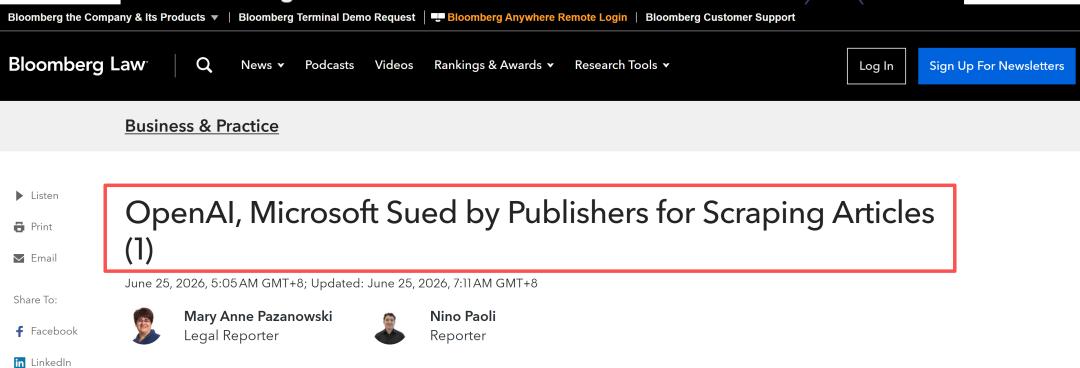
The list of plaintiffs includes the well - known New York Daily News, as well as many local newspapers in the United States that most Chinese people have never heard of, such as the Arkansas Democrat - Gazette, the Chattanooga Times Free Press in Tennessee, and local media outlets all over the United States.
The charge in the lawsuit: stealing content without paying.
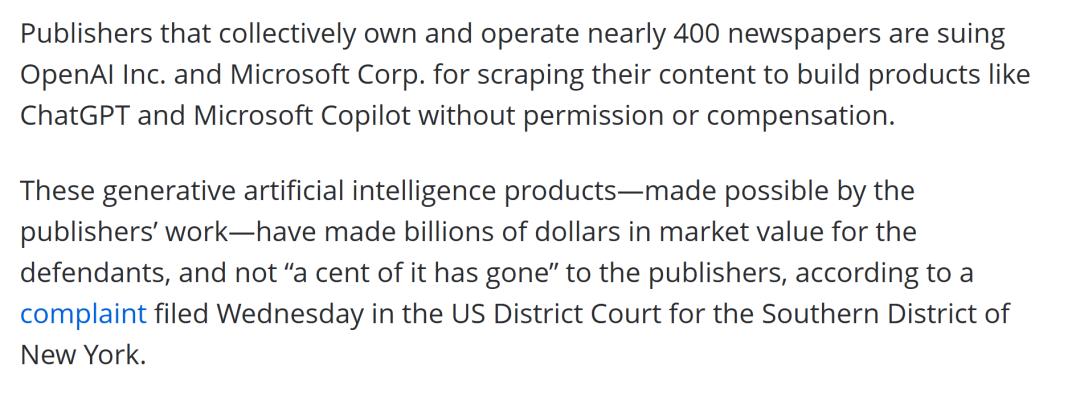
The publishers accused OpenAI and Microsoft of "systematically and secretly" scraping the content of hundreds of news websites, including articles behind paywalls, and copying them to their own servers for training ChatGPT and Microsoft Copilot.
Even worse, they also deleted the copyright management information, erasing the author's signature, copyright statements, and terms of use.
"These generative AI products are built on the content that publishers have invested in for a long time, bringing billions of dollars in market value to the defendants, while the publishers haven't received a single cent."
Matthew Platkin, the plaintiff's lawyer and the former Attorney General of New Jersey, put it more bluntly: If no responsibility is held, this wave of AI craze will be the 'death knell' for local journalism.
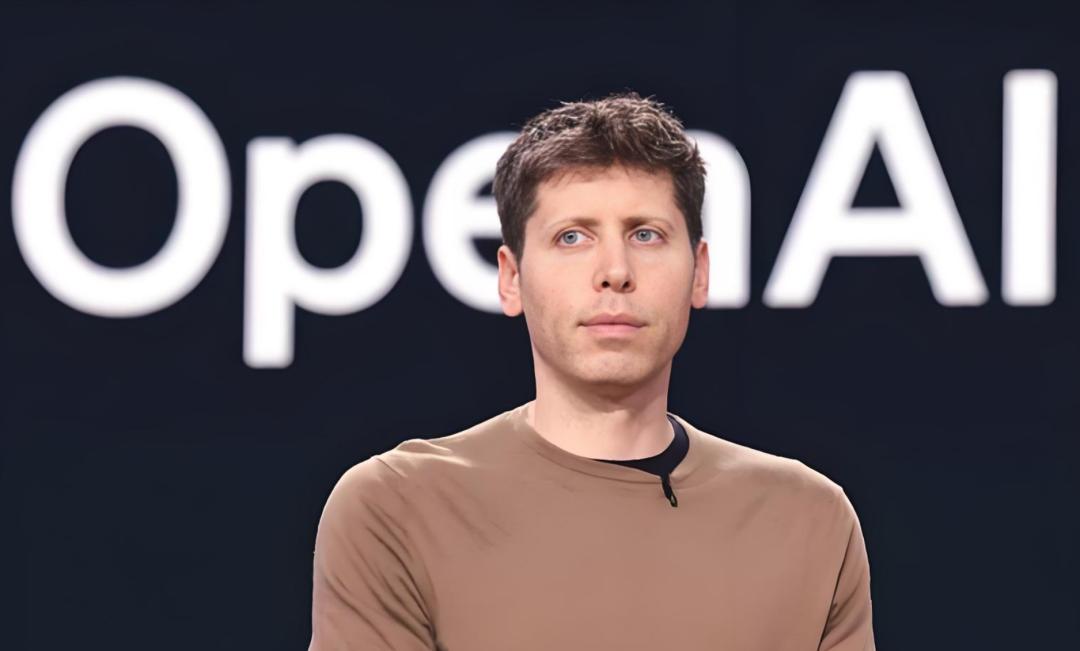
OpenAI, which is experienced in the industry's battles, responded with the same old tune: The model promotes innovation, and the training data comes from public channels, which is a reasonable use. Microsoft has remained silent for the time being.
This is not the first AI copyright lawsuit, but it may be the largest - scale one.
The chaos of AI infringement is not an isolated case
It's actually not very accurate to say that this lawsuit is an "outbreak." AI copyright disputes have existed for a long time, and this is just adding fuel to the fire.
In December 2023, The New York Times took the lead and became the world's first large - scale publishing institution to sue a generative AI company. Since then, the list of those suing AI companies has been getting longer.
In September 2025, Disney, Universal Studios, and Warner Bros. jointly sued the Chinese AI company MiniMax, accusing its video - generating tool, Conch AI, of using a large amount of copyrighted movie and animation content without permission. In November 2025, the Munich court in Germany ruled that OpenAI was infringing because its model "remembered" the lyrics of German musicians and reproduced them in its output.
In 2026, the scope of the controversy continued to expand. CNN sued Perplexity AI, and Reddit also sued Perplexity. Encyclopædia Britannica and its subsidiary, Merriam - Webster, also joined the ranks of suing OpenAI. A group of writers, such as John Grisham and Sarah Silverman, also sued AI companies, saying that their books had been used for free.
It's not just the media and creators. In June 2026, the music platform Jamendo sued NVIDIA, accusing its AI music model, Fugatto, of using a free dataset that was supposed to be used only for academic research for training without permission.
From news to movies, from music to literature, from pictures to code, AI's "data hunger" is hitting the copyright wall of every content industry. This is no longer an "isolated case" but a structural industrial conflict.
Why do AI companies always like to "use first and then talk"?
To understand this conflict, we need to first understand the business model of AI.
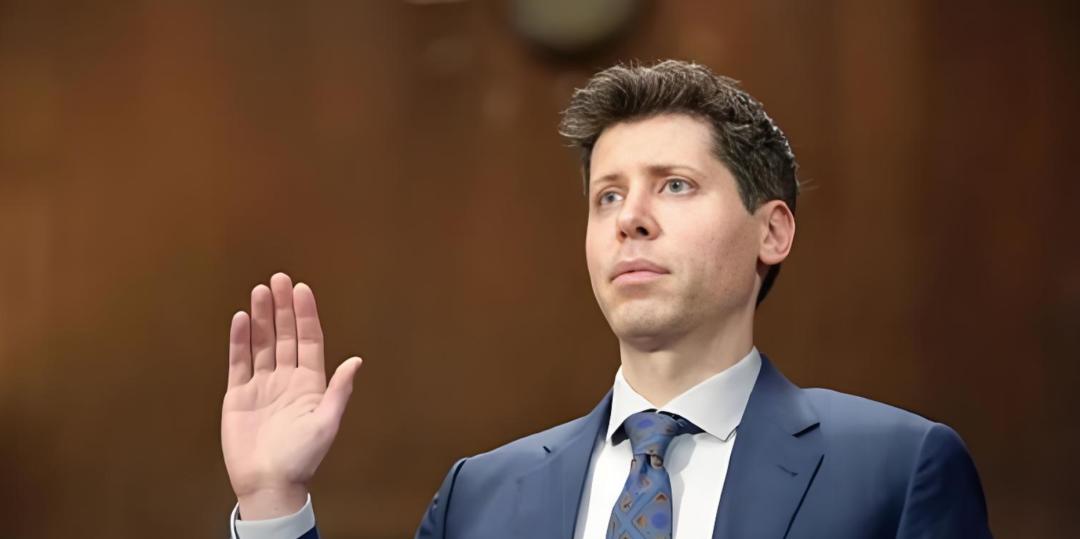
Training a large language model like GPT requires a huge amount of data. OpenAI itself has admitted that its founder, Sam Altman, testified in the UK House of Lords that "it is impossible to train today's leading AI models without using copyrighted materials."
This is where the problem lies. The entire business model of AI is based on the premise of "free access to data," while the creators of the data, such as journalists, writers, musicians, and photographers, rely on this content for a living.
Both sides have their reasons, but their interests are completely opposite.
AI companies will say: We are "learning," and don't humans also read books and newspapers when learning? This is called "reasonable use." Copyright holders will say: Your "learning" is a commercial act. You use my stuff to make money. Why don't you pay?
The core of this debate is actually a recurrence of an old problem in a new scenario: How should the benefits of the efficiency improvement brought by technology be distributed?
Looking at the numbers, we can understand why copyright holders are anxious.
OpenAI's revenue was about $2 billion in 2023, about $6 billion in 2024, and about $13.1 billion in 2025. As of the end of February 2026, its annualized revenue had exceeded $25 billion. After a $122 - billion financing in March 2026, its valuation reached as high as $852 billion.
Microsoft's situation is even more exaggerated. In the third quarter of fiscal year 2026 (as of March 31, 2026), its single - quarter revenue was $82.9 billion, a year - on - year increase of 18%; its net profit was $31.8 billion, a year - on - year increase of 23%. The annualized revenue run - rate of its AI business has reached $37 billion, a year - on - year increase of 123%.

On one hand, AI companies are making huge profits, while on the other hand, local newspapers are struggling on the verge of death. The balance of interests has seriously tilted.
The publishers said in the lawsuit that they had spent billions of dollars to protect their content, including setting up paywalls, but all their efforts were in vain. OpenAI extracted 138,144 articles from just one publisher.
This table will make it clearer for you:

Data sources: OpenAI's revenue and valuation are from Wall Street News and public reports; Microsoft's financial reports are from Microsoft's official announcements
The numbers speak for themselves: AI companies are making huge amounts of money using others' content, while the content creators not only don't get a share of the profits but also have their livelihoods threatened by AI.
What does this mean for AI users?
If you are just an ordinary user who uses ChatGPT to write emails and make summaries, this lawsuit will have little short - term impact on you. But if you are a corporate user or use AI to generate content for commercial activities, the outcome of this lawsuit may directly affect your "compliance cost."
Currently, the biggest legal uncertainty in the field of AI copyright is the boundary of "reasonable use." OpenAI has been using "reasonable use" as a defense. However, there is a lot of controversy in the academic community about this.
Wang Qian, a professor at East China University of Political Science and Law, pointed out that building a corpus requires copying a large number of works. Whether the copying is for human learning or machine learning, if it is done without permission and no new value is created, it is difficult to justify the claim of "reasonable use" based solely on the reason of "learning" in legal theory.
If the court finally rules that the large - scale data scraping by AI companies does not constitute "reasonable use," the rules of the game for the entire industry will have to be rewritten.
AI companies will either have to pay huge compensation (the lawyer for The New York Times has already called for "tens of billions of dollars"), or negotiate licenses with every copyright holder, which is almost an impossible task.
For ordinary users, the most direct consequence may be that AI tools become more expensive. The compliance cost will ultimately be passed on to the users.
Another trend worthy of attention is that more and more content platforms are starting to "build walls." Reddit has sued Perplexity AI. If AI companies cannot obtain data through legal channels, future AI models may face a "data shortage," and it will be increasingly difficult to obtain high - quality training data for free.
The inspiration this lawsuit brings to all content creators
This collective lawsuit by nearly 400 newspapers is essentially asking a question: After AI has "moved" all the data in the content industry, who will guarantee the value of original content?
The situation of local newspapers is particularly worthy of attention. In the past decade, more than 2,500 newspapers in the United States have closed down.
The remaining ones are having their last survival resources "freely taken" by AI. As Platkin said, "Local reporters cover city council meetings, community events, local crimes and corruption, and the opening of new restaurants. AI systems don't do these things."
This statement points out the essence of the problem: AI is a "consumer" of content, not a "producer."
If the original creators of content starve, what will AI "eat" in the future?
The good news is that the judicial system is responding to this problem. China's relevant departments announced in May 2026 that during the 15th Five - Year Plan period, they will research and formulate regulatory documents for the judicial protection of AI - related cases and data property rights. In 2025, Chinese courts concluded 908 cases of disputes related to data ownership and transactions, a year - on - year increase of 25.6%.
In this regard, China has always attached great importance, and the introduction of relevant documents has effectively regulated the market and protected the rights and interests of creators.
This lawsuit in the United States, regardless of the final outcome, will become a landmark case in the history of AI copyright law.
AI will not disappear, and copyright will not disappear either.
The end of this conflict will not be one side "eliminating" the other, but a new balance, a balance that allows both technological innovation and content creation to survive. This collective lawsuit by nearly 400 newspapers is another fierce collision before this balance arrives.
Technology can change the world, but it cannot devour the world.
This article is from the WeChat official account "Investment Banking Circle", author: Investment Researcher. It is published by 36Kr with permission.