Payment Gateway "Loan Cutoff": The Final Showdown of the Trillion-Dollar Internet Credit Industry
It's unclear when exactly the national-level apps on our phones quietly transformed into "financial applications."
When ordering takeaways or booking hotels, the default payment method has somehow become "monthly installment payment." When shopping online, the checkout page silently selects options like "Jingdong Baitiao" or "Alipay Huabei." Even when watching short videos or riding shared bikes, you might suddenly see a pop-up saying "Get a free interest-free credit limit of XX yuan."
For just a few yuan in instant discounts, many users unknowingly grant credit authorization and may even gradually fall into the quagmire of excessive debt.
These tactics of disguising credit products as "default options" and "welfare subsidies" are about to be prohibited at the regulatory level.
On April 24, 2026, eight departments including the People's Bank of China jointly issued the "Administrative Measures for Online Marketing of Financial Products" (to be implemented starting from September 30). Article 12 clearly stipulates that non-bank payment institutions shall not include financial products such as loans and asset management products in the payment tool options; nor shall they provide marketing services for financial products such as loans and asset management products.
In plain language, in the payment pages of major apps in the future, Huabei, Baitiao, and monthly installment payment options will no longer be on an equal footing with bank cards and WeChat balances. Moreover, there will be no more induced marketing like "Get a 5-yuan discount when paying with XX."
Payments should be kept separate from loans, and a "physical separation" must be enforced on the interface.
When the payment entry can no longer silently direct traffic to credit products, how will this trillion-yuan market be reshaped?
I. The Ultimate Business of Traffic: Why Do All Apps Eventually Want You to Borrow Money?
There is a saying in the Internet industry: "The end of the Internet is lending." This is not a joke but an inevitable business logic.
Simply put, the credit business is indeed profitable.
Take Ant Consumer Finance, which operates in the Alipay ecosystem, as an example. According to the Tianyancha app, Chongqing Ant Consumer Finance Co., Ltd., the operating entity of Huabei and Jiebei, had a revenue of 21.56 billion yuan in 2025, a year-on-year increase of 41.7%, and a net profit of 3.111 billion yuan. As of the end of 2025, its total assets reached 312.29 billion yuan, ranking first in the industry.
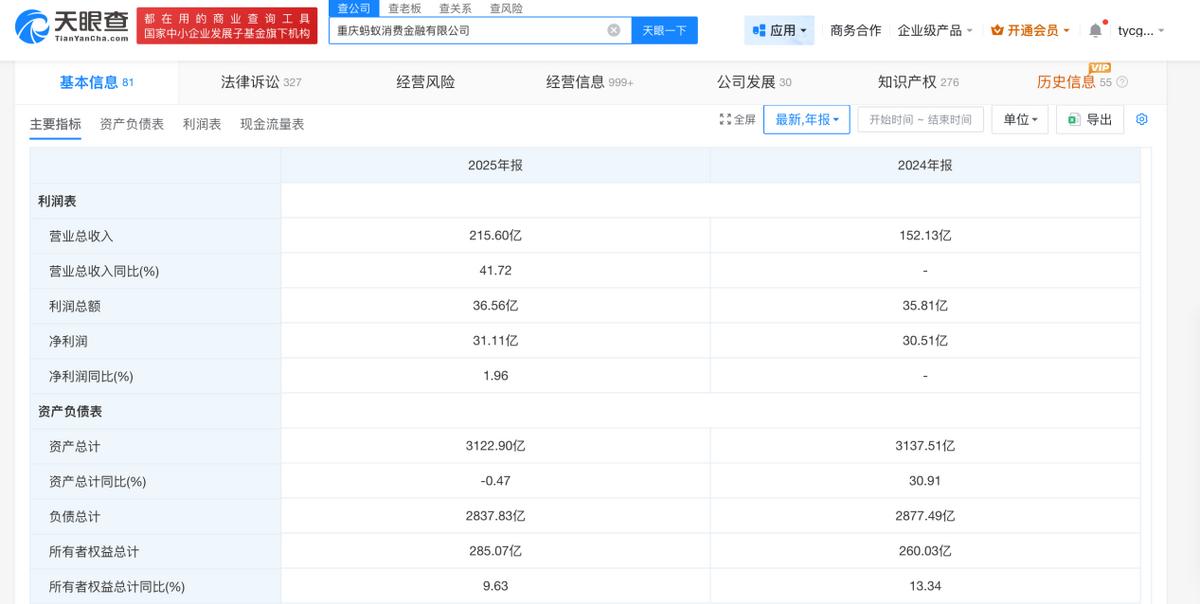
(Source: Tianyancha)
In addition to giants like Ant Consumer Finance, the small loan company under Meituan also has good earnings. According to the Tianyancha app, Chongqing Meituan Sankuai Small Loan Co., Ltd. had a revenue of 4.029 billion yuan and a net profit of 346 million yuan in 2025.
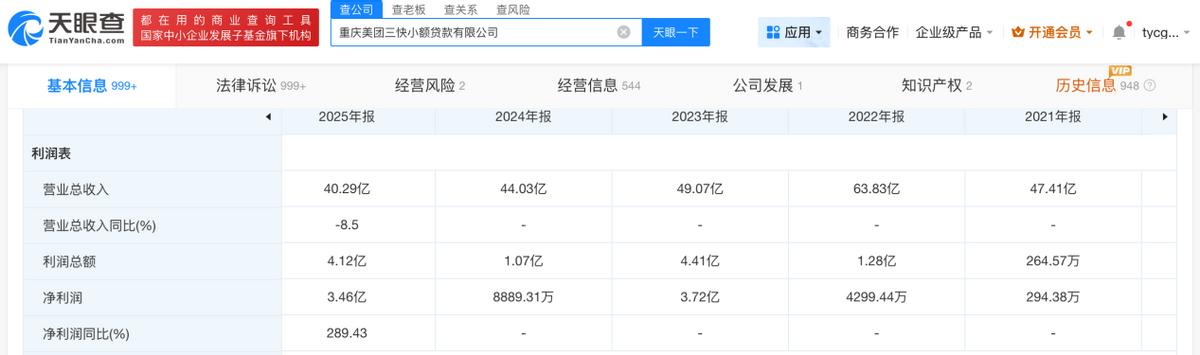
(Source: Tianyancha)
Even without relying on the payment scenario, Du Xiaoman, which has become independent from Baidu, also has good performance. According to its disclosed 2024 performance (the latest performance data is not available), from 2023 to 2024, its net profit increased from 212 million yuan to 859 million yuan, equivalent to earning more than 2.35 million yuan per day.
Running a game requires maintaining a team, doing e-commerce depends on logistics, and creating content requires purchasing copyrights. However, for the credit business, as long as there is traffic and a risk control model, the marginal cost is extremely low, while the profit is extremely high.
So, why do they stuff credit products into the payment entry?
Because there is a precisely operating business chain behind this: Payment is the customer acquisition entry, and credit is the exit.
Payment is the most frequent and essential scenario closest to money. At the moment of payment, users' attention is highly concentrated, and their payment willingness is the strongest.
At this point, by listing credit products like "Huabei" and "monthly installment payment" alongside bank cards and balances, or even setting them as the "default payment option," users may unknowingly complete credit authorization and borrowing for a few yuan in "instant discounts" or simply because they are too lazy to switch the payment method.
This means that credit products are nested in the high-frequency payment scenario, and the marginal customer acquisition cost is pushed to an extremely low level. Big tech companies are essentially "super traffic middlemen" for financial products, stably earning channel fees and profit shares. If the traffic is directed to their self-operated financial products, the profit margin is even higher.
More fundamentally, this is an upgrade of Internet companies from "tools" to "financial platforms."
Apps for ordering takeaways, hailing taxis, and photo editing all want to offer loans. This is because once a user borrows money on the platform, this user transforms from a "one-time user" into a "continuous interest contributor" financial asset.
Indicators such as user stickiness, retention rate, and ARPU value, which have always troubled product managers, seem to have answers in the face of lending.
Payment is the entry, credit is the exit, and in between is almost zero-cost traffic conversion. This closed-loop has been operating for more than a decade, nurturing trillion-yuan giants like Ant Consumer Finance and WeBank, and attracting countless Internet companies to flock to the financial track.
However, from the perspective of "technology for good," using the payment entry to "subsidize" users for credit product marketing has significant side effects.
When top-notch algorithms and computing power are no longer used to improve industrial efficiency but are instead used to precisely calculate users' debt limits; when the "borrow money" button is designed to be more prominent than the "spend money" button, and users with limited financial knowledge are induced to take on debt with terms like "interest-free" and "free membership," the so-called "financial technology" has deviated into a "traffic harvester" in the guise of technology.
Those who may be induced to take on debt include young people, middle-aged and elderly people with limited Internet experience, migrant workers, and food delivery riders. Beijing Daily once reported that an elderly person took on a consumer loan when ordering takeaways due to a monthly installment payment coupon and had to ask their children to come home to handle the repayment.
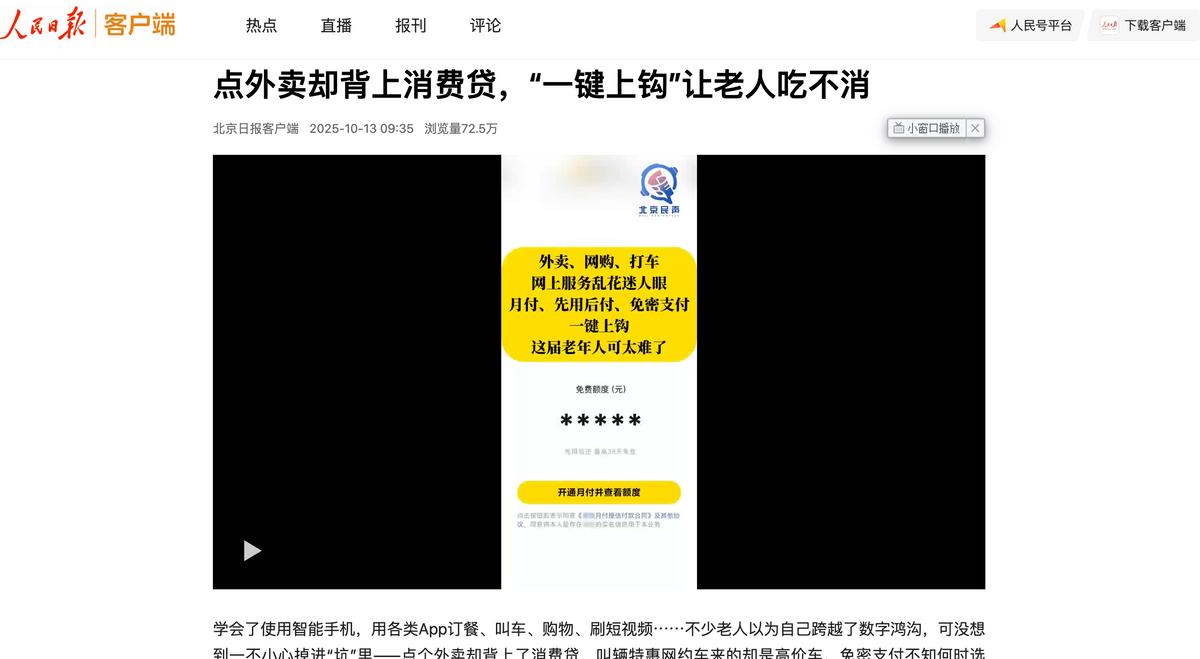
(Source: People's Daily)
All apps want users to borrow money because under the old rules, it is a "sure-win" business. However, the excessive profits of this business are essentially the realization of consumers' blind spots in financial knowledge.
But there is no such thing as a free lunch. As this "sure-win" business grows, the number of complaints about users' "unconscious debt" also increases. Finally, the regulatory measures have been implemented.
II. Payment "Loan Disconnection": The Break and Reconstruction of the Financial Marketing Landscape
With the implementation of the new regulations, the financial marketing systems of Internet giants are the first to be affected.
To understand this impact, we must first understand the current "dual-track" situation of online marketing of financial products.
Internet advertising can be roughly divided into two types. One is display advertising, which is also known as brand advertising. Its purpose is to build brand image and increase brand presence, such as elevator posters, subway screens, and variety show sponsorships. It emphasizes the trust endorsement of "a certain loan platform, a large-scale platform," but the conversion chain is long, and it is difficult to accurately measure the ROI.
The other is performance advertising, which pursues immediate conversion, and every penny spent must result in an order.
For a long time, financial marketing has also been carried out on these two fronts. Brand advertising is responsible for telling stories and building trust, while performance advertising is responsible for attracting customers and issuing loans.
The advertising at the payment entry is essentially the top "performance advertising" across the entire Internet.
It eliminates all intermediate jump links and directly completes credit conversion at the "last mile" when users are about to pay. It is the "golden funnel" with the highest ROI and the most core in past financial marketing.
The payment scenario is naturally suitable for financial product marketing. However, the problem lies here. Many consumers unknowingly complete borrowing behavior and may not even realize that they have opened "monthly installment payment" or "Jingdong Baitiao" until they receive a text message reminder on the repayment date.
This is the crux of the problem.
Now, the new regulations directly take away this "golden funnel." The "Measures" clearly stipulate that users should not be misled into confusing payment tools with loan products.
The core logic of regulation is very clear: Let users borrow money clearly, rather than unknowingly taking on debt.
So, who will be most affected by the loss of the payment entry for traffic diversion?
According to the degree of binding between the business and the payment scenario, the impact brought by the new regulations shows a clear echelon:
First Echelon: Ant and Tencent.
Huabei and WeChat Fenfu are deeply embedded in the payment checkout page and are the biggest beneficiaries of the old model.
As one of the "default options" on the Alipay checkout page, Huabei is the core weapon for Ant to maintain a loan balance of 313.6 billion yuan. Fenfu soared from about 12.9 billion yuan at the end of June 2024 to 112.588 billion yuan at the end of June 2025, an almost eight-fold increase in one year, all thanks to the ubiquitous scenario penetration of WeChat Pay.
After the new regulations, both the display logic and the traffic diversion path need to be significantly adjusted.
Second Echelon: JD, Meituan, and ByteDance.
Jingdong Baitiao, Meituan Monthly Installment Payment, and Douyin Monthly Installment Payment highly rely on the default selection on the payment page and discount inducement. The new user activation rate and installment penetration rate will face short-term pressure.
Third Echelon: Platforms such as Kuaishou and Baidu.
Kuaishou lacks a complete Internet payment license. Du Xiaoman's credit business is centered around loan assistance. Although it holds a payment license, the Baidu ecosystem (search, Tieba, map, etc.) is not a strong transaction payment scenario. The direct impact of the new payment regulations on these two platforms is relatively small.
However, the "Measures" also clearly prohibit misleading descriptions such as "low threshold" and "instant arrival of funds." Other general compliance requirements for financial product marketing also need to be followed.
Beyond the immediate impact, there are more far-reaching chain reactions.
On the one hand, the customer acquisition cost will increase across the board.
With the traffic diversion from the payment entry cut off, the growth rate of the new credit scale and interest-bearing assets will face a significant decline. To maintain the scale, they may have to buy traffic at a high price in the external market.
On the other hand, the large-scale migration of marketing budgets will lead to "external involution."
The huge financial marketing budget that was originally "internally digested" within the payment scenario will be forced to overflow externally. The customer acquisition cost of financial technology companies such as Du Xiaoman is already high, and it will become even higher. The competition in brand advertising, content marketing, etc. will become more intense.
Moreover, the cross-subsidy system of "the wool comes from the pig" will face collapse.
In the past, big tech companies often used the profits from financial business to subsidize their main business, such as "Get a 5-yuan discount when paying with monthly installment payment" to boost the GMV and order volume of the main business.
However, after the mandatory separation of payment and finance, this induced cross-subsidy will be strictly restricted. The main businesses such as takeaways and e-commerce will shed the "false prosperity" of financial subsidies and return to the real service value and supply chain efficiency.
III. The Post-Payment Era: Three Irreversible Trends
The "loan disconnection" at the payment entry is not the end of Internet finance but a coming-of-age ceremony for its maturity. Under the framework of compliance, the online marketing of financial products will show three irreversible trends.
First, the value of payment licenses will be re-evaluated.
In the past, the value of payment licenses consisted of two parts: payment handling fee income + the "traffic premium" from financial traffic diversion. After the new regulations, the latter will be stripped away. Payment licenses will return from being a "financial traffic entry" to a "commercial infrastructure," and the valuation logic will face a comprehensive reconstruction.
Second, the marketing front will shift.
After losing the "traffic interception" tool at the payment entry, the customer acquisition logic will shift towards content and private domains.
Within the boundaries of compliance, financial institutions can conduct financial consumer education and brand popularization through official accounts on short video, live streaming, and graphic channels. All marketing content must be reviewed and filed by the institution, and the conversion link must be uniformly redirected to the institution's self-operated platform to prevent non-licensed entities and individual accounts from conducting credit marketing in disguise.
At the same time, the marketing logic will shift from extensive "traffic harvesting" to refined "existing customer operation." Using compliant data tags, precise and restrained outreach can be carried out in non-payment scenarios of the app (such as the membership center and wealth management channel) to deeply cultivate the lifetime value (LTV) of individual customers.
Third, the competition logic will shift from "traffic" to "risk control + user experience."
When payment can no longer provide free traffic, the competition of credit products will return to three core capabilities: risk control, cost of funds, and user experience.
How do the major giants perform in these core capabilities?
On the risk control side, as the credit scale expands rapidly, the risk control pressure of Ant Consumer Finance also increases synchronously. In 2025, its credit impairment loss increased by about 55% year-on-year, and its asset quality and risk control ability are facing a new round of tests.
On the technology side, WeBank continues to increase the application of AI in the entire risk control and operation process. In 2025, both the computing power scale and the daily AI call volume increased several times, optimizing risk control efficiency and user experience through technological means.
On the capital side, JD completed the restructuring and acquisition of Home Credit Consumer Finance in 2024 and officially renamed it Tianjin JD Consumer Finance in 2025, obtaining a national consumer finance license. The advantages of leverage and national business expansion are gradually being realized. ByteDance is quietly accumulating strength, and its small loan license with a registered capital of 19 billion yuan is the biggest "ammunition" in the industry.
However, regardless of where they place their bets, one fact is clear: The "borrow money" entry will not disappear, but it can no longer be disguised as a coupon or the default payment method.
The core purpose of regulation is to let users borrow money clearly. Those who adapt to this logic first will be able to secure a seat