With China's auto exports surging 63%, real globalization has only just begun
From January to May 2026, China exported 4.059 million complete vehicles, a year-on-year increase of 63%. Among them, 1.833 million new energy vehicles were exported, a year-on-year increase of 1.1 times. Judging from the growth rate alone, this is a report card that would excite any industry.
However, when this report card is examined in the context of the global automotive industry landscape, another fact is equally clear: Scale expansion can verify product competitiveness, but system capabilities determine the sustainability of globalization. China's automotive industry's leap from "selling products abroad" to "establishing a solid presence overseas" has just entered the deep - water zone.
The global auto market is recovering, but the growth logic has changed
The global automotive market has basically emerged from the shadow of the pandemic and supply - chain shocks. According to data from the International Organization of Motor Vehicle Manufacturers (OICA), global vehicle sales reached 99.8 million in 2025, a year - on - year increase of 4.7%, returning to nearly 100 million units.
However, this round of recovery does not mean the start of a new high - speed growth cycle. The major mature markets around the world have entered a stage of stock competition. In the future, new demand will be mainly driven by structural factors such as the release of demographic dividends, urbanization, and the replacement of new energy products. Behind the moderate increase in the total volume, the global automotive market is shifting from being "driven by the recovery of mature markets" to being "driven by the growth of emerging markets and the transformation of the energy structure."
The most significant change is the eastward shift of the growth center. In 2025, vehicle sales in the Asia - Pacific and the Middle East reached 55.02 million, a year - on - year increase of 7.1%, accounting for about 55% of global sales. Sales in Europe were 18.63 million, a slight year - on - year decrease of 0.4%; sales in the Americas were 24.86 million, a 2.9% increase; although Africa had a 22% increase, the total volume was only 1.29 million.
Within Asia, growth is driven by two engines. China, with sales of 34.4 million, continues to hold the position of the world's largest market, accounting for about one - third of the global total. India's sales reached 5.52 million, a year - on - year increase of 5.5%, and it has become an important source of global growth. Meanwhile, markets such as ASEAN and the Middle East are becoming emerging spaces for competition between multinational automakers and Chinese automakers.
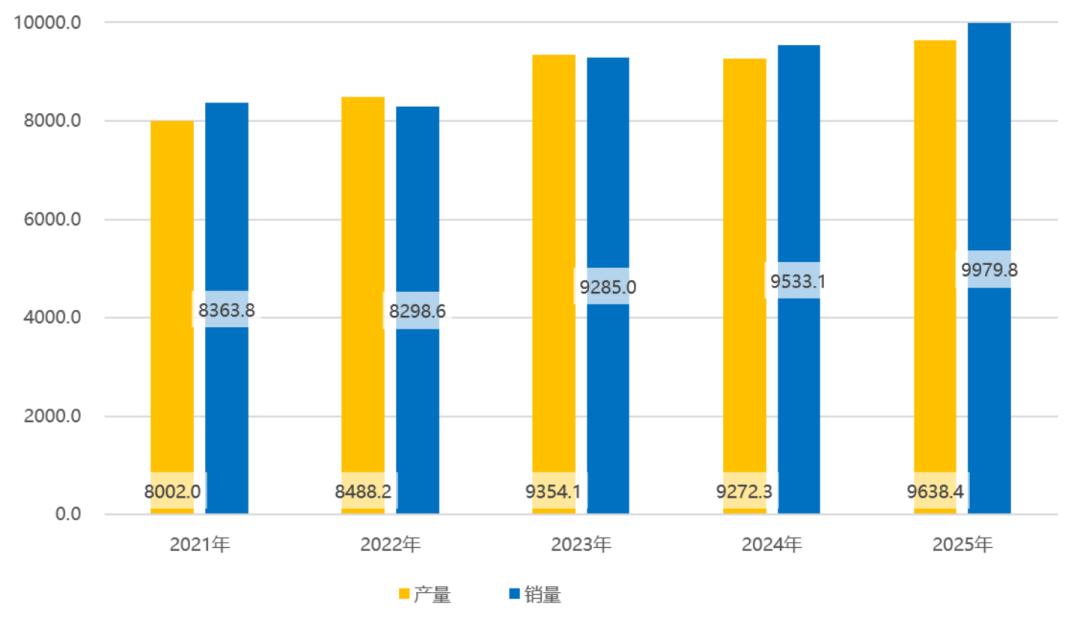
Figure 1: Global automotive production and sales from 2021 to 2025; in ten thousand vehicles
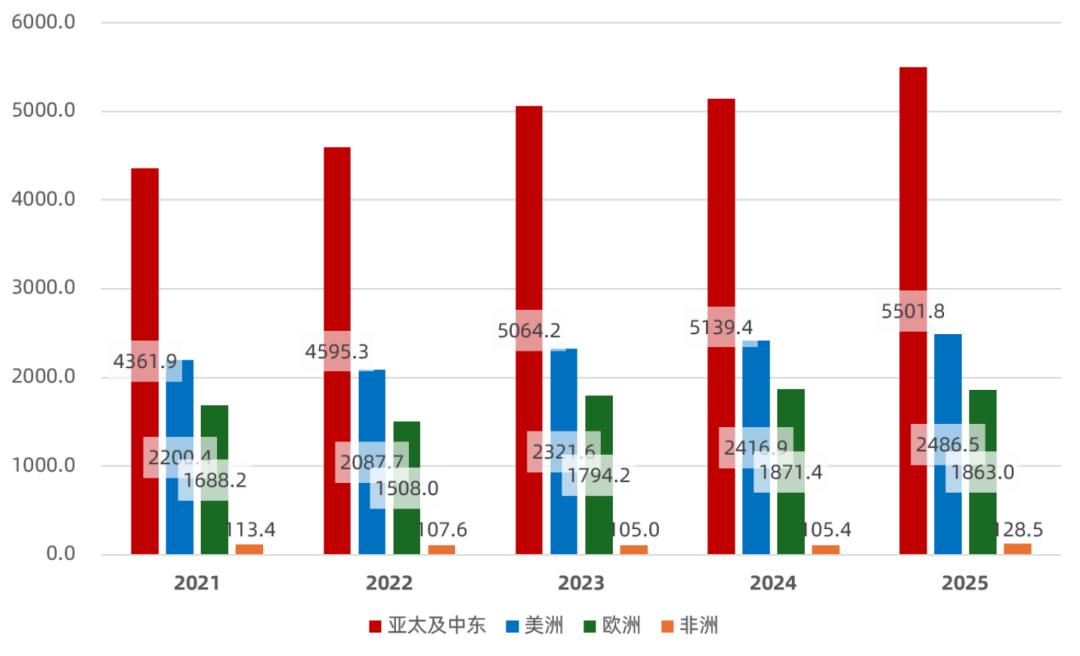
Figure 2: Vehicle sales in different regions from 2021 to 2025; in ten thousand vehicles
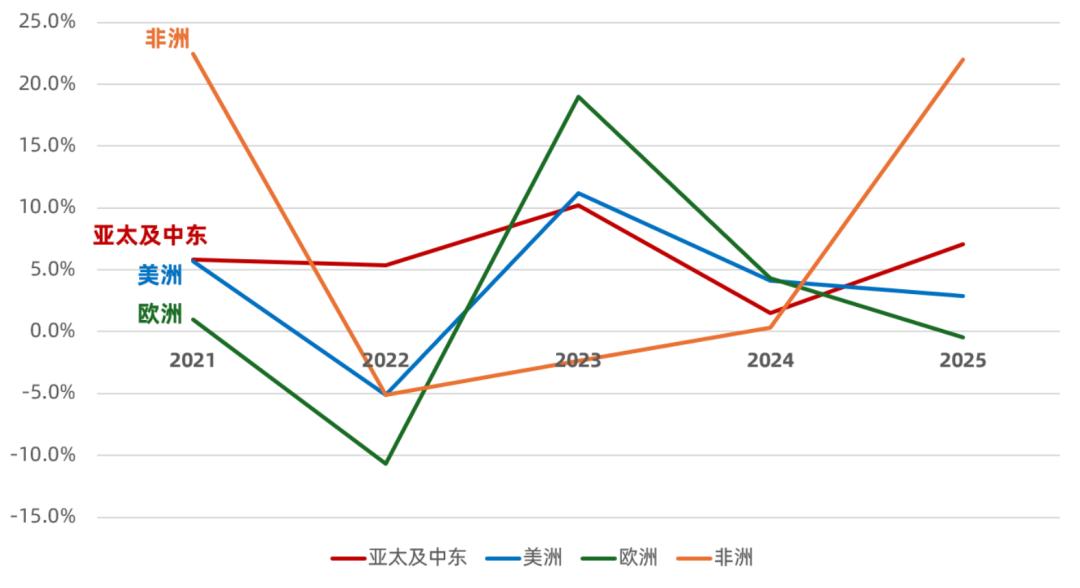
Figure 3: Year - on - year growth rate of vehicle sales in different regions from 2021 to 2025; %
New energy vehicles are accelerating towards mainstream, and the focus of competition is shifting
New energy vehicles remain the most important variable in the structural change of the global automotive industry. According to data from the International Energy Agency (IEA), global electric vehicle sales exceeded 20 million in 2025, a year - on - year increase of about 20%. The proportion of electric vehicles in global vehicle sales increased from about 20% in 2024 to about 25%, becoming a key variable affecting the structural change of the global automotive market.
China continues to be the main support for global growth. According to data from the China Association of Automobile Manufacturers, in 2025, China's production and sales of new energy vehicles reached 16.626 million and 16.49 million respectively, and the penetration rate of new energy vehicles climbed to about 47.9%, far exceeding the global average.
However, it is worth noting the accelerated introduction in emerging markets. IEA data shows that electric vehicle sales in Southeast Asia doubled year - on - year, exceeding 500,000 units; sales in Latin America soared by more than 60%; in the Middle East, the growth rate soared under the impetus of sovereign investment and energy transition strategies; Africa also entered the industrial introduction stage with breakthroughs in individual countries. Although these markets currently have limited scale, they are an important source of the next round of global new energy vehicle growth.
Meanwhile, the European and American markets are showing a divergence. The market share of pure electric vehicles in the EU increased from 13.6% in 2024 to 17.4%, making it a relatively active region among major mature markets. The US market was under pressure due to factors such as the adjustment of tax credit policies, and the share of pure electric vehicles for the whole year dropped to 7.8%, lower than 8.1% in 2024.
A key signal is that the focus of competition in the new energy vehicle market is shifting from increasing penetration rate to improving business quality. After the major markets enter the stage of large - scale application, only those who can achieve a comprehensive balance of cost, product, energy replenishment, channels, and services can transform their first - mover advantage into sustainable competitiveness.
After entering the top ten, how far is it from becoming a mature global automaker?
In the global automotive group sales/delivery ranking in 2025, BYD ranked sixth with 4.602 million vehicles, rising one place from the previous year. Geely jumped to eighth with 4.116 million vehicles, and the rankings of Chinese automakers have been steadily improving.
Table 1: Ranking of the top 10 global major automotive groups in terms of sales/delivery in 2025 (in ten thousand vehicles)
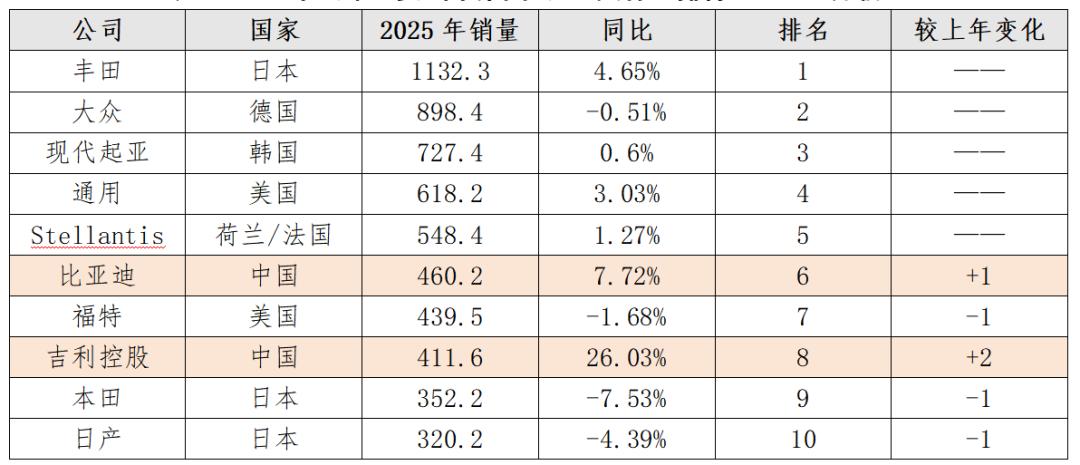
Note: There are differences in the disclosure standards of each enterprise, and the data in the table should not be aggregated. (Toyota's data is based on the group sales standard including Daihatsu and Hino; Volkswagen's data is based on the group delivery standard, including Chinese joint - ventures accounted for by the equity method; General Motors' data is based on the total vehicle sales standard; Stellantis' data is based on the combined shipment standard; Ford's data is based on the wholesale volume standard; Geely's data is based on the Geely Holding Group standard. This table is mainly used to reflect the enterprise scale and ranking changes and is not used as the basis for the global market share after deduplication.)
However, the ranking does not answer all the questions. Comparing Chinese automakers with multinational giants such as Toyota and Volkswagen in the same coordinate system can better clarify the globalization stages of different enterprises.
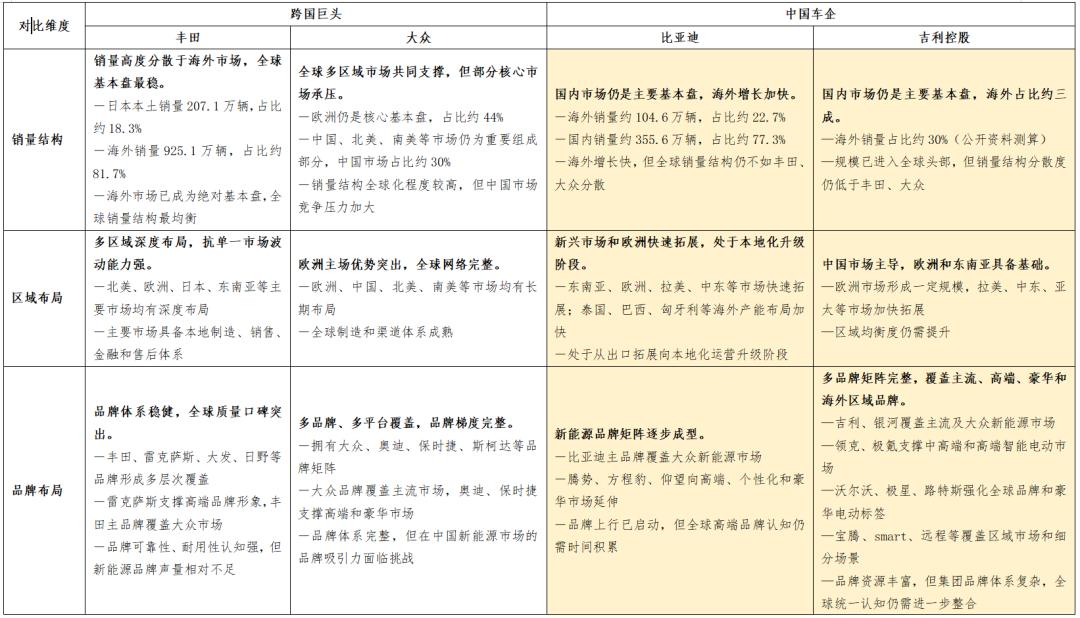
Toyota sold 11.323 million vehicles globally in 2025, with overseas sales accounting for about 81.7%, and only 18.3% in the Japanese domestic market. This means that Toyota's basic market is almost completely dispersed in the global market, and fluctuations in a single market are difficult to shake its foundation. Although Volkswagen's overseas sales proportion is lower than Toyota's, it has a balanced layout in multiple regions such as Europe, China, North America, and South America, and has a mature global manufacturing and distribution system.
BYD's overseas sales were about 1.046 million, accounting for 22.7% of its total sales; Geely Holding's overseas sales accounted for about 30% (including Volvo Cars). The domestic market is still the most important scale foundation and technology iteration scenario for Chinese automakers, and it also provides product, cost, and supply - chain support for their overseas expansion. However, from the perspective of the global sales structure, the regional distribution of Chinese automakers is still less dispersed than that of multinational giants such as Toyota and Volkswagen, and there is still room for improvement in the scale proportion, regional balance, and depth of local operation in the overseas market.
The gap is not only reflected in the sales structure. Toyota and Volkswagen have established a complete system covering local R & D, manufacturing, sales, finance, used - car, and after - sales in major markets, and their globalization has entered the stage of system operation. Chinese automakers' overseas layout is still in the stage of upgrading from export expansion to local operation. Although the overseas production capacity, channels, and brand systems are being accelerated, the support capabilities in finance, after - sales, compliance, etc. still need time to develop.
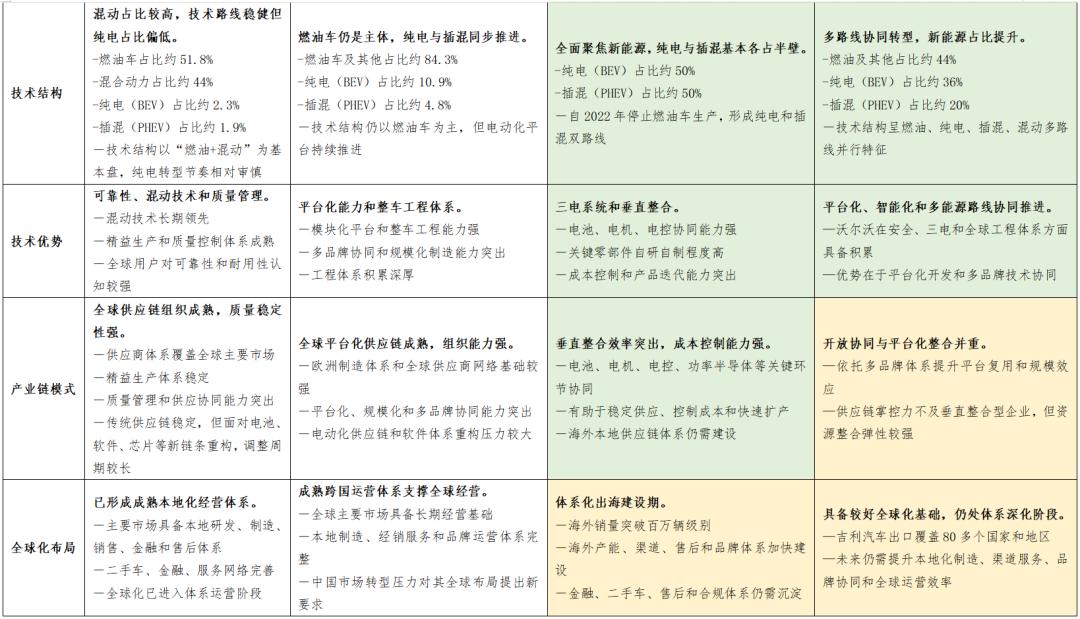
Table 2: Chinese automakers vs. multinational giants
Note: Some data are estimated from public information
The differences in technical routes are also worth noting. Toyota's technical structure is based on "fuel + hybrid", with the proportion of pure - electric vehicles only about 2.3%. Its transformation pace is prudent but has strong global adaptability. Volkswagen still takes fuel vehicles as the main body and promotes pure - electric and plug - in hybrid vehicles simultaneously. Since 2022, BYD has stopped producing fuel vehicles, with pure - electric and plug - in hybrid vehicles each accounting for about half. It focuses on the new energy track comprehensively, with distinct technical features. However, whether its product portfolio can adapt to the energy - replenishment conditions, policy environment, and consumer preferences in different regional markets still needs to be continuously verified in the process of globalization.
A core judgment is that the key for Chinese automakers in the next stage is not to prove that "products can be exported overseas" but to establish brand, channel, service, finance, compliance, and anti - cycle capabilities that can support global operations in the long term. The sales ranking is the result, and the system capabilities are the cause.
Invisible barriers: Rules are reshaping the globalization threshold
What is more worthy of vigilance than the sales gap is the change in the competition boundary of the global automotive industry, that is, the competition is extending from the market to the rules.
In the past, automotive globalization revolved around products, costs, and channels. Today, factors such as geopolitics, trade protection, industrial localization, carbon rules, supply - chain security, and artificial intelligence supervision are jointly rewriting the global operating conditions of automakers. For Chinese automakers, the model of relying solely on vehicle exports will face increasing uncertainty.
Trade protection tools are evolving from single to composite. The EU has implemented anti - subsidy measures on imported pure electric vehicles from China, adding enterprise - specific differential tax rates on top of the 10% basic tariff. Since 2026, while maintaining the overall framework, the EU has begun to adopt more flexible implementation methods such as minimum import prices, annual quotas, and individual - model commitment arrangements. This means that trade barriers are evolving from tariffs to a composite set of rules combining tariffs, price commitments, quotas, and local investment requirements. The US has raised the tariff on Chinese electric vehicles to 100% and has also imposed additional tariffs on related products such as power batteries and key minerals.
The requirements for industrial localization are also escalating. The US Inflation Reduction Act has effectively raised the local - content threshold for new energy vehicles to enter the US subsidy system through restrictive clauses on battery components, key minerals, and "foreign entities of concern." The EU's Net - Zero Industry Act aims to achieve the goal that the EU's domestic net - zero technology manufacturing capacity meets at least 40% of the EU's annual deployment demand by 2030, also intending to promote the reshoring of clean - technology manufacturing.
Carbon rules and battery rules are becoming new market - access conditions. The EU's battery regulations have included carbon - footprint declarations, recycling efficiency, and supply - chain due - diligence management in the regulatory framework. This means that in the future, for power batteries to enter the European market, they not only need to meet performance and safety requirements but also need to prove that their carbon emissions, material sources, and full - life - cycle management comply with the rules. Carbon - management ability is changing from an add - on in ESG reports to a basic ability for global competition.
Technical - rule barriers are also forming in the field of intelligentization. The US has established a licensing system for the export of advanced computing chips and AI (artificial intelligence) model weights, which may affect automakers' access to computing power in high - level intelligent driving, large - model training, and cross - border R & D. The EU's Artificial Intelligence Act will be implemented in phases, and the compliance requirements for AI systems such as autonomous driving and intelligent cockpits will continue to increase.
The common direction of these changes is that the globalization of Chinese automakers in the future will depend not only on product prices and technical performance but also on whether they can establish a systematic ability covering trade policies, regional manufacturing, supply - chain traceability, carbon management, data security, and intelligentization compliance. Overseas factories, local operations, and compliance systems are changing from "optional" to "mandatory."
Outlook for 2026: A year of accelerated structural adjustment
Based on the above judgment, the global automotive market is likely to continue the trend of low - speed growth and structural differentiation in 2026.
In an optimistic scenario, if the inflation and interest - rate environment in Europe and the US improve, the demand in emerging markets is released, and new energy vehicles are introduced more quickly in Southeast Asia and Latin America, global sales are expected to achieve a slight increase. In the baseline scenario, the growth mainly comes from Asia and some emerging markets, while the mature markets in Europe and the US maintain a low - speed adjustment. In a cautious scenario, if trade frictions escalate and geopolitical conflicts disrupt energy and logistics costs, the market may experience a slight decline.
However, regardless of the scenario, 2026 will not be a year of significant expansion in the global automotive total volume. More likely, structural adjustment, regional re - allocation, and rule adaptation will accelerate simultaneously. For China's automotive industry, this means that the window period and the pressure period are overlapping.
True globalization is not just about selling cars to more countries but about solving the systematic issues of products, brands, supply chains, compliance, and local operations in different regional markets simultaneously. The 63% export growth rate proves the competitiveness of Chinese cars. However, the growth rate will eventually stabilize, and at that time, the investment in system capabilities today will determine who can stay in the game.
Data sources: The global total - volume data in this article mainly refer to the public statistics of OICA. The regional