Over 120,000 people laid off, AI "bloodbathes" the tech industry

According to the latest data from the global tech layoff tracking database Layoffs.fyi, as reported by Zhidongxi on June 26, the cumulative number of layoffs in the global tech industry since the beginning of 2026 has almost matched the level of the entire year of 2025: There have been hundreds of layoff events in the global tech industry, involving 202 tech companies, and the cumulative number of layoffs has exceeded 120,000 people.
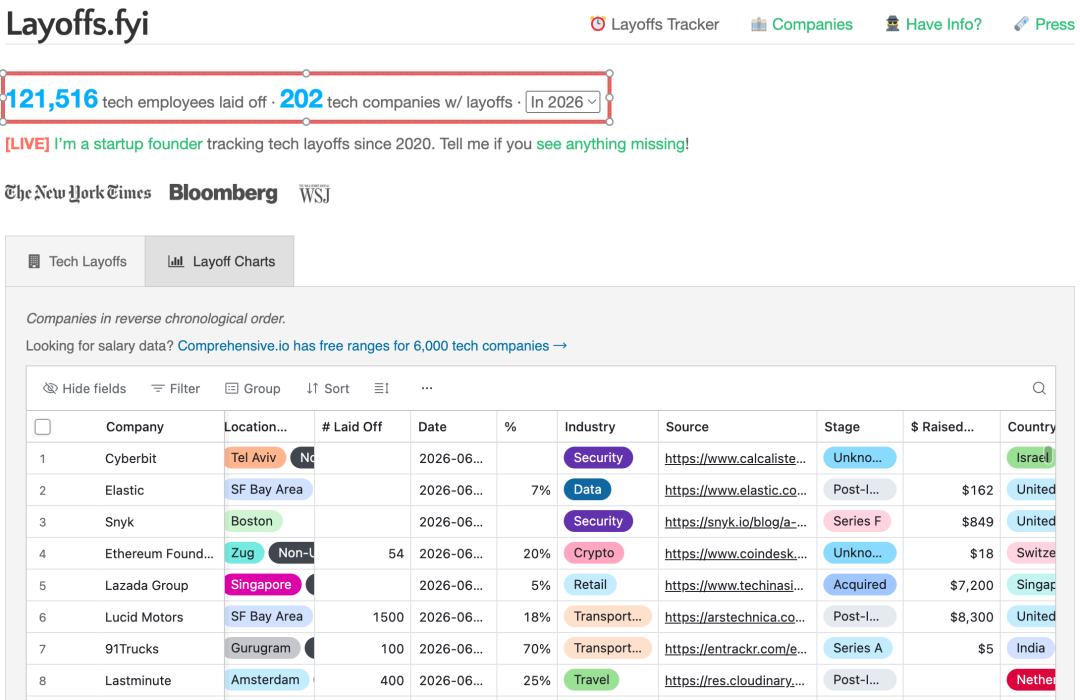
▲Layoffs.fyi's statistics on global tech layoffs in 2026
Data from the career consulting firm Challenger Gray&Christmas shows that in May this year, the number of layoffs in the tech industry reached a record high for a single month in many years, and AI was the most frequently mentioned reason for the layoffs.
On June 23, cloud giant Oracle disclosed in its annual report that as of May 31, 2026, the total number of its employees had decreased from approximately 162,000 in the same period of the previous year to 141,000, a cumulative reduction of approximately 21,000 people in the past 12 months, a decrease of 13%. Oracle admitted in its regulatory filing that "The application and deployment of AI technology in our operations have resulted in and may continue to result in a reduction in the number of employees."
This confirms the "epidemic" felt by many in the tech industry. According to Layoffs.fyi statistics, more than 200 tech companies, including Microsoft, Google, Amazon, Meta, Cisco, IBM, Dell, and Salesforce, have carried out layoffs this year, mostly related to AI.
In China, large companies such as ByteDance, Alibaba, and Meituan have also recently been rumored to be laying off employees on social media, with rumors such as "Large-scale layoffs on June 30" and "Overall layoffs of 10%" spreading widely. AI has become both a new growth engine for tech companies and a "death knell" for layoffs.
You may wonder: When a company's performance keeps hitting new highs, why does it still conduct significant layoffs? When AI can both create new business increments and replace existing human positions, what will happen to tech practitioners?
To answer these questions, this article systematically sorts out the global tech industry layoff wave in 2026, attempting to restore the full picture of the industry's talent structure reconstruction driven by AI by presenting this layoff map covering more than 20 multinational tech giants.
01. The layoff wave is back, but the script has changed: Not for "surviving the winter" but for "blood transfusion"
In the tech industry in 2026, on one hand, there are record-high revenues in the financial reports and an increasingly heated AI talent war, while on the other hand, there is an intensifying layoff storm. This sense of dissonance makes it difficult for everyone in the industry to feel at ease.
As mentioned at the beginning, Layoffs.fyi only counted layoffs in the tech industry involving 276 companies and approximately 124,636 tech practitioners throughout 2025. However, before even half of 2026 has passed, as of today, the number of companies involved in tech industry layoffs has reached 202, and the number of affected tech practitioners has reached 121,516, which is already close to the data for the entire year of 2025.
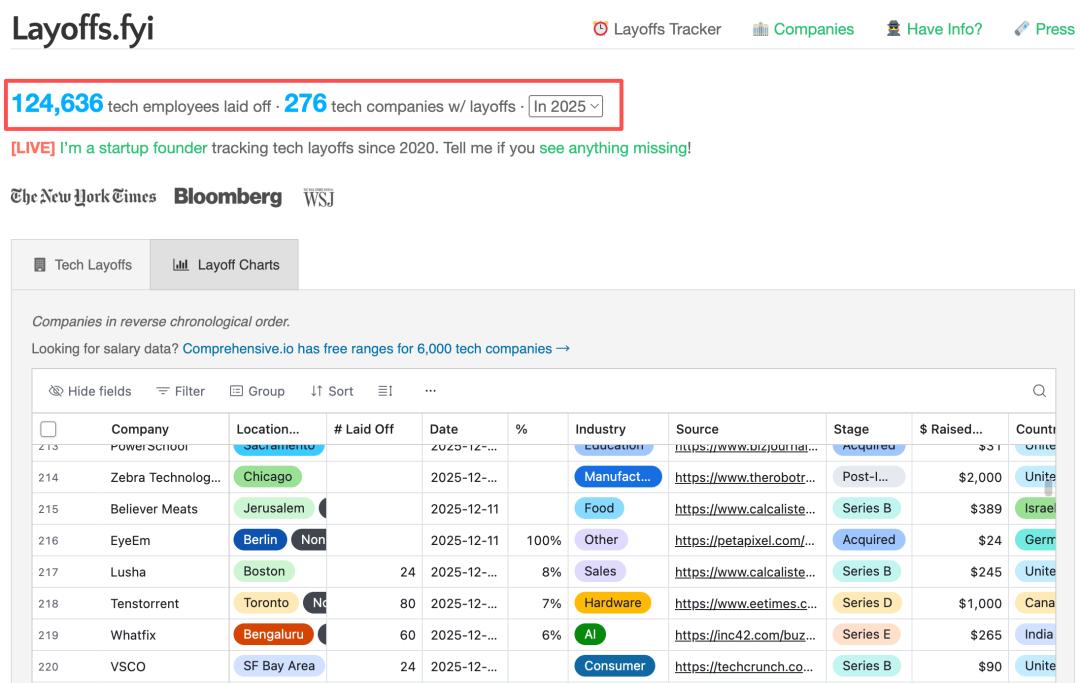
▲Layoffs.fyi's statistics on global tech layoffs in 2025
Data from another tech recruitment platform, TrueUp, shows that as of June 2026, there have been approximately 400 layoff events in the tech industry, affecting more than 153,000 employees, with an average of about 900 tech practitioners losing their jobs every day. At the current rate, the scale of layoffs in 2026 may even approach or exceed the peak of the historic tech industry layoff wave in 2023.
However, different from the "panic layoffs" from 2022 to 2023, which were caused by over-hiring after the pandemic and the cooling of the capital market, the layoffs in 2026 show significantly different characteristics: This is not because companies are struggling to survive, but because they see new directions.
In the past, tech companies laid off employees more to cut costs and improve financial statements; now, more and more companies are actively reducing their employee scale against the backdrop of profit growth and abundant cash flow. The purpose of the layoffs has also changed: It is not simply to reduce expenses, but to reallocate resources.
This phenomenon can be summarized as: Lay off traditional positions and invest the budget in AI. Many companies are reducing repetitive work positions such as back-office, customer service, HR, data annotation, and traditional software development, and middle managers have also become a hard-hit area for layoffs. At the same time, they are investing the budget and human resources in large models, AI infrastructure, chips, intelligent agents, and data center construction.
The head of global SaaS giant Salesforce said when talking about layoffs: "Since AI agents can handle these tasks, the company doesn't need that many people." The CEO of SaaS vendor Atlassian also said bluntly: "It would be hypocritical to pretend that AI won't change the number of positions." Amazon's CEO also said directly: "We will need fewer people to do some of the work currently done by AI."
At the same time, layoffs and recruitment are carried out simultaneously. For example, while Meta laid off 8,000 people, it transferred 7,000 people to AI positions. General Motors is still hiring for about 80 AI positions while laying off employees. IBM is tripling its AI recruitment while about 200 HR positions are being replaced by AI agents. Between "layoffs" and "recruitment", there is a clear replacement of the talent structure.
If the previous layoff wave was a "contraction", then this wave is more like a " cage replacement" centered around AI.
02. Even with plenty of money, they still lay off employees. In 2026, tech giants collectively turn to AI
After looking at the general trend, let's take a look at the specific trends of tech company layoffs.
On June 22, foreign media TechCrunch sorted out a list of large tech companies that have clearly listed AI as the reason for layoffs since 2026. The companies on the list cover multiple fields such as cloud computing, the Internet, software, fintech, automotive, and cryptocurrencies. Summarized by time, they are as follows:
GitLab: On June 3, code collaboration platform GitLab announced that it would lay off approximately 350 people, accounting for 14% of its total employees. The company's CEO, Bill Staples, said that the workload of intelligent agents is "pushing competitors into a corner", and the existing infrastructure can no longer meet the needs. Therefore, it is necessary to carry out a "generational reconstruction" of the core architecture and withdraw from 22 national markets to free up funds for AI infrastructure construction. Despite the company's first-quarter revenue increasing by 23% year-on-year to $264 million, it still chose to initiate a restructuring.
Google: Tech giant Google adopted a more concealed approach. As of May this year, Google quietly laid off employees in its cloud division, including the threat intelligence team and the cybersecurity team related to Mandiant. Meanwhile, Google Cloud's business revenue increased by 63%, exceeding the $20 billion mark for the first time, and the backlog of orders almost doubled, exceeding $460 billion.
In the past year, Google laid off more than one-third of its small team managers, and the number of direct subordinates also decreased by 35%. Different from most companies on the layoff list, Google has never announced the specific total number of layoffs. Its layoffs were carried out through methods such as rolling performance appraisals, voluntary separation programs, and structural reorganizations. It is estimated by the outside world that Google will lay off 1,500 to more than 3,000 engineers throughout 2026.
Intuit: On May 20, tax and accounting software giant Intuit announced that it would lay off approximately 3,000 people, accounting for 17% of its total employees. The company said that the core goal of this adjustment is to reduce organizational complexity and invest more resources in AI product development.
Meta: On May 20, Meta also carried out a large-scale organizational restructuring, laying off approximately 8,000 people, accounting for approximately 10% of its total employees, and at the same time reassigning approximately 7,000 employees to AI-related positions. Zuckerberg told employees frankly that in the AI competition, layoffs are necessary because in the field of AI, "success is not a given."
Cisco: On May 14, network equipment giant Cisco announced that it would lay off nearly 4,000 people, accounting for approximately 5% of its total employees. Although the company's profits and revenues exceeded market expectations, its Chief Financial Officer, Mark Patterson, emphasized that this restructuring is not to save costs, but to reallocate resources around chips, optical communication, security, and AI.
Cloudflare: On May 7, Cloudflare, a global interconnected cloud provider listed on the US stock market, announced that it would lay off approximately 20% of its employees, involving 1,100 employees. The company's quarterly revenue reached $639.8 million, a year-on-year increase of 34%, but it carried out layoffs while setting a new record for single-quarter revenue. The positions being laid off are mainly those responsible for data statistics, concentrated in fields such as data statistics, finance, law, auditing, and middle management.
General Motors: On May 12, General Motors announced that it would lay off 500 to 600 people, mainly involving the IT departments in Austin, Texas, and Warren, Michigan. The company said that in view of the unclear market situation, it is re-evaluating its manpower needs. A person familiar with the matter told CNBC that AI is one of the reasons for this layoff, but not the only one. General Motors said in a statement that the company is "transforming its information technology department to better prepare for the future." Despite the layoffs, the company still has approximately 80 IT positions open, covering fields such as AI, motorsports, and autonomous vehicles.
Coinbase: On May 5, this cryptocurrency exchange announced that it would lay off approximately 700 people, accounting for 14% of its total employees, as part of a restructuring plan aimed at coping with market fluctuations and improving AI efficiency. The company streamlined its organizational structure to five levels under the CEO and COO and said it would try the "one-person company" model, integrating roles such as engineering, design, and product. CEO Brian Armstrong wrote that AI has greatly changed the work rhythm, "Engineers can use AI to complete in a few days what used to take a team weeks to do", and the company needs to "fully utilize AI in all aspects of work."
PayPal: On May 5, PayPal announced that it plans to lay off approximately 20% of its employees, more than 4,500 jobs, in the next two to three years, as part of its transformation strategy centered around AI application and organizational simplification. CEO Enrique Lores told investors that the company will "actively adopt AI" in its development process and has established a new "AI Transformation and Simplification" team that reports directly to him and is responsible for redesigning the company's processes "function by function." Lores described the layoffs as streamlining organizational levels and said that the application scope of AI will far exceed programming and will also extend to fields such as customer service, support operations, and risk management.
Microsoft: From April to May, Microsoft offered a buyout plan in the form of voluntary separation but did not disclose how many employees would be affected. Chief Financial Officer Amy Hood said that the total number of employees in the third fiscal quarter decreased year-on-year, and it is expected that the total number of employees will continue to decline as the company focuses on "building efficient and agile teams" against the backdrop of increasing AI investment.
Snap: On April 16, AR social tech company Snap laid off approximately 16% of its global employees, approximately 1,000 full-time employees, and closed more than 300 open positions. CEO Evan Spiegel said that the progress of AI is the key driving factor for this layoff. Spiegel wrote in a memo submitted to the US Securities and Exchange Commission (SEC): "The rapid development of AI enables our team to reduce repetitive work, improve efficiency, and better support our users, partners, and advertisers." The company said that it has seen some small teams using AI tools to drive improvements in Snapchat+, advertising platform performance, and infrastructure efficiency.
IBM: The layoffs continued until 2026. It is expected that between the layoffs in the fourth quarter of 2025 and the layoffs in the Red Hat engineering department in April 2026, IBM will lay off 3,000 to 9,000 US positions, bringing the cumulative total number of layoffs since September 2024 to more than 15,000. Bloomberg reported that IBM plans to triple its recruitment for entry-level AI and hybrid cloud positions in the United States. At the same time, approximately 200 human resources positions have been replaced by AI agents. An IBM spokesperson said that the layoffs in the fourth quarter of 2025 were a routine adjustment that only affected a "single-digit percentage" of its global employees.
Atlassian: On March 11, SaaS vendor Atlassian, which develops collaborative tools, laid off approximately 1,600 people, accounting for 10% of its total employees, to "rebalance" its business focus and shift towards AI and enterprise sales. After the news was announced, the company's stock price rose by nearly 2%. Its CEO said: "Our approach is not 'AI replaces humans'. But it would be hypocritical to pretend that AI won't change the skill set we need or the number of positions required in some fields. That's really the case."
<