Surge 1200% on the first day, the post-80s sales engineer staged a counterattack: from selling FRP to a net worth of 29 billion yuan
On its first day of listing, the stock price soared by 1207%, and the profit per lot exceeded 270,000 yuan. Zhenbao Technology ignited the entire STAR Market with a capital carnival and became the second "10-fold new stock" this year. Its closing price of 585 yuan directly entered the top 20 in the A-share market in terms of stock price ranking. This "first stock in semiconductor consumables" supported by the entire semiconductor industry chain tells a more attractive "Band - Aid" story with its integrated closed - loop of "raw materials + components + surface treatment" - as long as the wafer factory is in operation, the revenue will keep flowing.
01
Don't Be the "Scalpel", Be the "Band - Aid"
In the past two days, the STAR Market has been ignited by a new stock.
Zhenbao Technology, a newly listed semiconductor equipment parts manufacturer (i.e., the new stock "N Zhenbao"), saw its stock price soar by 1207% after the opening, triggering a temporary trading halt. Calculated based on 500 shares per lot in the STAR Market, the maximum profit per lot of Zhenbao Technology exceeded 270,000 yuan.
In fact, during the issuance stage, Zhenbao Technology already showed signs of "overheating" - the offline subscription multiple reached as high as 4,363 times, making it almost one of the most crowded new stock subscriptions in the STAR Market in recent years. And when you look at its shareholder list, it's more like a "family photo" of the semiconductor industry chain: the second phase of the National Integrated Circuit Industry Investment Fund, SMIC, BOE, YMTC, Huahong Group... From the upstream to the downstream, from capital to the industry, almost all are present.
This means one thing: it is almost a target "jointly supported" by the entire industry chain. But we have a question - what exactly did it do to deserve such a pricing and expectation?
If we use a simple analogy to explain, there are actually only two types of businesses in the semiconductor industry. One is "selling scalpels". For example, etching machines and thin - film deposition equipment. These core equipment often cost hundreds of millions of yuan, and wafer factories can use them for several years after purchase, so the repurchase rate is extremely low.
The other is "selling Band - Aids". This is exactly what Zhenbao Technology does - the key consumables inside the equipment, such as silicon rings, quartz parts, and silicon carbide rings. These parts are exposed to a high - temperature plasma environment for a long time, and their service life is usually only a few months. In other words, as long as the wafer factory is still in production, these consumables will be continuously consumed, forming a stable and predictable cash flow.
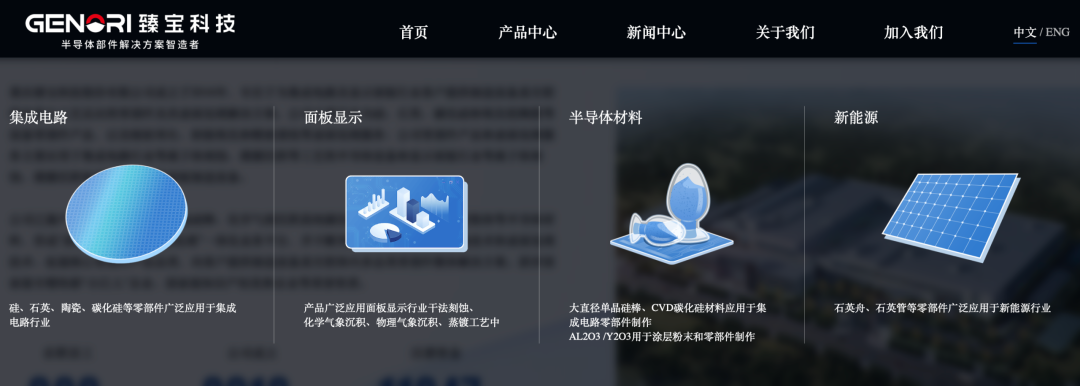
Image | From the company's official website
When selling scalpels, you have to wait for the hospital to buy new ones; but when selling Band - Aids, as long as there is consumption, there will be income every day.
This is exactly why the capital market is willing to give it a higher premium: it's not about whether you have orders, but whether the orders are continuous.
If the story stopped here, it would at most be a good business, far from reaching the current market frenzy. The key question is, how did Zhenbao Technology break into the market?
Different from most hard - tech companies, Zhenbao Technology's starting point is not in the laboratory, but at the front line of the market. The founder, Wang Bing, is an 80s generation. After graduation, he worked as a sales engineer at Shanghai Yaohua FRP Co., Ltd. and then entered the semiconductor equipment and materials field and worked in sales for many years. Based on the total share capital of about 155 million shares after the issuance of Zhenbao, Wang Bing's direct shareholding ratio was diluted to about 33%. According to the latest market value, his net worth is about 28.7 billion yuan.
Wang Bing noticed early on the structural dilemma faced by domestic wafer factories during the rapid expansion process: overseas manufacturers monopolize the preparation technology of high - purity silicon, quartz and other materials. Domestic wafer factories not only have high equipment maintenance costs, but also have extremely unstable supply cycles.
In the past, this problem could be tolerated. But as the uncertainty of the geopolitical environment increases, supply chain security has changed from a cost issue to a survival issue.
Therefore, Zhenbao Technology came up with a very clever and practical solution: Achieve 80% in performance, 50% in price, but 100% in delivery speed and response ability.
To achieve this, Wang Bing chose the most difficult path. Traditional parts manufacturers often only do "OEM + selling materials", but Zhenbao Technology has established the full - chain closed - loop of "raw materials + components + surface treatment". The company has independently developed and mass - produced key raw materials such as large - diameter single - crystal silicon rods, polycrystalline silicon rods, CVD high - purity silicon carbide ultra - thick materials, and ceramic granulated powders, which not only ensures the stability of the supply chain but also significantly reduces production costs.
For those wafer factory customers, this choice may not be perfect, but it is usable, controllable, and sustainable.
As a result, a subtle but crucial relationship began to be established - upstream suppliers are no longer just technology providers, but also risk - sharers; downstream wafer factories no longer pursue the single best option, but accept the "second - best but safe" combination.
That's why Zhenbao Technology's customer list includes not only domestic leading wafer factories such as BOE, Jinghe Integrated, CR Microelectronics, and Xinlian Integrated; but also it has entered the supply systems of international manufacturers such as SK Hynix (Dalian), GlobalFoundries, United Microelectronics Corporation, and Texas Instruments.
This shows that its competitiveness is not only about domestic substitution but also has a certain global comparability.
According to Frost & Sullivan data, in 2024, among domestic enterprises directly supplying semiconductor equipment parts to wafer factories, Zhenbao Technology ranked first in the silicon parts market with a revenue market share of 4.5% and ranked first in the quartz parts market with a revenue market share of 8.8%.
02
Behind the 1.6 Billion Yuan Fundraising
If the 1200% surge tells the story of "imagination", then the 1.6 billion yuan fundraising corresponds to a more realistic balance sheet.
In this IPO, Zhenbao Technology raised a net amount of 1.605 billion yuan, and the core purpose was to invest in capacity expansion. There is nothing wrong with this in itself, but once this money is converted into production capacity, it will quickly become an unavoidable cost: depreciation.
According to the prospectus, after the investment project is fully completed, the peak annual depreciation and amortization expenses will be 72.7718 million yuan. This is not a flexible cost but a rigid expenditure. Compared with the company's net profit of 226 million yuan in 2025, this expense is equivalent to directly swallowing about one - third of the profit. In other words, as long as the capacity utilization rate cannot increase, the income statement will "change its face" immediately. This is also an inflection point that all heavy - asset manufacturing enterprises cannot avoid.
Looking at the company's growth performance in recent years, this pressure once seemed controllable. From 2022 to 2025, Zhenbao Technology's revenues were 386 million, 506 million, 635 million, and 846 million yuan respectively, and its net profits attributable to the parent company were 81.62 million, 108 million, 152 million, and 226 million yuan respectively, showing a continuously accelerating growth trend.
In the first half of this year, the company is expected to achieve a revenue of 472 million - 492 million yuan, a year - on - year increase of about 29% - 34%, and a net profit attributable to the parent company of 105 million - 115 million yuan, a year - on - year increase of about 23% - 35%. On the surface, such a growth rate is sufficient to offset the profit erosion caused by the new depreciation. But the problem is whether this growth itself is based on a sustainable demand cycle.
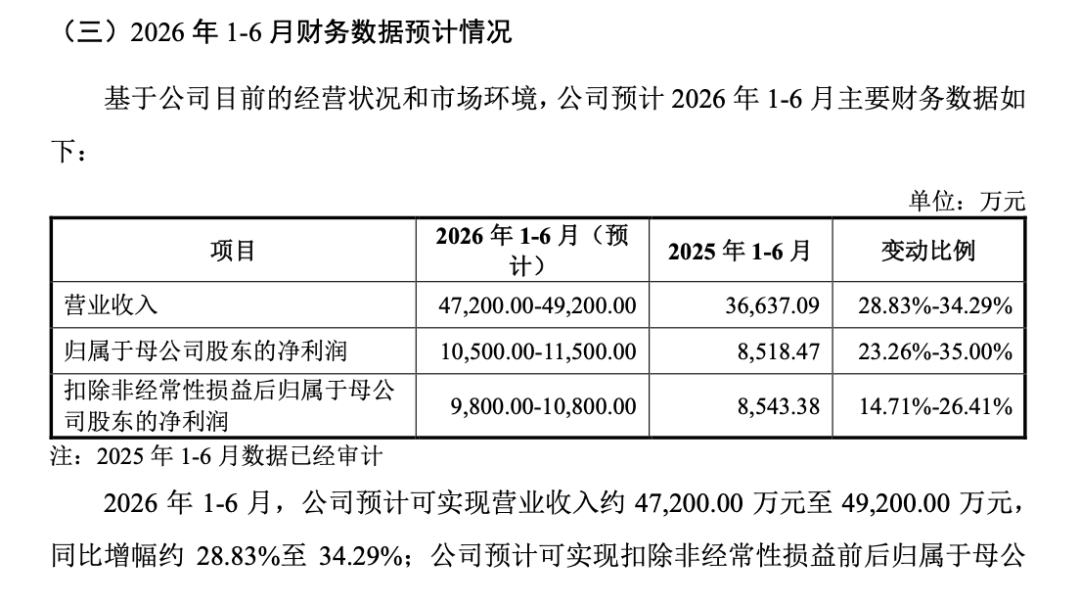
Image | From the company's prospectus
The company's answer is optimistic: it is expected that by 2028, the revenue will increase by 144.14% compared with 2024. This assumption implies a premise - downstream wafer factories will continue to maintain a high - intensity expansion.
However, from the perspective of industry rules, the semiconductor industry is a typical cyclical industry. Especially in the parts segment where Zhenbao Technology is located, although it has the "consumable attribute", it is still essentially tied to the equipment startup rate and new production lines. Once the storage or logic chips enter the inventory reduction cycle and the startup rate decreases, the demand for consumables will also shrink.
More realistic pressure comes from external competition. Japanese manufacturers still have a technological advantage in the high - end parts field. Once they counterattack by reducing prices or binding equipment manufacturers, the "cost - performance strategy" space of domestic manufacturers will be significantly compressed. At that time, the production capacity that has been built but cannot operate at full capacity will no longer be a moat but a burden.
In addition to the uncertainty on the production capacity side, the issue of capital occupation in the financial statements is also worthy of attention. In mid - 2025, the company's accounts receivable accounted for as high as 70.83% of its revenue, and the turnover efficiency declined significantly. This indicator reflects the typical position in the industry chain - although the company has entered the leading customers, its bargaining power is limited, and it needs to offer more lenient payment terms to obtain orders. For investors, this means that profits may not be smoothly converted into cash flow. Once downstream customers delay payment or the industry boom declines, the pressure on the capital chain will quickly increase.
The concentration of the customer structure further amplifies this uncertainty. The sales to the top five customers have long accounted for more than 70%. It may seem like "binding to the leading customers", but from a risk perspective, it is closer to single - point dependence. This structure is not a problem during the upward period of the industry, but in the downward period of the cycle, it often amplifies fluctuations.
More subtle risks come from the authenticity of its "science and technology innovation attribute". During the critical application period, the company's R & D personnel quickly increased from 38 to 113, just crossing the 10% red line of the STAR Market. But then 34 people were transferred out at once in the first half of 2025. Such a drastic fluctuation in the personnel structure inevitably raises questions about the authenticity and sustainability of its R & D investment.
At the same time, the company's early R & D management was relatively extensive, and there were abnormal fluctuations in working hour records and energy consumption statistics. For example, the R & D energy consumption in 2024 increased by 1135% year - on - year. Although these details may not directly affect the current performance, in an industry like semiconductors that requires extremely high process stability, they will affect the market's judgment of its long - term technological capabilities.
Overall, the core contradiction of Zhenbao Technology is very clear: on the one hand, there is the certain premium brought by the "consumable logic", and on the other hand, there is the performance elasticity risk brought by heavy - asset expansion.
For the secondary market, it can pay a high valuation for the "Band - Aid" story in the short term, but in the medium and long term, the pricing will ultimately return to two variables - whether the capacity utilization rate can be maintained at a high level and whether the cash flow can keep up with the income statement. If there are deviations in these two points, then this 74 million yuan depreciation is likely to be not only an item eroding profits but also the starting point for compressing the valuation.
This article is from the WeChat official account "Phoenix Tech". Author: Lu Chunfeng, Editor: Dong Yuqing. Republished by 36Kr with permission.