2026, AI is stepping out of the dialog box
On May 20, 2026, Google I/O came to an end. Sundar Pichai stood on the stage and made a definite judgment: the next stop of AI is not the chat - capable model, but the intelligent agent that can take action. When Gemini 4.0 was absent and Agentic Gemini made its debut, a turning point from "dialogue" to "execution" arrived.
One more thing. Yesterday, Anthropic completed a new round of financing worth $65 billion, and its post - investment valuation soared to $965 billion, officially surpassing OpenAI and taking the throne in the AI field.
Claude under Anthropic represents the intelligent agent (Agentic) and outperforms many AI companies in programming (coding) ability; while ChatGPT is a representative of Chatbot, but its decline is hard to hide.
This is not a simple arms race of financing among giants, but it has solidified the guiding sign of the AI industry's development - the growth of Chatbot has reached its peak, and the era of Agent has begun.
As early as the beginning of the year, a consensus had been formed in the AI industry that 2026 would be the first year of Agent, and AI would start to do work for people.
Starting from a week before the Spring Festival, milk tea shops on major commercial streets seemed to have been pressed the accelerator button. Inside the shops, the hands of the clerks hardly stopped, and milk teas were handed out one after another. Long order receipts dragged from the workbench all the way to the ground. Outside the shops, deliverymen had their hands full of heavy bags and trotted through the crowd and traffic, afraid of being a second late.
During that time, Qianwen connected with food delivery and e - commerce platforms and crazily attracted new users by "treating" them to milk tea. Users could receive a $25 free - order card in the app, and they could get another one by inviting new users. The familiar way of attracting new users through red envelopes and fission always works in the domestic Internet world. The download volume of the Qianwen APP exploded instantly and rushed straight to the top of the App Store's overall list. The surging traffic crashed the server several times, and the originally short - term activity period was extended again and again, spreading from Taobao flash sales to Hema, Tmall Supermarket, Fliggy, Damai... Alibaba's ecological layout was gradually involved in this carnival.
After that, intelligent agents such as OpenClaw (Lobster), RedClaw under Baidu, and WorkBuddy under Tencent were successively launched, presenting a flourishing situation of Agents.
Especially in May, three of the most important AI companies almost simultaneously completed the paradigm shift of their product lines: on May 12, Claude Code released the Agent view, which can manage multiple parallel Agents. This is a signal at the interface level for AI to move from "single - thread dialogue" to "multi - Agent parallel command"; on May 14, OpenAI Codex was launched on the mobile side, turning software development into a "remote task" that can be commanded at any time; and Google further strengthened this signal at the I/O 2026 conference.
The era of Agent has really come.
Approaching the upper limit, Chatbot has shown a growth ceiling
Since ChatGPT became popular, large models and Chatbots have once become the main theme in the technology circle. DeepSeek, Kimi, Doubao, Yuanbao... New products have emerged in an endless stream. People often haven't fully adapted to the previous one when a new product has already appeared.
However, such hustle and bustle is gradually fading away. Among the new entrants today, almost no one takes the pure Chatbot as the main direction of attack. As users' usage habits become fixed, they have passed the "running - in period" with their commonly used AIs, and their willingness to switch has greatly decreased. Each major product has basically locked in its core audience, and the market pattern has become more stable. Even if there are cases like Qianwen that create short - term traffic peaks through red envelope subsidies, it is difficult to break the existing retention barriers, and it has become extremely difficult to break into the stock market.
From a data perspective, the incremental space in the Chatbot track has approached the ceiling. According to the data of the AI product list, in April 2026, among the top 20 Chatbot products, the web traffic of 9 products declined. Although ChatGPT still maintained an absolute lead with 569 million visits, it also had a negative month - on - month growth of 3.84%. Although leading products such as Gemini, DeepSeek, and Doubao still maintained growth, their month - on - month growth rates were all in single digits, and the growth rate slowed down significantly. It can be seen that although the overall market is still expanding, the growth dividend has significantly diminished.
Against this background, the traffic of Claude increased by 34.18% against the trend. The main reason is that it completed the paradigm shift from a "passive - answering Chatbot" to an "active - acting Agent".
Anthropic released a new function, Claude Co - work, this year. Users only need to specify a goal, and Claude can automatically execute across software and long - process in the background, fully moving towards a new stage of an automated closed - loop where "humans issue instructions, and AI writes code and executes". In the process, the Agent independently disassembles, iterates multiple times, and corrects itself. The high - frequency automated interactions in the background directly led to a rapid increase in Token consumption and traffic.
The shift in the capital market is even more radical. Between 2023 and 2024, well - known VCs and CVCs such as Sequoia, a16z, Alibaba, and Tencent flocked to conversational AI. However, by 2026, this investment logic has undergone a substantial change. International top - tier investment institutions have basically stopped new investments centered on "dialogue" and turned to the Agent track: a16z has continuously bet on the programming Agent Cursor in multiple rounds; Sequoia, Tiger Global, and GV invested in the intelligent customer service Agent Sierra; Coatue and Index Ventures invested in the enterprise customer service Agent Decagon. In China, large companies such as Alibaba and Tencent have almost stopped investing in pure Chatbot - form products and instead integrated resources to invest in building their own Agent capabilities.
A similar trend can also be seen from the W26 (Winter 2026) list released by the world - famous incubator Y Combinator: among the approximately 200 selected startups, a large number of AI startup projects clearly focus on Agents rather than Chatbots.
The fundamental reason for this change lies in the natural bottlenecks of Chatbot itself. It can only provide information output and suggestions and cannot independently complete software operations, API calls, or business closed - loops. The execution link still requires manual intervention and manual operation. Limited by this, its commercialization path can only rely on the subscription system or Token consumption billing. The revenue model is single and concentrated among the top players.
As users, technology, and traffic gradually gather towards a few top platforms, the market pattern of Chatbot is basically solidified: in the international market, it is dominated by large - model companies and technology giants, while in China, it is more in the hands of large companies such as Alibaba, Tencent, ByteDance, and Baidu. Chatbot is becoming more and more a basic ability in the platform ecosystem rather than an independent startup track.
Dialogue, from "end" to "start"
In the past, the core capabilities of Chatbot mainly stayed at the level of information understanding and answer generation. However, what users really need is often not just "knowing how to do it", but "getting things done". The gap between cognition and action constitutes the "execution gap" that AI faces in implementation.
Now, AI is evolving from "only being able to talk" to "directly taking action": programming Agents enable AI to write code by itself, and engineers change from implementers to instructing agents; enterprise Agents move from the chat box into the workflow and autonomously complete tasks instead of answering questions; embodied intelligence gives AI "hands and feet", and humanoid robots have entered factories to replace workers; the multi - Agent protocol, like TCP/IP, enables intelligent agents to cooperate autonomously and connect seamlessly. AI no longer passively waits for the user's next sentence but has the ability to execute independently in a closed - loop.
This leap from passive response to active execution makes Agent the most important path to break the "execution gap" and drive Chatbot to evolve into the next - generation productivity tool.
In the process of Chatbot evolving into Agent, in addition to the upgrade from "giving answers" to "automatic execution", there is also a very crucial change - dialogue has changed from the end of information acquisition to the start of automatic execution.
In the past, when saying to a Chatbot, "Help me book a flight ticket from Beijing to Shanghai tomorrow", the AI would provide information such as recommended flights, ticket - booking websites, and travel tips in a dialogue form. At this point, the interaction would end. This is dialogue as the end.
Now, when saying the same thing to an Agent, the AI will not only provide information but also automatically execute the entire ticket - booking process, including checking flights, comparing prices, recommending flights, allowing user selection, and issuing tickets. Dialogue is just to tell the AI the intention, and a series of subsequent actions are all completed by the AI. This is dialogue as the start.
That is to say, dialogue itself is no longer the whole of value but has become a demand instruction that can be implemented and has become the basic layer of Agent services. This paradigm shift directly reconstructs the survival rules of enterprises: value is no longer only determined by the front - end interaction experience but also depends on whether it has the ability to be scheduled and executed.
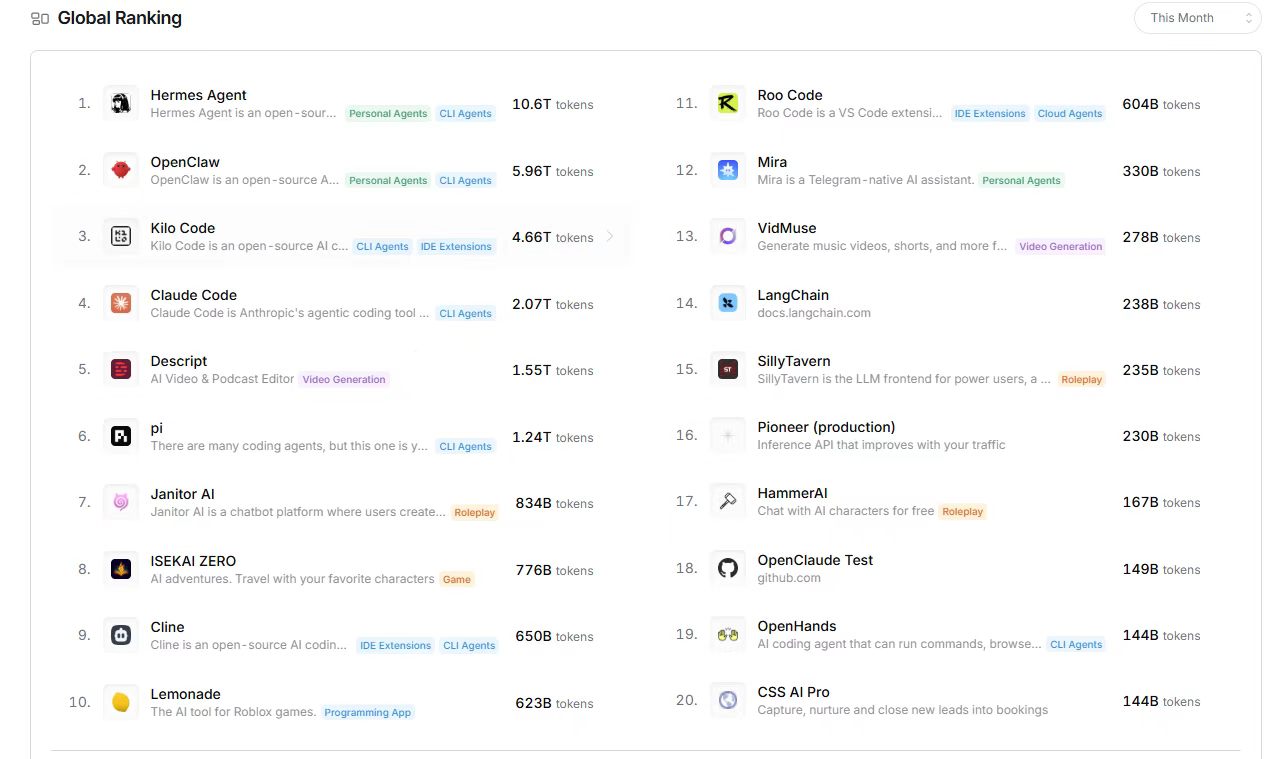
Image source: OpenRouter
In May 2026, among the top 20 global AI APP & Agent Token consumption rankings, 9 were Agents; among the 6 products with trillions of Token consumption, 5 were Agents.
In the transformation process, companies that can keep up with the pace are all doing the same thing: disassembling the original product functions into independent modules that can be flexibly called. They no longer require users to open their own interfaces for operations but support Agents to directly call services when performing tasks. Such companies often focus on niche markets and master industry - specific business processes and core data that are difficult to cover by general AI, which is also an important reason for their competitiveness in the industrial chain.
On the contrary, some "shell - wrapping" companies that simply build dialogue functions without core technology and industry accumulation will gradually lose their market value. There are also some traditional software companies that are reluctant to open APIs and cannot be read and called by AI. Over time, they are likely to be replaced.
When product forms are reshaped in this direction, the competition logic of the Agent track also changes accordingly. General dialogue capabilities are being rapidly internalized by large companies, and shallow applications at the basic layer will continue to be swallowed up. Those with real opportunities to survive are either platform - type players that connect the developer ecosystem and private - domain data or deep - diving players that hold irreplaceable processes and data in vertical and professional fields. Participants in the middle layer who have neither technical barriers nor industry accumulation will be squeezed out of the market.
Accelerating implementation, Agents are being put into use in batches
In the past two years, the evolution from Chatbot to Agent seems quiet, but the choices of developers are highly convergent, and the market has almost unanimously accepted this new paradigm without controversy.
On the C - side, users are gradually embedding Agents into their daily workflows. People are no longer limited to asking AI to make a PPT but deploying tools like OpenClaw to let AI take over and autonomously execute more complex operation processes. The penetration on the B - side is even more rapid. According to Gartner's prediction, by the end of 2026, about 40% of enterprise applications will integrate task - specific AI Agents, while this proportion was less than 5% in 2025.
Especially in fields that are more perceptible to the public, Agents are becoming the key entry point for enterprise layout.
In the e - commerce field, Alibaba's recently released AI customer service Xiaomimi marks the leap of the customer service system from "question - answering" to "execution". It can not only answer inquiries but also directly intervene in the after - sales process and handle complex operations such as refunding price differences, refunding deposits, and troubleshooting product failures that used to require manual work.
In the hotel service field, Hua Xiao AI jointly created by Huazhu Group and Tencent Cloud has also achieved an upgrade from "asking" to "doing". In scenarios such as room extension and guest - need delivery, the Agent can automatically generate work orders and directly connect to hardware robots to complete the entire process from receiving instructions, distributing tasks to delivering physical items.
In the catering field, KFC and Li Auto have implemented an intelligent ordering scenario of A2A (Agent to Agent). After users issue voice instructions in the car, Li Auto's Agent "Li Auto Classmate" directly transfers the needs to KFC's Agent "Xiao K", and the entire process of meal recommendation, order placement, payment, and pick - up reservation is completed in the dialogue, achieving end - to - end collaborative execution of cross - system Agents.
There are also many places where users can't see, and Agents have already been embedded in the business processes of enterprises, taking over various specific operation and back - end execution tasks.
When AI is no longer just providing suggestions across the screen but is given the authority to directly rewrite orders, allocate resources, and complete deliveries, the logic of human - machine collaboration also changes accordingly. People only need to set goals and boundaries and leave the specific execution to Agents. This reshaping of the division of labor is turning AI from a simple dialogue tool into a real digital labor force participating in the operation.
This article is from the WeChat official account "Xiaguang AI Laboratory", author: Zhu Fenglin, published by 36Kr with authorization.