Claude just launched "Group Chat Agent": Is it a new interaction paradigm praised by Karpathy, or a "digital supervisor" for office workers?
The group chat Agent track has welcomed a truly heavyweight player.
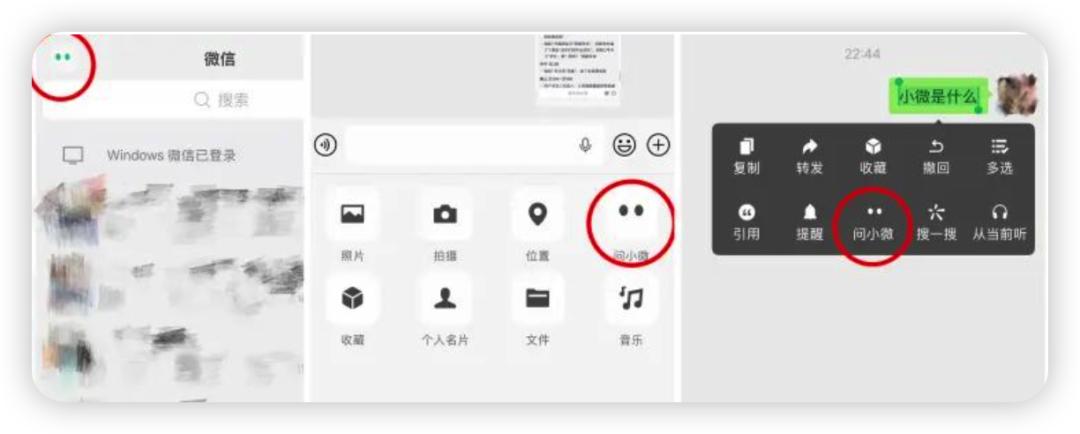
WeChat has just added "Xiaowei" to your drop - down box; "Dayuan" in WeCom has sneaked into workflows such as group chats/meetings. Meanwhile, across the ocean, Anthropic has also stuffed Claude into Americans' "company group chats" at the same time.
According to news on June 23 local time, Anthropic has launched a new feature, Claude Tag. Business owners only need to connect it to Slack, and employees can "@Claude" just like calling a colleague. It can read the current discussion, break down tasks, call tools, and continuously follow up on the task flow.
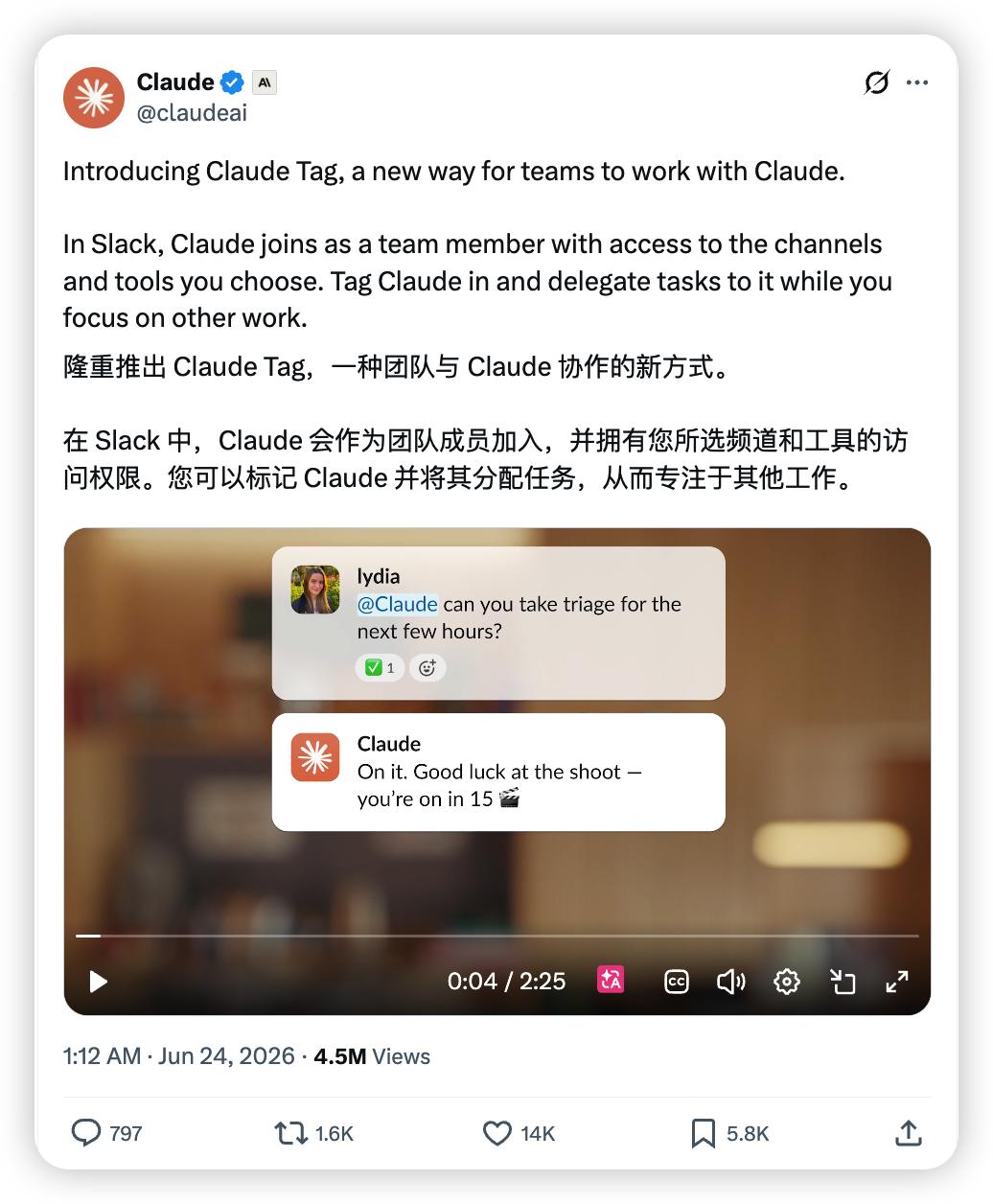
It will also remember work - related information in the current group chat. As the number of communication rounds increases, Claude can deeply understand project content, team division of labor, organizational structure, and communication habits, find missing items, and actively "look for" work to do.
At first glance, Claude Tag seems to be the American version of "Xiaowei", but in fact, it is Anthropic's dimensionality - reduction strike against the collaborative SaaS market.
Different from "Xiaowei", which focuses on personal assistants and life services, Claude Tag focuses more on multi - person collaborative office work. It relies on the Slack ecosystem, which has more than 200,000 paying customers and covers nearly 80% of Fortune 100 companies. It targets the continuous task requirements and real information flow in the group.
In fact, Claude Tag is not the first AI assistant in Slack. As early as 2024, Slack launched a similar Bot component, and at the beginning of this year, Slack's parent company, Salesforce, also defined the new version of Slackbot as the entrance to enterprise Agents.
(Speaking of Salesforce, the most successful model in the SaaS field - the more you follow Anthropic, the more you will find that it may be what Anthropic most wants to become.)
After the launch of Claude Tag, Andrej Karpathy, a former OpenAI expert and now an employee of Anthropic, gave a very high evaluation immediately.
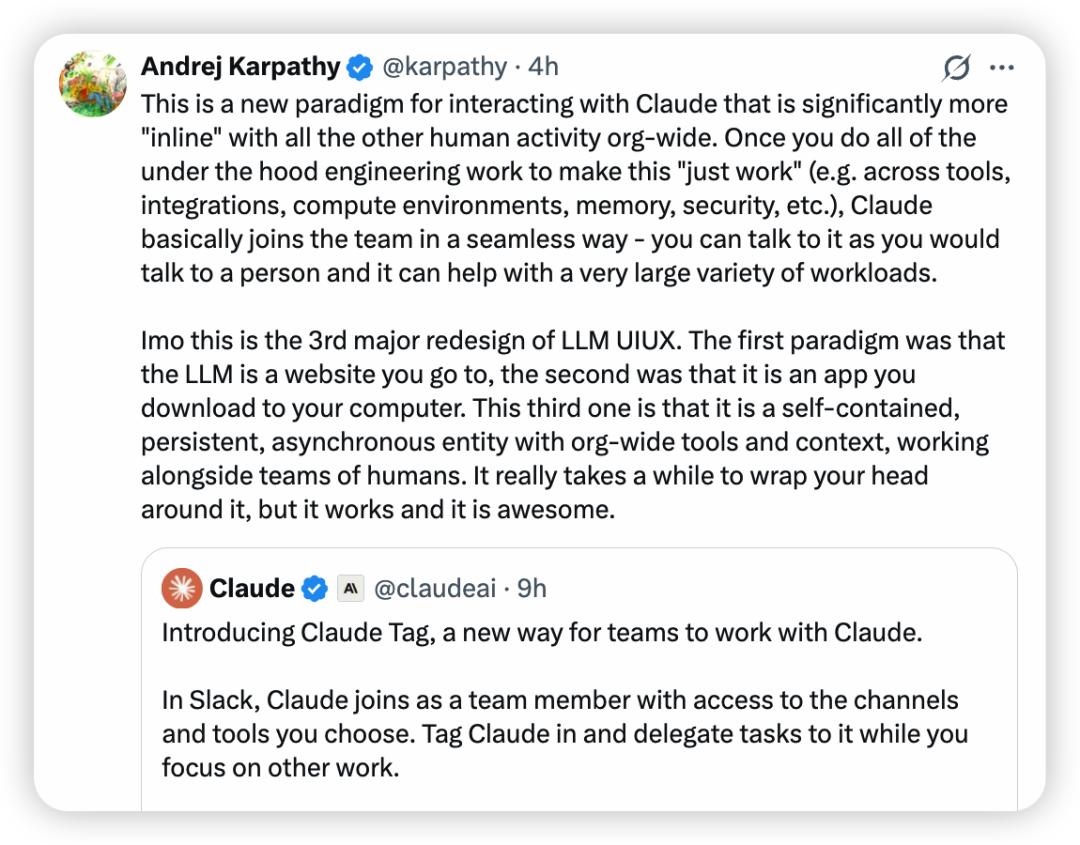
He believes that Claude Tag represents a new paradigm for interacting with Claude. The underlying engineering is ready, and Claude can act as an "AI employee" in a "plug - and - play" manner, join the team, and handle various tasks.
Karpathy summarizes the interaction methods of LLMs into three stages:
- Website stage: The LLM is a site you need to actively visit.
- Application stage: The LLM is software you download to your computer.
- Current Claude Tag: An independent, persistent, and asynchronous entity that has access to tools and context within the organization, truly achieving "working side by side".
He also said that although it will take some time for people to fully understand this evolution, it is indeed effective and very good.
Group chat is the Prompt
In the logic of Claude Tag, the group chat itself is the Prompt. So the really exciting thing is that in the past, users sent the context to the model, and now Anthropic sends the model into the context.
Users don't need to switch windows or explain the background laboriously. As long as they enter "@Claude", information such as who raised the question, what solutions have been discussed, and where the files are can be directly converted into the context for task execution.
The more crucial change lies in "initiative".
If you enable the "Ambient" mode, Claude will no longer passively wait to be named. It will continuously monitor the group chat, actively mark important information, follow up on pending discussions, and even remind that "this issue hasn't been followed up for three days".
Cat Wu, the product manager of Claude Code, shared that she first connected her Claude Tag to Gmail. When an important contact sends an email, Claude will automatically recognize it and then send a reminder to Slack.
"I still pay more attention to messages on Slack than email reminders."
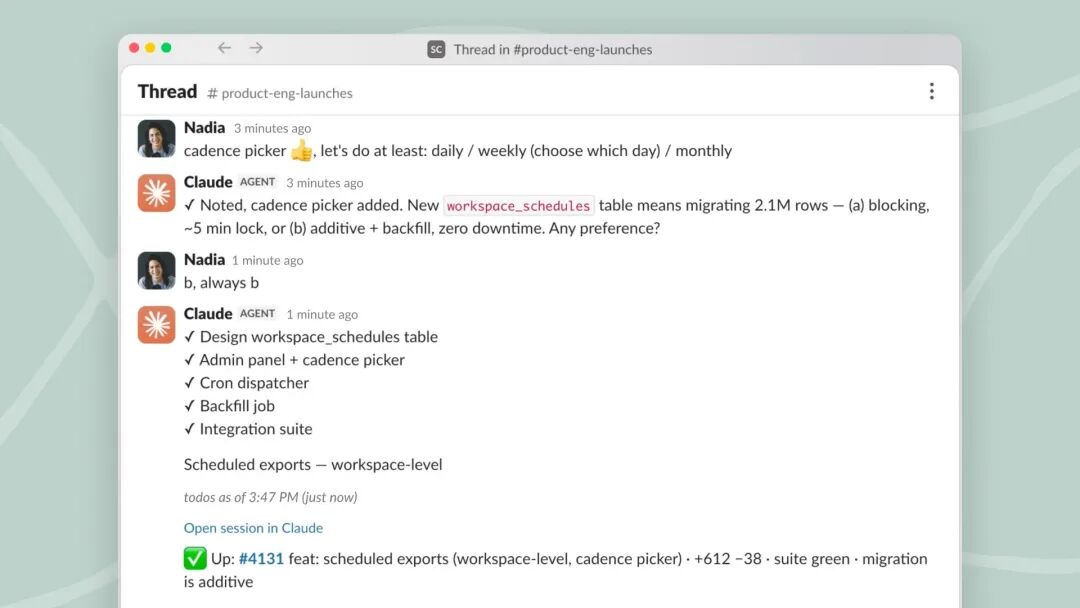
This also precisely hits the pain point of office workers: it is trying to rearrange the way information arrives.
The traditional notification system only pushes information indiscriminately, while Claude Tag first understands "which changes are relevant to you" and then decides whether to remind you. So, what Anthropic really wants to occupy is not another chat platform, but the first - hand site where tasks are discovered, assigned, and tracked.
Slack, the first stop for the implementation of Claude Tag, indeed has this value.
As mentioned earlier, it is the second - only choice besides Microsoft Teams in the North American market, especially highly sticky among developers in technology companies and those with a lot of cross - tool collaboration. For Anthropic, putting Claude here is equivalent to directly accessing a large amount of the most active unstructured information sources of many enterprises.
Currently, Claude Tag is being opened in beta form to Claude Team and Enterprise customers, running Opus 4.8, and will replace the previously relatively simple - function Claude for Slack.
Group chat administrators can define which channels/group chats it enters, which data, tools, and code libraries it connects to, and then configure isolated Claudes for different departments.
Always online = always being monitored?
Everything has two sides. Another way of saying "always on standby" is "always being monitored".
Anthropic specifically emphasizes that Claude will not report information from private group chats to other group chats; Claudes for different purposes are isolated from each other in terms of permissions and memory. The Claude in the sales department will not leak customer data to the engineering team.
Administrators can also limit the Token expenditure of the organization and individual channels and view all operations performed by Claude and their initiators.
However, these technical safeguards still cannot cover up the core contradiction in the product design.
When an AI resides in a group chat and actively follows up on the progress, saying "this issue hasn't been followed up for three days", is it an assistant to help employees or a "digital supervisor" for managers to patrol?
On Hacker News, many developers first ask not how much work Claude can do, but whether identities are shared between different channels, how permissions are attributed, and how enterprises can meet security and compliance requirements.
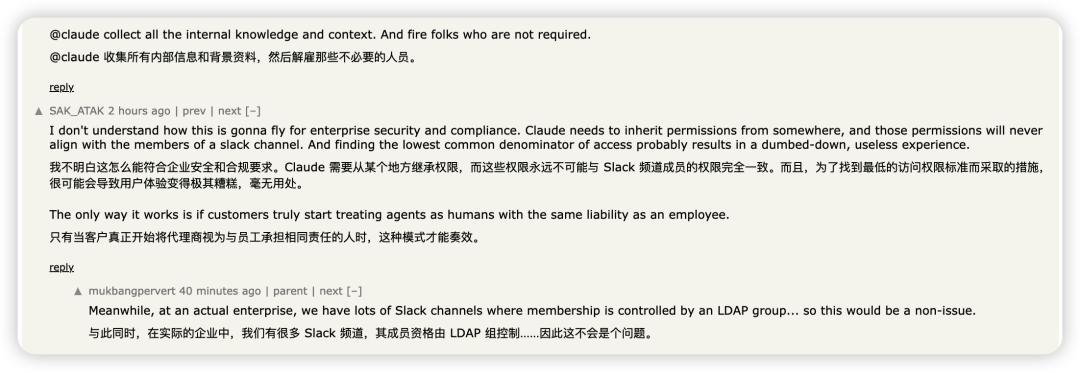
On the red line of security and privacy compliance, are enterprises ready to welcome an indefatigable "AI colleague"?
In the domestic context, this question is equally glaring: if similar capabilities are introduced into DingTalk, Feishu, or WeCom, who has the right to decide which groups the AI can see and what it can remember, and who should define the boundary between "active help" and "digital supervisor"?
Where is the "upgraded version of Claude Code" upgraded?
Anthropic defines Claude Tag as the "upgraded version of Claude Code", indicating its significant strategic importance to the company.
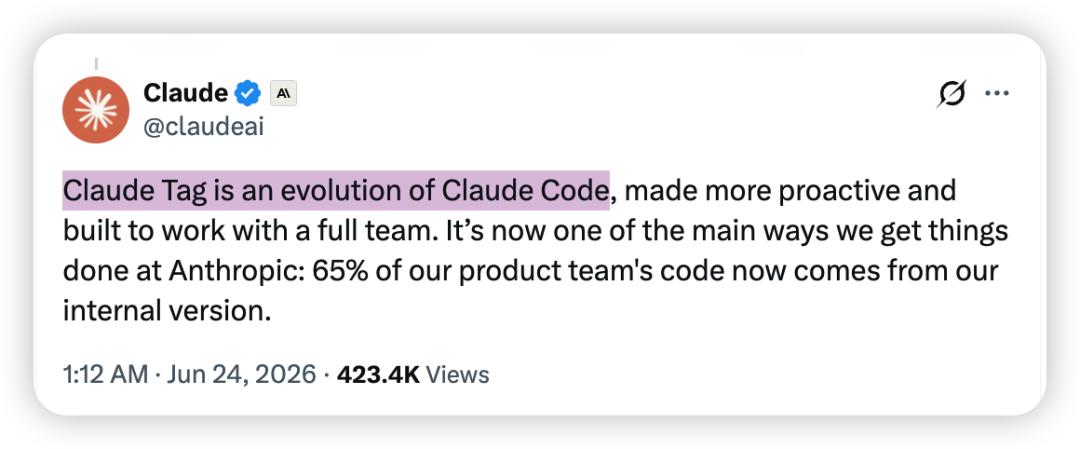
So, how can a terminal Agent for writing code evolve into a "group chat assistant"?
It doesn't come from the enhancement of the model's technical capabilities, but from the architecture of the Agent leaping from the "personal environment" to the "collaborative scene".
If Claude Code is a terminal - level Agent for personal use, then Claude Tag is a team - level Agent shared by multiple people.
From Karpathy's perspective and in terms of product evolution, Claude Tag actually integrates three forms:
- The earliest Slack Bot was a ChatBot, answering one question at a time when the user asked.
- The later Claude Code for Slack has become a Workflow Agent. Developers can assign a Bug to it in the group, and it will read the discussion and then enter the code repository to make modifications.
- The current Claude Tag takes another step forward. It no longer only handles one - time tasks but continuously follows messages, accumulates context, and actively discovers needs and handles matters.
This is not simply moving task requirements into Slack, but adding a layer of organizational identity to the Agent:
Which group chat it belongs to, which departments it can access, what tools it has, and which part of the memory it retains will all be determined by the enterprise's organizational and permission structure.
Overall, in the author's opinion, the most important upgrades of Claude Tag can be summarized into two points:
First, from "request - driven" to "event - driven".
The previous Claude Code solved execution problems: people found a Bug and called Claude to start working.
The current Claude Tag solves problem - discovery: when a Bug occurs in the group, Claude is on the spot. It decides when to intervene without the need for humans to carry the background information.
Second, what is reduced is not the inference cost but the call threshold.
Traditional Agents require users to switch windows and organize Prompts, which invisibly increases the psychological burden.
Claude Tag follows the most natural collaborative action of humans - in the past, it was @product manager, @engineer, and now it's just an additional @Claude. This product form of "naming an AI like naming a colleague" lowers the product threshold to the minimum and further broadens Claude's target group.
What else can Agent entrepreneurs sell?
To be honest, when I saw the news about Claude Tag, my first reaction was, "This is so similar to the office collaboration product of a certain company!" And they are also using models under the Claude brand.
I believe that there are not a few teams in the market that have launched similar functions or are developing products in this direction. Anthropic's entry into the market is obviously not good news for them.
In the past, group chat Bots, work - order assistants, and enterprise knowledge bases... could barely be considered a business.
Now? Top - tier model manufacturers are directly entering the market with native capabilities and enterprise - level entrances, and those "shell products" with just an additional interface have instantly lost their living space.
As mentioned earlier, model companies such as Anthropic and OpenAI are fiercely competing for the enterprise market. Since this year, Salesforce has become a poaching base for Anthropic and OpenAI!
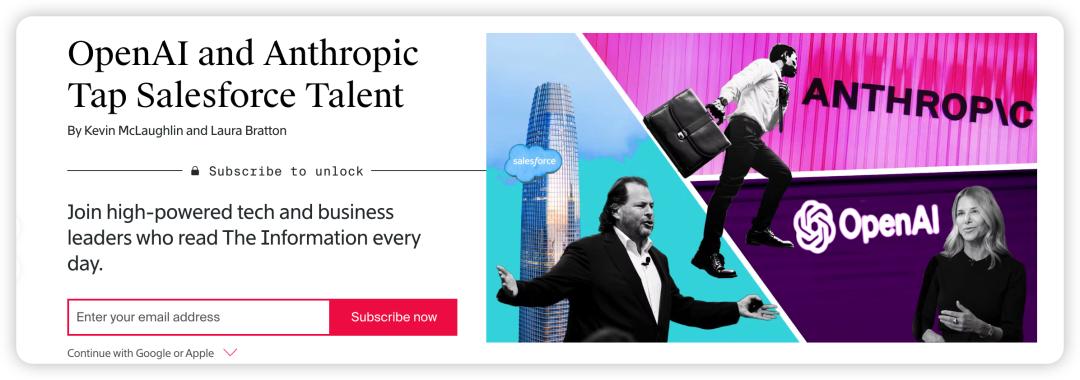
Just this year, these two companies have poached nearly a hundred employees from Salesforce in order to snatch the budgets that used to belong to SaaS manufacturers.
But does this mean the game is over?
From another perspective, Anthropic's entry may actually expose the real competition threshold in this track.
This weakness is the Token cost.
It leaves a gap for third - party manufacturers and open - source models because for service providers, Tokens are both costs and revenues.
To build an agency platform that is essentially for business owners to reduce costs and increase efficiency, the best business strategy must be multi - model entrances and focus on controlling the Token cost.
What business owners really care about is: for the same task, if Claude costs $10, can I complete it for $1? For the same group chat, if Claude burns 500,000 Tokens a day, can I burn only 50,000?
This is also the reason why more and more enterprises are trying to switch the agency traffic of Agents from Claude to DeepSeek (from the article "This Agent company switched from Claude to DeepSeek v4: saved millions of dollars a year, but the migration workload was 100 times the expected").
So, doing hybrid routing, embracing open - source models, and doing Agent compression... are all ways to counter the Token - gobbling Anthropic.
Conclusion
Claude Tag is bad news for shell products, but it may be good news for open - source models. The greater the Agent call volume it creates, the stronger the enterprise's motivation to optimize costs and avoid lock - in.
Model manufacturers determine the upper limit of